Salesforce Koa Built on NVIDIA Nemotron: What You Need to Know
Key Takeaways:
The data control pitch (weights and inference stay inside Salesforce's trust boundary) is the real differentiator, not raw benchmark supremacy.
Salesforce's press claims and its own arXiv technical report don't fully line up; check the paper before quoting the stats.
No public pricing yet; GA targeted for Winter 2026, U.S. regions first.
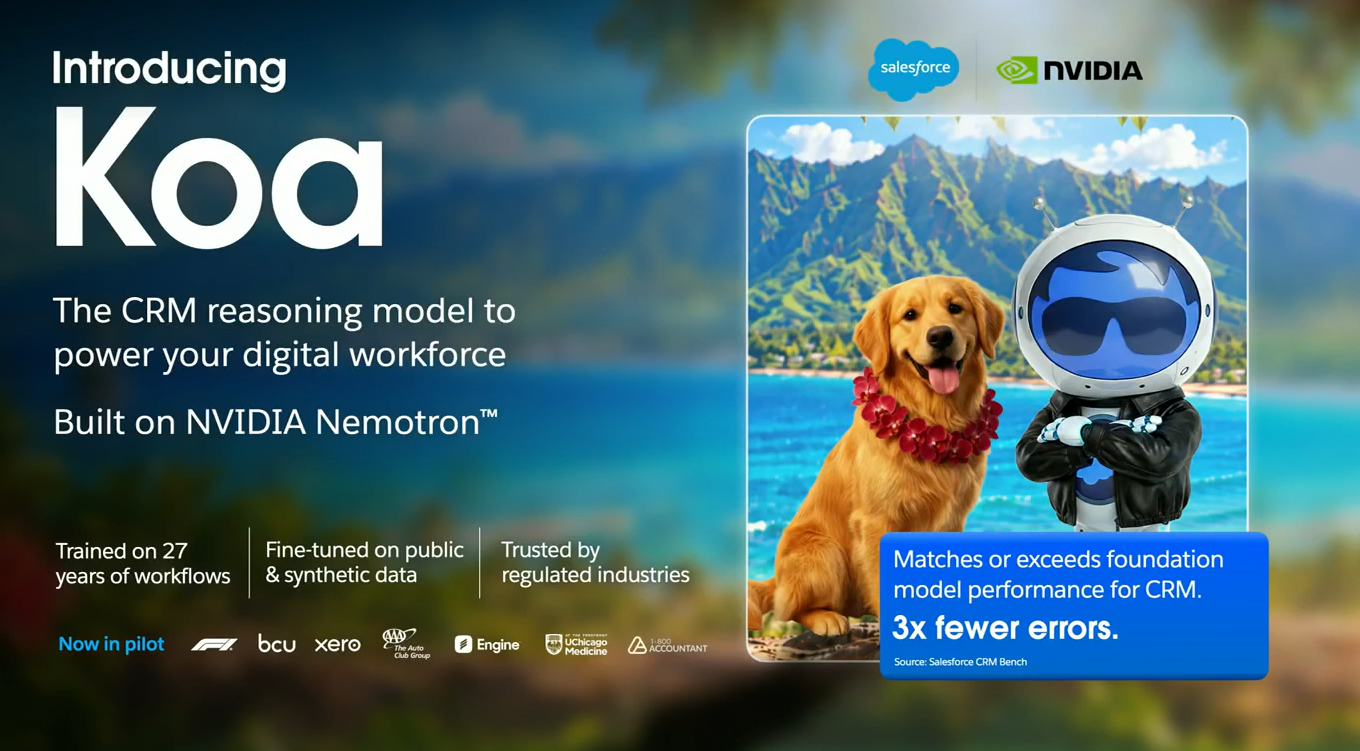
Salesforce Koa is the company's first purpose built CRM reasoning model, unveiled with NVIDIA at Dreamforce '26 on September 16, 2026. It runs on a fine tuned version of NVIDIA Nemotron 3 Super, trained on 27 years of synthetic Salesforce workflow data, and it's available now to select Agentforce pilot customers ahead of general availability this winter.
That's the announcement. Below is what's actually verified, what's marketing, and what independent technical scrutiny of Salesforce's own arXiv report says.
The Salesforce and NVIDIA Collaboration
Salesforce and NVIDIA expanded their partnership at Dreamforce 2026, and Koa is one part of it.
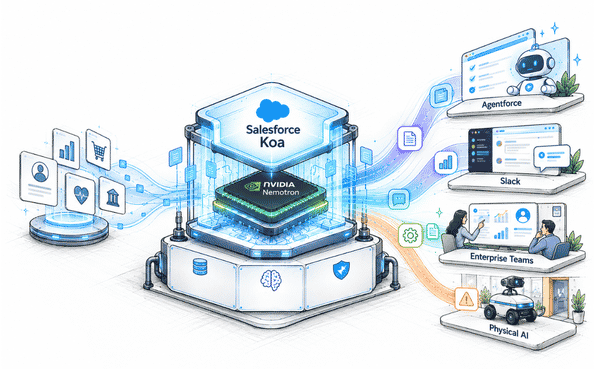
Koa: the CRM reasoning model, built by post-training NVIDIA Nemotron 3 Super on Salesforce's own workflow data.
Agentforce integration: Nemotron models are built into Agentforce for faster, lower-cost processing.
Slack as a working surface: internally, Koa already runs inside a Slack-based Employee Agent at Salesforce, helping staff find information and complete tasks without leaving Slack.
Beyond Koa, physical AI: the two companies also connected Cobalt's security robots at Salesforce Tower to Agentforce, using NVIDIA's visual AI as the robots' "eyes" to spot issues like an open door and trigger a fix automatically.
Regulated environments: the same Nemotron-based approach extends into Missionforce, for government and other secure, private-cloud deployments.
What Koa Actually Is
| Attribute | Detail |
|---|---|
| Full name | Salesforce Koa |
| Base model | NVIDIA Nemotron 3 Super (open weights) |
| Purpose | CRM reasoning for Agentforce agents (multi-step, tool-use tasks) |
| Training data | Synthetic scenarios only, no customer data, spanning 14+ industries |
| Training method | SFT + reinforcement learning (GRPO), via NVIDIA NeMo RL, NeMo Gym, NeMo AutoModel |
| Hosting | Salesforce controls weights, runs inference inside its own infrastructure |
| Status | Pilot customers now; GA expected Winter 2026 in U.S. regions |
Koa isn't a new foundation model. It's Nemotron 3 Super, post-trained on scenario data that simulates how Salesforce agents route cases, update opportunities, and schedule follow-ups.
Rohan Kumar, Salesforce's president and chief platform and engineering officer, said Koa was built by post-training NVIDIA Nemotron 3 Super with a synthetic dataset modeled on enterprise knowledge from three decades of CRM deployments, not customer data.
Where You Can Actually Use It
| Deployment surface | What it means |
|---|---|
| Data Cloud Generative Models catalogue | Managed LLM, available to all customers out of the box |
| Model provider in Setup | Selectable org-wide across all agents, opt-in like any other provider |
| Agentforce Builder | Assignable per agent or sub-agent |
Koa is not a standalone model you can call outside Agentforce, and it isn't downloadable. It only functions inside Salesforce's product surfaces.
The Trust Boundary Pitch
Salesforce's core sales argument is data control, not raw capability. Weights stay with Salesforce, inference runs on Salesforce infrastructure, and no customer data crosses that boundary during training or serving.
Marc Benioff framed it this way: "The most valuable thing Salesforce has built isn't our platform, it's the accumulated knowledge of how enterprise business actually works. With Koa, the knowledge is put inside the model itself." That's a positioning statement, not a benchmark claim. Keep the two separate when you're deciding whether this matters for your stack.
The Benchmark Numbers, and Why You Should Read Them Twice
Salesforce's own marketing page states three comparative stats against "today's default general intelligence models":
11% more precise at calling the right action
2.1x greater reliability in recalling customer context
15% better at retaining context in long conversations
These come from Salesforce's internally built CRM Bench, not a third-party benchmark. That's a real limitation: Salesforce is grading its own model on a test it designed and hasn't published as an independent standard.
Here's where it gets more interesting. Salesforce published a technical report on arXiv on September 14, 2026, and independent analysis of that report surfaces gaps between the press narrative and the paper itself.
| Claim in press materials | What the technical report actually shows |
|---|---|
| "Matches or exceeds leading model performance with 3x fewer errors" | That specific error-rate figure does not appear in the report's tables |
| Comparison baseline sounds like current frontier models | The report's proprietary baseline is GPT-4.1, released April 2025, not a current model |
| Koa (RL-tuned) is the better checkpoint | An SFT-only checkpoint scored higher on both Tau2Bench (70.04 vs 69.41) and CRM Bench (0.88 vs 0.86); Salesforce shipped the RL version anyway because it scored notably better on multi-turn tool use (BFCL: 59.50 vs 53.25) |
| Koa competes with frontier models | On the benchmark Salesforce chose to lead with, Koa trails GPT-5.5 by roughly 14.6 points |
None of this means Koa is a bad model. It means the RL-versus-SFT tradeoff and the age of the comparison baseline are legitimate things to ask a Salesforce rep about before you cite Koa's numbers in a client deck. Flag this if you're briefing anyone internally: the gap between the press release and the paper is real, and multiple independent outlets caught the same discrepancy.
Who's Piloting It
Internally, Koa already powers a Slack based Employee Agent at Salesforce. External pilots include 1-800Accountant, Baxter Credit Union, Engine, Formula 1, UChicago Medicine, and Xero.
UChicago Medicine's CMO Andrew Chang said Koa can work across longer multi-step workflows and help teams manage that complexity more effectively, freeing up capacity for patient care. These are named pilot testimonials from Salesforce's own launch page, which is normal for a pre-GA product, but worth labeling as such rather than as independent validation.
Pricing and Availability
No public pricing has been released as of this writing. Availability is limited to select pilot customers now, with general availability targeted for Winter 2026 in U.S. regions and an open beta expected shortly after. If a vendor or partner quotes you a Koa price today, verify it directly with Salesforce; it isn't published.
What Becomes Easy Now, and Where This Is Headed
What gets easier immediately for Salesforce shops:
| Before Koa | With Koa |
|---|---|
| Agentforce agents leaned on general-purpose frontier models for reasoning, priced and routed externally | CRM-specific reasoning is now a native, in-catalogue option, no separate vendor contract needed |
| Multi-step workflows (route case, then update record, then schedule follow-up) needed heavier prompt engineering to keep an agent on track | The model is tuned specifically on tool-use sequences like this, so agent builders need less scaffolding to get reliable multi-step behavior |
| Regulated teams (healthcare, finance, government) had to justify sending CRM context to a third-party model | Data-residency and trust-boundary questions get a straightforward answer: it never leaves Salesforce's infrastructure |
| Switching model providers meant re-testing prompts across agents | Because Koa slots in as a Setup-level provider, org-wide swaps are a configuration change, not a rebuild |
Where the roadmap points next
Missionforce extension. Salesforce and NVIDIA are already extending Nemotron-based post-training into Missionforce, aimed at air-gapped and private-cloud deployments for government and regulated customers. Post-trained NVIDIA models are slated for select customers in October 2026.
Cheaper CRM inference at scale. NVIDIA's pitch on Nemotron is token efficiency: lower cost per task and faster time-to-first-token. If that holds up in production, the realistic near-term win isn't "smarter agent," it's "cheaper agent at the same reliability," which matters more once you're running thousands of agent calls a day.
A template for other verticals. The method (take an open-weights model, post-train it on your own domain's synthetic workflow data, keep it inside your infrastructure) is the more transferable idea here. Any enterprise sitting on years of process documentation and a regulator to answer to can copy this playbook, independent of whether they ever touch Salesforce.
Open beta as the real test. Pilot testimonials are curated by definition. The open beta, expected shortly after Winter 2026 GA, is when broader, less filtered performance data will start showing up.
Conclusion:
Koa is Salesforce's first real attempt at a CRM-specific reasoning model, not just another chatbot wrapper. It's still early: pilot stage, no public pricing, and a benchmark story that needs a second read before you repeat it to a client.
If you're evaluating whether Agentforce and Koa fit into your CRM setup, or want a straight read on what's hype versus what's real, connect with a certified Salesforce partner to map it against your actual stack before you commit budget.
Ready to explore Agentforce for your business? Talk to a Salesforce partner today.
More from Salesforce Dreamforce 2026
Dreamforce 2026 Announcement: AIforce, Claudeforce, Koa & AI Updates (Day 1)
AIforce: Salesforce's Big Dreamforce 2026 Announcement
Dreamforce 2026's Trust and Security Keynote
Dreamforce 2026 Day 2: Main Highlights
Dreamforce 2026 Day 3: Slack and Marketing Cloud Keynotes Recap
Dreamforce 2026 Admin Keynote: Key Updates for Salesforce Admins
Frequently Asked Questions
-
Salesforce Koa is Salesforce's first CRM reasoning model for Agentforce, built by fine-tuning NVIDIA Nemotron 3 Super on synthetic Salesforce workflow data.
-
No. It's a post-trained version of NVIDIA's open-weights Nemotron 3 Super model, not a foundation model Salesforce built independently.
-
Salesforce says no. Training used only synthetic scenarios modeled on CRM workflows, and inference runs inside Salesforce's own infrastructure so customer data doesn't cross the trust boundary.
-
On the benchmark Salesforce led with in its own technical report, Koa trails GPT-5.5 by about 14.6 points. Salesforce's pitch is data control and CRM-specific tuning, not raw frontier performance.
-
It's in pilot now with select customers. General availability is expected Winter 2026 in U.S. regions, with an open beta to follow.
-
As a managed LLM in the Data Cloud Generative Models catalogue, as an org-wide model provider in Setup, or assigned to individual agents and sub-agents in Agentforce Builder.
Related Readings
Let’s Talk

Drop us a note, we’re happy to take the conversation forward 👇🏻