
Speed-to-Lead: How AI Voice Agents Respond to Inbound Leads in Under 60 Seconds
Key Takeaways:
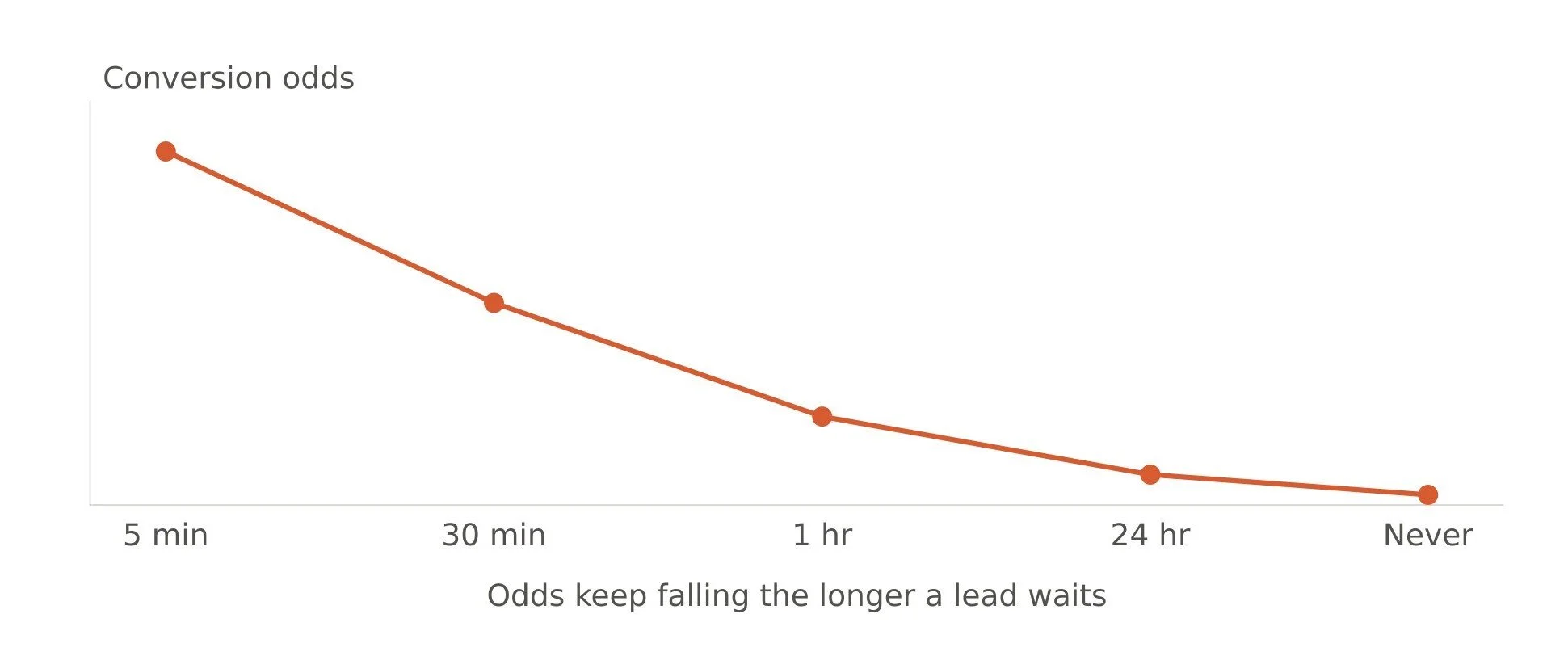
Response speed decides the deal more than most teams realize. Leads contacted within minutes convert better than those left waiting even 30 minutes.
Response time within 60 seconds requires a full chain working in real time. Instant triggers, live CRM context, low-latency voice, and natural conversational AI all have to work together, not just one fast step.
Speed alone doesn't close the deal. AI-powered lead response and a smooth human handoff are what turn a fast callback into an actual sales opportunity.
What happens to a lead the moment after someone submits your form? For most companies, the honest answer is: nothing, for hours. It lands in a CRM, triggers an email nobody's watching, and waits for a rep to notice it during business hours. Meanwhile, the prospect isn't waiting and has already talked to two of your competitors and picked one.
This isn't a rare story. It's the default outcome for most businesses, and the data backs it up. A Harvard Business Review study that audited over 2,200 U.S. companies found that while about a third responded to a web-generated test lead within an hour, nearly a quarter never responded at all, and the average response time among companies that did reply came out to 42 hours.
In a world where most customers end up buying from whichever company reaches them first, that gap is not a minor inefficiency. It's the difference between winning the deal and funding your competitor's growth.
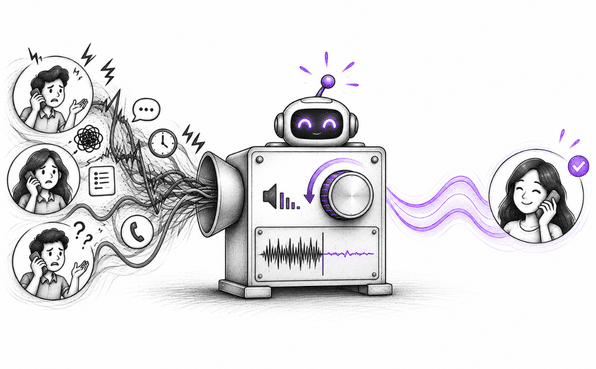
This is where AI voice agents change the math entirely. Instead of a lead sitting in a queue overnight, an AI voice agent for sales can call back within seconds of form submission, any hour of the day, every day of the week.
This article breaks down why speed-to-lead matters so much, how AI sales agents actually pull off response times in under 60 seconds, and what to think about if you're considering this for your own pipeline.
Why AI Lead Response Speed Determines Whether You Win the Deal
The research on this is old news to marketers but still underused. MIT and InsideSales.com analyzed over 15,000 leads and found that responding within five minutes makes a business dramatically more likely to make contact and qualify the lead compared to waiting even thirty minutes. The window closes fast, and it keeps closing the longer you wait.
Why does this happen? Two reasons, and both are about human behavior, not technology. First, the moment someone submits a form or makes an inbound call, they're actively thinking about their problem. They're in research mode, comparing options, mentally ready to talk. That window of attention is narrow. Second, most buyers aren't just contacting you. They're contacting your competitors at the same time, and whoever picks up the phone first usually wins the conversation, if not the deal outright.
This is exactly why AI lead response has become such a serious lever for revenue teams. A human sales rep, no matter how good, can't be available at 11 PM, can't call back the instant a form is submitted, and can't handle five inbound calls at the exact same minute. An AI voice agent can do all three. It doesn't get tired, doesn't take lunch breaks, and doesn't let a lead sit for six hours because the assigned rep was in back-to-back meetings.
None of this means speed alone wins the deal. A fast callback from an AI agent that sounds robotic, misunderstands the prospect, or can't answer a basic question will burn the lead just as fast as a slow one. Speed creates the opportunity. What happens on the call determines whether you keep it.
How AI Voice Agents Deliver Sub-60-Second Lead Response
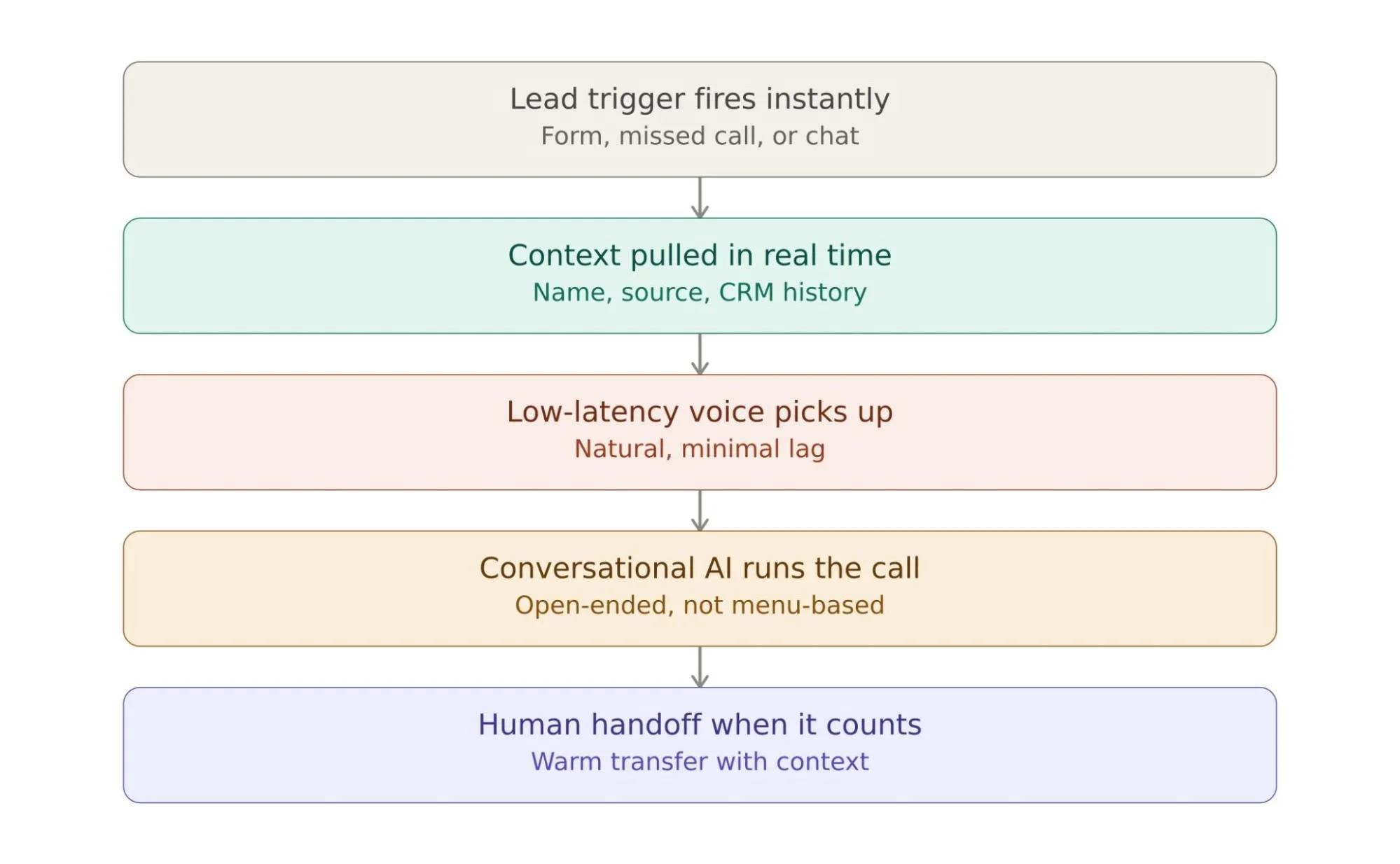
Getting from "lead submitted" to "phone ringing" in under a minute isn't one clever trick. It's a chain of steps that each needs to happen almost instantly.
1. Instant trigger from the lead source.
The moment a form is submitted, a call is missed, or a chat conversation goes cold, the event needs to fire immediately into the system that triggers the callback. This usually means a direct integration with your website forms, ad platforms, or CRM, rather than a nightly batch sync. Batch processing is exactly the kind of delay that killed response times in the pre-AI era, and it's still the most common reason a "fast" system is actually slow.
2. Real-time lead context pulled automatically.
Before the AI voice agent dials, it needs to know who it's calling and why. That means pulling the lead's name, the source they came from, whatever they filled in on the form, and any existing CRM history, all in the second or two before the call connects. A generic "hi, I saw you filled out a form" call converts far worse than one that references the specific service or product the prospect asked about.
3. Low-latency voice generation and speech recognition.
This is the technical core of AI voice agent development. The agent has to listen to what the prospect says, understand it, decide how to respond, and generate natural-sounding speech, all with minimal lag. If there's a noticeable pause after every sentence, the call feels off, and prospects notice within the first few seconds. Getting this right is a big part of what separates a genuinely useful voice agent from a gimmicky one.
4. Conversational AI for sales, not a scripted IVR.
Older automated calling systems relied on rigid menus: press 1 for this, press 2 for that. Modern conversational AI for sales doesn't work that way. It handles open-ended answers, interruptions, and follow-up questions the way a real conversation does, which matters extremely for lead qualification. A prospect who wanted to say "I'm actually looking for something a bit different" needs the agent to actually understand that, not force them into a menu option that doesn't fit.
5. Automatic handoff to a human when it matters.
Not every call should stay with the AI. Automated lead follow-up systems that work well are built to recognize when a prospect is ready to talk pricing specifics, has a complex objection, or simply asks for a person. The best setups route that call live to a rep, with full context already passed along, so the prospect never has to repeat themselves.
AI-Powered Lead Qualification Inside the First Call
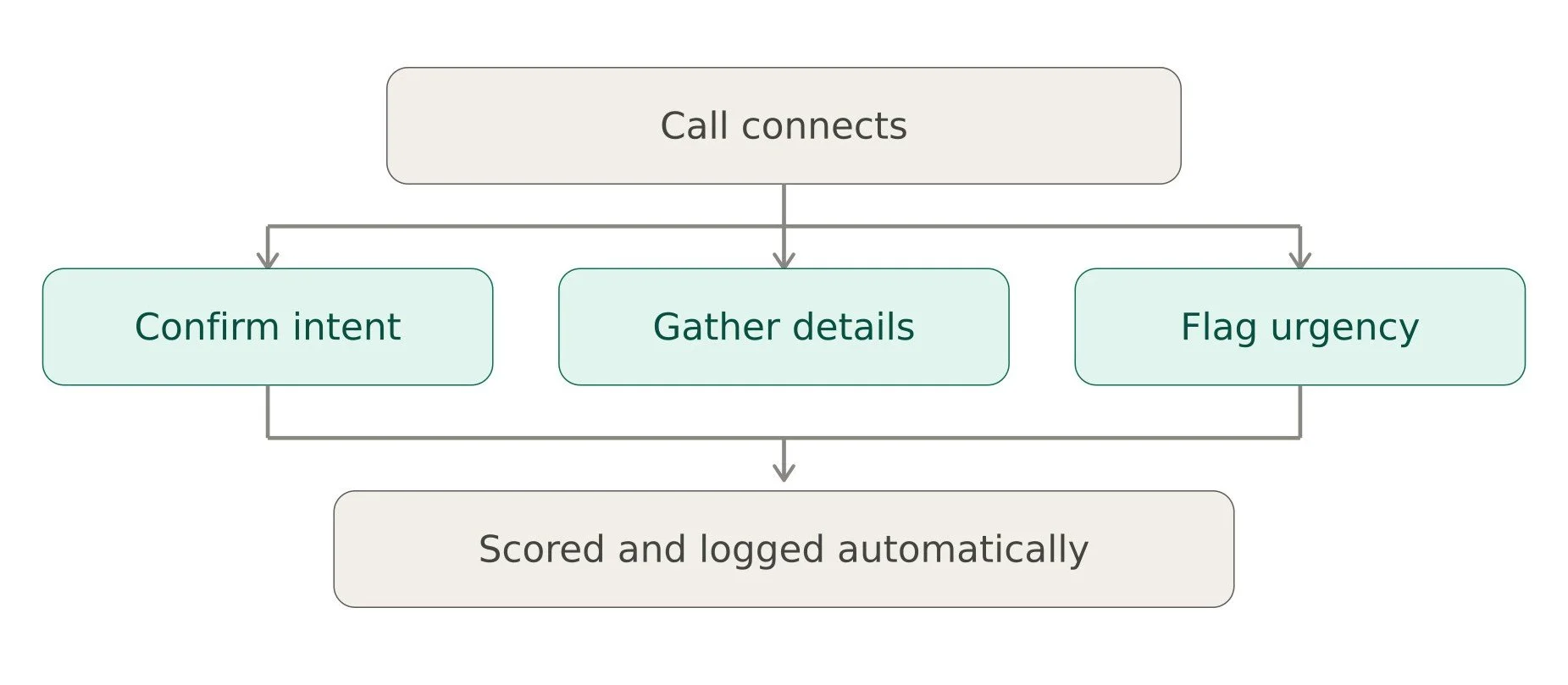
Speed gets the call connected. Qualification is what makes that call worth having. A well-built AI voice agent isn't just placing a fast callback; it's running a structured conversation designed to sort leads the moment they come in.
This typically covers a few things:
confirming intent (are they actually interested in what they inquired about, or was it a stray click),
gathering basic qualifying details (budget range, timeline, company size, whatever matters for your sales motion),
and flagging urgency (is this someone ready to buy now, or someone six months out doing early research).
All of that gets logged and scored automatically, so by the time a human representative gets involved, they're not starting from zero. They're picking up a conversation that's already been half-run.
This is a meaningful shift in how AI sales automation gets used. Early automation efforts mostly focused on emails and reminders, nudging reps to follow up faster. Voice takes it a step further by actually having the qualifying conversation itself, at a speed and consistency no human team can sustain across every single lead, every hour of the day.
What to Consider Before Adopting Lead Response Automation
Automating lead response with AI voice agents isn't a plug-and-play switch. A few things are worth thinking through before rolling it out.
1. Define what "qualified" means for your business. An AI agent can only qualify leads well if you've actually specified the criteria. Vague or missing qualification logic leads to noisy handoffs that waste your sales team's time, which defeats the purpose.
2. Decide where the human handoff happens. Some businesses want the AI to handle the entire first call end to end. Others want it to qualify and then transfer live the moment the prospect shows real intent. Get this wrong, and you either overload your reps with unqualified transfers or lose warm leads to a bot that stays on the call too long.
3. Test the voice and tone extensively. A voice agent that sounds stilted or overly scripted undercuts the trust you're trying to build in that first sixty seconds. This is one of the areas where working with an experienced team on voice agent development services pays off, since tuning latency, tone, and conversational flow well takes real iteration, not a one-time setup.
4. Watch the data, not just the anecdotes. Track contact rate, qualification rate, and time-to-first-touch before and after rollout. Research compiled from Harvard Business Review, InsideSales.com, and Velocify shows a sharp jump in conversion for businesses that respond within five minutes versus those that respond more slowly, so the upside is well documented. But every business's lead mix is different, and the only way to know it's working for you is to measure it directly.
The Bottom Line
The data on lead response time has been sitting in front of sales teams for over a decade, and most companies still haven't acted on it. The gap between what the research says and what businesses actually do is exactly the opportunity AI voice agents are built to close. A prospect who fills out a form at midnight shouldn't have to wait until morning, and one who calls during a lunch rush shouldn't get a voicemail.
An AI voice agent isn’t about replacing your sales team. It's about making sure no lead goes cold before a human ever gets the chance to talk to it. Whether you bring in an AI voice agent development partner or build your system internally, the objective is simple: be the first to reach the prospect, providing value while your brand is still top-of-mind.
Frequently Asked Questions
-
Under 5 minutes is the widely cited benchmark, but leading teams now aim for under 60 seconds. Every extra minute of delay measurably lowers your odds of contacting and qualifying the lead.
-
Not entirely, and it doesn't need to. The AI handles the instant callback and initial qualification, then hands off live to a rep once the prospect shows real buying intent or asks a question outside its scope.
-
Often not immediately, since modern conversational AI for sales sounds natural and handles open-ended conversation. Most businesses disclose this upfront regardless, since transparency tends to build more trust than it costs.
-
We've seen how an AI voice agent focuses on inbound response, but the same AI sales agent infrastructure can be pointed at outbound follow-up, re-engaging old leads, or nurturing leads that went cold after an initial no-response.
-
It varies by how complex your qualification logic and CRM integrations are. Simple setups can go live in a couple of weeks, while more customized AI voice agent projects with deeper CRM and routing logic take longer.
Related Readings
Let’s Talk
Drop us a note, we’re happy to take the conversation forward 👇🏻