
Cascade vs. Speech-to-Speech: Which Architecture Should Your Voice Agent Use in 2026?
Key takeaways:
Speech-to-speech AI wins on latency and natural, expressive conversation; cascade wins on debuggability, compliance, and fine-grained control.
There's no universal winner. The right voice agent architecture depends on your industry, tool-calling complexity, and budget model.
Hybrid architectures, blending an S2S front end with a cascade backend, are emerging as a practical middle ground for many teams in 2026.
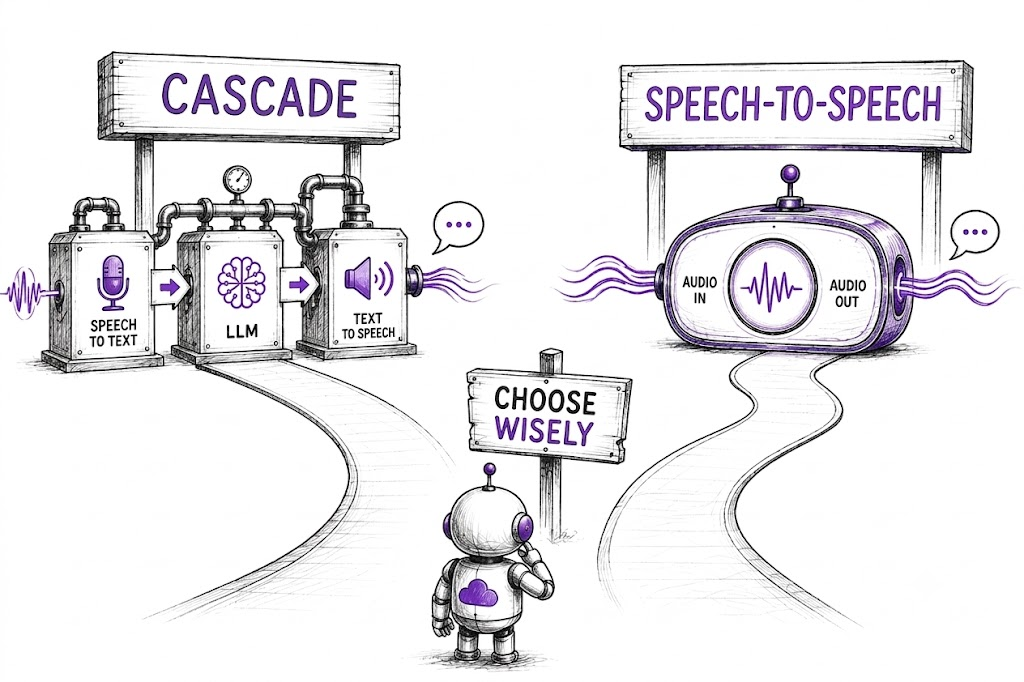
If you've spent any time building or buying an AI voice agent this year, you've probably run into a debate that sounds technical but actually shapes everything from your latency numbers to your compliance posture: should you build on a cascaded pipeline, or go all-in on speech-to-speech AI?
It's not a small decision. The architecture you pick determines how natural your agent sounds, how fast it responds, how much it costs per minute, and even how easy it is to debug when something goes wrong. And in 2026, with real-time voice AI architecture options maturing fast on both sides, there's no lazy default answer anymore. Cascade used to win by default because S2S models were experimental. That's no longer true.
This article breaks down both approaches, compares them head-to-head across the metrics that actually matter, and gives you a practical framework for deciding which one fits your use case.
What Is a Cascade Architecture?
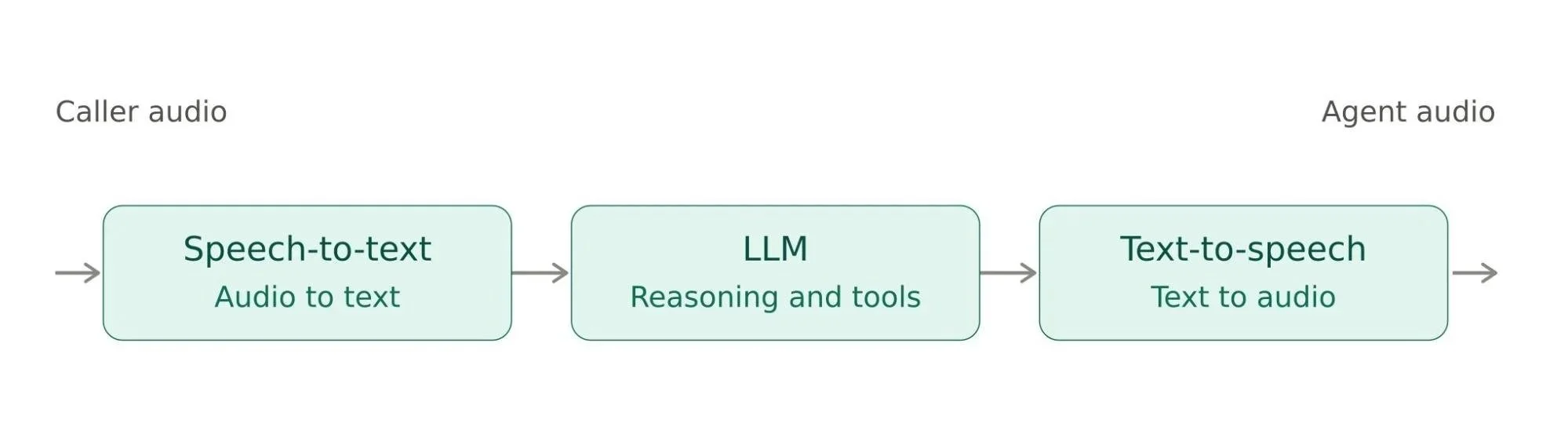
A cascaded voice pipeline is the "classic" approach, and it's built from three separate stages stitched together:
1. Speech-to-text (STT) converts the caller's audio into text.
2. An LLM reads that text, reasons about it, and generates a text response, often calling tools, querying a database, or checking business logic along the way.
3. Text-to-speech (TTS) converts that text response back into audio.
Each stage is a separate model, often from a separate vendor, connected by API calls. This is why cascade has been the default for so long. You can mix and match best-in-class components, swap out a TTS provider without touching your LLM, and you get a clean text transcript at every step.
The tradeoff is that information gets lost between stages. Tone of voice, hesitation, laughter, emotional emphasis - all of that gets flattened into plain text before the LLM ever sees it. The LLM never actually "hears" the caller; it only reads what the STT model decided the caller said. That's also where a lot of the pipeline's latency comes from: each stage waits on the previous one to finish before it can start.
What Is Speech-to-Speech (S2S)?
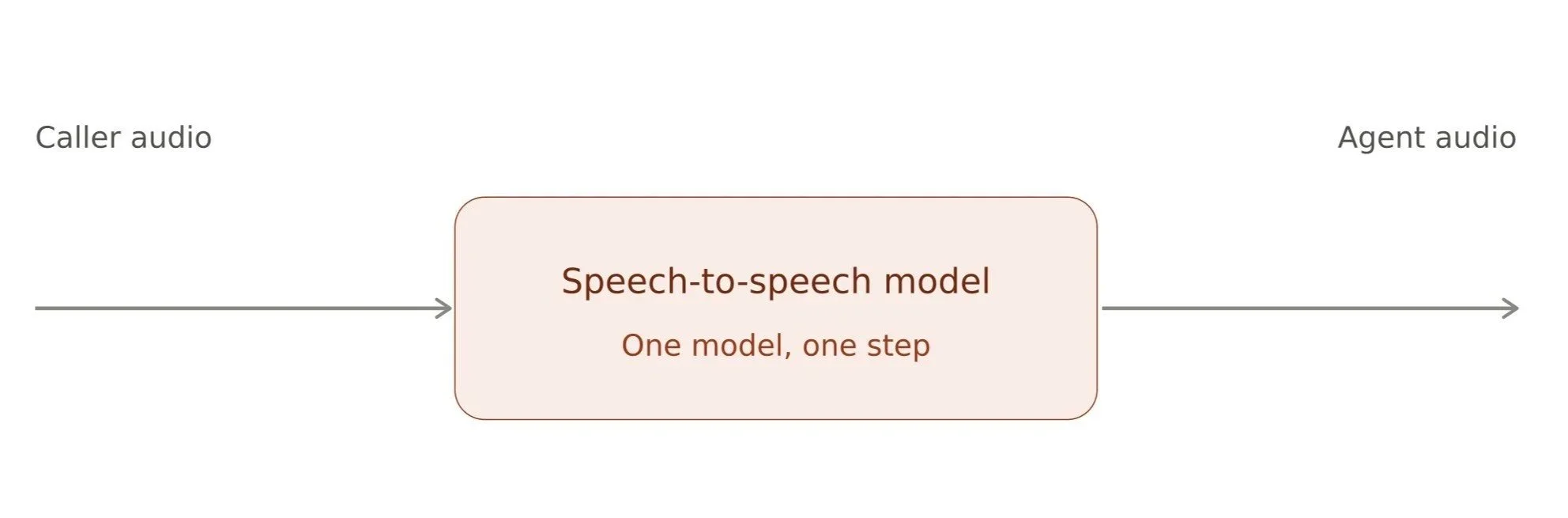
A speech-to-speech AI model collapses that three-stage pipeline into a single model that takes audio in and produces audio out, with no intermediate text transcript required. The model listens to raw audio, including tone, pauses, and overlapping speech, and generates a spoken response directly.
This is the architecture behind OpenAI's Realtime API, which streams audio in both directions over a persistent connection and now runs on models purpose-built as an S2S voice model rather than a repurposed text model.
GPT-4o voice mode was the moment this approach went mainstream: instead of stitching together Whisper, GPT-4, and a TTS engine, OpenAI trained a single model end-to-end across text, vision, and audio, which is why it can express emotion, laughter, and interruptions in a way cascaded voice mode never could.
On the open and research side, the Moshi voice model (from Kyutai) has been an influential example of a fully end-to-end, low-latency speech-to-speech model designed to handle natural back-and-forth conversation, including interruptions, without falling back to a text intermediary.
Cascaded Voice AI vs. Speech-to-Speech: Head-to-Head Comparison
Comparing voice AI architectures across different metrics to decide where each one fits well.
| Factor | Cascade | Speech-to-Speech (S2S) | Winner |
|---|---|---|---|
| Latency | Adds delay at each stage (STT → LLM → TTS). | Single-step inference with minimal handoff delay. | S2S |
| Voice Quality & Naturalness | Synthesized from flat text; less emotional nuance. | Captures tone, prosody, and interruptions directly. | S2S |
| Accuracy & Reliability | Transcript-based and easier to validate. | Harder to catch mishearing or hallucination in real time. | Cascade |
| Multilingual & Accent Handling | Can plug in specialized STT for each language. | Handles mid-sentence language switching more naturally. | S2S (trending) |
| Cost per Conversation | Optimize each component's pricing separately. | Bundled per audio-token pricing. | Depends on volume |
| Tooling & Function-Calling | Native to the text-based LLM step. | Now supports live function calling, closing the gap. | Cascade (slight edge) |
| Debuggability & Observability | Full transcript at every stage. | Harder to inspect without a text intermediary. | Cascade |
| Customization & Fine-Tuning | Swap or fine-tune any single component independently. | More of an all-or-nothing approach to customization. | Cascade |
1. Latency:
Winner: S2S. Because there's no waiting for STT to finish before the LLM starts, and no waiting for the LLM to finish before TTS starts, S2S models can respond with far less lag. Cascade pipelines add up delay at every handoff, even when each individual component is fast.
2. Voice Quality & Naturalness:
Winner: S2S. Prosody, emotional tone, and mid-sentence interruptions (barge-in) are all things S2S handles more gracefully because the model never loses that information to a text bottleneck. Cascade TTS has gotten much better at sounding human, but it's still synthesizing from flat text, not from the original emotional signal.
3. Accuracy & Reliability:
Winner: Cascade, usually. This is where cascade claws back ground. Because there's an explicit text transcript, it's easier to catch transcription errors, apply business rules, and validate what the model actually understood before it acts. S2S models can occasionally mishear or hallucinate in ways that are harder to catch since there's no intermediate transcript to inspect in real time.
4. Multilingual & Accent Handling:
Toss-up, trending toward S2S. Modern S2S models are increasingly strong at switching languages mid-sentence and handling accents naturally, since they're trained directly on audio rather than relying on an STT model's language detection. But cascade lets you plug in a specialized STT model tuned for a specific accent or language if the general-purpose option underperforms.
5. Cost per Conversation:
Depends on volume and provider pricing. Cascade lets you shop for the cheapest STT/LLM/TTS combination per component, which can be cheaper at certain volumes. S2S pricing is usually bundled per audio token (input and output), which can simplify budgeting but doesn't let you optimize each stage independently.
6. Tooling & Function-Calling:
Cascade has the edge, but S2S has closed the gap. Cascade's text-native architecture makes complex tool orchestration and RAG lookups very natural. The LLM stage is just a normal LLM call. That said, current-generation S2S models now support function calling directly during a live audio session, so this is less of a dealbreaker than it was a year or two ago.
7. Debuggability & Observability:
Winner: Cascade. Having a transcript at every stage means you can log exactly what the STT heard, what the LLM decided, and what text got sent to TTS. That's a big deal for compliance-heavy environments where you need an audit trail of every conversation.
8. Customization & Fine-Tuning Control:
Winner: Cascade. You can fine-tune or swap any single component without retraining the whole system. For example, a custom STT model for a specific industry's jargon, a branded TTS voice, or a specialized LLM. S2S customization is improving, but it's still more of an all-or-nothing proposition.
Where Each Architecture Shines
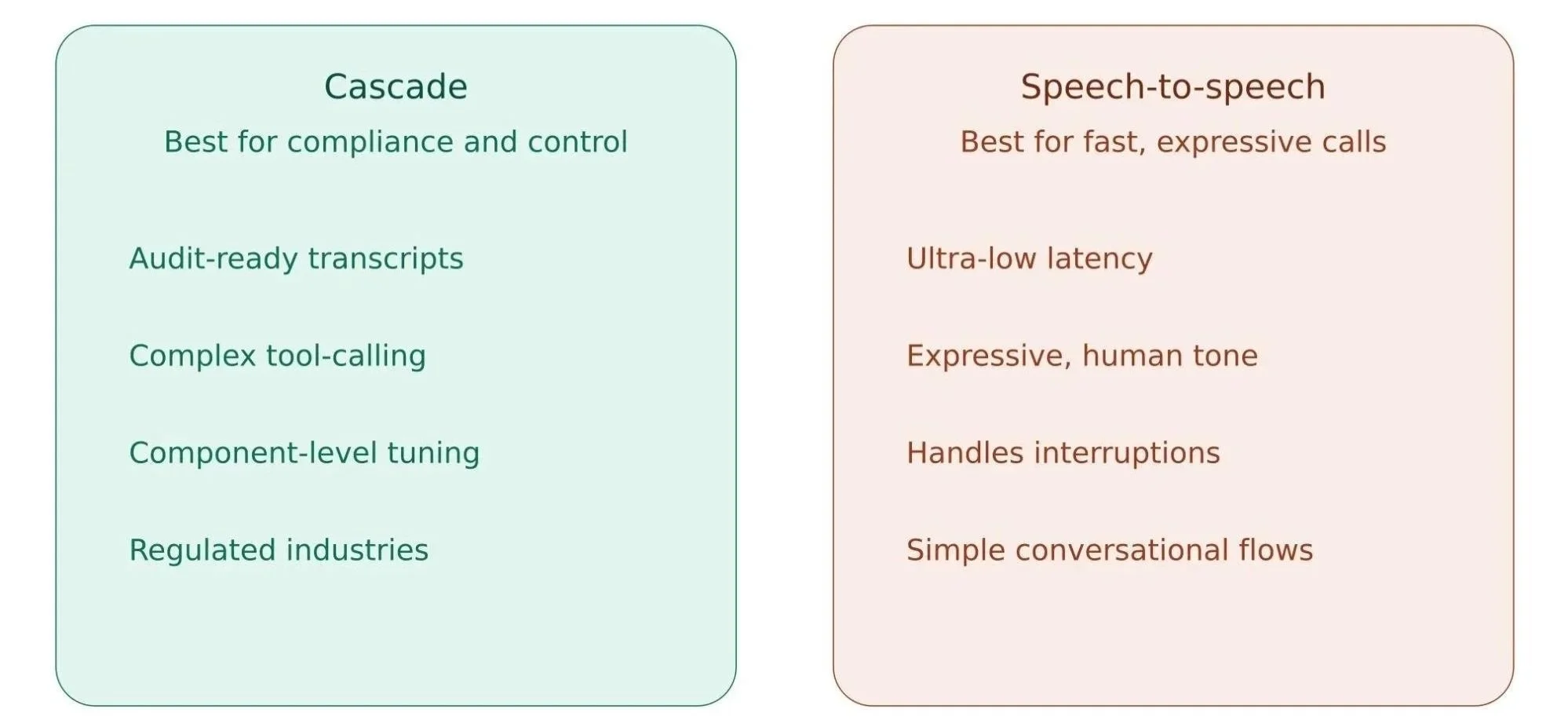
Cascade tends to be the better fit when:
You operate in a regulated industry (healthcare, finance, insurance) and need clean transcripts for compliance and audit purposes.
Your agent relies heavily on tool calls, database lookups, or multi-step business logic.
You need fine-grained control over individual components for cost or quality reasons.
Speech-to-speech tends to be the better fit when:
You're building a consumer-facing AI voice agent where natural, emotionally expressive conversation is the differentiator.
Ultra-low latency is critical to the user experience (real-time coaching, live translation, gaming companions).
Your conversational flows are relatively simple and don't require heavy tool orchestration.
Hybrid Architecture for AI Voice Agents
Increasingly, teams aren't choosing one architecture and sticking with it forever. They're blending both. A common pattern is running an S2S model for the natural, low-latency conversational layer, with a fallback cascade path (or a parallel transcription stream) for logging, compliance, and complex tool-calling moments.
Another emerging pattern uses S2S for the "front door" of a call and hands off to a cascade-style backend once the conversation needs structured business logic. This hybrid model is becoming a popular middle ground precisely because it captures the strengths of both without fully committing to either one's weaknesses.
How to Choose the Right Voice Agent Architecture
Before you commit to a voice agent architecture, ask:
How much latency can you tolerate? If every 200ms matters, go with S2S.
Do you need compliance-grade transcripts? If yes, choose cascade or a hybrid with transcript logging.
How complex is your tool-calling? Heavy multi-step logic still favors cascade, though S2S is catching up fast.
What's your budget model? Per-component pricing (cascade) vs. bundled audio-token pricing (S2S) suit different cost structures.
How emotionally expressive does the agent need to be? Consumer-facing, relationship-driven use cases favor S2S.
Do you need multilingual, mid-conversation switching? S2S generally handles this more gracefully.
There's no universally correct answer to which architecture your voice agent should use. It depends entirely on what your agent needs to do and who it needs to sound like doing it.
Final Thoughts
Both architectures are legitimate, production-ready choices in 2026. This isn't a case of one being outdated and the other being the future. Cascade still wins on control, transparency, and compliance. Speech-to-speech still wins on latency and natural expressiveness. And hybrid setups are quickly becoming a serious third option for teams that want the best of both.
If you're not sure which fits your product, the most practical next step is to prototype both with a small, representative slice of your real conversations and see which one actually holds up in the kinds of interactions your agent will have every day.
Whether you're evaluating architectures internally or looking to bring in outside expertise, a good AI voice agent development company will build proofs-of-concept on both architectures before recommending one, precisely because the right answer depends a lot on your specific use case.
Frequently Asked Questions
-
Cascade uses three separate models (STT, LLM, TTS) connected in sequence, while speech-to-speech AI uses a single end-to-end model that takes audio in and produces audio out directly, without a text transcript step in between.
-
Generally yes. Because S2S skips the sequential handoffs between STT, LLM, and TTS, it typically responds with lower latency. Cascade latency stacks up across each stage, even when individual components are fast.
-
Cascade is usually the safer choice for healthcare, finance, and insurance, since it produces a clean text transcript at every stage, making audit trails and validation much easier.
-
Yes. Current-generation S2S models support function calling during a live audio session, though cascade still has a slight edge for very complex, multi-step tool orchestration.
-
A hybrid setup runs an S2S model for natural, low-latency conversation while routing to a cascade-style backend for tool-calling, logging, and compliance needs, combining the strengths of both approaches.
Related Readings
Let’s Talk

Drop us a note, we’re happy to take the conversation forward 👇🏻