
How to Scale Multi-Agent Orchestration Without Communication Failures
Key takeaways:
Scaling AI agents creates coordination problems like conflicts and duplication.
Proven patterns improve reliability across multi-agent systems.
Strong orchestration turns AI experiments into production solutions.
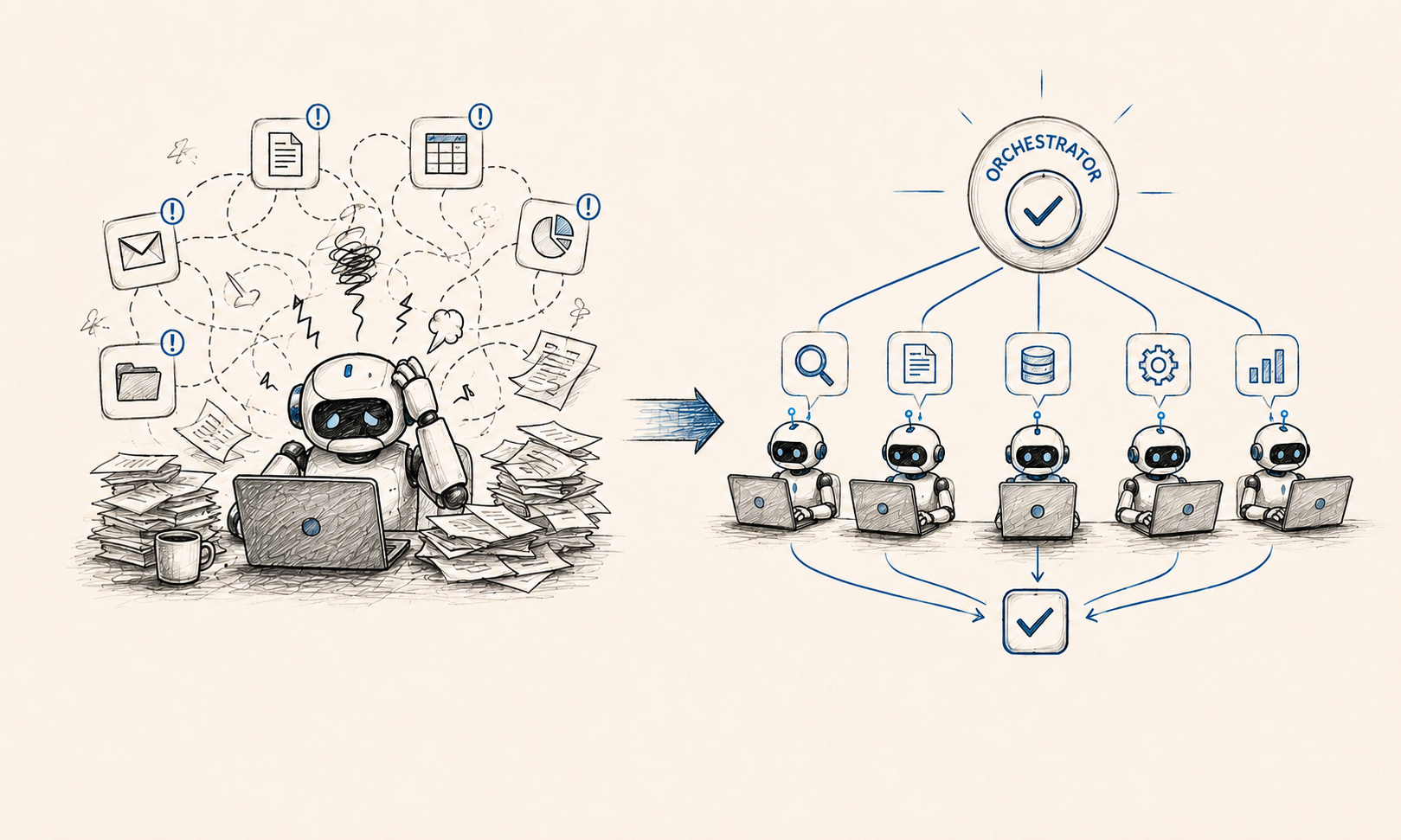
If you've ever tried to run a big group project where everyone talks over each other, forgets what was already decided, and duplicates work nobody asked for, then you already understand the biggest challenge in multi-agent orchestration today. Except instead of coworkers, it's dozens of AI agents trying to get something done together, but instead, your production system is grinding to a halt.
As more companies move from "let's try one AI agent" to "let's build an entire fleet of them," a new and very real problem shows up: communication bottlenecks. Today, we’ll break down why communication bottlenecks happen in multi-agent orchestration and how you can solve them at scale.
Why Multi-Agent Systems Are Suddenly Everywhere
A year or two ago, most AI agent projects were single-agent setups. One model, one job, one clear task. Simple, contained, easy to debug.
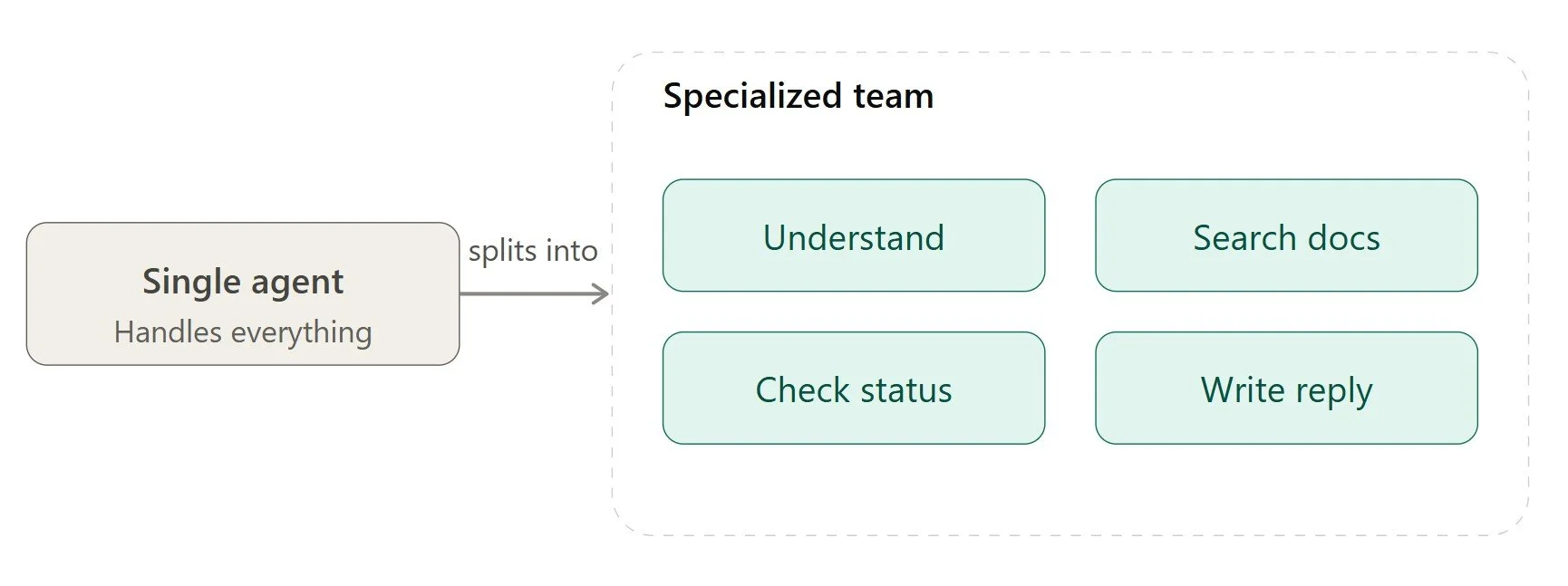
But business problems aren't usually that simple. A customer support workflow might need one agent to understand the query, another to search internal documents, another to check order status, and a final one to write the response. That's not one agent anymore, that's a small team. This is where multi-agent systems come in: instead of forcing one model to do everything, you split responsibilities across specialized agents that each do one thing well. Anthropic's own write-up on how they built their multi-agent research system is a good real-world look at this in action.
It's a smart idea in theory. In practice, once you scale from three agents to thirty, things get messy fast. This is exactly the tension that multi-agent orchestration exists to solve. Figuring out who does what, when, and how they all stay in sync.
What Happens When AI Agent Swarms Grow Too Fast
Picture an AI agent swarm working on a logistics problem. Routing agents, inventory agents, pricing agents, customer-facing agents, all talking to each other in real time. When it's five agents, it works beautifully. When it's fifty, weird things start happening:
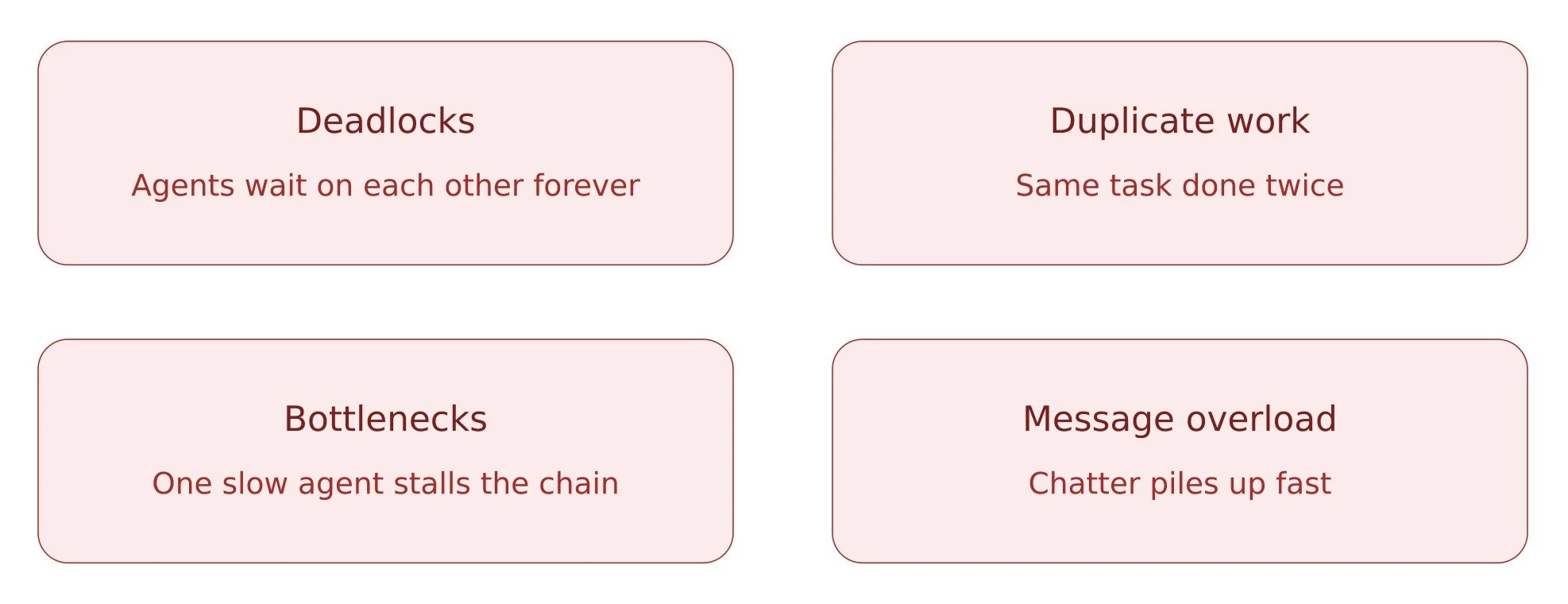
Agents wait on each other, and nothing moves (classic deadlock).
The same task gets done twice because two agents didn't know the other one had already started it.
One slow agent holds up an entire chain of decisions (a pattern related to what's often called an infinite loop or stalling problem).
Messages pile up faster than agents can process them.
Small errors early in the chain snowball into completely wrong outputs later.
None of this is really about the AI models being "dumb." It's a coordination problem, not an intelligence problem. Humans have the same issue in large organizations; that's literally why middle management exists. Swarms need the equivalent of that structure, just built into the system architecture.
The Real Bottleneck in AI Multi-Agent Orchestration
AI agent communication isn't just "sending a message from Agent A to Agent B." Every message needs to carry context, intent, and enough information for the receiving agent to actually act correctly without wasting tokens or time. This is part of why standardized protocols like Anthropic's Model Context Protocol have caught on so quickly. Agents and tools need a shared, structured language rather than ad hoc messages.
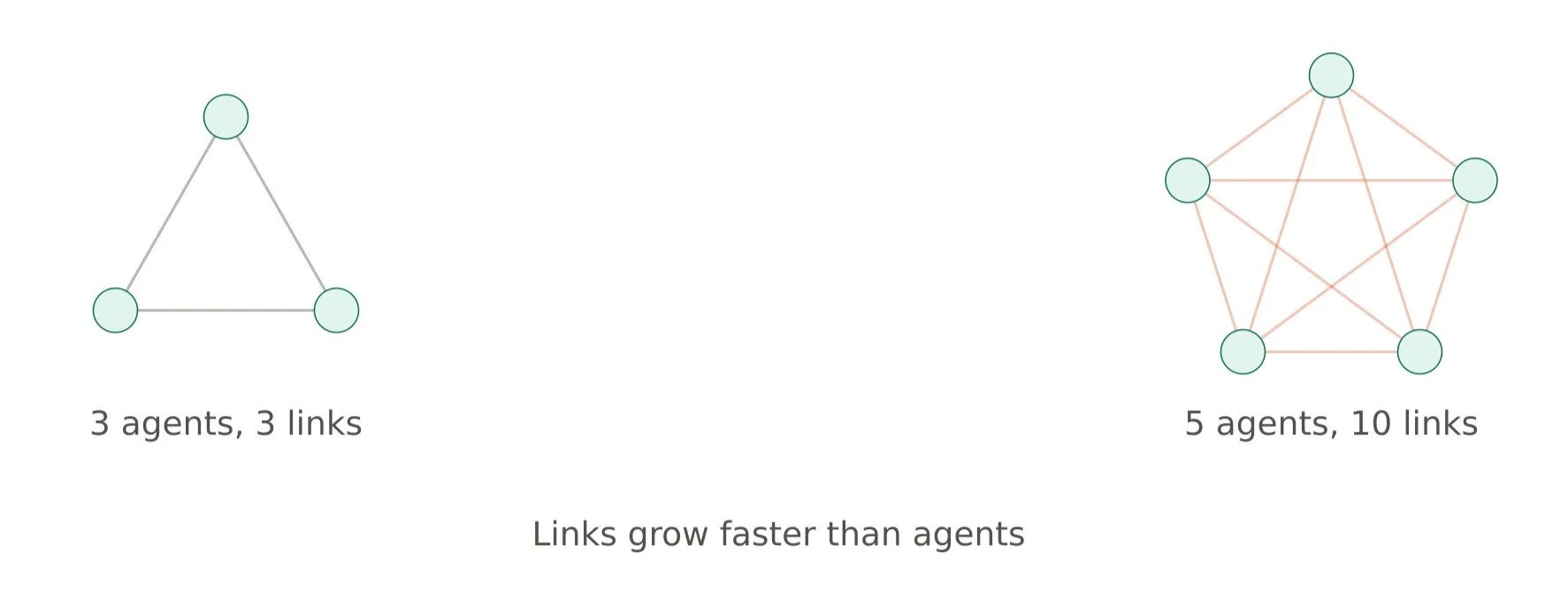
At a small scale, agents can basically shout into a shared space, and things work out. At production scale, that shared space turns into a firehose. Every additional agent you add doesn't just add its own communication load, but it multiplies the possible communication paths between everyone else, too. This is the core reason multi-agent orchestration gets exponentially harder as swarms grow, not just linearly harder.
A few common failure patterns show up again and again in production systems:
1. Message overload. Agents broadcast updates to everyone instead of just the agents that need them, flooding the system with irrelevant chatter.
2. Context loss. As messages get passed agent to agent, important details get dropped or summarized away, and by the fifth hop, the original intent is barely recognizable.
3. No shared source of truth. Different agents end up with different understandings of the current state of a task, leading to contradictory actions.
4. Latency stacking. Even small delays add up when ten agents need to talk to each other sequentially before a task finishes.
If you've built or managed any kind of distributed system before, this will sound familiar because it basically is one. The difference is that instead of servers passing structured data packets, you've got probabilistic language models passing messages that can be ambiguous, verbose, or occasionally just wrong.
Fixing Multi-Agent Coordination at Scale
So how are teams actually solving this? A few patterns have emerged as genuinely effective for agent coordination. The kind of patterns an experienced AI agent development company has usually already battle-tested across multiple client builds.
1. Introduce a hierarchy, not a free-for-all
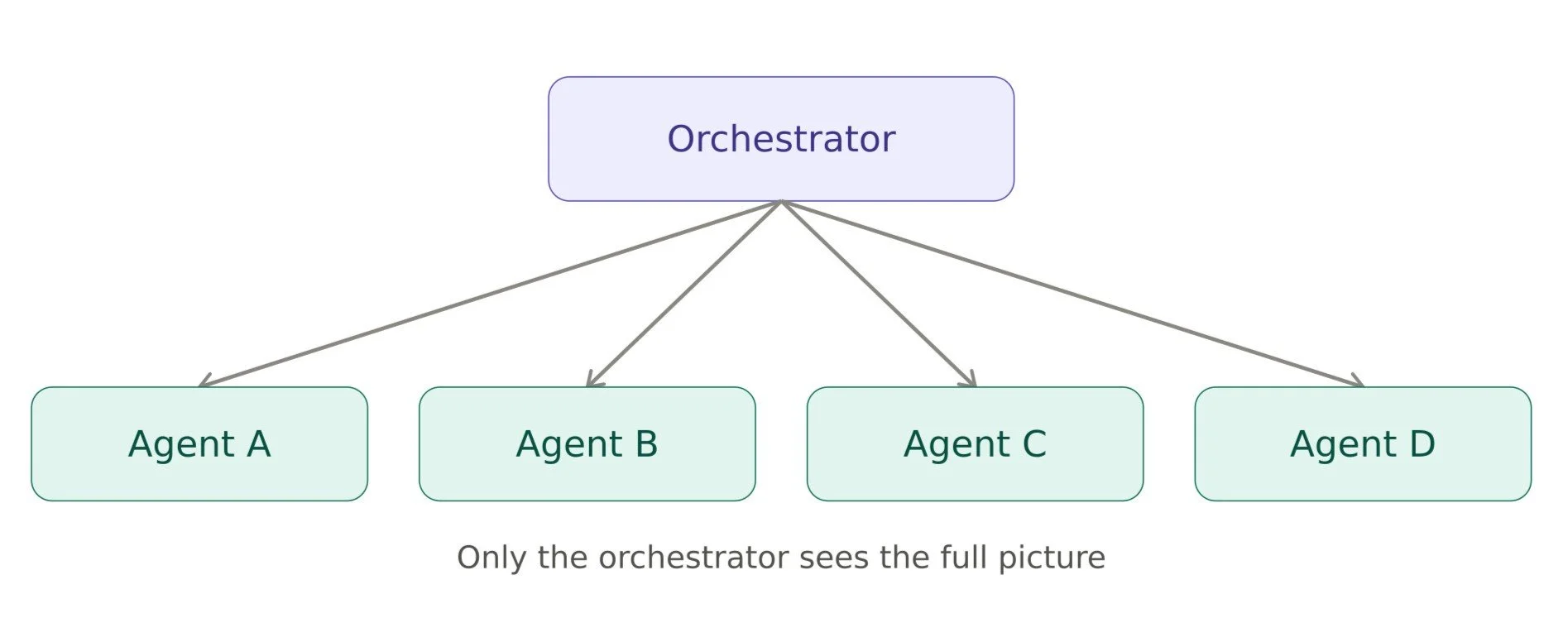
Flat systems where every agent talks to every other agent don't scale. Most successful production systems introduce some kind of manager or "orchestrator" agent that assigns tasks, tracks progress, and routes information only to the agents that need it. Some teams take this a step further with what's increasingly being called an agent gateway, a checkpoint that sits between agents and everything they touch. Either way, this mirrors human org charts for a reason; it works.
2. Structured messaging over free text
Letting agents communicate purely in natural language is flexible, but flexible also means unpredictable. Many production systems now use structured message formats like JSON schemas with clear fields for task, status, and required action. So agents parse each other's outputs reliably instead of "interpreting" them. This is similar in spirit to how a Salesforce Hosted MCP Server exposes clearly defined, structured actions to external agents rather than leaving them to guess at unstructured prompts.
3. Shared memory and state stores
Instead of agents passing the entire conversation history back and forth (expensive and error-prone), a shared state store lets any agent check the current status of a task without needing to be told by another agent directly. This alone removes a huge amount of unnecessary chatter.
4. Event-driven rather than constant polling
Rather than agents constantly checking in with each other ("are you done yet? are you done yet?"), event-driven systems let agents publish an event only when something actually changes. This cuts down enormously on wasted communication cycles.
5. Circuit breakers and timeouts
Just like in traditional software engineering, if one agent is unresponsive or stuck, the system needs a way to fail gracefully rather than let the whole chain hang. Timeouts, retries, and fallback agents keep a single slow node from freezing the whole swarm.
None of these ideas is exotic. They're borrowed from decades of distributed systems engineering, just applied to the AI agent instead of the microservice.
What This Looks Like for Enterprise AI Agent Scaling
For most companies, it's a very practical question of whether their AI investment can actually handle real workloads. Enterprise AI agent scaling almost always runs into the same wall: a proof of concept works great with five agents on a laptop, and then completely falls apart when it needs to handle thousands of concurrent tasks in production.
This is usually where teams realize they need more than internal effort alone, so they can bring in AI consulting services early, before the architecture gets complicated. It is far easier than retrofitting orchestration logic after launch.
This is usually where the difference between a demo and a genuinely reliable system for enterprise AI agents becomes obvious. The demo doesn't need orchestration discipline. Production absolutely does.
Companies that get this right tend to invest early in the orchestration layer itself, not just the individual agents. That means monitoring communication patterns, setting clear ownership boundaries between agents, and building in observability so a human can actually see where a task got stuck when something goes wrong.
Wrapping Up
Multi-agent systems are genuinely powerful. Splitting work across specialized agents lets you solve problems that a single model just can't handle alone. But the moment you scale a swarm from a handful of agents to a real production fleet, communication becomes the make-or-break factor.
The good news is that these problems aren't mysterious. They look a lot like the coordination problems distributed systems engineers have been solving for years, just with a new kind of intelligent, sometimes unpredictable worker in the mix. Add structure, reduce unnecessary chatter, give agents a shared understanding of state, and build in graceful failure handling, and suddenly a swarm of AI agents stops feeling like chaos and starts feeling like an actual team.
Get the orchestration layer right, and multi-agent orchestration stops being your bottleneck and starts being your biggest advantage.
Frequently Asked Questions
-
Multi-agent systems refer to the actual setup where multiple AI agents work together, each with a specific role. Multi-agent orchestration is the layer that manages how those agents interact: assigning tasks, routing messages, and keeping everyone in sync. You can have a multi-agent system without good orchestration, but it usually falls apart at scale.
-
This almost always comes down to coordination, not intelligence. Each agent can be doing its job perfectly, but if messages get lost, duplicated, or delayed between agents, the swarm as a whole breaks down.
-
More than most teams expect. Every additional agent doesn't just add its own messages, but it also multiplies the possible communication paths between every other agent in the swarm. This is why communication overhead, not model quality, is usually the real bottleneck once you scale past a handful of agents.
-
Introducing a hierarchy is usually the highest-leverage fix. Instead of every agent talking to every other agent, a manager or orchestrator agent routes information only where it's needed. This alone eliminates a huge share of unnecessary chatter and duplicate work.
-
If you're moving past a handful of agents into real production workloads, it's often worth bringing in AI consulting services not because in-house teams can't do it, but because avoiding the classic bottleneck traps (message overload, no shared state, poor failure handling) can save months of trial-and-error debugging.
Related Reading
Let’s Talk

Drop us a note, we’re happy to take the conversation forward 👇🏻