
Salesforce Bets $1 Billion on Switzerland
Key takeaways:
Salesforce will invest $1B in Switzerland over the next five years.
The investment focuses on AI skills, workforce training, and partner growth.
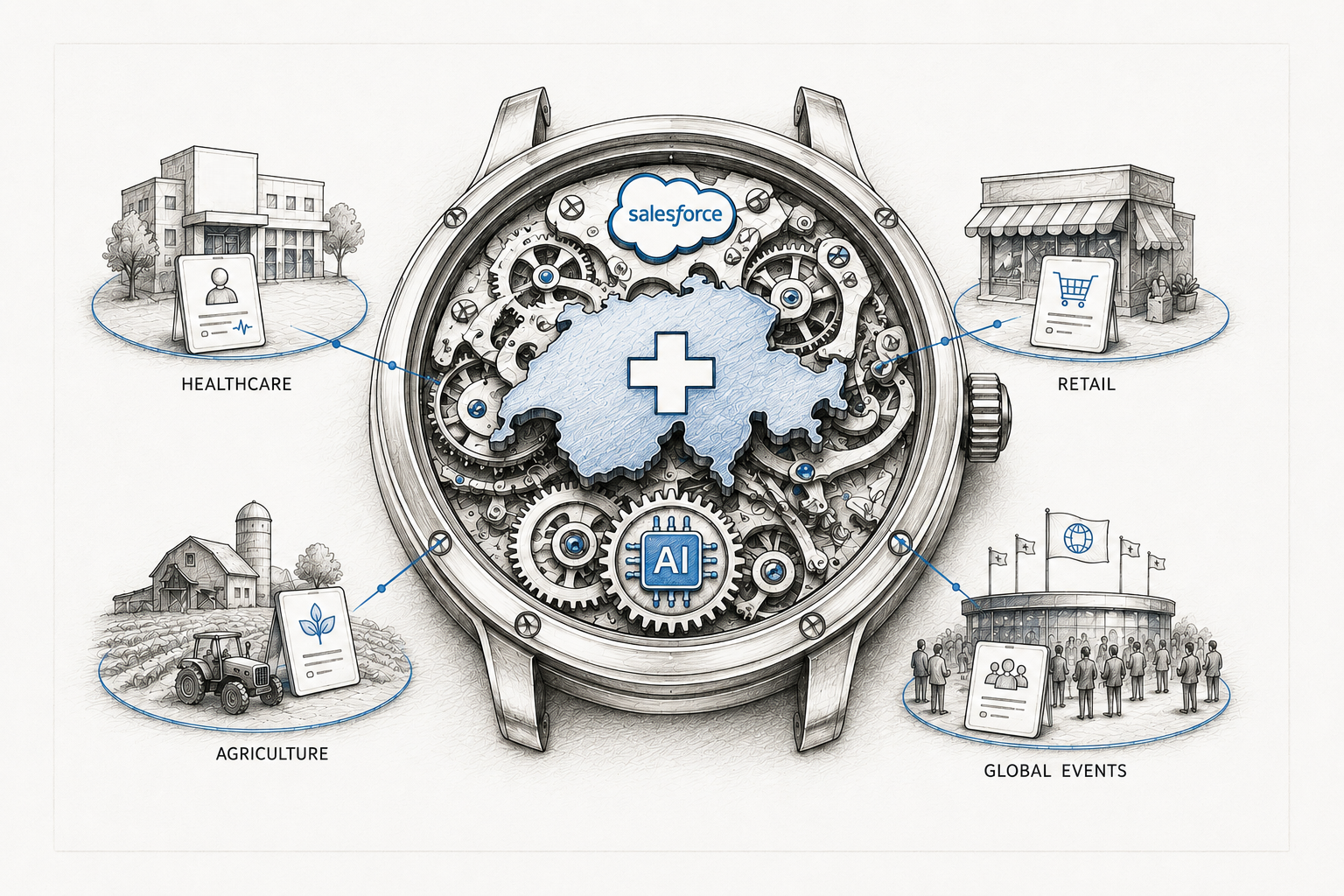
The announcement highlights four live customer deployments: Oviva, FREITAG, WEF, and Syngenta.
A few weeks ago, one of our clients, a mid-sized financial services firm evaluating Agentforce, asked us a blunt question during a scoping call: "Is agentic AI actually running in production anywhere, or is this still a slide deck?"
It's a fair question. Most enterprise AI conversations are still stuck at the pilot stage, and leadership teams are right to be skeptical of vendor promises. So when Salesforce announced a $1 billion, five-year investment in Switzerland on July 7, 2026, we paid close attention, not because of the number, but because of what's backing it.
Salesforce isn't just funding offices and headcount in Switzerland. It's using the country as a live showcase for Agentforce running at production scale across healthcare, retail, agriculture, and global events.
For anyone still treating agentic AI as an emerging technology to watch, this announcement is a signal that the window for early-mover advantage is closing.
Here's what actually happened, why Switzerland matters, and what it means if you're a decision-maker weighing whether to move from pilot to production.
What Did Salesforce Actually Announce?
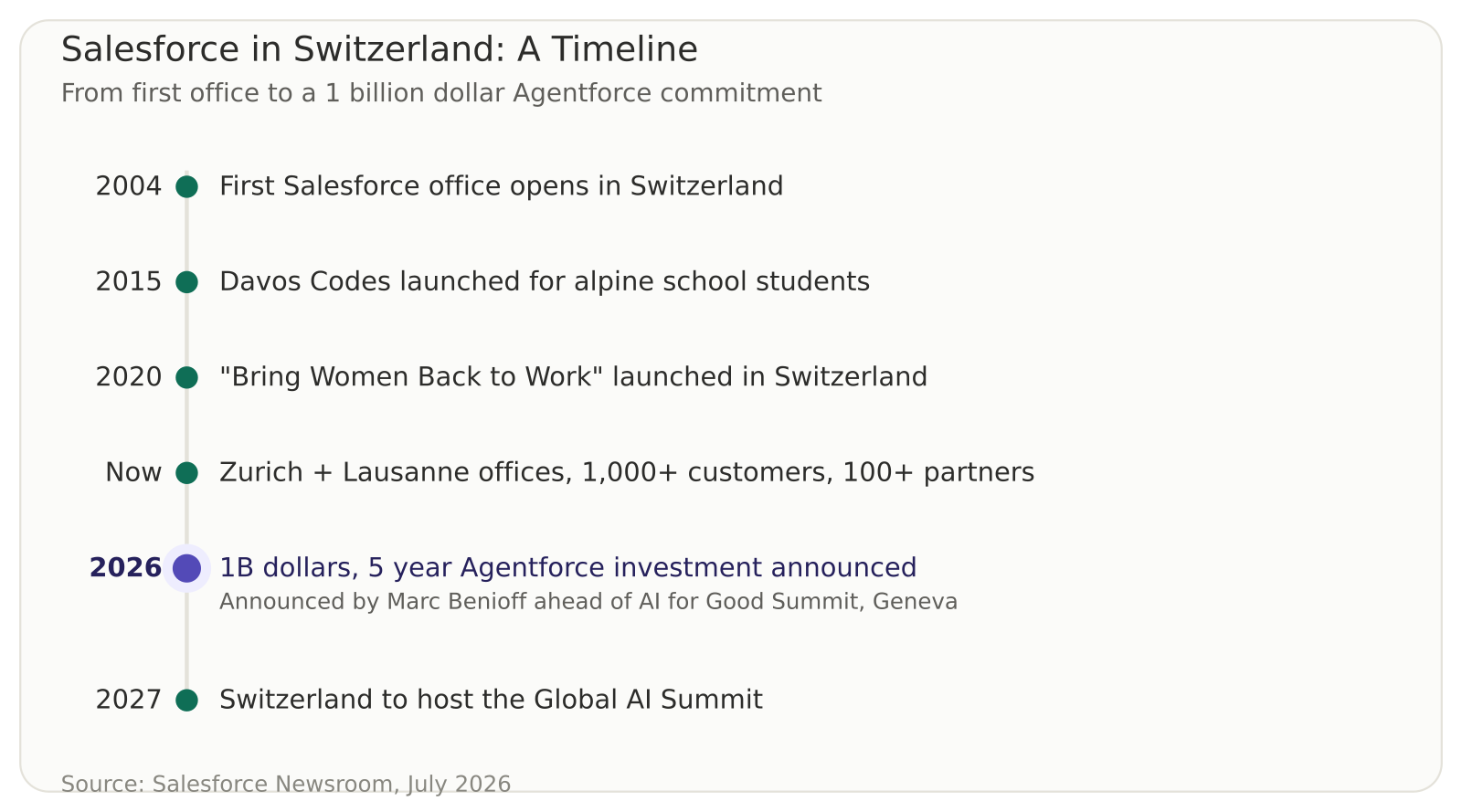
Salesforce Chair and CEO Marc Benioff announced the investment in Geneva, ahead of the AI for Good Global Summit. The commitment builds on Salesforce's existing footprint in the country: offices in Zurich and Lausanne, more than 1,000 Swiss customers, and a partner network of over 100 organizations built up since Salesforce first opened in Switzerland back in 2004.
The money is earmarked for three things:
Workforce and skills development, including AI training programs and initiatives like "Bring Women Back to Work," which has already produced over 1,000 Salesforce certifications for more than 600 participants
Customer and partner ecosystem growth, deepening the bench of Swiss organizations that can implement and scale Agentforce
Continued platform investment, positioning Switzerland as what Salesforce is calling a flagship market for its agentic enterprise strategy
Benioff framed the announcement around Switzerland's role as a neutral convening ground for global institutions, noting the country is "where the world comes together to solve its greatest challenges." That's not just branding language. Switzerland hosts the ITU, the World Economic Forum, and dozens of international bodies, and it's scheduled to host the Global AI Summit in 2027, following France in 2025 and India in 2026.
Why Switzerland, and Why Now?
There's a governance angle here that's easy to miss if you focus only on the dollar figure.
Benioff is co-chairing the first meeting of the AI for Good Global Commission, a body bringing together more than 40 heads of state and industry leaders to shape practical, responsible AI policy. Anchoring a major commercial investment in the same country, during the same week as that meeting, is as much a positioning move as a business one.
For Salesforce, being seen at the center of AI governance conversations matters almost as much as the technology itself. Enterprise buyers, especially in regulated industries like banking and life sciences, are increasingly asking about AI governance and trust before they ask about features. Switzerland lets Salesforce answer both questions in one announcement.
The Proof Points: What's Already Running, Not What's Promised
This is the part that should matter most to anyone evaluating Agentforce for their own organization. Salesforce didn't lead with a roadmap. It led with production data from four Swiss deployments.
| Organization | Sector | What Agentforce Is Doing |
|---|---|---|
| Oviva | Virtual healthcare | Handles 300,000+ monthly messages, deflects 50% of inquiries, and resolves 40% of operational queries, such as password resets, without human involvement. |
| FREITAG | Retail | "FRIDA" agent handles recurring queries across Germany and Switzerland, achieving 95%+ customer satisfaction. |
| World Economic Forum | Events | "EVA" agent supported 3,000+ leaders at Davos 2026 by handling scheduling, navigation, and briefing documents in seconds. |
| Syngenta Group | Agriculture | Embedded in sales and advisory workflows, building on a 14-year Salesforce partnership. |
What connects these four examples isn't the industry. It's the volume. These aren't chatbots handling FAQ traffic. They're agents resolving real operational work at a scale that would require significant headcount to replicate manually.
Is This Different From the Last AI Hype Cycle?
We get this question a lot, and it's worth answering honestly instead of just repeating vendor talking points.
The difference is measurable. Past AI cycles in enterprise software were dominated by predictive scoring and generative content assistance, useful, but bounded. What Oviva and FREITAG are running is autonomous resolution: the agent doesn't just suggest a next step, it completes the task and closes the loop.
That said, a few things are worth flagging honestly:
Production numbers aren't the same as universal readiness. These are flagship case studies Salesforce chose to publicize. They tell you what's possible with strong data hygiene and a clear use case, not what's typical.
A regional investment announcement is partly a governance and PR play. The timing around the AI for Good Summit is deliberate. That doesn't make the deployment data less real, but it does mean the framing is designed to build trust as much as demonstrate capability.
"$1 billion over five years" is a broad commitment, not a single product line item. It covers workforce programs, partner incentives, and platform investment together, so it's not a direct proxy for R&D spend on Agentforce itself.
We covered a similar dynamic when we looked at where Agentforce implementations tend to stall. In our experience, it's almost never a model capability problem. It's a data quality and governance problem: fragmented systems, duplicate records, and no clear ownership over what "trusted data" actually means inside the org.
What This Means for Your Agentic AI Roadmap
If you're a CX, sales, or operations leader still treating agentic AI as something to monitor rather than something to plan for, here's what this announcement should change about your thinking:
The pilot-to-production gap is closing faster than expected. Vendors now have enough real deployments to point to. "We're still evaluating" is a weaker position to hold in a board meeting than it was a year ago.
Data readiness is the actual bottleneck. Every case study above depended on unified, accessible CRM data. If your data is fragmented across systems, that's the work to start now, regardless of which AI platform you choose.
Governance credibility is becoming a buying criterion. Enterprise buyers, especially in finance and healthcare, are factoring in how a vendor talks about responsible AI, not just what the agent can do.
Regional investment signals long-term platform commitment. A five-year, market-specific investment is a different signal than a product launch. It tells partners and customers that support and roadmap continuity aren't going anywhere.
A Quick Checklist Before You Move From Pilot to Production
Audit your CRM data for duplicates, gaps, and governance ownership
Define which workflows are safe for full autonomous resolution versus human-in-the-loop
Set measurable KPIs for deflection rate, resolution rate, and customer satisfaction before launch, not after
Identify a partner with real implementation experience, not just platform certification
Build a rollback plan for edge cases the agent shouldn't handle alone
Where can I read the original announcements?
Salesforce's official release is available on the Salesforce Newsroom, and CX Today has additional analysis on what it means for CX and sales leaders.
If you're weighing whether your organization is ready to move Agentforce from pilot to production, we will guide you on how to implement Agentforce and lay out a practical Agentforce implementation roadmap covering timeline and cost factors.
Want a second opinion on your data readiness before you commit budget? Talk to our Salesforce AI consulting team.
Frequently Asked Questions
-
A $1 billion investment in Switzerland over five years to accelerate agentic AI adoption, expand workforce training, and grow its Swiss customer and partner ecosystem.
-
Salesforce's autonomous AI agent platform, built to handle customer service, sales, and operational workflows using CRM and enterprise data, without requiring human intervention for every step.
-
Oviva, FREITAG, the World Economic Forum, and Syngenta Group, spanning healthcare, retail, global events, and agriculture.
-
Not automatically. The Swiss case studies succeeded because of strong underlying data governance. That's the prerequisite worth solving before evaluating any agentic AI platform.
Related Reading
Let’s Talk

Drop us a note, we’re happy to take the conversation forward 👇🏻