Agentforce for Revenue Cloud: where it fits and where it doesn't
Key takeaways:
AI-Powered Revenue Workflows: Enhances CPQ, quoting, billing, and renewals with Agentforce AI.
End-to-End Revenue Lifecycle: Connects product configuration, pricing, contracts, billing, and revenue operations.
Unified Revenue Management: Combines revenue processes with Agentforce for smarter quoting and billing assistance.
At Dreamforce 2025, Salesforce launched Agentforce for Revenue Management, bringing AI agents into quoting, billing, and renewals inside Salesforce Revenue Cloud. It's being pitched as the next leap in Agentforce, but does it actually change how revenue teams work, or is it a rebrand around familiar Revenue Cloud functionality?
The truth sits in between. Salesforce revenue intelligence has genuinely improved in specific areas, like agentic quoting and billing assistance, driving real revenue operations efficiency. But not every stage of the lifecycle has changed equally.
This post breaks down the modern evolution of Salesforce Revenue Cloud stage by stage, where Agentforce fits inside this unified lifecycle management platform, and where it still falls short.
Revenue Cloud Meets Agentforce: What Actually Changed?
Every business hits the same wall eventually. Selling something is easy, but turning that sale into cash, without a dozen disconnected tools, becomes complicated.
Quotes in one tool. Contracts in another. Billing somewhere else entirely. Finance and sales looking at different numbers.
Here's Salesforce's fix for that.
Salesforce Revenue Cloud is a complete revenue lifecycle management platform, built natively inside Salesforce.
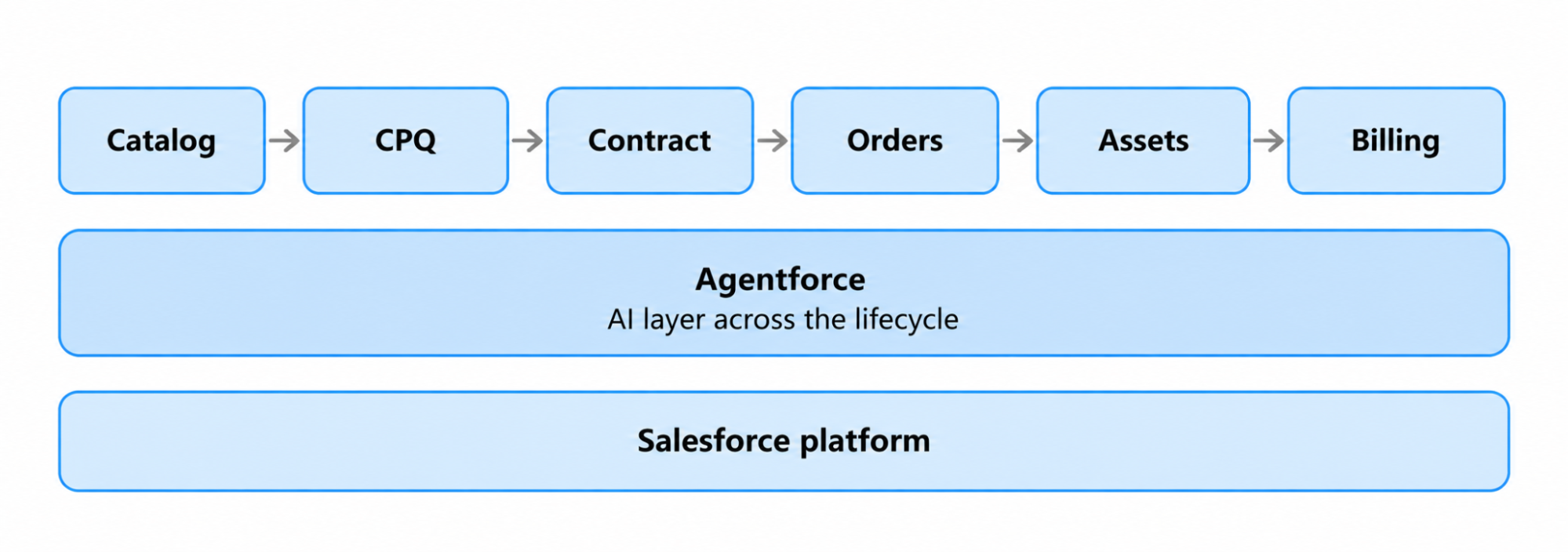
It brings every step of the revenue process onto one system:
Product Catalog & Pricing Management
Next-Gen CPQ (Configure, Price, Quote)
Contract & Asset Lifecycle Management
Dynamic Revenue Orchestration (DRO)
Billing & Invoice Automation
It’s tightly integrated with Agentforce 360, so it connects directly to Sales Cloud, Service Cloud, and other Salesforce apps. No middleware needed.
Revenue Cloud grew out of Salesforce CPQ, a tool built just for configuring products, pricing deals, and generating quotes. Over time, Salesforce kept expanding it until it became the full platform it is today. A quick comparison of the traditional vs. modern CPQs is given below:
Traditional CPQ vs. Modern Revenue Management
To understand how the platform scales, it is helpful to look at how it compares to legacy Salesforce CPQ tools
| Feature | Legacy Salesforce CPQ | Agentforce Revenue Management |
|---|---|---|
| System Architecture | Managed Package extension | Fully native, core platform architecture |
| Scope of Process | Strict focus on Quoting & Sales | Full product-to-cash (Billing, DRO, Analytics) |
| Integration Layer | Limited outside CRM plugins | API-first, modular, channel-headless |
| Automation Driving | Manual rules/custom scripts | Embedded autonomous AI agents |
Why Rename Revenue Cloud to Agentforce Revenue Management at Dreamforce 2025?
Because Salesforce launched Agentforce for revenue, and it wasn't just a fresh coat of paint.
The idea behind the rename: put revenue operations on one unified platform, then let AI agents actually run parts of it. Generating quotes, managing renewals, keeping an eye on consumption, breaking down invoices for customers. All so reps spend less time on admin and more time on the relationship itself.
Here's what's really going on underneath that:
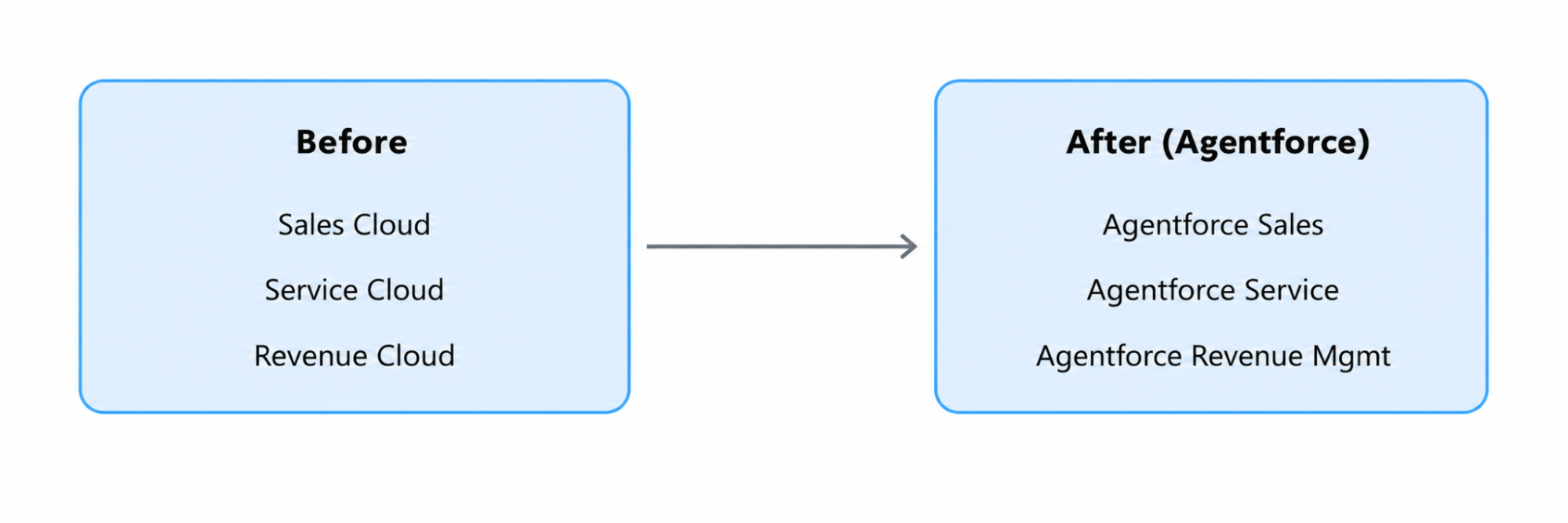
Salesforce is pulling every major cloud into one Agentforce 360 platform
Sales Cloud → Agentforce Sales
Service Cloud → Agentforce Service
Revenue Cloud → Agentforce Revenue Management
Same pattern, every time: take a mature product, wire AI agents directly into the workflow instead of bolting them on the side.
For revenue management in Salesforce, that means agents that can:
Generate quotes from a plain-language request
Manage renewals without a human kicking things off
Monitor consumption in real time
Explain a confusing invoice to a customer
1. Company-wide rebrand tied to Agentforce 360
Salesforce is consolidating its major products under the Agentforce name, as AI agents become a core part of each platform rather than an add-on:
Sales Cloud → Agentforce Sales
Service Cloud → Agentforce Service
Revenue Cloud → Agentforce Revenue Management
This isn't specific to Revenue Cloud; it's the same naming pattern applied across the product line.
2. AI agents were added natively to the platform
Before the rename, AI features in Revenue Cloud were optional add-ons. After the rename, AI agents are built into the core workflows able to generate quotes, monitor consumption, explain invoices, and process renewals directly, without a rep initiating each task.
Salesforce's own positioning: the name change reflects a shift toward AI-powered, autonomous revenue operations while the underlying platform and its capabilities (catalog, pricing, quoting, contracting, billing) stay the same.
So the rename signals a change in how work gets executed on the platform, not a change to the platform itself.
Where Agentforce Actually Fits in the Revenue Cloud Lifecycle
Revenue Cloud runs on connected capabilities across the entire lifecycle. Here's what each one does.
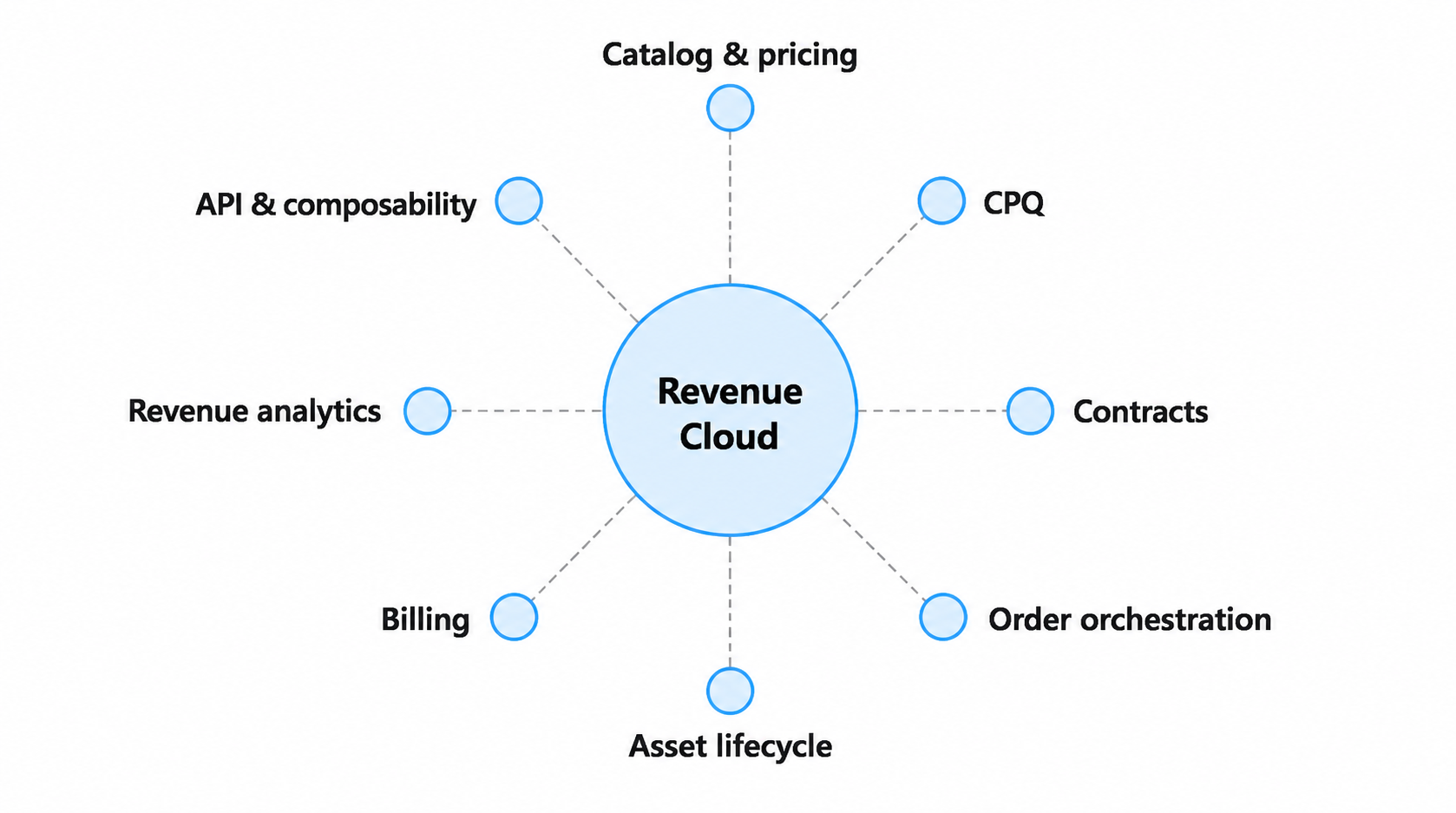
1. Product Catalog & Configuration
Handles attribute-based catalogs and large configurations (quotes over 1,000 lines) using guided constraint builders.
AI agents assist reps with intelligent product bundling and real-time rule validation.
Build revenue cloud pricing procedures with a declarative designer. Manage discount matrices. Track pricing effectiveness on a built-in dashboard.
2. Configure, Price, Quote (CPQ)
Constraint-based configurator. Handles complex deal scenarios using Constraint Modeling Language (CML).
What it supports:
Dynamic deal management: spreadsheet-style editor for multi-year, multi-product deals
Ramp deals: quantity and pricing changes across years
Scheduled uplifts: future price increases, locked in automatically
Instant pricing: real-time calculations, full pricing waterfall visibility
Agentforce quoting: generate compliant quotes using plain-language requests
3. Contract Lifecycle Management
Turns an accepted quote into a contract.
Includes:
AI-powered clause generation: draft contract language faster
Collaborative redlining: real-time editing with customers
Automated amendments: update contracts without starting over
Template management: stay compliant using pre-approved templates
4. Order Fulfillment & Orchestration
Runs on the Dynamic Revenue Orchestration engine.
What it does:
Decomposes orders
Manages fulfillment plans
Tracks dependencies
Flags bottlenecks
Reduces fallout through built-in analytics
5. Asset Lifecycle Management
Tracks what each customer owns: products, services, entitlements in one place.
Manages:
Amendments
Renewals
Cancellations
Full asset history
Sales, finance, and customer success all work from the same data.
6. Billing & Invoice Management
Automates billing for any model: subscription, usage, one-time, hybrid.
Core functions:
Consumption pricing: token grants, commitments, rating engines
Accurate invoicing: usage rating, discounts, proration handled automatically
Self-service portals: customers view invoices, pay, resolve issues
Collections management: tracks balances, automates reminders
Payment processor integration: real-time, secure payment capture
Billing agent: AI assistance for explaining complex charges
All billing data flows to ERP for revenue recognition.
7. Revenue Analytics
Built on Tableau Next.
Dashboards cover:
Pricing analytics: discount trends, waterfall impact, margin analysis
Subscription analytics: ARR, MRR, churn, renewal rates
Order analytics: fulfillment bottlenecks, fallout
Billing analytics: invoice health, collection efficiency
8. API-First & Composable Architecture
Every component is exposed via REST APIs. No rigid rollout path: start with what you need, expand later, and integrate with existing tools.
How Does Revenue Cloud Work Across Revenue Automation Management
Agentforce for Revenue Cloud runs quote-to-cash workflows on Salesforce's core platform. Before Agentforce, configuration and quoting relied on rule-based logic and manual triggers. After Agentforce, a constraint-based configuration engine and embedded AI agents handle parts of that execution directly.
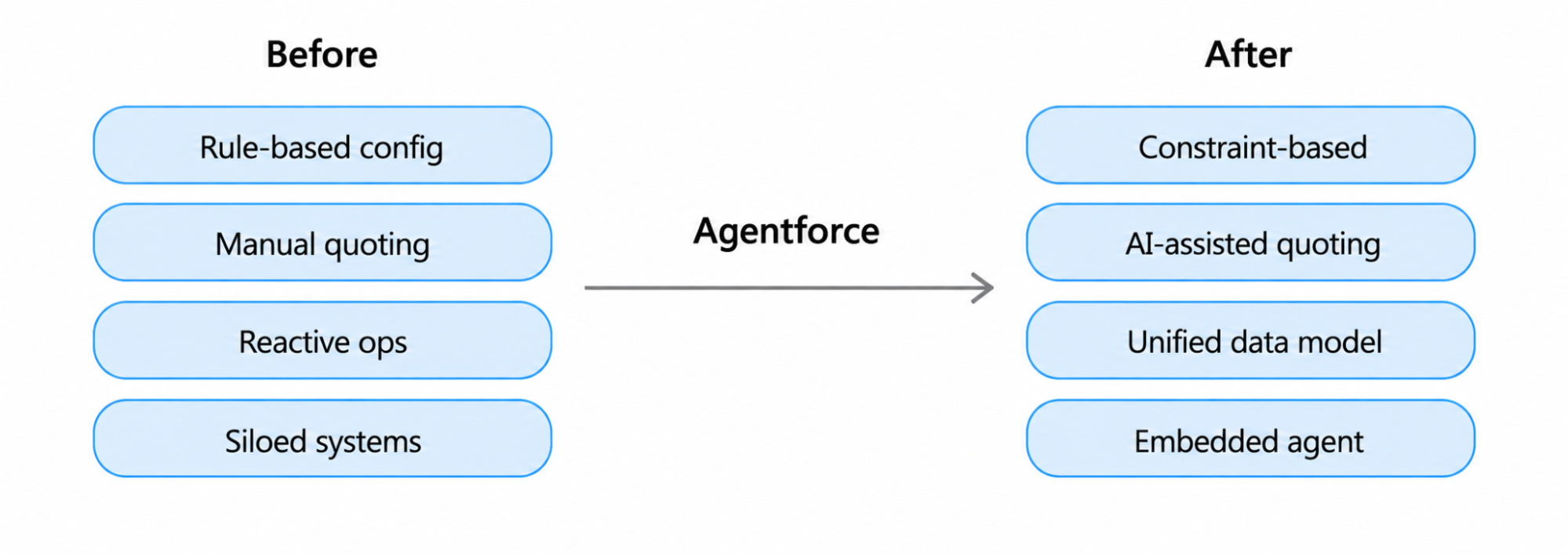
Before Agentforce Work
Rule-Based Configuration: Product configurations were driven by if-then rule chains. As product portfolios grew, these rules had to be rewritten or duplicated for every new scenario, creating rigidity and maintenance overhead.
Manual Quoting: Reps configured products and applied pricing through the standard configurator step-by-step, with no natural-language quote generation available.
Reactive Operations: Consumption thresholds, renewal tracking, and billing disputes required manual review by finance and RevOps teams.
Siloed Systems: CPQ, contracting, and billing operated as related but separately managed functional areas.
After Agentforce Work
Constraint-Based Configuration: The Advanced Configurator replaced sequential rule chains with a constraint model instead of scripting every step; teams define what must be true for a configuration to be valid, and the solver finds it automatically.
AI-Assisted Quoting: Sellers can create, update, and send quotes from within Salesforce using AI-supported quoting, without relying on external tools.
Unified Data Model: Quoting, contracting, order orchestration, billing, and revenue analytics run on a single platform rather than separate systems, integrating with Data Cloud and Tableau Next.
Embedded Agent: Revenue Agent for Agentforce is included with Revenue Cloud, working alongside the Constraint-Based Configurator rather than as a separate add-on.
How Agentforce Supports Billing for Customers and Employees
Agentforce supports billing by automating invoice management, quote-to-cash workflows, and payment plan setups for customers, while providing employees with instant customer payment insights, automated charge analysis, and flexible internal platform consumption billing options
Salesforce provides two Agentforce experiences for billing: one for customer-facing assistance and another for internal finance and billing teams.
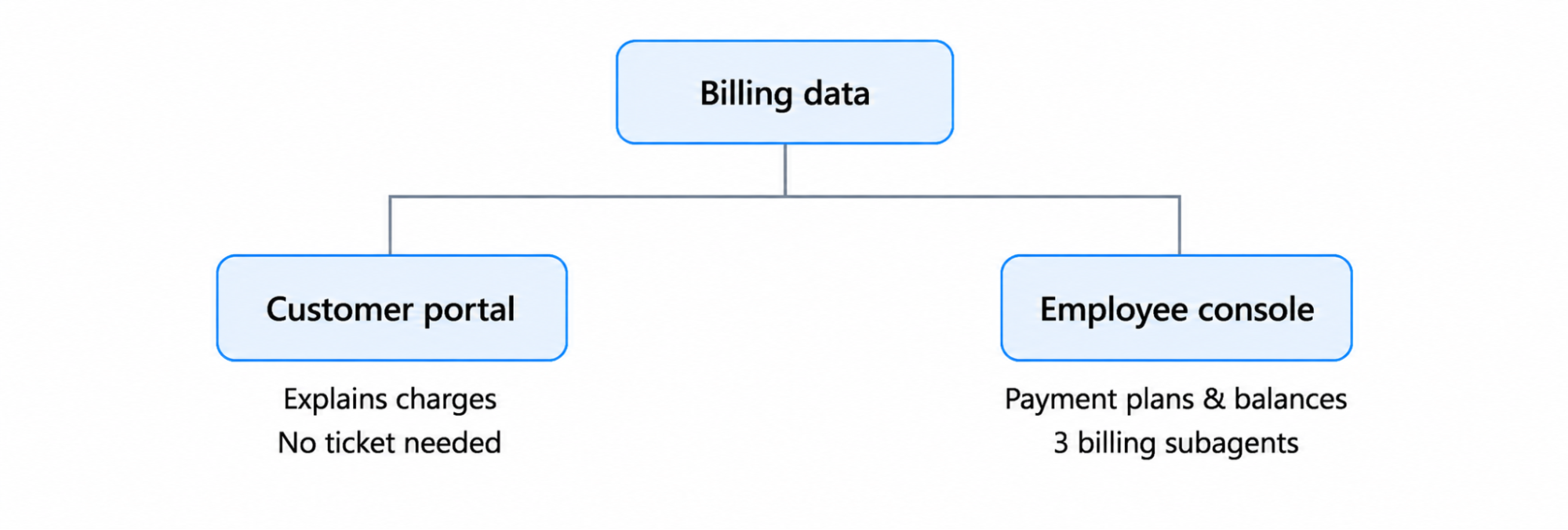
Agentforce for Billing Service Assistance: Agent Customers
Provides conversational billing assistance through the Experience Cloud billing portal
Explains invoice charges and billing information
Customers can view unpaid bills, check balances, look up payment histories, and analyze specific charges 24/7 through Agentforce for Communications.
Helps customers resolve billing questions without creating a service request
Agentforce for Billing Employee Assistance Employees
Data Retrieval: Internal teams instantly surface context on failed transactions, refunds, or customer ledgers directly inside the CRM.
Workflow Automation: Employees rely on automated invoice data capture and streamlined approval chains to produce consolidated enterprise bills.
Platform Billing Models: Organizations pay for Agentforce usage via flexible models like pay-as-you-go Flex Credits or pre-commit tiers tracked via a digital wallet.
How Agentforce Automates Quotes in Revenue Cloud
Agentforce brings conversational quoting to Revenue Cloud, allowing sales reps to create, update, and manage quotes using natural language while following the business rules and logic already defined in the platform.

Agentforce Quoting
Create quotes using natural language from an opportunity, account, or quote
Search and select products using AI-powered Product Selection
Apply pricing and discounts based on the product catalog and business rules
Add or update quote line items through conversational requests
Create amendment quotes for changes to existing customer assets
Manage quotes and make adjustments without manually navigating through multiple quoting steps
Follow business rules and logic to help keep quotes accurate and compliant
Where Agentforce Doesn’t Fit in Revenue Cloud
This brings AI directly into the Configure, Price, Quote (CPQ) workflow while Agentforce for Revenue Cloud continues to manage the underlying product, pricing, configuration, and quote data.
Agentforce adds AI assistance to Revenue Cloud workflows, but it does not replace the core capabilities that execute and manage the revenue lifecycle.
Product data still has to be right. Agentforce works with whatever product catalog and pricing data you've set up in Revenue Cloud. If your product definitions, attributes, bundles, or pricing rules are messy, the AI doesn't fix that. Garbage in, garbage out still applies.
Complicated pricing setups need a second look first. If you're running highly customized pricing models, or you're still carrying over legacy CPQ logic, don't expect that to just plug into AI-assisted workflows out of the box. It's worth an architectural review before you get there.
Negotiations are still a people thing. Agentforce can help with the parts of quoting and pricing that follow a clear pattern. But when it comes to actual back-and-forth negotiation, exceptions to the rule, or a judgment call on a big deal that's still on your team, not the AI.
The core of Revenue Cloud hasn't gone anywhere. Catalog, pricing, contracts, order orchestration, billing, revenue management Agentforce assists around the edges of these, but Revenue Cloud is still the one running them.
In Short: Agentforce as a layer that sits on top of Revenue Cloud, not a replacement for it. It's genuinely good at picking up repeatable, well-defined tasks.
Everything else the business logic, the actual transaction lifecycle that's still Revenue Cloud's job.
Conclusion
Agentforce enhances Revenue Cloud with AI assistance, including AI agents for CPQ and Agentforce billing automation, but it doesn’t replace the platform’s core revenue processes. It works best where AI can simplify repeatable tasks while Revenue Cloud continues to manage the underlying revenue lifecycle.
Planning a Revenue Cloud implementation? Work with a Salesforce Partner to identify the right opportunities for Agentforce and build a revenue workflow that is ready for the next stage of AI-powered automation.
Frequently Asked Questions
-
Salesforce Revenue Cloud is an end-to-end platform that connects and manages the revenue lifecycle, from product catalog and pricing to quoting, contracting, order fulfillment, billing, and renewals.
It has evolved into Agentforce Revenue Management as Salesforce brings AI agents into these revenue workflows.
-
Revenue Cloud evolved from Salesforce CPQ into a broader revenue lifecycle management platform.
CPQ remains an important capability within Revenue Cloud, while the platform now extends across contracting, ordering, billing, asset management, and revenue analytics.
-
Salesforce CPQ primarily focuses on configuring products, pricing deals, and generating quotes. Revenue Cloud extends beyond CPQ to manage the wider quote-to-cash lifecycle, including contracts, orders, assets, billing, and revenue analytics.
-
Revenue Cloud connects key revenue processes on a unified platform. It manages product and pricing data, uses CPQ for configuration and quoting, moves accepted quotes into contracts and orders, and continues through asset management, billing, and revenue analytics.
-
Salesforce Revenue Cloud is used to manage and automate quote-to-cash and revenue lifecycle processes. Businesses can use it for product and pricing management, CPQ, contract lifecycle management, order fulfillment, billing, renewals, and revenue analytics.
-
Agentforce for Revenue Cloud brings AI-powered assistance into Revenue Cloud workflows. It can help with tasks such as product selection, quote creation and management, billing assistance, and other repeatable revenue operations.
-
AI agents for CPQ can use natural language to help sales teams select products, create and manage quotes, and work with pricing and configuration rules within Revenue Cloud.
-
No. Agentforce adds an AI-powered layer to Revenue Cloud but does not replace its underlying revenue management capabilities. Revenue Cloud continues to manage the core product, pricing, configuration, contracting, ordering, and billing processes.
Related Readings

Let’s Talk

Drop us a note, we’re happy to take the conversation forward 👇🏻