

Key takeaways:
Agentforce brings AI closer to your CRM: It combines Salesforce data, business logic, and the Atlas Reasoning Engine to automate customer-facing workflows.
Custom AI agents expand what AI can do: They offer greater freedom over models, architecture, and integrations across enterprise systems.
The smartest choice is the right fit, not the biggest technology: Evaluate your CRM needs, technical resources, and long-term goals. A hybrid approach can bring both capabilities together.
What if your CRM could do more than store customer data and automate workflows? What if it could understand business context, reason through complex requests, make decisions, and take action autonomously?
This is the shift agentic AI is bringing to customer relationship management.
Salesforce Agentforce brings AI agents directly into the CRM ecosystem, combining the Atlas Reasoning Engine with Data 360, Salesforce Flows, business data, and enterprise security controls. It allows businesses to build Salesforce AI Agents that can understand context and execute tasks within defined workflows.
On the other hand, Custom AI Agents give development teams greater control over foundation models, APIs, orchestration frameworks, retrieval-augmented generation (RAG), and integrations across platforms. This makes custom AI agent development a suitable option for businesses with specific requirements beyond the Salesforce ecosystem.
However, choosing between these approaches involves more than comparing Agentforce features. Flexibility, data governance, integration complexity, pricing, and scalability all play an important role.
So, when comparing Agentforce vs. Custom AI Agents, which approach makes more sense for growing CRM operations? Let's explore their capabilities, limitations, and key differences to help you make the right choice.
A Brief Overview: Agentforce vs. Custom AI Agents
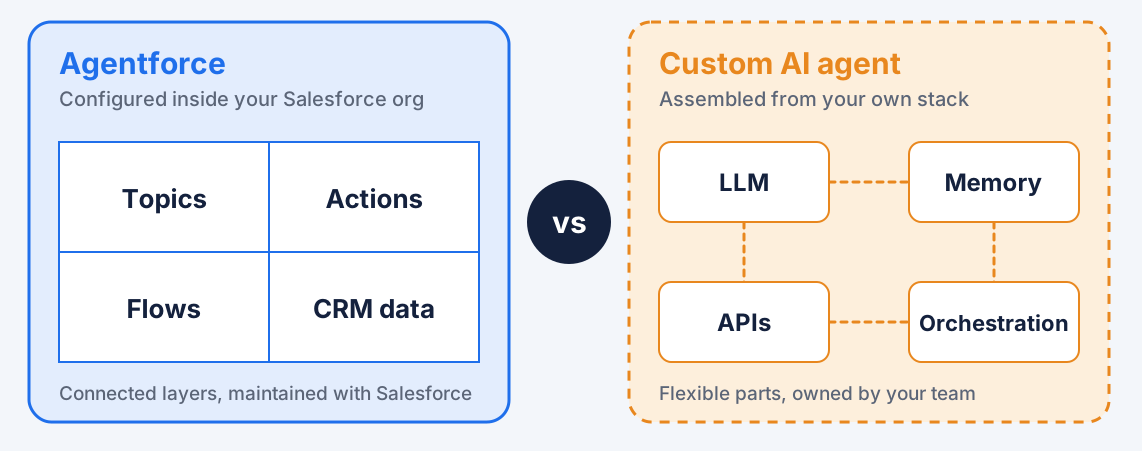
Agentforce vs. custom AI agents comes down to where the intelligence lives: inside Salesforce, or in a stack your team builds. This table shows how they differ on the factors that matter most to CRM teams.
| Factor | Salesforce Agentforce | Custom AI Agent |
|---|---|---|
| Platform | Native to the Salesforce ecosystem | Standalone, connects through APIs |
| CRM Data Access | Native access to Salesforce CRM data | Requires API integration or a data integration layer |
| Build Time | Often weeks with low-code configuration | Can take months depending on engineering complexity |
| Security and Compliance | Einstein Trust Layer included | You build it yourself |
| Pricing Pattern | Usage-based, rises with volume | High build cost, flatter after |
| Skills Needed | Admin and low-code | Engineering team |
| Model Choice | Salesforce-managed | Any LLM, fine-tuning allowed |
| Flexibility | Limited to platform capabilities | Tailored logic and greater control |
What Salesforce Agentforce Is and How It Helps Businesses
Salesforce Agentforce is an AI-powered platform that helps organizations create and manage autonomous agents for different business activities.
These agents can understand requests, evaluate information, make decisions, and perform tasks with minimal human involvement. They can support both customer interactions and internal business processes at any time.
How Salesforce Agentforce Supports Different Business Functions
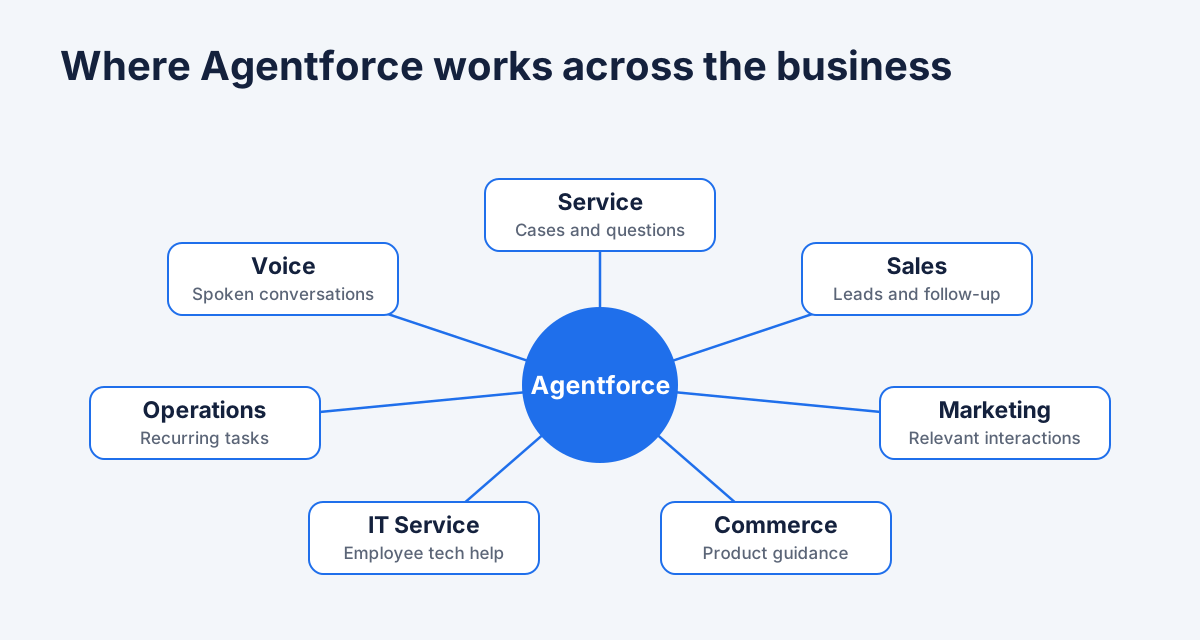
Salesforce Agentforce can be used across multiple departments, helping teams manage routine activities, respond faster, and improve operational efficiency.
Agentforce Service: Assists customers with common questions, service requests, and support needs without requiring an employee to handle every interaction.
Agentforce Sales: Helps sales representatives manage prospect engagement, qualify leads, answer customer queries, and maintain follow-up activities.
Agentforce Marketing: Supports marketing teams in delivering relevant customer interactions and improving campaign-related activities.
Agentforce Commerce: Makes online shopping more personalized through product suggestions, customer assistance, and AI-driven interactions.
Agentforce IT Service: Helps employees get support for common technical issues while reducing repetitive work for IT teams.
Agentforce Operations: Supports business operations by automating recurring tasks and simplifying everyday workflows.
Agentforce Voice: Allows customers to communicate with AI agents using natural, voice-based conversations.
Key Capabilities
Agentforce brings together AI reasoning, automation, and connected business information to help organizations build agents around their operational needs.
Low-Code Customization: With Agent Builder, teams can configure agents, define their responsibilities, and customize workflows without building everything from scratch.
Multi-Agent Orchestration: Different agents can handle individual parts of a task and coordinate with one another when a workflow requires multiple steps or capabilities.
Trust and Guardrails: Security, permissions, and governance controls help organizations set boundaries for agent behavior and manage how business information is used.
Omnichannel Deployment: AI agents can be made available across multiple channels, allowing customers and employees to interact with them through their preferred touchpoints.
What Are Custom AI Agents and How Do They Work?
Custom AI agents are AI-powered systems designed to handle specific business tasks with less manual effort. They can understand instructions, process information, make decisions, and complete tasks by using company data and connected tools.
Unlike traditional chatbots that mainly respond to individual questions, custom AI agents can manage multi-step tasks. They can maintain relevant context, interact with different software systems, and continue working toward a specific goal instead of simply generating a response.
How Custom AI Agents Work
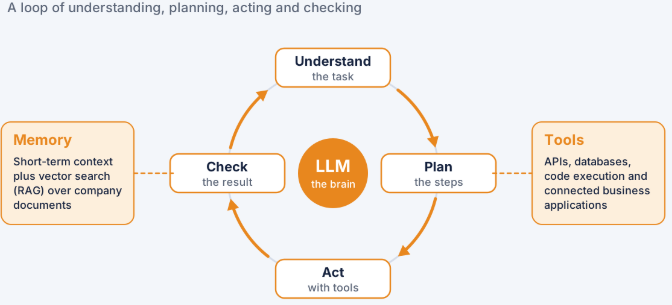
Custom AI agents follow a continuous process of understanding a task, planning what to do, taking action, and checking the results. This process is commonly known as an agentic loop.
Several components work together to make this possible:
1. The Brain (Large Language Model): The language model acts as the agent's decision-making engine. It understands the user's request, processes available information, and determines the next steps.
2. Planning and Reasoning: When a task involves multiple activities, the agent breaks it into smaller steps. It then decides how to complete those steps based on the task requirements and available information.
3. Memory Systems: Memory helps an agent retain useful information and access relevant knowledge when needed.
Short-Term Memory: Keeps track of current instructions, conversation details, and information needed to complete an ongoing task.
Long-Term and Vector Memory: Uses techniques such as Retrieval-Augmented Generation (RAG) and vector databases to find relevant information from company documents, manuals, and internal records.
4. Tool Use (The Hands): Agents use external tools to perform tasks beyond generating text. They can interact with APIs, retrieve database records, execute code, and communicate with connected applications.
5. Observation and Self-Correction: After completing an action, the agent checks the result. If the output is incorrect or the task is incomplete, it can adjust its approach and take another step.
Common Types of Custom AI Agents
Businesses can develop different types of AI agents depending on their goals, workflows, and operational needs. Some common examples include:
Knowledge and Retrieval Agents: Find relevant information from internal documents, company knowledge bases, and other private resources to answer questions.
Customer Service and Support Agents: Handle customer requests such as product returns, warranty questions, and account-related issues.
Automation and Operations Agents: Manage repetitive business activities, including data entry, transaction processing, and IT ticket assignment.
Compliance and Risk Agents: Review documents, transactions, and code against business policies or regulatory requirements and identify cases that need human attention.
What Are the Pros and Cons of Agentforce and Custom AI Agents?
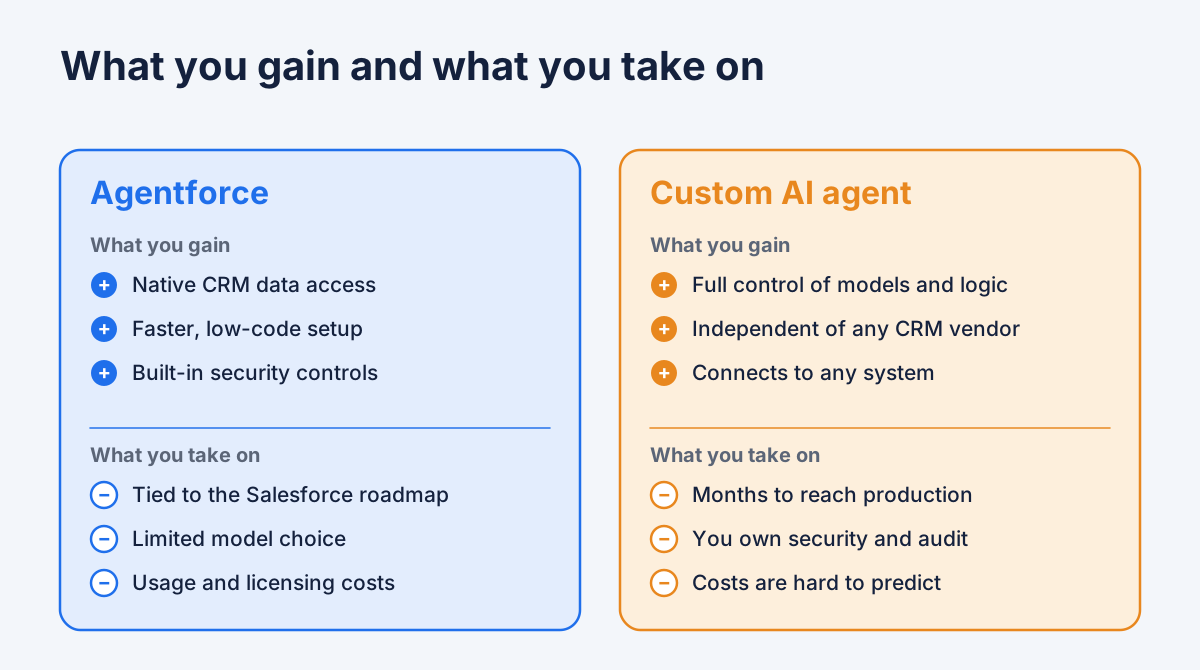
Both Salesforce Agentforce and custom AI agents offer distinct advantages, but each comes with limitations that businesses should consider before choosing an approach.
1. Salesforce Agentforce
| Pros | Cons |
|---|---|
| Native CRM data access: Works directly with Salesforce data and CRM workflows. | Salesforce dependency: Tied to the Salesforce ecosystem, platform capabilities, and product roadmap. |
| Faster deployment: Low-code tools can reduce development time and simplify agent configuration. | Platform limitations: Customization and model choices depend on supported Salesforce capabilities. |
| Built-in security: Einstein Trust Layer provides enterprise security and AI governance capabilities. | Additional integration effort: Workflows outside Salesforce may require APIs, MuleSoft, or other integrations. |
| Low-code development: Agent Builder helps Salesforce teams create agents without building everything from scratch. | Ongoing monitoring: Agents still need internal ownership, testing, and performance tuning. |
| Managed infrastructure: Salesforce manages the underlying platform and infrastructure. | Usage and licensing costs: Agent usage, Salesforce editions, and additional Data 360 requirements can increase costs. |
2. Custom AI Agents
| Pros | Cons |
|---|---|
| Complete control: Choose your preferred AI models, frameworks, architecture, and business logic. | Longer development cycle: Building, testing, and deploying production-ready agents can take months. |
| Platform independence: Not restricted to a single CRM vendor or ecosystem. | Engineering requirements: Requires AI developers and software engineering expertise. |
| Cross-platform integration: Connects with multiple applications, databases, and external systems. | Security responsibility: Your team must implement and maintain security, compliance, and audit controls. |
| Model flexibility: Supports model selection, customization, and fine-tuning where supported. | Maintenance ownership: Infrastructure, updates, monitoring, and troubleshooting remain your responsibility. |
| Specialized use cases: Can be designed for unique workflows, including non-CRM applications. | Cost uncertainty: Infrastructure, API usage, development, and maintenance costs can be difficult to predict. |
Agentforce reduces the effort of building AI agents within Salesforce, while custom AI agents offer greater control over architecture and technology.
The right choice depends on your existing CRM environment, technical resources, integration needs, and long-term costs.
How Does Agentforce Think and Make Decisions?
Generating an answer is one thing; deciding what to do next is another. AI agent reasoning makes this possible, enabling the Atlas Reasoning Engine to support complex CRM operations through contextual decisions and AI-powered automation.
Two concepts help explain this approach: Chain-of-Thought (CoT) and ReAct (Reasoning and Acting).
Chain-of-Thought (CoT): Breaking Down Complex Requests
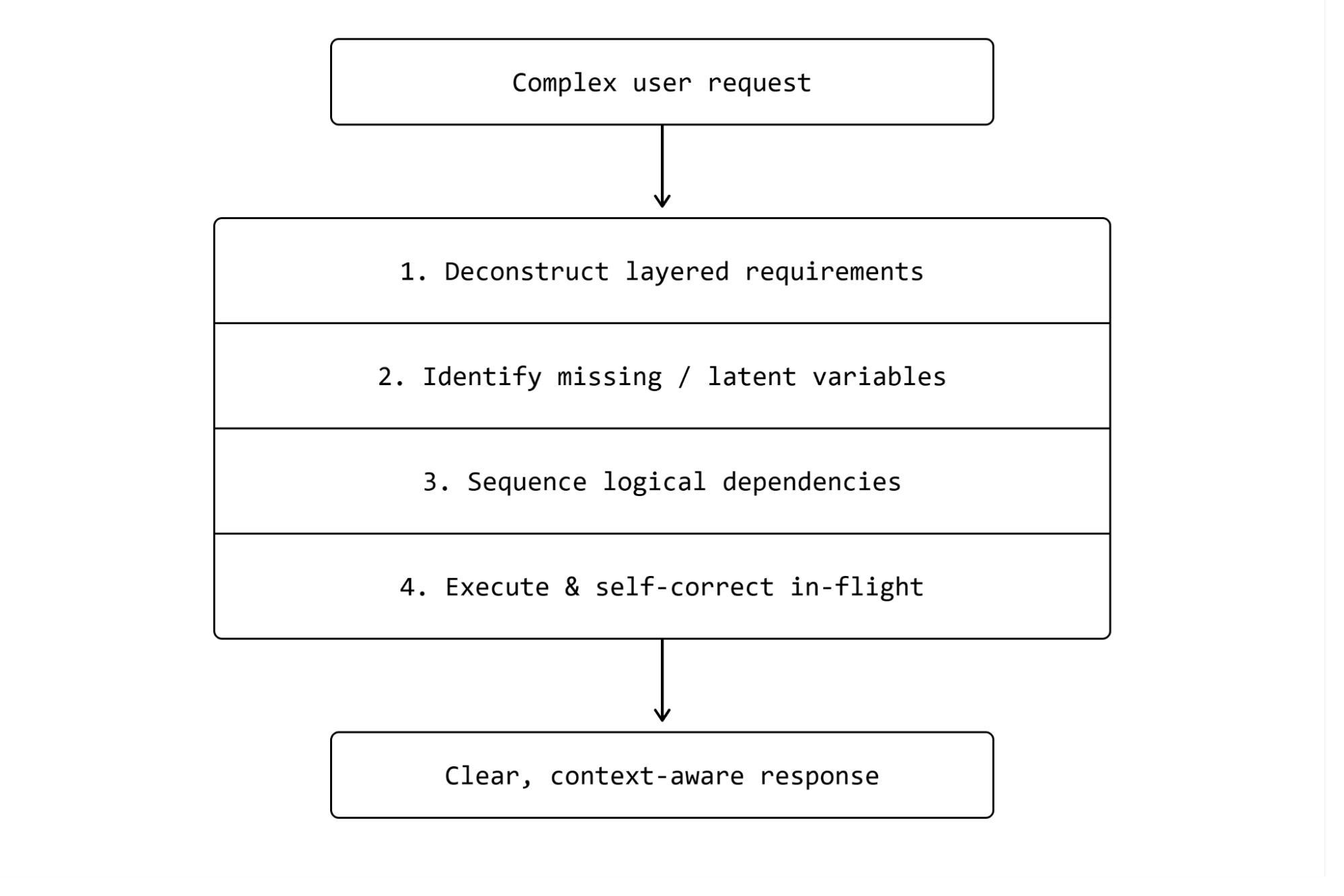
Chain-of-Thought (CoT) prompting is an AI reasoning technique that encourages a Large Language Model (LLM) to break complex requests into smaller, logical steps before generating a final response.
This helps the model approach multi-step tasks more systematically and can improve performance in areas such as logical reasoning, calculations, and decision-making. However, CoT alone does not enable an AI agent to access external data or execute CRM actions
Instead of mapping an input directly to an output (Input --> Output), Chain-of-Thought introduces intermediate reasoning steps. (Input → Reasoning → Output)This helps the model break complex requests into smaller steps before generating a response.
How Agentforce Reasons Using the Atlas Reasoning Engine
Salesforce brings its reasoning capabilities into Agentforce through the Atlas Reasoning Engine. It coordinates how agents interpret requests, route tasks to relevant subagents, execute actions, and generate responses.
The newer Agentforce architecture uses a hybrid reasoning model, combining LLM-based decision-making with deterministic, rules-based execution. Three components support this architecture:
Agentforce Builder: The environment for developing and configuring agents through visual tools or Agent Script.
Agent Script: A declarative language that defines agent instructions, business logic, conditions, and actions.
Agent Graph: The execution structure generated from Agent Script, which the reasoning engine uses to manage the agent's workflow.
Core Decision-Making Architecture
Agentforce combines reasoning, business data, and configured actions to process requests. Four capabilities play an important role in this process:
Atlas Reasoning Engine: Coordinates how an agent interprets requests, evaluates instructions, routes tasks, and selects the next action. Its execution follows the configured Agent Graph rather than relying on a single fixed response.
Data Grounding and Retrieval (RAG): Provides relevant business context from sources such as Salesforce CRM records, Data 360, and configured knowledge sources. Retrieval-Augmented Generation (RAG) grounds responses in relevant information and reduces unsupported answers.
Intent and Context Analysis: Interprets natural-language requests, uses conversation history, and identifies the appropriate task or subagent. This helps the agent respond to changing requests and context.
Security and Guardrails: The Einstein Trust Layer and Agentforce security controls help protect sensitive data, enforce configured policies, and mitigate risks such as toxic outputs and prompt injection.
How the Agentforce Decision-Making Process Works
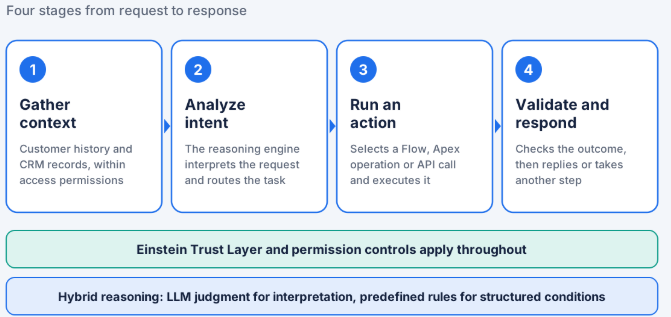
The process can be understood through four key stages:
1. Input and Context Gathering
The agent receives an input, such as a user prompt, a newly created case, or a configured event. It retrieves relevant customer history, CRM records, and other available context while respecting applicable access permissions and security controls.
2. Intent Analysis and Dynamic Reasoning
The Atlas Reasoning Engine interprets the request, evaluates the available context, and determines the next step. It can route the task to a relevant subagent and use LLM-based reasoning when interpretation or contextual judgment is required. Predefined business rules handle tasks that follow structured conditions.
3. Action Selection and Execution
Once the agent determines the next step, it selects an available action, such as a Salesforce Flow, Apex operation, or API call. These actions can retrieve data, update CRM records, trigger workflows, or interact with external systems while using existing business logic.
4. Validation and Response
The agent evaluates the action results and determines whether another step is required or a response can be generated. Security controls, including the Einstein Trust Layer, help enforce data protection and safety policies throughout the interaction.
The exact execution path depends on the agent's configuration, available data sources, actions, and business rules.
Agentforce vs Custom AI Agents: A Detailed Comparison of Key Features
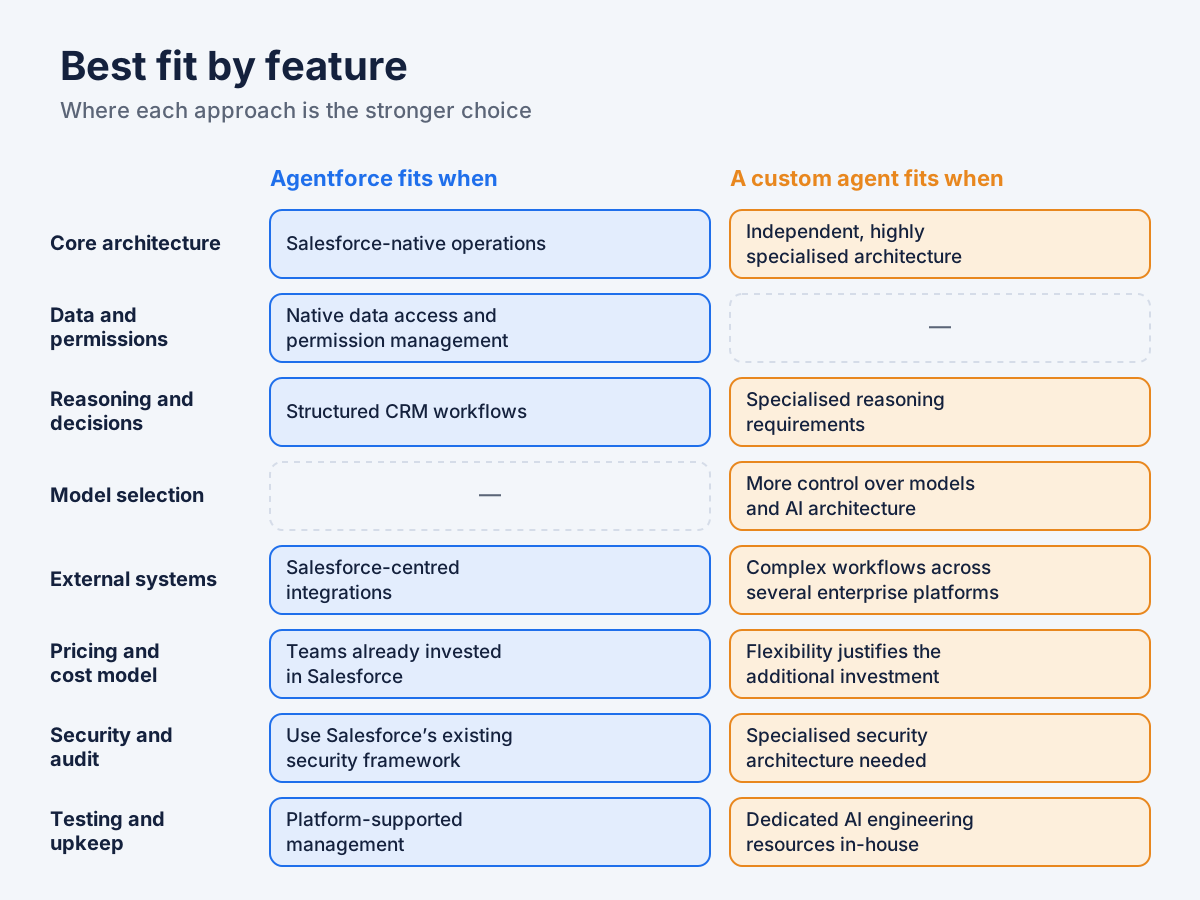
Agentforce and custom AI agents differ in how they access CRM data, manage reasoning, connect with enterprise systems, and handle ongoing operations. Here are the key technical differences.
1. Core Architecture & Foundation
Agentforce: Built natively into the Salesforce platform, Agentforce uses the Atlas Reasoning Engine, Agentforce Builder, Agent Script, and Agent Graph to configure and execute AI-driven workflows.
Custom AI Agents: Built using independent AI frameworks, LLMs, orchestration layers, APIs, and cloud infrastructure. Developers have control over the architecture and technology stack.
Best Fit: Agentforce for Salesforce-native operations; custom AI agents for independent and highly specialised architectures.
2. Data Access and Permissions
Agentforce: Accesses Salesforce CRM data through the platform's security and permission framework. Its access depends on the agent's execution context and configured permissions.
Custom AI Agents: Connect to Salesforce through APIs or middleware. Developers must implement authentication, record-level access, and field-level permissions.
Best Fit: Agentforce for Salesforce-native data access and permission management.
3. Reasoning and Decision-Making
Agentforce: Uses the Atlas Reasoning Engine to interpret requests, determine the next steps, and coordinate configured actions. Agent Script and Agent Graph help define instructions, business logic, and execution paths.
Custom AI Agents: Allow developers to design their own reasoning architecture, including custom planning logic, decision rules, memory, and multi-step orchestration.
Best Fit: Agentforce for structured CRM workflows; custom AI agents for specialised reasoning requirements.
4. Model Selection and Flexibility
Agentforce: Provides supported AI models and configuration options within the Salesforce ecosystem. The available choices depend on the product configuration and supported integrations.
Custom AI Agents: Give developers greater control over model selection, providers, fine-tuning options, and model combinations. The team also manages model updates, testing, and inference costs.
Best Fit: Custom AI agents for businesses that require greater control over models and AI architecture.
5. External System Integration
Agentforce: Connects with external systems through options such as External Services, Apex, Flow, MuleSoft, and supported MCP integrations. External actions require appropriate configuration, authentication, and permissions.
Custom AI Agents: Can connect to multiple applications through APIs, connectors, and orchestration frameworks. Developers control how the agent selects tools and coordinates operations across systems.
Best Fit: Agentforce for Salesforce-centred integrations; custom AI agents for complex workflows spanning multiple enterprise platforms.
6. Pricing and Cost Model
Agentforce: Costs depend on Salesforce licensing, agent usage, and applicable consumption-based pricing. Existing Salesforce capabilities may reduce additional development and infrastructure expenses.
Custom AI Agents: Costs include model usage, cloud hosting, development, API integrations, testing, and ongoing maintenance. Expenses vary with model selection, usage volume, and infrastructure requirements.
Best Fit: Agentforce for teams already invested in Salesforce; custom AI agents when architectural flexibility justifies the additional investment.
Want the complete breakdown? Read our guide on how much Agentforce costs.
7. Security, Compliance, and Auditability
Agentforce: Uses Salesforce security capabilities and the Einstein Trust Layer, which provides controls such as sensitive-data masking, toxicity detection, and audit-related features. Additional configuration is required to meet specific organisational and regulatory requirements.
Custom AI Agents: Require developers to implement security controls such as authentication, encryption, data masking, access policies, retention rules, and audit logging.
Best Fit: Agentforce for teams looking to use Salesforce's existing security framework. Custom agents suit organisations requiring a specialised security architecture.
8. Testing, Monitoring, and Maintenance
Agentforce: Provides platform capabilities for testing and reviewing agent behaviour. Salesforce manages the underlying platform infrastructure, while teams remain responsible for monitoring conversations, refining instructions, and updating workflows.
Custom AI Agents: Require dedicated testing, evaluation, monitoring, and maintenance processes. Developers manage model performance, integrations, infrastructure, execution logs, and ongoing updates.
Best Fit: Agentforce for teams seeking platform-supported management; custom AI agents for organisations with dedicated AI engineering resources.
Agentforce or a Custom AI Agent: Which Should You Pick?
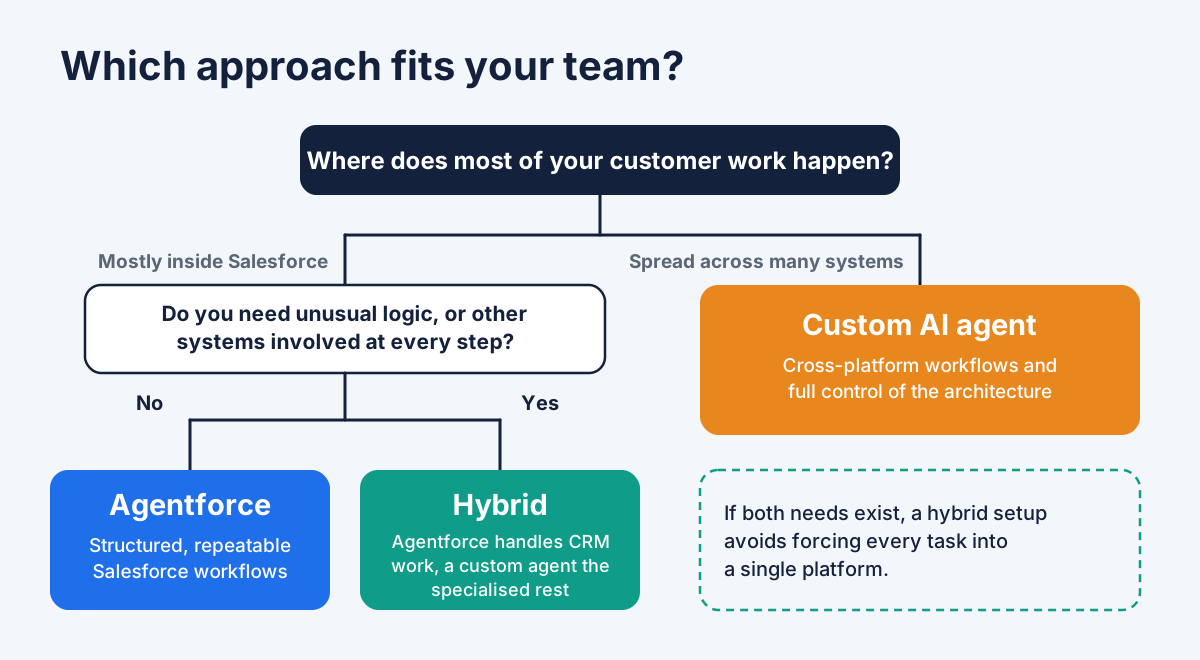
The choice depends on your CRM architecture, integration requirements, and the level of control your team needs over AI development.
When Agentforce Is the Better Choice
Agentforce is a strong fit when Salesforce is the primary platform for customer operations.
CRM-centric workflows: Your sales, service, and customer processes already run on Salesforce.
Native capabilities: You want to use Salesforce data, Flow, Apex, and existing business logic.
Platform-managed infrastructure: You prefer to build and manage agents within the Salesforce ecosystem.
Faster implementation: Your requirements can be met using supported Agentforce features and existing integrations.
When Custom AI Agents Make More Sense
Custom AI development is worth considering when your requirements extend beyond standard CRM automation.
Cross-platform workflows: Your agents need to coordinate Salesforce, ERP, finance, and other enterprise systems.
Architecture control: You need flexibility over LLMs, frameworks, orchestration, and hosting.
Specialised reasoning: Your workflows require custom decision logic or complex multi-agent coordination.
Independent infrastructure: You want to develop and manage AI capabilities outside a specific CRM platform.
What About a Hybrid Architecture?
A hybrid approach combines Salesforce's native agent capabilities with independently developed AI components.
| Agentforce handles | Custom agents handle |
|---|---|
| CRM record operations | Specialised AI processing |
| Sales and service workflows | Complex cross-platform tasks |
| Salesforce business actions | Custom model orchestration |
| CRM-based automation | External application coordination |
The Final Decision
Choose Agentforce when your AI requirements are closely connected to Salesforce processes. Choose custom AI agents when specialised capabilities and architectural flexibility are essential.
When both requirements exist, a hybrid architecture can connect the two without forcing every task into a single platform.
Conclusion
What if the best AI solution for your CRM isn't a choice between Agentforce and custom development, but knowing where each one fits?
Salesforce Agentforce vs Custom AI Agents is ultimately a question of business needs, flexibility, and long-term goals. While Agentforce brings intelligence into existing Salesforce workflows, custom AI agent development extends automation across platforms. The real opportunity lies in choosing the right approach or combining both to build smarter, more scalable business operations.
Book a consultation with our AI agent development experts to plan and build your next AI agent.
Frequently Asked Questions (FAQs)
1. What is the main difference between Salesforce Agentforce and custom AI agents?
Salesforce Agentforce is built into the Salesforce ecosystem, while custom AI agents are developed using independent models, frameworks, and infrastructure. Agentforce supports CRM-focused automation, whereas custom agents offer greater architectural flexibility.
2. How much does Salesforce Agentforce cost compared to custom AI agents?
Agentforce costs depend on Salesforce licensing and agent usage. Custom AI agent costs include development, model usage, hosting, integrations, and maintenance. The total investment depends on project complexity and usage. Agentforce costs come from Salesforce licensing and agent usage. Custom AI agents add development, hosting, and maintenance. Compare the numbers in our Agentforce vs. custom AI cost comparison.
3. Does Salesforce Agentforce Work With Professional Edition?
Standard Agentforce availability requires a supported Salesforce edition, such as Enterprise, Performance, Unlimited, or Developer Edition. Professional Edition is not listed among the supported editions for standard Agentforce agents. Additional licenses may be required depending on the agent type.
4. How Long Does a Salesforce Agentforce Implementation Take?
A focused Agentforce implementation may take a few weeks when CRM data is ready, and workflows are clearly defined. Projects involving complex integrations, data preparation, custom actions, and extensive testing can take considerably longer. The actual timeline depends on your Salesforce environment and project scope.
5. How secure is Agentforce compared to a custom AI agent?
Agentforce uses Salesforce security capabilities and the Einstein Trust Layer, which provides sensitive-data masking, toxicity detection, and audit-related features. Some configuration is still needed for specific regulatory requirements. A custom AI agent requires your team to build authentication, encryption, access policies, and audit logging.
Let's Talk

Drop us a note, we’re happy to take the conversation forward 👇🏻