
Connect Claude or ChatGPT to Salesforce today and the agent borrows a person's access. On Hosted MCP (Model Context Protocol) servers it runs on the authorising user's permissions, and its calls draw on the org's daily API allocation.
Agentic Identity, Salesforce's coming registration for outside agents, changes that. Each successful production call by a registered agent becomes one Headless Platform Interaction (HPI), paid in Flex Credits, Salesforce's usage currency. That is a second meter.
The rate is TBA. The registration clocks are already written.
And agents rarely finish a task in one call. To update one record, Salesforce's own sObject Mutations server has the agent make four: list the objects, read the object's fields, find the record, then update it. Each would be a call on the meter.
So customers must commit their agents to a meter, at purchase and at renewal, before Salesforce has said what it costs. Measure your calls now, design for fewer, and get the rate in writing.
Agent calls will be metered. The rate is still blank.
TL;DR
Salesforce plans to bill each successful production call by a registered AI agent as one Headless Platform Interaction (HPI), paid in Flex Credits, its usage currency. The rate is TBA.
Salesforce says customers will have to register AI agents: new purchasers and MCP users within three months of a notice, existing API customers at renewal. Salesforce promises only 30 days' notice before metering.
Count your agents' MCP and API requests now in the API Total Usage event log, move multi-step work into Flows or invocable actions, and get the HPI rate written into your order.
What's confirmed, what's TBA (status as of 16 Nov 2026)
| Item | Status | Source |
|---|---|---|
| Metering of agent calls | Not started. | Understand AIforce Impact (005360285), Salesforce Help, 17 Sep 2026 |
| HPI rate | TBA | Flex Credits rate card, 3 Nov 2026 |
| Notice | Salesforce says 30 days before metering begins, when a multiplier is added. None is set for later changes. | Same article; rate card |
| Agentic Identity (agent registration) | Announced, not shipped. Salesforce targets November. | Same article; Salesforce Admins blog, 12 Nov 2026 |
| Headless 360 allocation in Max editions | Announced. No size or date. | Salesforce newsroom, 3 Sep 2026 |
What is a Headless Platform Interaction?
A Headless Platform Interaction (HPI) is Salesforce's planned billing unit for AI agent calls. Every successful call by a registered agent to an active production org counts as one, over MCP or the direct API. Sandboxes, scratch orgs and Developer Edition are excluded. Traditional integrations keep today's pricing.
Two documents define the model. One is a Salesforce Help article, Understand AIforce Impact (005360285). The other is the Flex Credits rate card. Each points to the other. Neither holds the number.
Registration is the switch. In the AIforce article's words, "the same registration step that gives an external agent its own identity on the Platform is what makes that agent's activity visible, governable, and billable."
The gaps sit where the money is. The article uses two words for the unit, call and interaction, and defines neither. It is silent on failed calls, retries, composite requests and discovery calls.
Discovery is Salesforce's own design, not an edge case. The Data 360 MCP server finds the right tool, fetches an example payload, then runs it. The beta Headless 360 server discovers an action, describes it, then dispatches it. That is three calls per task, and three HPIs if each one counts.
The unit has changed once already. The 17 Jun card listed two rows, Record Operation and Process Invocation. The 31 Aug card replaced them with one HPI row. One price will cover a cheap read and an Apex run.
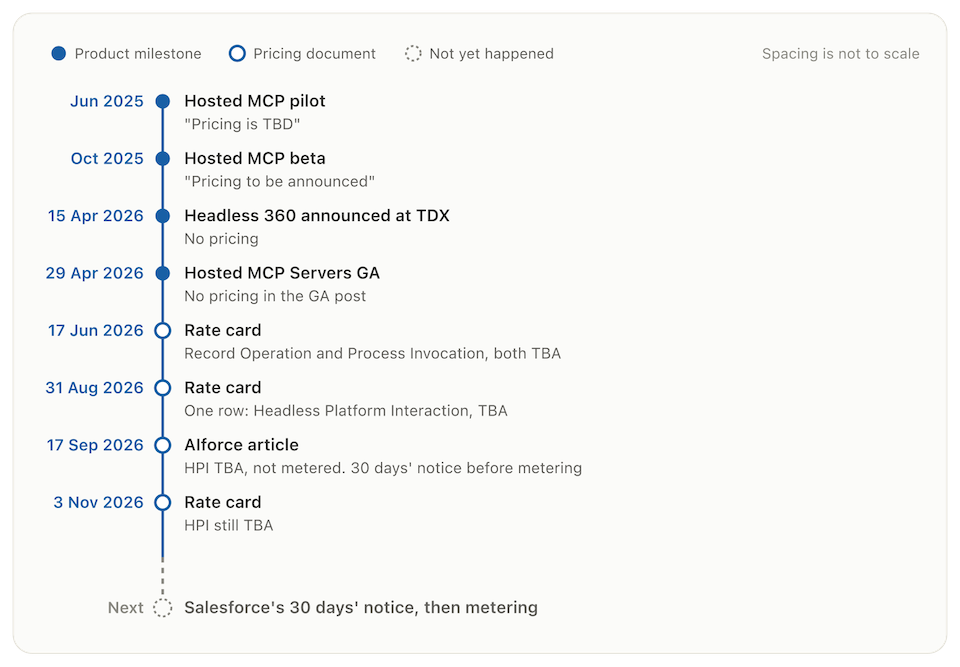
From pilot to the latest rate card, every Hosted MCP milestone left the price open.
What an agent's bill could include
A registered agent's bill could carry up to five lines: the employee's seat, an agent identity licence, the HPIs, the org's daily API allocation, and other Flex Credit usage a call triggers. Three have a list price. The licence and the HPI do not.
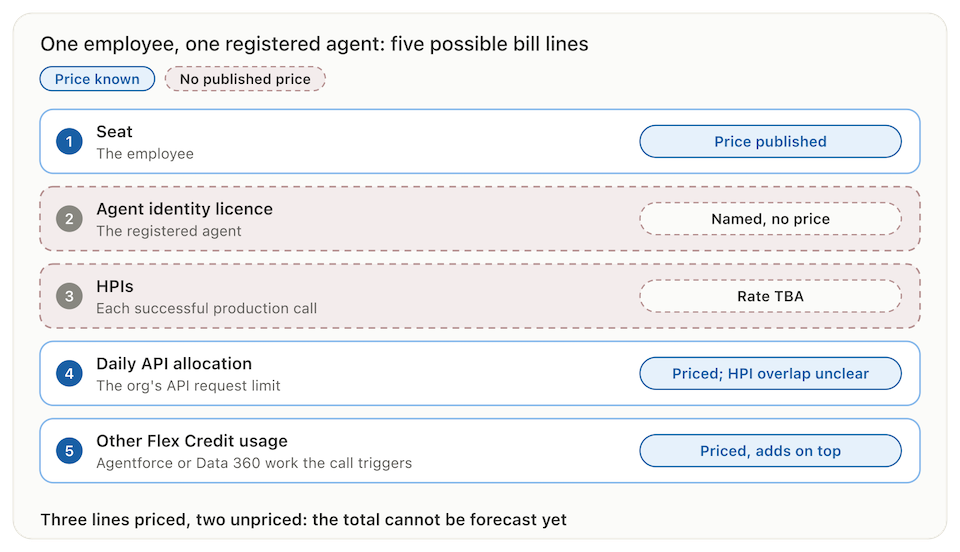
Two of the five lines have no price, so the total stays open.
Extra API capacity lists at $25 a month per 10,000 daily calls, billed annually. Hosted MCP calls draw on that allocation today. Neither the AIforce article nor the rate card says whether HPI calls still will.
The Data 360 MCP reference is explicit for its own server: it counts MCP server calls as calls to the underlying Connect API "for limits and Flex Credit usage".
The Headless Toolkit datasheet names dedicated agent identity licences, with no SKU or price. Patrick Stokes, Salesforce's President and CMO, said at the Mizuho Technology Conference in June that identity decisions would almost certainly mean "some sort of agent user license showing up". Charging is possible, he added, though Salesforce is wary of its seat-pricing bias.
The lines also stack. The 18 Aug card set Headless 360 usage on top of other usage types "that may apply"; by 31 Aug the condition was gone. Our reading: an HPI adds to any Agentforce or Data 360 usage the call triggers.
The credit has a price. The call does not.
A Flex Credit costs $0.005 at US list price. The HPI price is the missing number: its multiplier, the credits one HPI consumes, is TBA. The often-quoted $0.10 is a standard Agentforce action at 20 credits, not an agent call.
One rate card row already meters single API calls. Data 360 Real-Time Pipeline counts profile and engagement events and API calls, server-to-server traffic included, at 0.25 credits each on the base tier.
Like the HPI, it folds unlike units into one count. It covers traffic tied to a real-time data graph, which Salesforce processes in its sub-second layer.
| Unit | Credits | Cost |
|---|---|---|
| Extra API call (add-on) | About 0.017 (our arithmetic) | About $0.00008 |
| Data 360 Real-Time event or API call | 0.25 (0.05 at top monthly tier) | $0.00125 |
| Agentforce standard action | 20 | $0.10 |
Our reading: an HPI is a platform call with no Salesforce-side reasoning; its relatives cost 0.017 to 0.25 credits, not 20, with the Real-Time rate as the ceiling. That is a negotiating line, not a forecast.
Take 200 service reps, each passing an agent 25 cases a day, at 4 calls per task, 20 days a month: 400,000 calls.
| Credits per HPI (assumed) | Credits a month | Cost a month |
|---|---|---|
| About 0.017 (extra API call) | About 6,700 | About $33 |
| 0.25 (Real-Time event) | 100,000 | $500 |
| 1 (round number) | 400,000 | $2,000 |
| 20 (standard action) | 8,000,000 | $40,000 |
At 0.25 per HPI, a Core org's 500,000 included credits, listed with no period, last five months; at 20, under two working days.
Who must register, and by when
| Connection | Purchased on or after 17 Sep 2026 | Existing customer (purchased before 17 Sep 2026) |
|---|---|---|
| Any Salesforce MCP server | Within three months' notice from Salesforce | Same: within three months' notice. The rule covers all customers |
| Salesforce APIs, no MCP server | Three months from the notice that Agentic Identity is available | At renewal |
The article never defines a Salesforce MCP server, and its MCP rule never mentions renewal. Nothing says whether an add-on order counts as a purchase, even the Salesforce Foundations order the article's own steps begin with. Foundations is currently available at $0, Salesforce says.
Keep two notices apart. Salesforce's notice that Agentic Identity is available starts the API clock for new purchasers. The MCP rule names none; we read it as this one. Salesforce's 30 days' notice comes before metering. Their order is not stated, and 30 days is thin cover against a three-month window and credits that expire at the Order End Date.
CIOs: the cut-off rests on a date shown on a web page, so get it in your order.
Measure now, then design for fewer calls
Hosted MCP traffic can be measured in production today. The API Total Usage event log writes one row per API request and tags Hosted MCP rows API_CLIENT_CATEGORY = SALESFORCE_HOSTED_MCP, with a status code that separates successes from failures. Salesforce's known-limitations page says one tool call can make several requests, so the row count is a ceiling.
Admins: turn on event log files and keep the log. Without the Event Monitoring add-on, Salesforce holds each file for one day, so save a copy daily.
To estimate HPI cost before Salesforce publishes a rate, count successful agent requests per task in the API Total Usage event log. Multiply by tasks per day and working days per month. Apply assumed multipliers from about 0.017 to 20 credits per HPI. Price the credits at $0.005 each, US list.
Architects: then cut the count. The API Catalog guide maps each tool to one REST endpoint and steers multi-step work into Flows or invocable actions. A custom MCP server can expose a Flow or an Apex action as one tool. The Apex invocable action runs server-side. If each arriving call is an HPI, that four-call update becomes one HPI, plus one or more requests against the daily API allocation today.
Salesforce has not said whether that call also bills as the 20-credit custom action on the rate card. Its Agentforce Prospecting billing page counts custom actions an Agentforce agent calls in a text conversation, and says nothing of an outside agent's tool call.
Salesforce's Digital Wallet FAQ confirms its usage tracker does not block or throttle any service. The brake belongs in the agent: cap retries, cache reference data, set a stop condition.
Self-hosting is no exit: a self-hosted MCP server still calls Salesforce's APIs, and the AIforce article counts direct API calls too.
What to get in writing at renewal
CIOs and CTOs: take these six asks to your account executive before you sign.
| Ask | Why it matters |
|---|---|
| Is an HPI one tool call or one API request, and do failed calls, retries, composite requests and discovery calls count? | Sets the count before any rate. |
| Will HPIs be priced like Data 360 Real-Time, with volume tiers? | 0.25 credits a call, less at volume. |
| Does each agent need a licence, and at what price? | Named, never priced. |
| Do HPI calls still draw on the API allocation? | If so, one call hits two meters. |
| What happens to calls from unregistered agents? | Salesforce has not said how it detects them. |
| How big is the Max allocation, and when does it start? | It could absorb part of the bill. |
Two more terms have precedent. Workday's Flex Credits rate card fixes rates for the order term. HubSpot's pricing announcement reads "we turned spend controls on by default".
The best case for asking comes from inside Salesforce. "We should not create a new toll simply because an agent" makes the API call rather than a traditional application, Rohan Kumar wrote in a LinkedIn post on agent access on 25 Oct. He is Salesforce's President and Chief Platform and Engineering Officer.
User licences already carry generous API capacity, he argued, and basic governed agent access should extend that value. Read fairly, he opposes a per-call toll and names no price. He leaves room for paid identity, which leads his list of where Salesforce's value sits.
No Salesforce document reflects him yet. The rate card issued nine days later still shows HPI as TBA. Show his sentence to your account executive.
Our Agentforce consulting services team can help you build the estimate.
FAQ: Headless Platform Interactions and Flex Credits
Has Salesforce started charging for agent MCP and API calls?
No. Agent MCP and API calls are not metered yet, and the HPI rate is TBA on the current rate card. Salesforce says it will give 30 days' notice before metering begins. Agentic Identity, the registration step, has not shipped. Data 360 work an agent runs over MCP already consumes Flex Credits.
What is a Headless Platform Interaction (HPI)?
An HPI is the unit Salesforce plans to bill for AI agent calls. Every successful call by a registered agent to an active production org counts as one, over MCP or the direct API. Sandboxes, scratch orgs and Developer Edition are excluded.
What is Agentic Identity, and does it cost anything?
Agentic Identity is Salesforce's announced feature for registering an outside AI agent, giving it its own identity and narrower permissions. It has not shipped. Salesforce has named agent identity licences but published no SKU or price, so do not assume registration is free.
What are Flex Credits, and how much do they cost?
Flex Credits are Salesforce's usage currency for Agentforce and Data 360 work. They list at $500 per 100,000 in the US, or $0.005 each. Each usage type has a multiplier, the credits one unit consumes. Overage is billed monthly in arrears at your contracted rate.
Is $0.10 the price of one agent call?
No. $0.10 is the US list price of a standard Agentforce action, which consumes 20 Flex Credits at $0.005 each. An outside agent's call will be billed as a Headless Platform Interaction, a separate rate card row whose multiplier is TBA.
What are AIforce, Headless 360 and SIForce?
Salesforce's own documents conflict. In one Salesforce Help article, AIforce was announced as Headless 360. On the Admins blog, Headless Toolkit, formerly Headless 360, powers AIforce. Marc Benioff called AIforce "officially SIForce", and the latest rate card says Headless 360.
Sources
| Document | Why read it |
|---|---|
| Understand AIforce Impact (Salesforce Help 005360285) | The rules: what an HPI is, who must register and by when, and what the article leaves undefined. |
| Flex Credits rate card, 3 Nov 2026 | The HPI row still at TBA, every multiplier, and the footnote that stacks HPIs on other usage. |
| Billing Considerations for Segmentation (Data 360) | Where Salesforce already meters single API calls in Flex Credits, with a worked example. |
| Agentforce pricing page | The credit price, how overage is billed, and Salesforce's own worked cost examples. |
| API Total Usage event type reference | The fields you need to count your agents' calls today. |
| Rohan Kumar on agent access (LinkedIn) | A Salesforce president's case against a per-call toll, in his own words. |
Let's Talk
Drop us a note, we’re happy to take the conversation forward 👇🏻