
Is Salesforce Agentforce Pricing More Cost-Effective Than Building and Maintaining Proprietary In-House AI Agents?
Key takeaways:
Agentforce's real cost goes well beyond the per-action price; licensing, Data Cloud, and setup add up fast.
In-house agents cost more upfront but avoid usage fees, often paying off at high volume.
The best choice depends on your usage, not a one-size-fits-all answer.
AI agents have moved from experiment to expectation. Every CIO and RevOps leader is now asking the same question: do we buy a platform like Salesforce Agentforce, or do we build our own?
On paper, it sounds like a simple math problem: compare the invoice to the payroll. In practice, Salesforce Agentforce pricing and the cost of custom AI agents are structured so differently that a fair comparison takes more than a glance at a pricing page.
Agentforce runs on consumption-based pricing tied to actions and conversations. In-house AI agents run on engineering time, infrastructure, and ongoing maintenance. Neither one is "cheap"; the real question is which one is cost-effective for your specific volume, team, and use case.
This guide breaks down what it really costs once every hidden fee is included, what building enterprise AI agents in-house actually takes, and how to decide which path makes financial sense for your organization.
Agentforce Pricing vs. In-House AI Agent
Choosing between Salesforce Agentforce and in-house AI agents requires looking beyond the initial price.
The table below compares both solutions across key decision-making factors, such as pricing model, upfront investment, deployment time, scalability, maintenance, and customization, to highlight their strengths and trade-offs.
| Factor | Salesforce Agentforce | In-House AI Agents Pricing |
|---|---|---|
| Pricing Model | Consumption-based (Flex Credits or Conversations) or per-user licensing. | No fixed pricing; costs include engineering time, infrastructure, and LLM/API usage. |
| Upfront Investment | Low to moderate. Foundations tier is free, while paid tiers require no major capital investment. | High. Requires hiring, tooling, and development before deployment. |
| Scales with Usage | Approximately $0.10 per action, $2 per conversation, or $5–$550 per user/month. | Scales with headcount, infrastructure, and LLM API usage. Salaries continue regardless of usage volume. |
| Mandatory Prerequisites | Requires a Data Cloud subscription. A knowledge base is often needed. | No vendor-imposed requirements, but you must build your own data and retrieval layer. |
| Time to Deploy | Typically weeks for standard use cases after Data Cloud and the knowledge base are configured. | Usually takes months, especially for production-ready reliability and integrations. |
| Scalability | Easy to scale, but costs increase linearly with actions and conversations. | Scales efficiently once built, with lower infrastructure costs per action at very high volumes. |
| Customization | Limited to Agentforce tools, actions, and the Salesforce data model. | Complete control over workflows, data sources, and AI models. |
| Data Control & Compliance | Data is managed through Salesforce Data Cloud and the Salesforce platform. | Full control over data residency, storage, and compliance requirements. |
| Maintenance Burden | Salesforce manages updates, model improvements, and platform reliability. | Your team is responsible for retraining, monitoring, security patches, and ongoing maintenance. |
| Talent Required | Salesforce admins and low-code builders; minimal AI engineering expertise required. | Dedicated AI/ML engineers and MLOps specialists are typically needed. |
| Cost Predictability | Usage spikes directly increase costs. | More predictable due to fixed salaries and infrastructure, but harder to reduce quickly. |
| Best Suited For | Standard CRM-focused use cases, rapid deployment, and organizations already using Salesforce. | Highly customized, high-volume AI workflows or organizations with established AI engineering teams. |
When Salesforce Agentforce Is the Better Choice
Agentforce tends to make the most financial sense when speed, existing Salesforce infrastructure, and predictable use cases matter more than full control.
Total Cost of Agentforce Implementation
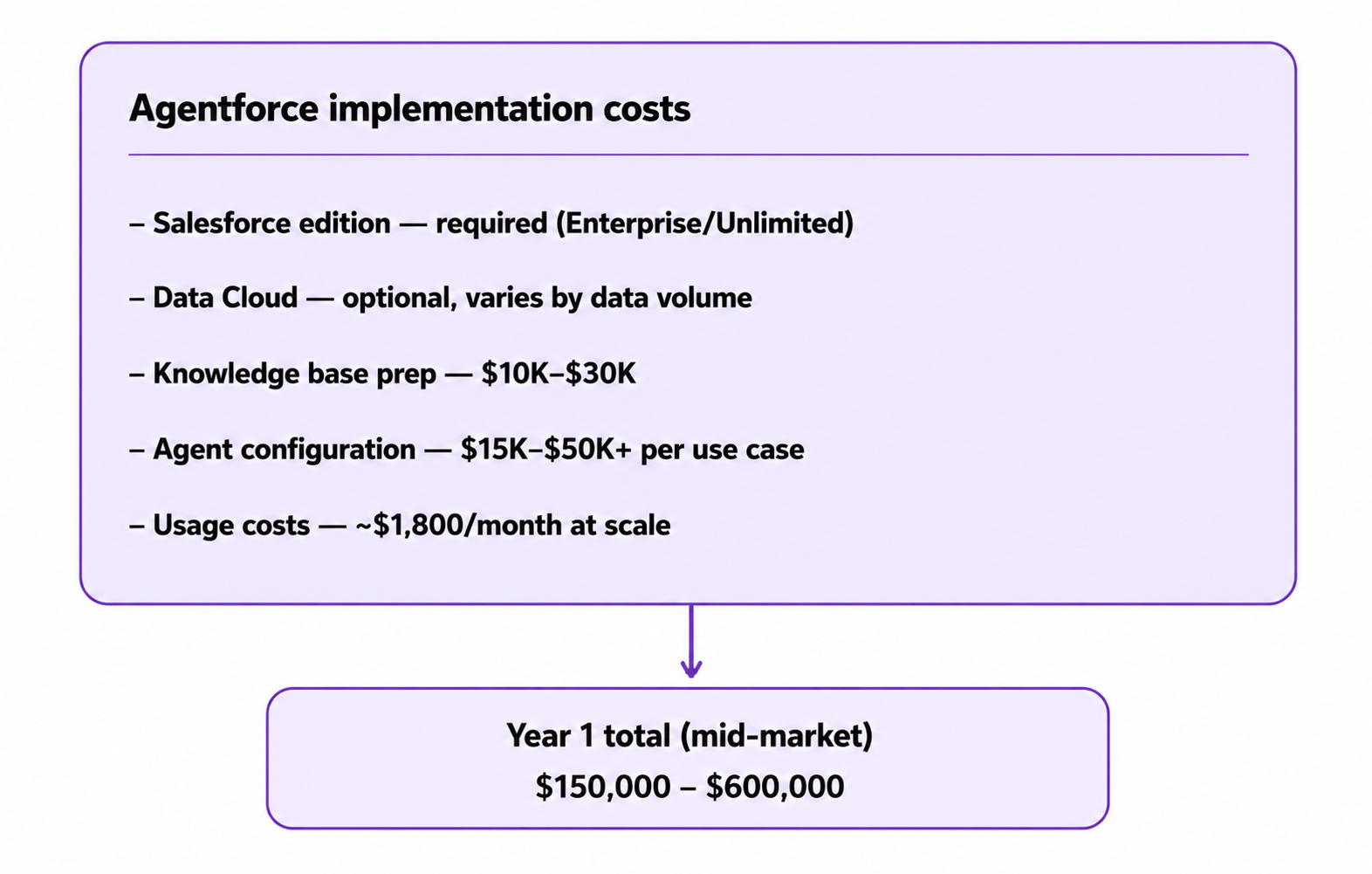
The $2/conversation or $0.10/action pricing only covers usage; it's not the full cost. A real deployment typically adds:
Salesforce Edition (Required): Agentforce needs an existing Enterprise or Unlimited Edition environment underneath it.
Data Cloud (optional): Needed for advanced use cases to unify customer data; cost varies by data volume and complexity.
Knowledge base prep: $10,000-$30,000 to organize content agents can draw from.
Agent configuration: $15,000-$50,000+ per use case for setup, integration, and testing.
Usage costs: e.g., 100 users × 3 cases/day × 20 days, at 3 actions/case ≈ 360,000 credits/month ≈ $1,800/month.
Once licensing, implementation, and usage are combined, industry estimates put Year 1 costs for a mid-market deployment at roughly $150,000-$600,000, depending on scope.
Agentforce is often the more cost-effective option when:
Your organization already uses Salesforce products such as Sales Cloud or Service Cloud.
Fast deployment matters more than building a custom AI platform from scratch.
Common business workflows, customer service, sales assistance, and order management cover most of your use cases.
Having Salesforce manage the underlying AI infrastructure, security, and updates is preferable to maintaining an in-house AI engineering stack.
When Building In-House AI Agents Makes More Sense
For organizations with unique workflows, long-term scale, or existing engineering capacity, custom AI agents can offer more control and, over time, a better cost curve.
The Real Cost of Building In-House AI Agents
The AI agent development cost for a custom build looks very different from a subscription bill, but it's just as real and often less visible until months into the project.
Engineering talent: AI/ML engineers and MLOps specialists to design, build, and maintain the agent typically represent the highest cost, often exceeding $150,000-$250,000+ per senior engineer annually, and most serious deployments need more than one.
Model and infrastructure costs: LLM API usage (or hosting costs for self-hosted models), vector databases, and compute scale with usage, similar in spirit to Agentforce's consumption model but without a single bundled rate.
Development time: Building a production-ready agent typically takes months, not weeks, especially when integrating with existing systems and handling edge cases.
Ongoing maintenance: Prompt and agent behavior tuning, retraining, monitoring for drift, security reviews, and compliance work continue indefinitely after launch.
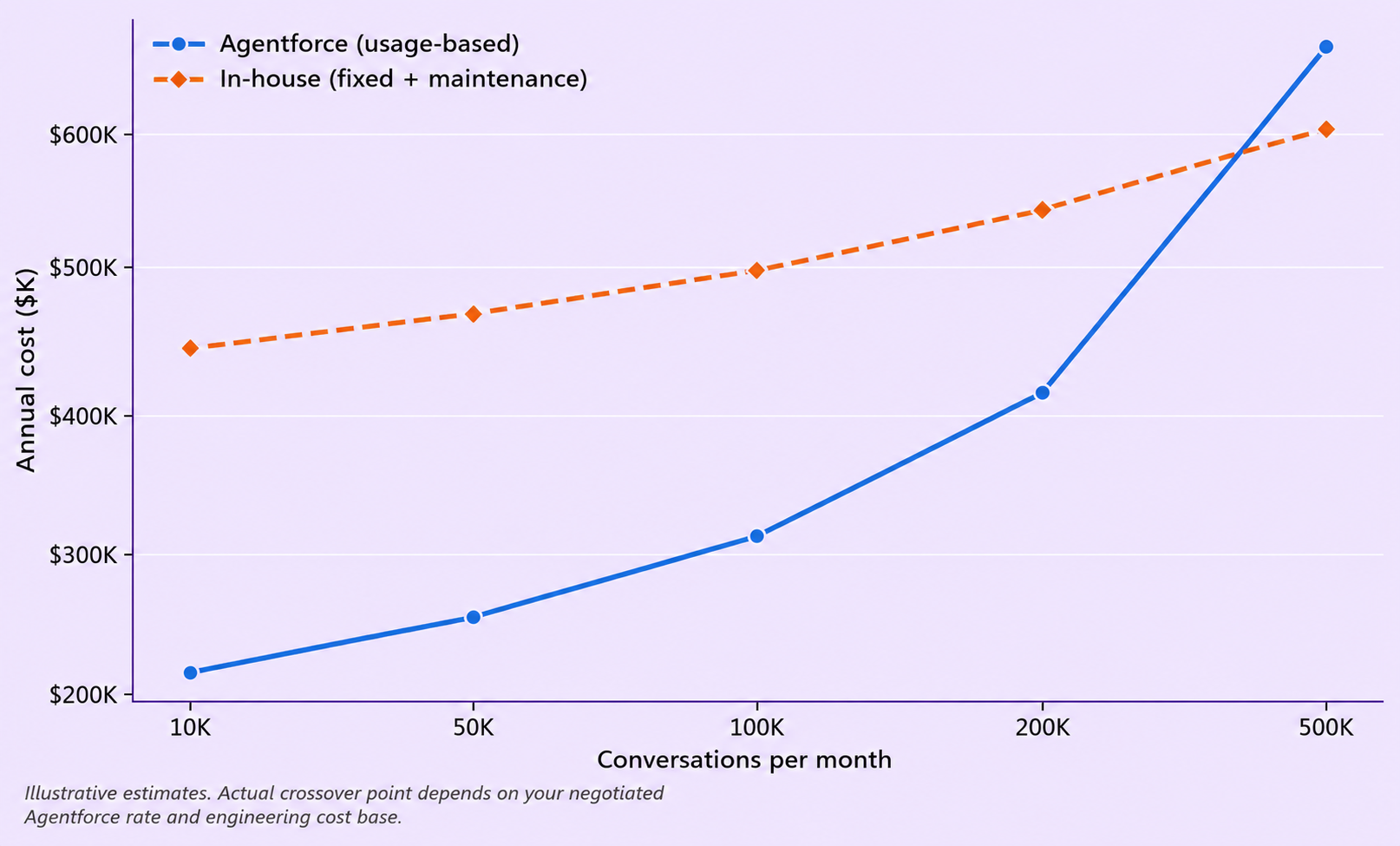
In-house AI agents tend to be the more cost-effective choice when:
High, sustained usage would make per-action or per-conversation pricing compound into a bill larger than fixed engineering cost.
Workflows span systems well outside Salesforce's data model.
Full control over data residency, model choice, or compliance posture is a requirement, not a preference.
Existing in-house AI/engineering talent can be leveraged rather than hired from scratch.
Conclusion
Here's the twist most cost comparisons miss: this isn't a decision you make once. Agentforce's pricing model has already shifted three times in under two years from per-conversation, to Flex Credits, to per-user licensing.
In-house AI costs are shifting too, as LLM API prices keep falling and open-source tooling keeps maturing. The "cheaper" option today may not be the cheaper option in eighteen months.
Whether you're evaluating Agentforce or exploring a custom build, the right Agentforce integration services partner can help you model real costs, avoid the hidden fees covered above, and deploy without costly missteps. Reach out to discuss your use case before you commit budget either way.
Frequently Asked Questions
-
Beyond the advertised $2/conversation or $0.10/action rate, most mid-market deployments run $150,000-$600,000 in Year 1 once Salesforce Edition licensing, Data Cloud, implementation, and usage are included.
-
Data Cloud isn't required for every basic use case, but it's commonly needed for advanced, enterprise-grade deployments that rely on unified customer data.
-
It depends on usage volume. At high, sustained usage, fixed engineering costs can beat per-action pricing over time. At low-to-moderate usage, Agentforce is typically more cost-effective.
-
The mandatory Salesforce Enterprise or Unlimited Edition license, plus Data Cloud for advanced use cases, both sit underneath Agentforce and aren't included in the headline per-action rate.
-
Agentforce can typically go live in weeks for standard use cases. In-house AI agents usually take months, especially with custom integrations and production-grade reliability requirements.
Related Reading

Let’s Talk

Drop us a note, we’re happy to take the conversation forward 👇🏻