
Key Takeaways
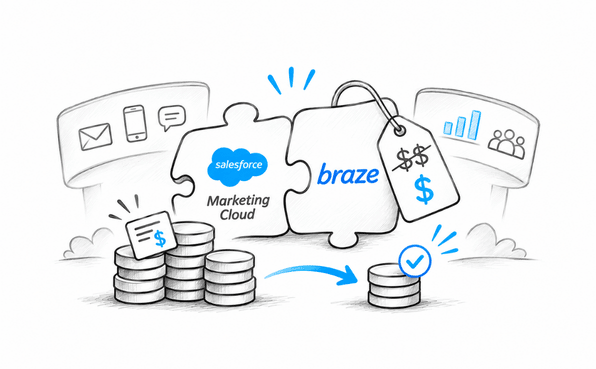
Braze and Salesforce Marketing Cloud share several capabilities, making it important to identify overlapping features and unnecessary marketing expenses.
Auditing subscriptions, integrations, campaigns, and workflows helps businesses reduce duplicate costs without losing valuable customer engagement capabilities.
Salesforce's planned Braze acquisition makes reviewing existing investments important while keeping future pricing and product integration decisions flexible.
Modern marketing teams have more technology options than ever. The 2026 martech landscape lists 15,505 products, with Salesforce and Braze being just two names among dozens of serious options.
Naturally, teams want the best tool for each workflow. Some deliberately use both Braze and Salesforce Marketing Cloud (SFMC), while others end up running both without fully realizing the additional costs or overlapping capabilities.
This overlap becomes even more relevant after Salesforce announced its planned acquisition of Braze. While the deal is yet to close, businesses already using both platforms have a reason to reassess their marketing technology stack. Are they getting distinct value from each platform, or paying twice for capabilities that serve the same purpose?
Why is Salesforce Acquiring Braze?
Salesforce has been clear about what it wants from Braze. We set those reasons against what Braze and Marketing Cloud each do today, to see what the deal could add and what it could mean for teams running both.
What Salesforce says
Real-time messaging. Braze is built to respond to what customers do as it happens, across mobile apps, websites, email, SMS and WhatsApp. Salesforce wants that ability close to its own platform.
A stronger Marketing Cloud. Salesforce expects Braze to strengthen Marketing Cloud’s cross-channel personalization for high-volume B2C brands, so they can reach very large audiences with messages that fit each person.
Fuel for AI. Salesforce says marketers now need systems that can understand customers, make decisions and act in real time. It expects BrazeAI’s decisioning to work alongside the customer data in Data 360 and its Agentforce products.
Customers and people. Braze serves about 2,770 customers, including Canva, Instacart and Venmo. Salesforce says it also brings its team’s expertise in mobile, data engineering and customer engagement.
What we make of it
A rival comes in-house. Braze and Marketing Cloud compete for many of the same B2C messaging use cases, so the deal will also bring a competing platform under Salesforce’s roof.
Real-time and mobile strength. Braze is known for push, in-app messaging and reacting to behavior as it happens. We read the deal as a way for Salesforce to add that depth to Marketing Cloud, rather than build it from scratch.
The short version: Salesforce wants Braze’s real-time strengths close to Marketing Cloud. How that will work for customers hasn’t been said, which is why it’s worth checking your own overlap now.
Why Do Companies Use Both Braze and Salesforce Marketing Cloud?
Dual-platform setups rarely begin as a strategy. As time passes, teams extend or buy what they are most comfortable with. Let’s look at some common examples:
Channel-led adoption. Some companies use SFMC for email and journeys, while also choosing Braze for mobile and real-time engagement based on the channels they work with. Companies often prefer specialized tools for specific channels.
Mergers and acquisitions. When one company acquires another, or two companies join, each usually brings its own marketing tools. Over time, the stacks keep running side by side, and each tool builds up its own campaigns, data, and habits, making it harder to pick one and let the other go
Team autonomy. Regional or product teams often choose the tool that fits their own needs, without waiting for a company-wide decision. That works well at first, because each team moves faster. But the contracts quietly renew each year, and nobody steps back to ask whether the company still needs both.
Like these, there are dozens of other examples where teams use more tools than necessary and end up paying heavily for them.
Where Braze and SFMC Overlap, and Where They Don’t
On paper, Braze and Marketing Cloud do the same job: send the right message to the right customer at the right time. That is why the overlap is easy to miss, and why it is worth checking before you assume you need both.
Where they overlap
Channels. Email, mobile push, SMS, WhatsApp and in-app messaging are available on both. Exact coverage depends on your edition and region.
Journey building. Each platform has a visual tool for building multi-step customer journeys: Canvas in Braze and Journey Builder in SFMC.
Segmentation and personalization. Both tools let you split your audience into groups, and send each group a message that fits, like a product they viewed or a relevant offer. It is a core capability to both platforms, and a common place for double spend.
AI and optimization. Each platform uses AI to take the guesswork out of campaigns. For example, it can choose the best time to message each customer, test which version of a message works better, or suggest the offer a customer is most likely to respond to.
Reporting. Opens, clicks and conversions for your campaigns are tracked in Braze and Salesforce Marketing Cloud.
Where they differ
Braze started as a mobile messaging tool and is known for push, in-app messages and reacting to customer behavior in real time.
SFMC is known for its close link to Salesforce CRM data, which ties marketing to sales and service, and for tools that reach beyond messaging, such as advertising.
What this means for your decision
Overlap is only a problem when both platforms do the same job for the same customers. If Braze runs your app messaging and SFMC handles CRM-linked email, each one is earning its place. If both are sending email to the same audience, one of them is probably extra.
Here is a simple test. For each platform, can you name one thing it does that the other cannot do for you? If you can’t, that is the first place to look for savings.
How to Reduce Overlap Without Losing What Works
Running both Braze and SFMC for your marketing doesn't always mean you're wasting money. The problem starts when teams pay for similar capabilities without having a clear reason to maintain both. Here are a few ways to identify and reduce that overlap.
1. Audit your existing marketing tools
Start by reviewing what your teams are actually using across both platforms. List the active campaigns, customer journeys, integrations, subscriptions, and features. You may find that some tools are barely used or that two platforms are performing the same tasks.
2. Assign clear responsibilities to each platform
Decide which platform should handle each marketing activity. For example, you might use Braze for mobile push notifications and in-app engagement while keeping CRM-connected email campaigns in SFMC. The idea is to give each platform a distinct role instead of running similar workflows across both.
3. Review duplicate customer data and integrations
When both platforms work with the same customer data, businesses may end up maintaining duplicate records and unnecessary data synchronization processes. Review which customer information each platform actually needs and remove integrations or data flows that serve no clear purpose.
4. Consolidate overlapping campaigns and journeys
Check whether both platforms are running similar campaigns for the same customer segments. If they are, decide which platform is better suited to manage those campaigns and consolidate the workflows where possible. This can reduce campaign management effort without affecting customer engagement.
5. Calculate the actual cost of running both platforms
Finally, look beyond subscription fees. Include integration costs, maintenance, employee training, platform administration, and usage charges. Once you understand the total cost of each platform, you can identify where the spending is justified and where you can cut back.
What the Salesforce and Braze deal does and doesn’t change
In October, 2026, Salesforce announced a definitive agreement to acquire Braze. The deal is expected to close in Salesforce’s fiscal year 2028.
Salesforce says it expects Braze to strengthen Marketing Cloud’s cross-channel personalization, so the two products are expected to work more closely together over time. But until the deal closes, the two companies remain separate businesses.
Braze’s CEO has said the company will continue building as Braze, and Salesforce’s announcement does not say how products, contracts or pricing will be combined.
That means the overlap you pay for today is still yours to solve, and any future bundle is something to evaluate, not assume. Here are three pieces of advice that will help:
Don't wait for a combined package. The acquisition will take time to close, and combining the two platforms could take even longer. Review your current costs instead of waiting for a bundle.
Check what a new package includes. A combined package may look cheaper, but make sure it includes features your team actually needs and will use.
Keep your contracts flexible. Avoid locking yourself into long-term pricing or usage commitments. Negotiate terms that let you adjust your subscriptions as your needs change.
So, Is Running Both Worth It?
Using both Braze and SFMC can make sense. Plenty of teams do it on purpose, because each tool is better at something. It stops making sense when you can’t say what each one does that the other can’t, and you’re still paying for both.
With Salesforce planning to acquire Braze, now is a good time to find out where you stand. The deal hasn’t closed, and nobody has said how contracts or pricing will change, so waiting for a bundle to sort things out is a gamble. Start with what you have: see where the two platforms overlap, work out what the second one really costs you, and decide whether it earns its place.
Ready to find out where you’re paying twice? Start with a conversation with our Salesforce Marketing Cloud consultants. We’ll go through your platforms, your contracts and your campaigns, and help you decide what to keep, what to trim and what to leave alone.
Suggested Reading
2026 Marketing Technology Landscape Supergraphic
Salesforce Signs Definitive Agreement to Acquire Braze
Marketing Cloud Engagement vs Marketing Cloud Account Engagement
Salesforce Marketing Cloud Services Guide
Frequently Asked Questions
-
Braze can already send data out. Current streams events such as sends, opens and clicks, and export tools and APIs pull user, campaign and segment data. That data can reach Salesforce through its APIs, a data warehouse in the middle, or a tool like MuleSoft. Salesforce hasn’t announced a dedicated migration tool. Decide which data you need first, such as profiles, consent status and message history, and plan to rebuild journeys by hand.
-
The main difference between Braze and SFMC is that Braze specializes in real-time, cross-channel customer engagement, particularly mobile push notifications and in-app messaging. Salesforce Marketing Cloud focuses on broader marketing automation, with strong CRM integration, customer journeys, email campaigns, and advertising capabilities.
-
It hasn’t been said yet. Salesforce expects Braze to strengthen Marketing Cloud’s cross-channel personalization, and Braze’s CEO says it will keep building as Braze. No feature list has been published, though. Write down the features you rely on most, and check them against any new offer before you agree to anything.
-
Nothing has been announced about how Braze will be sold after the deal. Today it is sold on its own, and your contract continues as written. Salesforce hasn’t said whether it will keep selling it separately, bundle it into Marketing Cloud, or do both. If you’re offered a bundle, check what you’d pay for but never use, and ask whether Braze can still be bought alone at renewal.
Let's Talk

Drop us a note, we’re happy to take the conversation forward 👇🏻