
Why Every Big Tech Company Suddenly Wants to Own the "Agent Gateway"

Key takeaways:
Agent gateways securely manage how AI agents access tools, APIs, and data.
Gateways are most valuable when multiple agents share the same systems.
AI voice agents also require governance and monitoring, just like chat agents.
A new piece of software called an "agent gateway" is showing up everywhere in enterprise AI right now. Think of it as a checkpoint that sits between your AI agents and everything they touch, like your CRM, your database, or a payment tool.
Want me to drop both of these directly into the markdown file, right below the summary paragraph?
In the last two months, Nutanix launched one, Palo Alto Networks bought a company that makes one, and a group of open-source companies gave their version away to a neutral foundation. All of them are chasing the same problem: agents are now doing real work inside companies, and most companies have no idea how many agents they have or what those agents can touch.
The question can be raised anytime by anyone: "How many AI agents are actually talking to our systems right now?" Nobody will have a real answer.
So What Is an Agent Gateway, in Plain Terms?
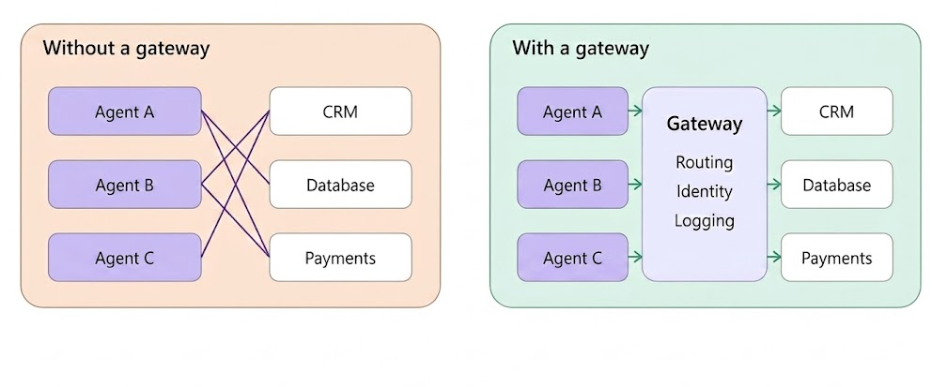
Picture an AI agent as an employee who never sleeps and never asks permission before acting. It talks to a model to figure out what to do, then it reaches out to real tools, maybe your CRM, a payment system, or an internal database, to actually get the work done. Along the way, it might even call in a few smaller agents to help. Every one of those steps is a door into your systems.
Now imagine ten teams each building their own agents, each with their own doors, and nobody keeping a master list of which door goes where. That's what most companies look like today.
An agent gateway is just one guarded checkpoint that every agent has to pass through. It does three simple jobs:
It decides where a request goes. If one AI model is down or too slow, it can quietly switch to a backup, without the agent even noticing.
It checks who's allowed to do what. Each agent gets its own ID, instead of everyone sharing one login, so a support bot can look something up but can't go rewrite a record.
It keeps a record of everything. Every action gets logged, so you can see which agent did what, and how much it cost you, without digging through ten different systems.
Why Is Everyone Talking About This All of a Sudden?
Because in the space of about six weeks, several big companies made moves that all point the same direction.
| When | Company | What They Did |
|---|---|---|
| Late May 2026 | Nutanix | Released its Agent Gateway, enabling secure access to OpenAI, Claude, and private AI models through a single gateway. |
| May 2026 | Palo Alto Networks | Acquired Portkey and integrated its AI gateway capabilities into its security platform. |
| June 2026 | Solo.io | Donated its Agent Gateway project to a neutral open-source foundation. |
| Early July 2026 | Arcade & Manufact | Improved integration with existing Microsoft and Amazon cloud environments. |
None of this happened by accident. Big companies are watching agents multiply across departments the same way apps did a decade ago, and they don't want a repeat of the mess that caused.
Two Very Different Ways This Is Playing Out
Watching these moves, you can see two separate instincts at work, and it's worth knowing the difference before you pick a side.
The first instinct is to buy it and lock it in. That's what Palo Alto Networks did with Portkey. The gateway becomes part of one company's bigger security product, and you get it as part of that package.
The second instinct is to give it away so no one owns it. That's what Solo.io did by handing its project to an open foundation. Big names like Adobe, Salesforce, Red Hat, and Microsoft are already contributing to it together.
Neither one is automatically the right pick. A packaged product from one vendor is often faster to set up and easier to get support for. An open, shared project is harder to get locked into and usually cheaper long-term, but you'll need a team that's comfortable running it yourselves.
Wait, Does Every Company Actually Need One of These?
Not every tool call an agent makes needs to go through a heavy checkpoint, and it's worth saying that plainly, because some of the sales pitches make it sound otherwise. If an agent runs a small, one-off script that only your own team ever touches, a gateway is probably overkill.
Where a gateway earns its keep is when a tool, database, or API is shared across many agents and many teams, and someone eventually needs to answer "who touched this, and when."
There's also a real cost question nobody likes to bring up.
Analysts at Gartner have predicted that more than 40% of agentic AI projects will get cancelled by 2027 because costs spiral or the payoff never shows up. A gateway is meant to prevent exactly that kind of runaway spending, but it's also one more system you have to pay for and maintain. Before buying one, it's worth being honest about whether your agent sprawl is actually big enough yet to need it.
What Should You Actually Check Before Picking One?
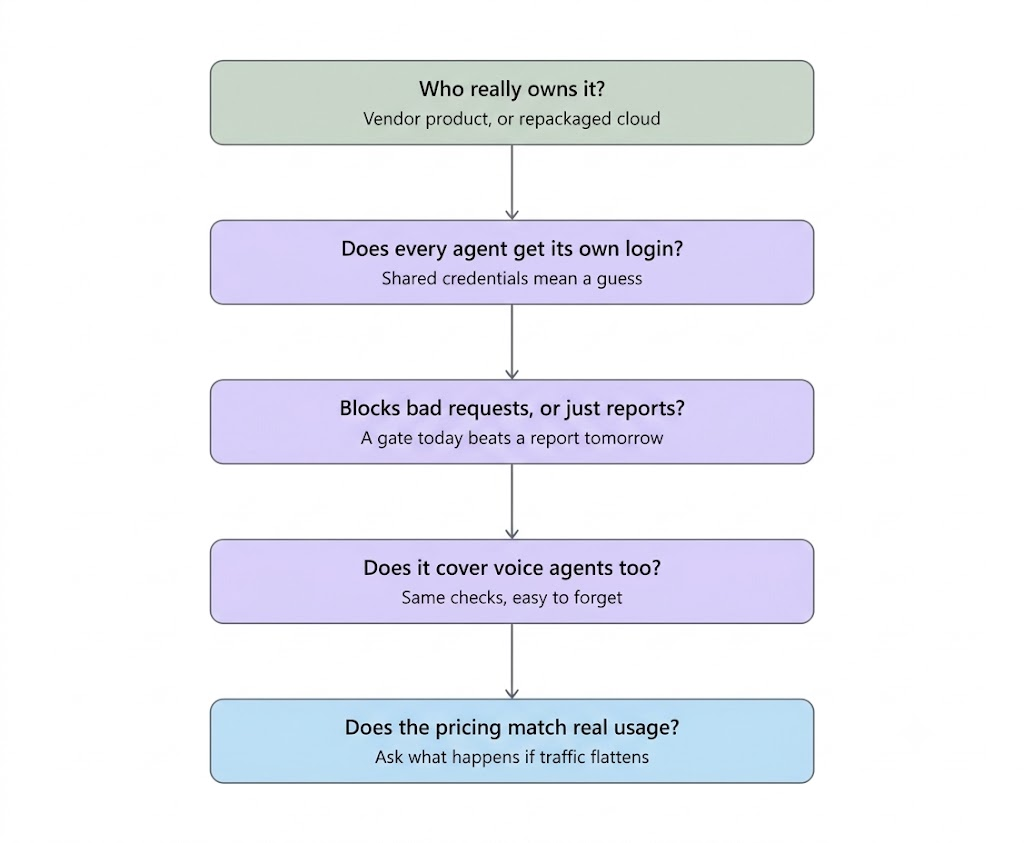
If you're the person stuck answering "how many agents are hitting our systems," here's a short, plain list to work through before signing anything:
Who really owns it? Is this a product from one vendor, or a piece of your existing cloud renamed and repackaged? Ask directly.
Does every agent get its own login? If agents are sharing one set of credentials, you don't really have an audit trail, you just have a guess.
Does it stop bad requests, or just report on them afterward? A report that tells you what went wrong yesterday is not the same as a gate that blocks it today.
Does it cover voice agents too? Companies rolling out AI voice agents for support or bookings often forget these need the exact same checks as a chat-based agent, and they're usually the ones IT hears about last.
Does the pricing make sense for how you'll actually use it? Some pricing models assume your agent traffic will keep climbing fast. Ask what happens to the bill if it doesn't.
What This Means If You're Building Agents, Not Just Buying Gateways
If your team is still in the "let's build this agent" phase rather than the "let's govern what we already built" phase, this is good timing, not bad news. The smartest move is to design with this in mind from day one instead of bolting it on after something breaks.
This is really the case for building agentic AI applications with a problem-first approach instead of a framework-first one. Pick the one workflow that genuinely needs an agent, figure out exactly what it needs to touch, and build the access, logging, and guardrails around that one job. Do that, and adding a gateway later becomes simple. Skip it, and you'll be redoing your whole setup once someone asks the same question our client asked us.
Whether that work happens with an in-house platform team, an outside AI automation agency, or a dedicated AI agent development company, the order you do things in matters more than which brand of tool you buy.
The Bottom Line
Analysts at Forrester have started formally reviewing agent control planes as their own category this year, which is a strong sign this has moved past "interesting new idea" and into "thing every serious company needs an answer for."
Nobody in the industry agrees yet on who should own this layer. Nutanix, Google, Palo Alto Networks, and an open foundation are all pulling in different directions. But they all agree on one thing: agents running loose with no one watching is no longer something a company can shrug off.
So here's the honest question to sit with. If someone on your team asked, right now, how many AI agents are touching your systems and what each one is allowed to do, could you actually answer that? If the honest answer is "not really," that's exactly the gap this whole category of tools exists to close.
Not sure who or what is touching your systems right now, or planning a new agent build and want to get the access and logging right from day one? Let's talk.
Frequently Asked Questions
-
An AI gateway usually just manages calls to a language model, things like API keys, spending limits, and switching providers if one goes down. An agent gateway covers more ground. It also manages what an agent does after that first call, including which tools it can use, what data it can touch, and what other agents it can call in.
-
Because agents are quick to spin up and easy to forget about. A team member connects a chatbot to a database on a Tuesday afternoon, it works, and six months later nobody remembers it's there or checks what it can access. Without one central place to see all of this, that kind of thing piles up quietly.
-
Yes, and they're often the ones that get missed. A voice agent handling support calls or bookings is touching the exact same tools and data as a text-based chatbot. It just doesn't show up on a dashboard the same way, so it's easy to lose track of.
Related Reading
Let’s Talk

Drop us a note, we’re happy to take the conversation forward 👇🏻