
The Definitive Guide to Building AI Agents for AgentExchange
Key takeaways:
AI agents adapt to complex inputs and work across multiple systems.
Four core building blocks ensure reliable agent performance.
Success depends on a clear use case, secure data, and thorough testing.
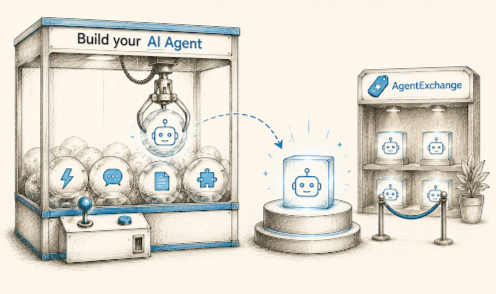
If you've been keeping an eye on the Salesforce ecosystem lately, you've probably heard the buzz around the Salesforce apps marketplace called AgentExchange. And for good reason, this platform is quickly becoming the go-to destination for businesses that want to put AI to work without starting from zero. Whether you're a developer or a business leader exploring your options, this guide will walk you through everything you need to know about building AI agents for AgentExchange.
Why AI Agent Development Is a Big Deal Right Now
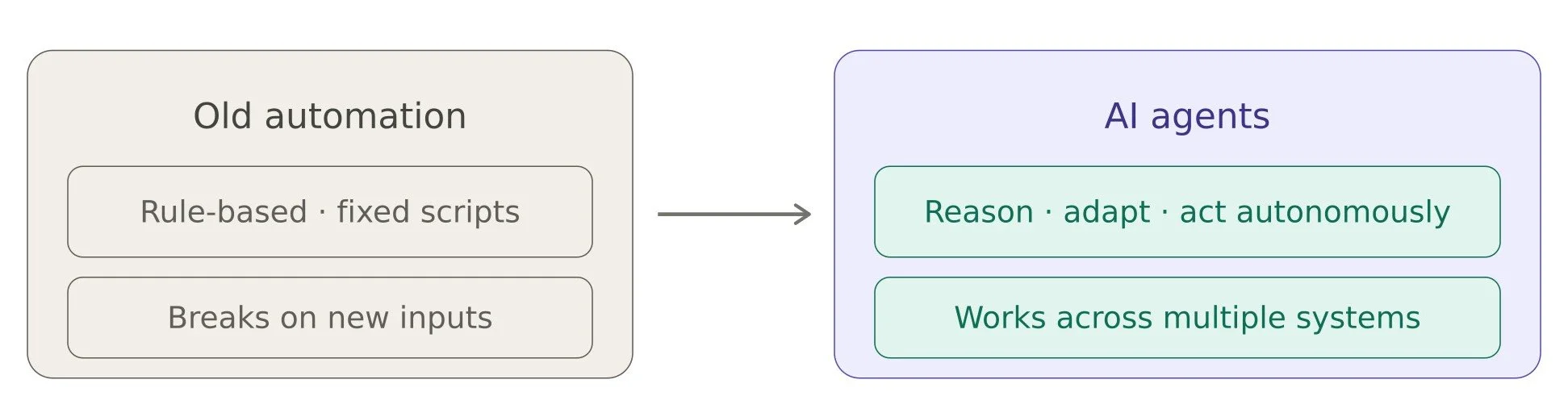
Traditional automation tools are great for predictable, rule-based tasks. But AI agents are different. They can understand natural language, reason through complex situations, adapt to changing inputs, and take action across multiple systems. All without someone hovering over their shoulder. Instead of following a script, they understand the goal and figure out how to get there.
This is why AI agent development has moved from a "future-forward" idea to a present-day priority for enterprises. Companies are already citing AgentExchange's ready-made solutions as a way to improve speed, efficiency, and customer experience. Meanwhile, developer teams are using agents to automate everything from compliance checks and deployment testing to HR onboarding and contract management.
The shift is real: Salesforce reported 119% agent growth in just the first half of 2025, and Agentforce has since been described as the company's fastest-growing product ever.
The Building Blocks of AgentExchange AI Agents
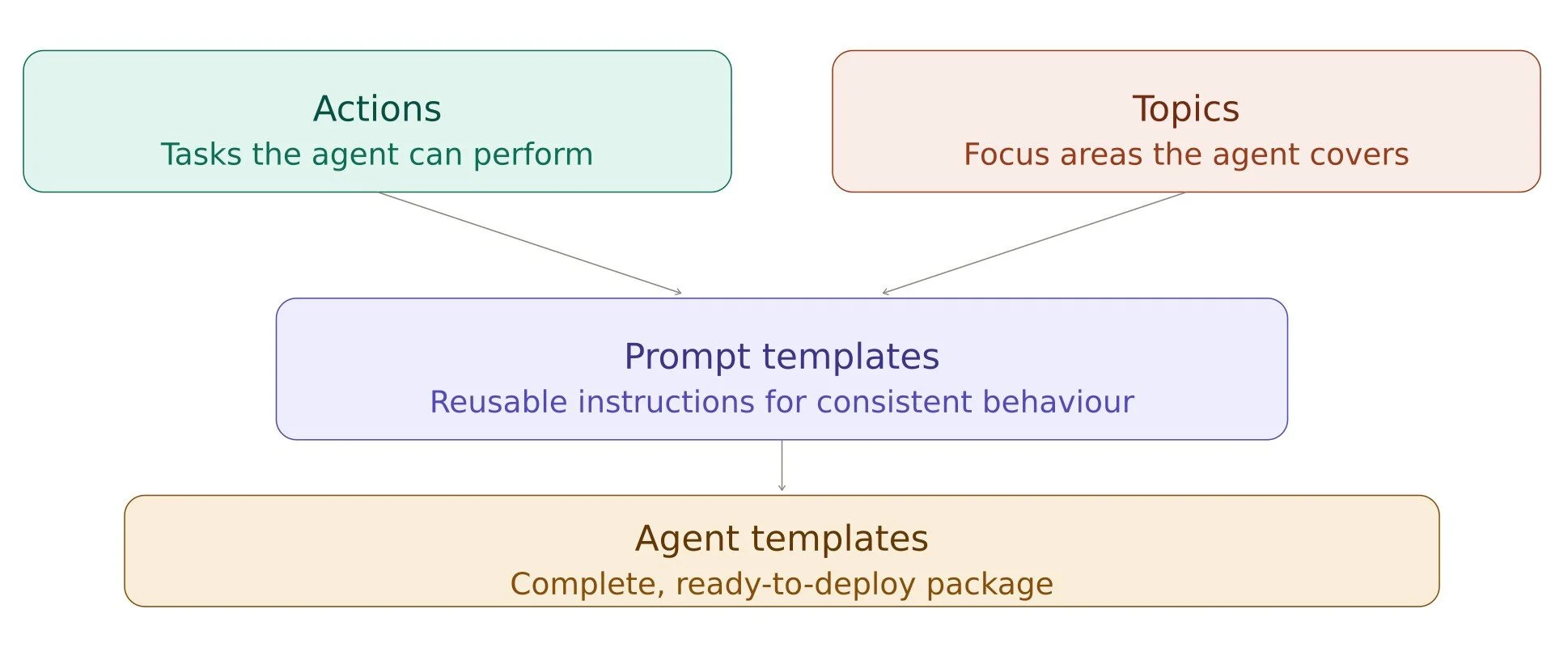
Before you start building, it helps to understand the four core components that make up AgentExchange AI agents:
Actions are the individual tasks an agent can perform. Things like creating a case, sending a message, updating a record, or querying an external API. Think of them as the verbs in your agent's vocabulary.
Topics are where you define the focus areas of your agent. If you're building a customer service agent, your topics might include order inquiries, return processing, or technical support. Topics shape how the agent interprets requests and which actions it considers relevant.
Prompt Templates are pre-written, reusable instructions that ensure consistent agent behavior. They help guide the agent toward specific outcomes without requiring you to re-engineer the logic every time.
Agent Templates are the most comprehensive building block. They combine multiple topics, pre-built actions, and global instructions into a complete, ready-to-customize solution.
When building AI agents for AgentExchange for the marketplace, you can package and list any of these components so other businesses can discover and deploy them.
Step-by-Step: How to Build an AI Agent for AgentExchange
1. Define Your Use Case Clearly
This is the most important step, and it's one that many teams rush through. Ask yourself: what specific problem will this agent solve? Is it reducing case resolution time in customer support? Qualifying sales leads faster? Automating onboarding workflows for HR?
The more specific your use case, the better your agent will perform. Vague agents tend to underperform because the AI has too much room to interpret and too little direction to act on. Match your agent's capabilities to measurable KPIs from the start. For example, reducing average handling time by 30% or improving first-contact resolution rates.
2. Set Up Your Salesforce Environment
For AI agent development with Agentforce, you'll need a Salesforce org running on Enterprise, Performance, or Unlimited Edition. Once you're in, head to the Setup menu and make sure both Einstein and Agentforce are enabled. From there, configure your data access permissions carefully. Agents inherit user permissions, so a solid security model is essential before you go live.
If you’re just getting started or experimenting, Salesforce’s Trailhead Playground is a great sandbox to build and test without touching a production environment.
3. Use Agentforce Builder to Design Your Agent
Agentforce Builder is the low-code interface where the actual agent design happens. You don't need to write complex code to get started. The platform uses natural language inputs and a visual interface to let you define your agent's behavior.
Here's what you'll configure:
Agent role and description: a clear explanation of what the agent does and what it's responsible for.
Topics: the subject areas the agent will handle.
Instructions: plain-language guidelines telling the agent how to behave, what to prioritize, and where to hand off to a human.
Actions: the tools the agent can use to complete tasks, built using Salesforce Flows, Apex, or API integrations.
Agentforce's Atlas Reasoning Engine powers the decision-making under the hood. It combines the flexibility of large language models with structured business logic (called Agentforce Script) to ensure your agent is both smart and predictable.
4. Ground Your Agent in Good Data
An AI agent is only as good as the data it can access. Connect your agent to Salesforce Data Cloud for a unified view of customer information. Use Retrieval-Augmented Generation (RAG) to pull real-time, contextually relevant data into your agent's responses. Feed it your company's knowledge base, policies, and product documentation so it can answer with accuracy and confidence.
Poor data integration is one of the most common reasons AI agents underperform. Research consistently shows that data accessibility is the single biggest factor in agent success.
5. Test Thoroughly Before Going Live
Agentforce Studio includes a dedicated Testing Center where you can simulate real-world conversations and scenarios before deployment. Run your agent through diverse query types, including edge cases, ambiguous inputs, and multi-step requests. Test for accuracy, tone, escalation behavior, and how well it handles things it doesn't know.
Don't skip this step. An agent that behaves unexpectedly in production can destroy user trust quickly and is much harder to fix after the fact.
6. Deploy and Monitor
Once testing checks out, deploy your agent across the channels that matter to your business. Channels like chat, email, voice, messaging apps, or all of these. Agentforce supports omnichannel deployment, so your agent can meet users wherever they are.
After launch, use Agentforce Observability tools to track performance metrics like response accuracy, resolution rates, and escalation frequency. Treat this as an ongoing loop where great agents improve over time based on real usage data.
Listing Your Agent on AgentExchange
If you're building custom AI agents with the intention of distributing or selling them, you'll need to package them properly for the marketplace.
This is where your relationship with the Salesforce partner ecosystem becomes important. Working with a reputable Salesforce AppExchange development company or an experienced team of AppExchange partners can make this process significantly smoother. They understand the packaging requirements, security review standards, and listing best practices that Agentforce's marketplace demands.
Every component listed on AgentExchange goes through a rigorous security and quality review. Salesforce doesn't just allow anyone to publish. Your agent needs to meet enterprise-grade standards for data security, compliance, and customer usability. This is actually a feature, not a hurdle: businesses trust AgentExchange precisely because the bar is high.
Once your agent is listed, it becomes discoverable through AgentExchange's AI-powered semantic search (built on Data Cloud), directly within Agentforce Builder, and through the Salesforce and Slack interfaces that millions of users already work in every day.
How a Salesforce Consultant Can Help
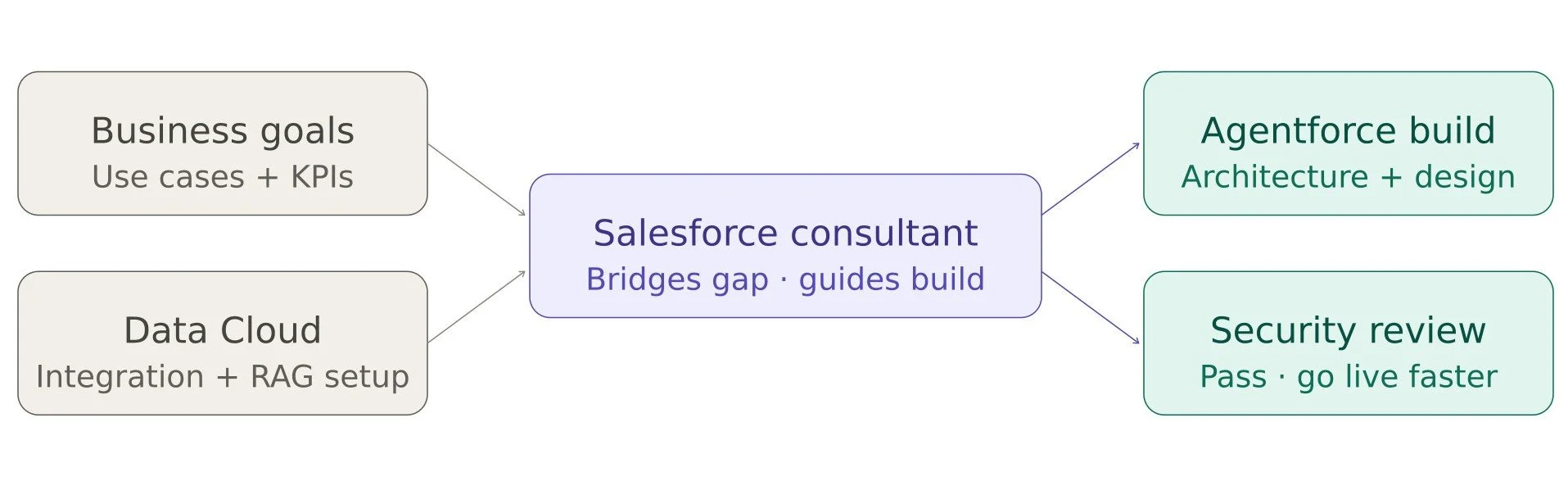
Not every business has the internal expertise to navigate Salesforce AppExchange development from scratch. A skilled Salesforce consultant can bridge the gap between your business goals and what's technically possible on the Agentforce platform.
They can help you identify the right use cases for automation, design the agent architecture, configure Data Cloud integrations, and guide you through the security review process. For organizations that want to become official Salesforce AppExchange partners and publish to AgentExchange, this kind of expert guidance makes the difference between a successful listing and months of rework.
Even if you're just deploying agents internally, working with experienced Salesforce AppExchange development professionals ensures your agents are built on a solid foundation. An agent that's scalable, secure, and aligned with Salesforce's evolving platform standards.
What Makes a Great AI Agent for AgentExchange?
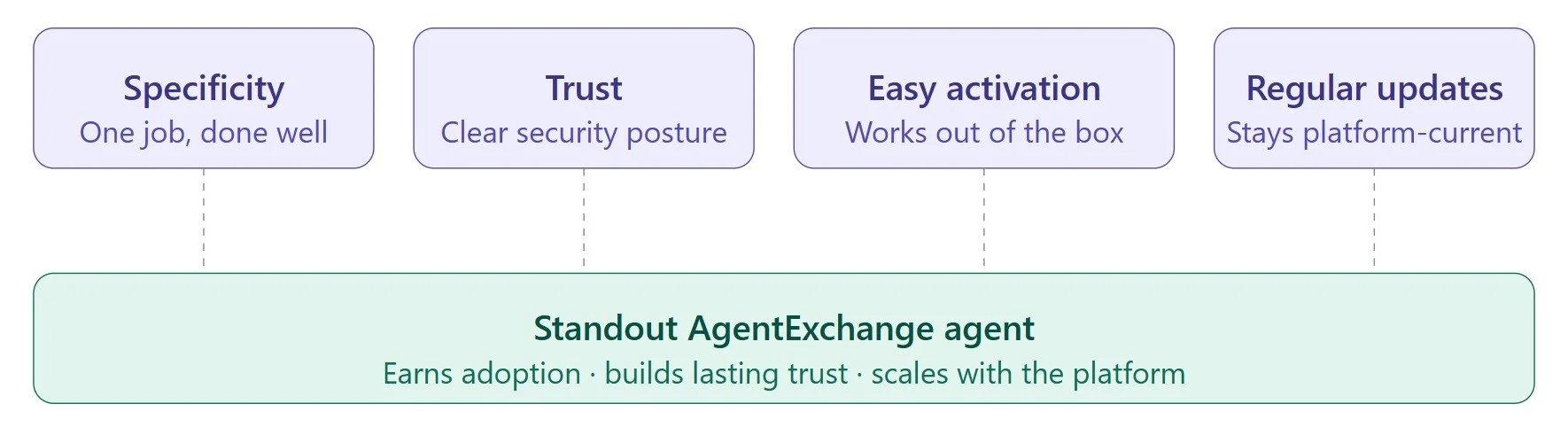
Having helped review the landscape of what's thriving on the platform, a few qualities consistently separate standout AgentExchange AI agents from the ones that get ignored:
1. Specificity wins. Agents designed for a narrow, well-defined job outperform broad, general-purpose ones. The most successful agents on AgentExchange solve a real, specific pain point really well.
2. Trust matters. Businesses want to know their data is safe. Agents that clearly communicate their security posture, use Einstein Trust Layer guardrails, and stay within a defined scope earn adoption faster.
3. Ease of activation. The best-listed agents can be found, evaluated, purchased, and deployed in just a few clicks. Heavy customization requirements are a barrier. Design your agent to work out of the box, with optional extensions for advanced users.
4. Regular updates. AgentExchange applications are expected to stay current with Salesforce platform updates. Agents that fall behind quickly become liabilities.
In a Nutshell
AgentExchange isn't just about a product launch; it's a signal about where enterprise software is heading. The era of apps that humans operate is gradually giving way to an era of agents that operate on behalf of humans. Salesforce is prioritizing this shift a lot, and so are hundreds of partners who are already building, listing, and monetizing agents on the platform.
For businesses, that means there's never been a better time to start exploring building AI agents, whether for internal use or for the broader market. For developers and Salesforce partners, it's a genuine opportunity to establish a position in a fast-growing marketplace.
From raw concept to production-ready automation, AI development experts at Concret.io can turn complex AI possibilities into practical, profit-driving solutions for your company.
Frequently Asked Questions
-
AppExchange is Salesforce's general app marketplace. AgentExchange is its AI-focused evolution built specifically for discovering, buying, and deploying AI agents within the Salesforce and Slack ecosystem.
-
It varies. Building and packaging the agent can take a few weeks. Salesforce's mandatory security review adds additional time. It is typically around 4-6 weeks, depending on complexity. Working with experienced Salesforce AppExchange partners can speed this up significantly.
-
Atlas Reasoning Engine is the AI decision-making layer that powers Agentforce agents. It combines large language model reasoning with structured business logic to ensure agents behave accurately and predictably within enterprise workflows.
-
Every agent listed on AgentExchange goes through Salesforce's rigorous security review. Additionally, agents built on Agentforce operate within the Einstein Trust Layer, which enforces data masking, zero data retention policies, and audit logging.
-
Not always, but it helps. A skilled Salesforce consultant can accelerate the build, ensure your agent meets ISV standards, handle Data Cloud integrations, and guide you through the security review process, especially if you're new to Salesforce AppExchange development.
Related Reading

Let’s Talk

Drop us a note, we’re happy to take the conversation forward 👇🏻