
What Are the Requirements for an App to Get Listed in the New AgentExchange?
Key Summary:
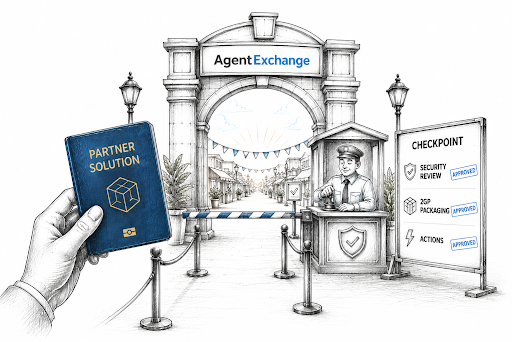
Meet AgentExchange Requirements with 2GP packaging, security compliance, and Agentforce integration.
Build Agentforce-Ready Solutions using Actions, Topics, and Agent Templates.
Optimize for Semantic Search to improve AgentExchange visibility and discoverability.
Salesforce’s new AgentExchange is a massive opportunity for AppExchange partners. It’s a dedicated marketplace where customers look for AI-powered agents, actions, and templates to automate their workflows.
If you already have an app listed in AgentExchange or are looking to publish for the first time, you are probably wondering: How do I handle the Salesforce AgentExchange app listing process?
To get your app featured, you need to meet specific technical standards, security rules, and eligibility criteria. This guide breaks down what you need to do to get your solution ready.
Understanding AgentExchange and How It Differs from AppExchange
Salesforce introduced AgentExchange. It is a new, dedicated marketplace built only for Agentforce-ready solutions.
Think of it this way: the classic AppExchange is still the general marketplace for everyday apps and services. AgentExchange is different. It focuses strictly on AI-powered components, custom actions, and integrations that improve the performance of autonomous agents.
Once partners understand the core differences between these two marketplaces, it gets much easier to see if their current AppExchange apps qualify for the new AgentExchange categories.
What Is AgentExchange?
AgentExchange is a dynamic marketplace offering a variety of pre-built prompts, actions, topics, and agent templates developed by trusted partners, Salesforce, and Agentblazers, each bringing expertise in their respective domains.
Why AgentExchange Stands Out? It's the ability to easily discover and deploy pre-built solutions directly into Agentforce with little to no custom development required. Once installed, organizations can leverage the pre-built agents, actions, and topics included in the solution to enhance Agentforce capabilities and accelerate automation.
Key facts about AgentExchange:
Navigating the AgentExchange transition and the subsequent approval process requires understanding these specific operational details:
| Aspect | Details |
|---|---|
| Purpose | Helps businesses discover, buy, activate, and manage trusted AI agents and solutions for Salesforce & Slack. |
| What you can find | 1,000+ prebuilt AI agents, partner actions, topics, and templates. |
| Initial launch | 200+ trusted partners with hundreds of ready-made solutions that passed rigorous security and customer reviews. |
| Integration | Built directly into Salesforce, accessible from within the Agent Builder tool or the marketplace at agentexchange.salesforce.com. |
| Target users | Businesses, developers, partners, startups, and "Agentblazers" wanting to build and implement AI agents. |
| Goal | Fast-track AI agent creation, boost productivity, and bring AI from the lab into everyday business workflows. |
Why Salesforce Created AgentExchange
Salesforce created AgentExchange to give businesses a trusted, centralized marketplace where they can discover, buy, and deploy ready-to-use AI agents for Agentforce, just like AppExchange did for cloud apps in 2005.
The marketplace solves the real problem of too many fragmented AI tools by offering hundreds of prebuilt, vetted solutions (actions, topics, templates, and agent templates) that integrate directly into Salesforce workflows, enabling companies to rapidly build AI agents without starting from scratch.
AppExchange for AI: Delivers prebuilt agents and integrations while letting partners build businesses in the $6 trillion digital labor market
Rapid deployment: 1,000+ prebuilt components to deploy AI agents in hours, not months
Trust & security: 200+ partners (Google Cloud, DocuSign, Box) passed rigorous enterprise security reviews
Monetization: Partners sell AI components via sales, subscriptions, and usage-based pricing
Built into Salesforce: Accessible directly in Agent Builder without leaving CRM
Industry solutions: Tailored AI agents for healthcare, retail, financial services
Collaboration: Partners share best practices and co-create AI agents
Key Differences at a Glance
AppExchange (2005) was Salesforce's original app marketplace for standalone apps and integrations, while AgentExchange (2026) unifies AppExchange, Slack Marketplace, and Agentforce AI agents into one platform. Reflecting the latest AppExchange 2026 updates, this shift transforms Salesforce into an agentic AI ecosystem where customers discover both traditional apps and autonomous AI agents
| Aspect | Legacy AppExchange App Marketplace | Unified AI Agent Marketplace (AgentExchange) |
|---|---|---|
| What's Listed | Standalone apps, integrations, workflows, consultancies | Apps plus AI agents, actions, topics, prompt templates, and agent templates |
| Focus | Cloud apps and integrations for CRM | Agentic AI, apps, and automation for Agentforce |
| Marketplace Scope | Standalone app marketplace (pre-2026) | Unified marketplace merging AppExchange, Slack Marketplace, and Agentforce |
| Total Listings | ~10,000 apps (original count) | ~13,000+ total (10,000 apps + 1,000 AI agents + 2,600 Slack apps) |
| Search Type | Keyword search | Intent-aware semantic search |
| New Categories | Apps and consultancies | Actions, Topics, Prompt Templates, and Agent Templates |
| AI Capability | Autonomous | Autonomous AI agents that can act on your behalf |
| Activation | Install and activate apps | Buy and turn on solutions in one click within Salesforce and Slack |
| Billing | Separate billing per app | Unified billing across all solutions |
| Security | Standard trust reviews | Baseline security checks plus AI-specific vetting |
Requirements for Getting a Solution Listed in AgentExchange
To be listed in AgentExchange, partners must meet Salesforce's core publishing, security, and compliance standards and explicitly demonstrate how their solutions extend Agentforce's capabilities. Because AgentExchange unifies traditional apps, Slack apps, and autonomous agents, partners must align with an ecosystem built for digital labor.
1. Partner Eligibility & Business Plan
Must be an active member of the Salesforce Partner Network (ISV or Consulting).
Requires a submitted business plan outlining the solution’s value proposition and target market.
2. Agentforce Architecture & Compatibility
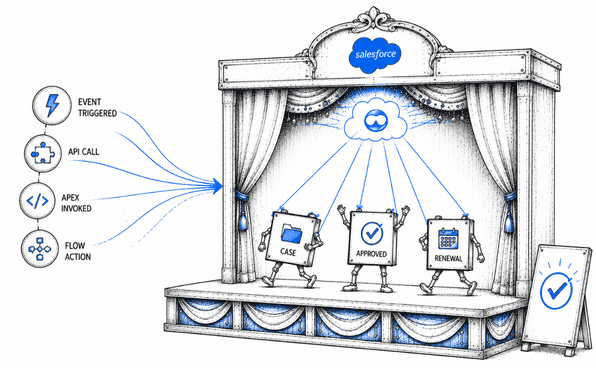
Action-Oriented Architecture: Solutions cannot just be passive UIs. They must be built as modular, composable building blocks (Apex, Flows, or external APIs) that an autonomous agent can trigger.
Seamless Integration: Must easily plug directly into the Agentforce Builder.
3. Technical Packaging & Security
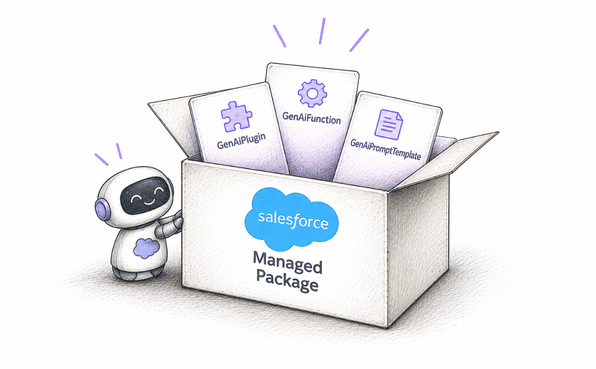
2GP Packaging: Solutions must use Second-Generation Managed Packages (2GP) for versioning and deployment.
Security Review: Must pass Salesforce’s strict automated and manual security review, including secure data handling and clear permission scoping.
Secure Connections: Infrastructure must use modern authentication (like Named Credentials).
4. Listing Content & Semantic Search
Intent-Based Optimization: AgentExchange uses semantic search powered by Data 360. Descriptions must focus on exact use cases and user intent rather than keyword stuffing.
Required Assets: Clear documentation of input/output schemas, installation guides, and high-quality demo videos.
5. Supported AgentExchange Components
AgentExchange supports a diverse array of AI-focused and traditional solution types, categorized by how they plug into the agentic workflow:
Actions: Discrete, reusable tasks an agent can perform, built from Apex, Flows, or external APIs.
Topics: Groupings of related actions and instructions that define an agent's guardrails and focus areas (e.g., a "Billing" topic).
Prompt Templates: Pre-configured, grounded instructions that ensure consistent, contextual LLM interactions.
MCP Servers: Open-standard connections that seamlessly bridge Agentforce with external enterprise data platforms and tools.
Agent / Sub-Agent Templates: Complete, industry-specific autonomous agent frameworks that accelerate out-of-the-box deployment.
6. Pricing and Licensing
Partners can leverage modern, flexible monetization strategies managed via the AgentExchange Go-To-Market App. This includes automated provisioning, unified customer billing through existing Salesforce accounts, and private enterprise offers alongside traditional models like subscriptions, consumption-based pricing, freemium, or free utilities.
Step-by-Step Process to Pursue an AgentExchange Listing
Follow this chronological roadmap to understand how to list an app on AgentExchange from initial setup to final deployment
Step 1: Join the Salesforce Partner Community
Sign up at partnersignup.salesforce.com and enroll specifically under the AgentExchange ISV Program Track. Expect 1-3 weeks for corporate application approval.
Step 2: Access the Partner Developer Org
Log in to your dedicated Partner Org, connect your Environment Hub, and register your unique corporate Namespace to isolate and protect your package components.
Step 3: Build Your Agentic Components
Develop your solution layers inside your scratch org or developer environment. Focus on composable, action-oriented blocks: Actions (Apex/Flows), Topics, Prompt Templates, or external MCP (Model Context Protocol) Servers.
Step 4: Create a Second-Generation Managed Package (2GP)
Bundle your metadata using SFDX into a 2GP package. Upload a Beta version for rigorous QA testing, then promote it to a Released state (the Golden Package).
Step 5: Build Your Listing Layout
Navigate to the Publishing Console > Listings tab and click New Listing. Select your package type and optimize your text for Semantic Intent-Based Search (Data 360) rather than standard keyword stuffing.
Step 6: Link the Package and Organization
Go to the Organization tab in the Publishing Console, click Connect Organization, and link your finalized, released 2GP managed package version to your public-facing listing draft.
Step 7: Run Pre-Submission Scans
Run your codebase through Salesforce Code Analyzer and Checkmarx to eliminate CRUD/FLS violations, SOQL injection, and cross-site scripting (XSS). For external endpoints, execute DAST scans using tools like OWASP ZAP or Burp Suite.
Step 8: Gather the Trust Dossier
Prepare a clear documentation bundle for the reviewers: Technical data flow diagrams (specifically mapping how LLM inputs and outputs move safely), safety/guardrail configurations, and external compliance certificates (SOC 2, ISO 27001, GDPR) if your app communicates outside of Salesforce.
Step 9: Submit for Security Review
Submit your finalized package via the portal to the Product Security Queue. Your code and architecture will undergo a comprehensive automated and manual review to ensure alignment with Einstein Trust Layer security policies.
Step 10: The Review Window & Launch
Wait 4-6 weeks for the evaluation. Address any flagged vulnerabilities or architectural feedback from the security team. Once fully approved, toggle your listing status to Active to publish it live to the AgentExchange.
Common AgentExchange Listing Challenges and How to Overcome Them
1. Security Review Failure
Challenge: Code vulnerabilities (SOQL injection, XSS, missing FLS/CRUD) cause rejection or delays.
Solution: Run Salesforce Code Analyzer scans before submission and fix all critical/high severity issues.
2. Incomplete Documentation
Challenge: Vague descriptions, missing screenshots, or no demo videos lead to poor conversions.
Solution: Add clear user guides, high-quality screenshots, 2-5 minute demo videos, and specific business use cases.
3. Poor Discoverability
Challenge: Listing doesn't show up in relevant searches due to weak keywords.
Solution: Use industry-specific keywords and tag relevant Salesforce clouds (Sales Cloud, Marketing Cloud, Service Cloud).
4. Weak Early Reviews
Challenge: Zero or few reviews make buyers hesitant to try your solution.
Solution: Offer free trials, recruit beta testers from the Partner Community, and provide discounted access for honest reviews.
Conclusion
The transition from the classic AppExchange model to the unified Salesforce AgentExchange represents a major shift in how enterprise software is built, discovered, and deployed. For partners, the goal is no longer just shipping a clean user interface; it is about delivering composable, modular business logic that autonomous AI agents can execute flawlessly in the background.
By matching the rigid requirements of Second-Generation Managed Packages (2GP), enforcing tight user context security boundaries, and designing listing assets for intent-based semantic search, your product can confidently navigate the AgentExchange approval process. Start auditing your codebase with the Salesforce Code analyzer today to position your solution at the forefront of this digital labor revolution.
If your internal team lacks experience with 2GP packages or agentic workflows, it is highly recommended to hire an AppExchange developer to streamline your technical readiness.
Frequently Asked Questions
-
While the legacy AppExchange focuses on standalone, UI-driven cloud apps and CRM integrations, AgentExchange unifies traditional apps, Slack components, and Agentforce ecosystem assets. Listings here are built as composable building blocks like custom agent actions, topics, and templates that autonomous agents pull into their workflows dynamically.
-
AgentExchange utilizes semantic intent-based search driven by Salesforce Data 360, completely moving away from legacy index keyword matching. Instead of evaluating keyword-stuffed descriptions, the engine matches solutions based on user intent and specific "Jobs-to-be-Done." Your listing copy and technical input/output parameter schemas must clearly define the exact business outcomes your tool achieves.
-
Salesforce requires 2GP packaging because it supports source-driven development, branch versioning, and atomic deployments. Because AgentExchange components (Actions, Topics, and Prompts) are highly modular and interdependent, 2GP allows partners to seamlessly deploy continuous security patches and minor upgrades without breaking the customer's active Agentforce workflows.
-
AgentExchange supports Actions, Topics, Prompt Templates, MCP Servers, and Agent/Sub-Agent Templates designed for Agentforce automation.
Related Reading

Let’s Talk

Drop us a note, we’re happy to take the conversation forward 👇🏻