
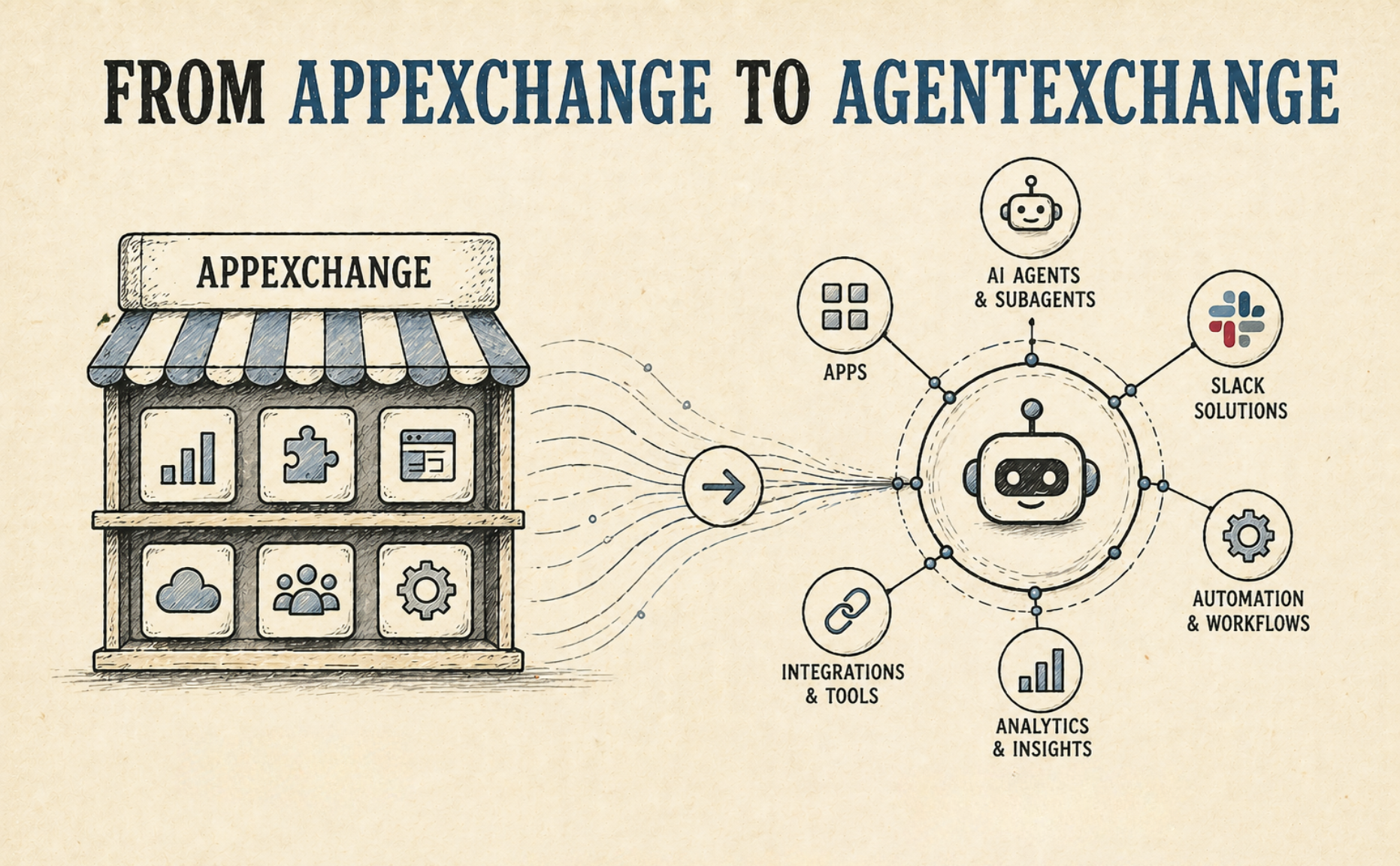
Overview: “What is the difference between AppExchange and AgentExchange? Salesforce has rebranded and expanded its classic AppExchange into AgentExchange to support the era of autonomous AI. While the legacy AppExchange focused entirely on managed applications, AgentExchange unifies traditional software packages with autonomous Agentforce components, pre-built Agent Actions, and Slack MCP integrations.”
Key Summary:
AgentExchange transforms AppExchange into Salesforce’s unified AI marketplace.
It combines AppExchange, Slack Marketplace, and Agentforce in one ecosystem.
Users can discover, buy, and activate solutions directly within Salesforce and Slack workflows.
Salesforce has officially moved beyond AppExchange.
What began as a traditional enterprise app marketplace 20 years ago has now evolved into AgentExchange, a unified platform built for the AI era. This shift isn’t just a rebrand. It reflects a deeper transformation in how businesses discover, deploy, and scale solutions in an increasingly AI agent–driven world.
With the rise of agent-based systems, automation, and intelligent workflows, Salesforce is redefining its ecosystem to align with where enterprise technology is heading.
What is AgentExchange?
AgentExchange is Salesforce’s next-generation marketplace that brings together:
Apps
AI agents and subagents
Integrations and tools
Slack-based solutions
Consulting services
All in a single, unified platform
AgentExchange is designed to help businesses not just find tools, but deploy outcomes. It enables users to discover, purchase, and activate solutions directly within their workflow environments, such as Salesforce and Slack.
The platform already includes over 10,000 apps, 1,000+ AI agents, and 2,600+ Slack-based solutions, reflecting the scale and maturity of Salesforce’s evolving ecosystem.
The process of building and listing solutions on AgentExchange largely follows the same foundation as AppExchange. For partners looking to get started, understanding the listing process remains just as important.
To learn more, check out our in-depth guide on how to list an app on AgentExchange.
Why Did Salesforce Evolve AppExchange?
Salesforce didn’t evolve AppExchange for a surface-level update. The fundamentals of how software is built, discovered, and used have changed.
AppExchange was built for a time when companies searched for tools, compared features, and installed apps to solve problems. That model worked until AI entered the picture.
Today, businesses aren’t looking for more tools. They’re looking for outcomes:
Faster execution
Smarter decision-making
Automation at scale
This is where AI agents come in. Unlike traditional apps, they don’t just support workflows; they run them.
At the same time, Salesforce’s ecosystem had grown in silos:
AppExchange for apps
Slack Marketplace for collaboration
Agentforce for AI
Finding and connecting these pieces created friction across teams and workflows.
AgentExchange solves this by bringing everything into one unified experience, so businesses can discover, use, and scale solutions without switching between platforms.
Key Features: What’s New in AgentExchange
On the surface, AgentExchange might seem like a continuation of AppExchange. But once you start using it, the change becomes obvious; it’s built for a completely different way of working. Here’s what’s actually new:
1. Unified Marketplace
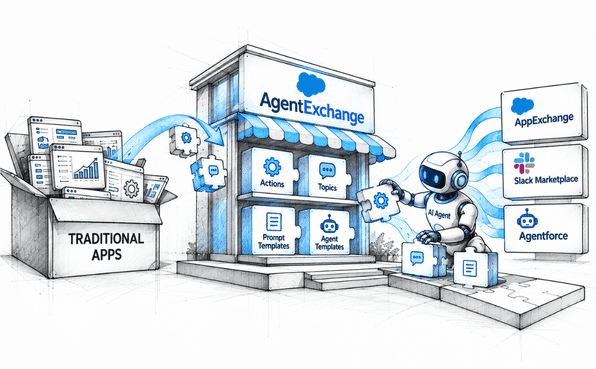
The updated marketplace brings together everything that was previously scattered across platforms into a single destination.
Apps from AppExchange
Solutions from Slack Marketplace
Agentforce AI agents
This unified approach makes it easier to discover, compare, and deploy solutions without switching between platforms. Behind the scenes, everything now runs on a shared system, creating a more consistent structure across listings.
2. Intent-Led Discovery
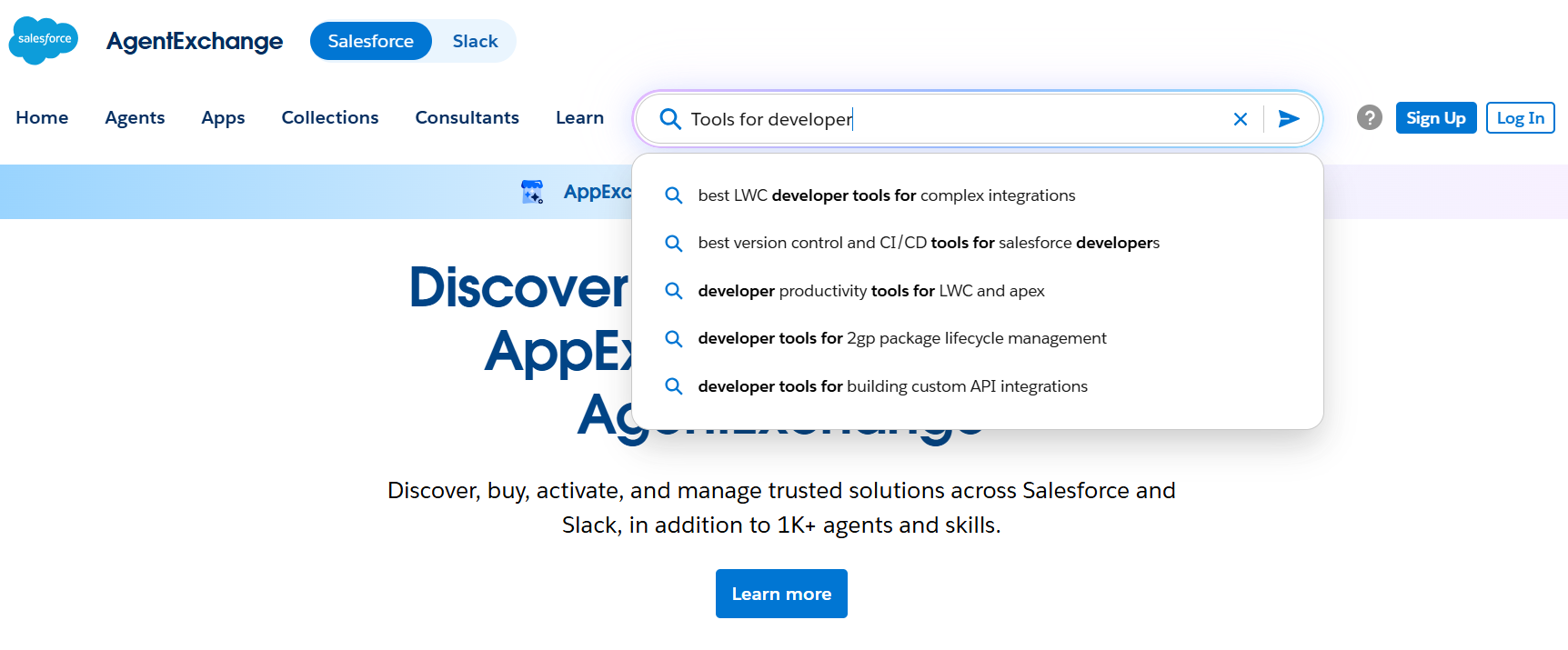
AgentExchange shapes how users define their problem from the start. Instead of relying on basic autocomplete or keyword suggestions, it surfaces queries and problem statements that guide users toward clearer intent. Discovery begins before the search itself, helping users find the right solution, whether it’s an app, an agent, or a service.
3. Agent-First Ecosystem
AI is at the core of how solutions are built and delivered on AgentExchange. The platform now supports:
AI agents
Subagents
Automations
MCP servers
Instead of focusing only on apps, the new marketplace is built for systems that can take action. These agents can handle tasks, run workflows, and interact across tools, reducing manual effort and changing how work gets done inside Salesforce.
4. Seamless Purchasing Experience
AgentExchange introduces private offers, allowing partners and customers to negotiate custom pricing and terms directly within the platform. Alongside this, unified billing brings all purchases across Salesforce and Slack into a single system, making enterprise buying more flexible and straightforward, especially for complex deals that don’t fit standard pricing models.
While these features make AgentExchange more powerful, success on the platform still depends on how well solutions are built and implemented. This is where experienced Salesforce PDO partners play a key role in turning capabilities into real outcomes.
What This Means for Businesses & Developers
AgentExchange is built keeping developers, ISVs, and businesses in mind, changing how value is created and delivered across the ecosystem.
For Businesses
Businesses now operate in a system where solutions are not just installed, but activated within workflows.
Faster access to ready-to-use AI agents and apps
Reduced dependency on manual configuration
Better alignment between business intent and solution discovery
More streamlined operations across Salesforce and Slack
Instead of spending time assembling tools, businesses can focus on executing outcomes.
For ISVs (Independent Software Vendors)
For ISVs, AgentExchange opens a more integrated and scalable distribution model.
Apps and agents now coexist in one marketplace
Better visibility across Salesforce’s unified ecosystem
Easier monetization through private offers and unified billing
Opportunity to build AI-native solutions, not just traditional apps
The shift encourages partners to think beyond standalone applications and move toward outcome-driven solutions powered by agents.
For Developers
Developers are no longer building just apps; they are building intelligent systems.
Move from component-based development to agent-based design
Work with AI agents, subagents, and automation layers
Build solutions that interact across Salesforce, Slack, and external systems
Focus shifts from UI logic to workflow intelligence
This changes the development mindset from “building features” to “designing behavior.”
Since the foundation remains the same, success on AgentExchange still depends on strong execution and development practices. This is where hiring AppExchange developers is a practical way to move faster and build effective solutions.
Conclusion
AppExchange laid the foundation as a marketplace for enterprise apps. AgentExchange builds on that foundation by expanding beyond apps to include AI agents, services, and outcome-driven solutions.
What may seem like a simple rebrand is actually a shift in direction. Instead of focusing on tools that businesses need to configure and manage, AgentExchange moves toward systems that can act, automate, and deliver results within workflows.
This change impacts every layer of the ecosystem, from how developers build solutions to how ISVs package, position, and deliver them, to how businesses adopt and use them.
Need help navigating the shift to AgentExchange? Talk to our Salesforce consulting services team.
As AI continues to reshape enterprise technology, platforms like AgentExchange will play a key role in defining how solutions are discovered and executed.
Further Reading
Frequently Asked Questions
-
No, AgentExchange builds on AppExchange rather than removing it entirely. It expands the marketplace to include AI agents, services, and Slack-based solutions in a unified platform.
-
No, existing apps, reviews, and ratings remain intact. Solutions listed on AppExchange continue to exist within AgentExchange, along with their reviews, rankings, and history. The transition does not remove or reset existing listings; it builds on top of them.
-
AgentExchange improves discovery by guiding users through real-world use cases rather than relying solely on keywords. For example, typing “test data generator” may surface complete problem-based suggestions, helping users find the right app, agent, or service more quickly and accurately.
-
Private offers allow buyers and partners to negotiate custom pricing, discounts, and contract terms directly within the platform. This is especially useful for enterprise deals, where standard pricing may not fit, enabling more flexible and tailored purchasing agreements.
Related Reading
Let’s Talk

Drop us a note, we’re happy to take the conversation forward 👇🏻