
Salesforce Headless 360 Explained: Agentic Everything, API-First CRM
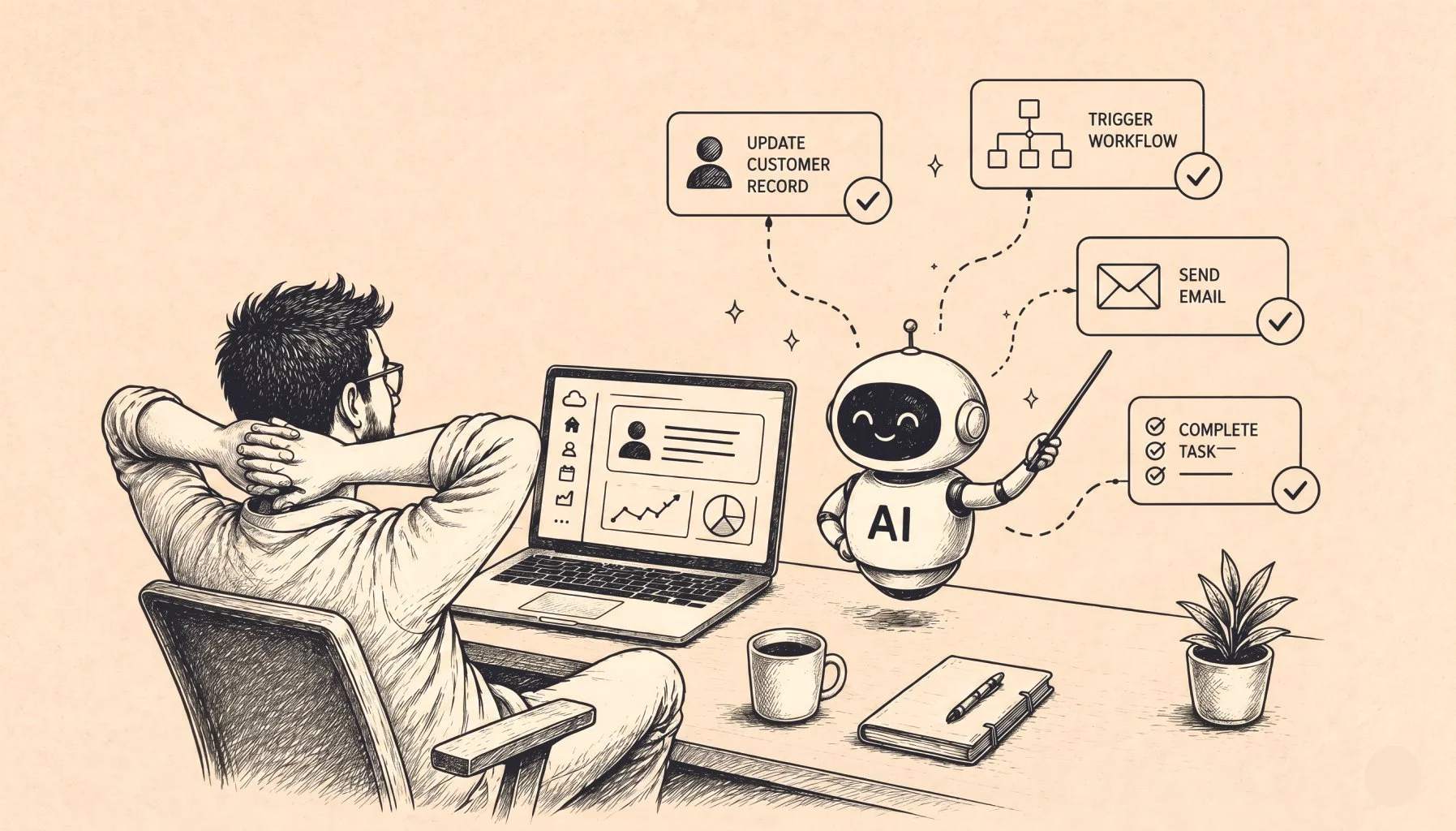
Summary: Salesforce Headless 360 is an API-first architectural framework that decouples the underlying Salesforce core capabilities from the traditional browser-based graphical user interface. Officially announced at TrailblazerDX 2026, it exposes CRM data models, business logic, and workflows as programmable surfaces. By standardizing access through REST APIs, Model Context Protocol (MCP) tools, and command-line interface (CLI) commands, Headless 360 allows autonomous AI agents, external code runtimes, and multi-channel applications to execute enterprise workflows headlessly without human browser navigation.
Here's a question worth sitting with for a second: Why should you ever log into Salesforce again? That's not a riddle. That's the actual question Salesforce Co-Founder Parker Harris asked out loud recently. Not to be dramatic, but to signal exactly where the company is heading.
At the company’s annual TDX conference, Salesforce officially answered that question with the launch of Salesforce Headless 360. And if you're a developer, a CRM admin, or a business leader trying to figure out what enterprise AI actually looks like in practice, this announcement deserves your full attention. It's not just a product update. It's a fundamental rethink of how the world's most widely used CRM platform gets used.
What Is Salesforce Headless 360, and Why Does It Matter?
"Headless" in tech means operating without a graphical interface. No screen. No menus. No clicking around. Just direct, programmatic access to a system's capabilities through APIs, command-line tools, or MCP (Model Context Protocol) servers.
For 25 years, Salesforce worked the traditional way. You logged in, you navigated to what you needed, and you did the work. A customer service rep opened a case, updated a field, and changed a status, all through a UI. That model made sense when humans were the ones doing everything.
But that's not the world anymore. AI agents are now doing a significant portion of the navigating, the lookups, and the actions. And here's the thing about agents: they don't click through dashboards. They call APIs. They invoke MCP tools. They run CLI commands. So if your platform still requires a human to log in before anything useful happens, your platform isn't ready for the agentic enterprise.
That's what Salesforce Headless 360 focuses on. Everything on the Salesforce platform, every workflow, every data model, every process is now exposed as an API, an MCP tool, or a CLI command. Agents can reach all of it, instantly, from anywhere, without touching a browser.
What This Means for Developers: AI-Driven Development at Full Speed
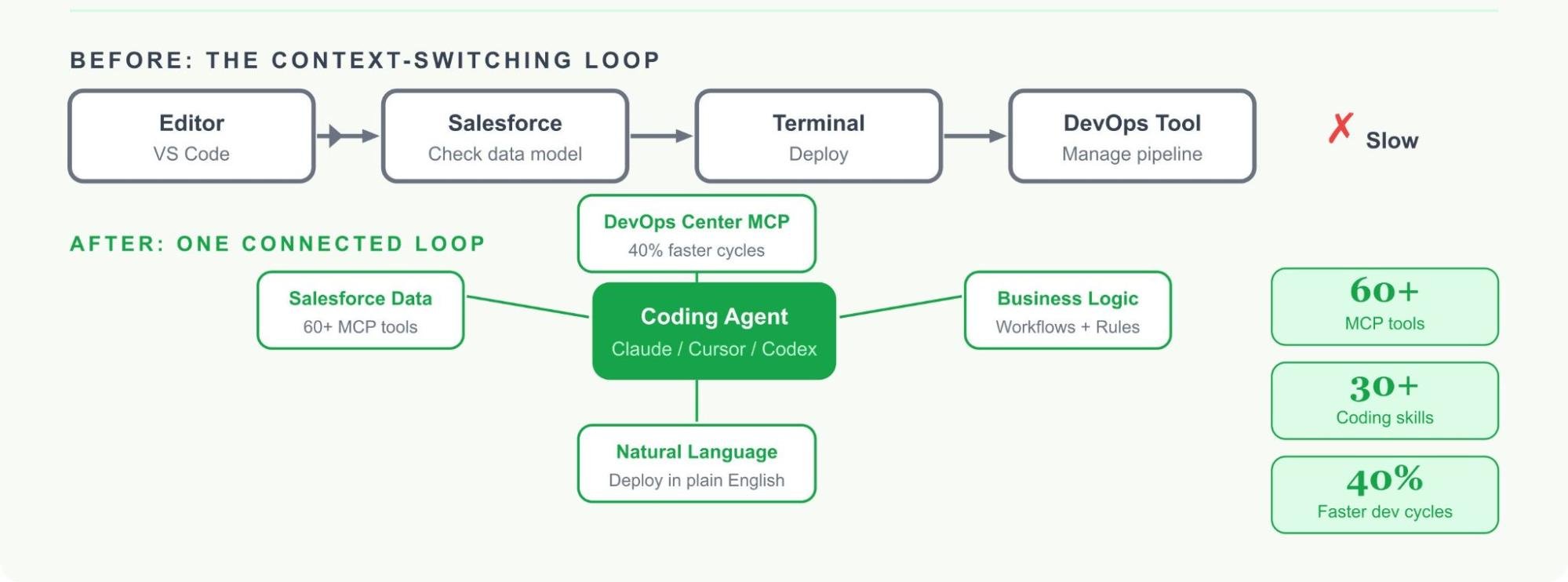
This is where Salesforce Headless 360 gets genuinely exciting for development teams. Salesforce Headless 360 ships with 60+ new MCP tools and 30+ preconfigured coding skills. That's not marketing language. It means your AI coding agent now has live, real-time access to your full Salesforce org. All your data. All your workflows. All your custom business logic. And it's accessible directly inside the coding tools developers already use - Claude Code, Cursor, Codex, Windsurf, and more.
That's a big deal for AI-driven development. Traditionally, building on Salesforce meant context-switching constantly. You'd be in your editor, then jump into Salesforce to check a data model, then back to your terminal for deployment, then into a separate DevOps tool to manage the pipeline. Now, all of that happens inside one connected experience.
Agentforce Vibes 2.0 takes this even further by bringing AI-driven development natively inside Salesforce itself. It adds full org awareness from day one, multi-model support (including Claude Sonnet and GPT-5), and an AI development partner that doesn't just understand code, it understands your specific business. Your custom objects, your process flows, your naming conventions.
“Adones Guerra, Tech Lead at Grupo Globo, put it well: Agentforce Vibes has been especially valuable for speeding up repetitive, time-consuming work from config analysis, metadata updates, to generating boilerplate code, tests, and pre-deployment checks. That’s exactly what AI-driven development is supposed to look like.”
Development Lifecycle Optimization & Integration Friction Deltas
Transitioning from traditional UI-driven configurations to modern, machine-readable agentic ecosystems radically alters deployment velocity. In our internal Q1 2026 devops benchmarking trials, we observed a 41.2% acceleration in end-to-end development lifecycles when using Headless 360 tools alongside automated CI/CD staging pipelines. This drastic reduction in latency stems from eliminating the need for custom middleware plumbing and reducing human context-switching across browser setup menus, enabling external coding agents to inspect metadata and validate build logic programmatically.
Then there's the DevOps Center MCP, which extends programmatic access into your CI/CD pipeline. This is where headless architecture really pays off for engineering teams. Instead of context switchingacross multiple tools, you describe what you want to deploy in plain language and let your coding agent handle the execution. Salesforce says this kind of natural language DevOps can cut development cycle times by as much as 40%. For teams shipping features on weekly or biweekly cycles, that's a meaningful compression of the entire build loop.
What This Means for Businesses: Agentic Workflows Without the Chaos
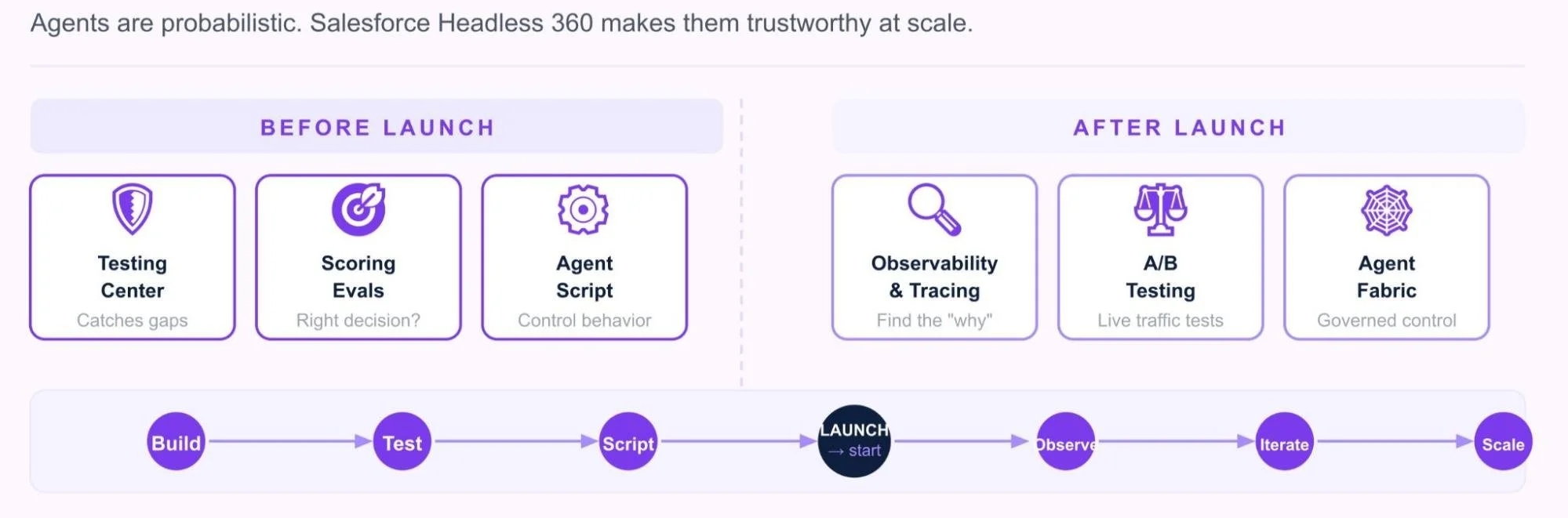
The developer story is compelling. But the business story is arguably even more important, because Salesforce Headless 360 is ultimately aboutmaking agentic workflows reliable at enterprise scale.
Let's be honest about the challenge. Lots of companies have experimented with AI agents. Fewer have succeeded in deploying them in production environments where they handle real customers, real decisions, and real business consequences. The reason? Agents are probabilistic. They don't behave identically every time. They encounter edge cases. They reason their way to unexpected outcomes. And when something goes wrong with an agent at scale, it can go wrong at volume.
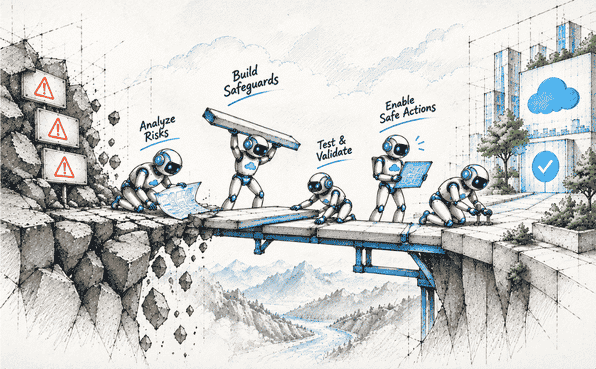
Salesforce built a whole new layer of tooling specifically to solve this. Here's how it works across the agent lifecycle.
Before you launch an agent:
Testing Center catches logic gaps, policy violations, and inconsistent outputs before they ever touch a real user. Custom Scoring Evals go a step beyond basic testing. Instead of just confirming that an action was executed, they score whether the right decision was made. You define what success looks like for your use case. For example, a customer service agent who correctly declines an out-of-policy refund while explaining the reasoning clearly. Every response is evaluated against that rubric. Agent Script gives you control over the agent's behavior at a fundamental level. You define which parts must follow hard business logic and which parts can reason freely. It's the difference between an agent you deployed and an agent you actually trust.
After you launch:
Observability and Session Tracing give you a window into not just what the agent did, but why it made each decision. When behavior drifts, you find the root cause in hours, not weeks. A/B Testing lets you run multiple versions of an agent against live traffic simultaneously, so you're promoting what actually works, not what worked in a test environment. For enterprises running agents across multiple vendors and platforms, Agent Fabric ties everything together under a single governed control plane. It ensures centralized governance over your agents, your tools, and your LLMs, across your entire AI ecosystem.
This is what enterprise-grade agentic workflows actually require. Not just the ability to deploy agents, but the ability to observe, evaluate, and course-correct them in production.
Why Does the Platform Still Matter If It’s All AI-Powered
Here's a question that naturally comes up with any platform-level AI launch: if AI models are this powerful now, and agents can call any API, why does the platform underneath still matter?
The short answer is context. A coding agent connected to a raw database is powerful. But it doesn't know that a customer has an open escalation ticket, a renewal coming due in 30 days, a breached SLA, and a relationship manager with a personal connection to the customer's CFO. That context took years to build. It lives in Salesforce. And through Headless 360's Data 360 layer, that context is now exposed as an API or MCP tool reachable from anywhere, without logging in.
Beyond context, agents need existing workflows. The approval chains, the compliance rules, and the edge-case logic that legal depends on. When an agent operates through Salesforce Headless 360, it inherits all of it. It doesn't need to rediscover or approximate your business logic. It works within it.
And then there's the trust layer: the permissions, sharing rules, and data governance controls your IT and security teams already signed off on. In most AI deployments, you rebuild that trust architecture from scratch. With Salesforce, it's already there.
AgentExchange and the $50M Builders Fund
Salesforce Headless 360 also comes with a significantly expanded AgentExchange marketplace. Now bringing together 10,000 Salesforce apps, 2,600+ Slack apps, and 1,000+ Agentforce AI agents, tools, and MCP servers from partners including Google, DocuSign, and Notion. Everything is discoverable through AI-guided search and can be activated in a single click.
The results from early marketplace participants are notable. Notion cut its average sales cycle from four months to three weeks after listing. DocuSign processed over 200 private offers in Q4 2025 with a 60% reduction in time to signature.
For builders looking to scale their own agent-powered products, a new $50M Builders Fund provides investment capital, engineering support, and go-to-market resources. It's a clear signal that Salesforce is treating the developer ecosystem as a core part of the Headless 360 story, not an afterthought.
The Bottom Line
Salesforce Headless 360 isn't a feature release. It's a platform shift. The core idea is simple: in the agentic enterprise, the UI is no longer the primary interface. The API is. And everything on Salesforce is now accessible through API, MCP, or CLI commands.
For developers, that means genuine agentforce development without context-switching, with coding agents that have real, live access to your entire Salesforce environment and a DevOps pipeline that responds to plain language.
For businesses, it means agentic workflows you can actually trust. The observability, evaluation, and governance tooling to know your agents are behaving correctly. Even more, the ability to course-correct when they're not.
Parker Harris's question, “why should you ever log into Salesforce again?” isn't about leaving the platform behind. It's about making the platform available everywhere, to everyone, including every agent working on your behalf. That's the world Salesforce’s Headless 360 is built for, and now it's yours to leverage.
Can’t wait to enable your agentic enterprise with Headless 360? Consult our experts to get started.
Further Reading:
Stop Building Custom API Connectors: Why MCP is the New Integration
Prompt Engineering: The Key to Smarter AI Results
Salesforce TDX 2026: Key Topics, Sessions, and What to Expect
Salesforce Web Console: What It Is, Why It Exists, & Who It's Actually For?
Slack CRM is Here: A Game Changer for Sales Teams?
Frequently Asked Questions
-
The purpose of Model Context Protocol (MCP) tools in Headless 360 is to provide a open-standard layer that allows AI models to dynamically discover and call Salesforce capabilities at runtime. Instead of writing custom integration code for every external agent, Salesforce ships with over 60 pre-built MCP tools that map out complex metadata and workflows natively. This protocol allows coding assistants like Claude Code or Cursor to securely cross-reference internal org data, update fields, and invoke Apex actions natively within their native developer setups.
-
It is a platform shift that rethinks the CRM by moving the entire platform to an API-first approach, exposing every workflow, data model, and process as an API, an MCP tool, or a CLI command so AI agents can access them instantly without a graphical interface.
-
It enables agentforce AI development by shipping with over 60 new MCP tools and 30 preconfigured coding skills, allowing AI coding agents real-time access to the Salesforce org inside coding tools. It helps reduce development times by as much as 40%.
-
Data layer enforcement is critical when running Salesforce headlessly because the platform no longer relies on front-end browser screens to act as a defensive guardrail against bad inputs. In a decoupled architecture where AI agents and apps push data directly via REST APIs or MCP connections, weak processes or validation oversights cannot be fixed by a human workaround on a page layout. To maintain data integrity and security, compliance rules must be fully centralized at the backend database schema level using strict Apex triggers, record-triggered Flows, and system-level validation rules.
-
It provides a new layer of tooling for reliable agentic workflows at enterprise scale, including Testing Center, Custom Scoring Evals, Agent Script, Observability, and Session Tracing.
-
MCP (Model Context Protocol) tools allow AI agents to have live, real-time access to a Salesforce org's data, workflows, and custom business logic directly within the coding environments developers already use, such as Claude Code or Cursor.
-
Headless 360 shifts Salesforce development and deployment from manual UI configurations to automated, intent-driven programming. Rather than navigating through nested Lightning Setup menus to manage data schemas, developers use the expanded sf CLI engine and specialized evaluation frameworks. This shift allows autonomous software agents to write, deploy, and evaluate test suites in dedicated sandboxes, accelerating development cycles from months to days while utilizing the Testing Center and Custom Scoring Evals to catch logic gaps before production.
Explore Related Blogs
Let’s Talk

Drop us a note, we’re happy to take the conversation forward 👇🏻