Slack CRM: A Game Changer for Sales Teams To Manage Customers?

Key Summary:
Slack CRM is a new conversational CRM launched as part of Salesforce Slack’s 30+ updates, built directly into the Slack platform.
It helps reduce context switching and improve data quality by letting teams manage customer records through Slack conversations with Slackbot.
Slack CRM is a conversational CRM built directly into Slack.
The landscape of customer relationship management is evolving rapidly, and Slack has just made a bold move that could reshape how small businesses and sales teams manage their customer data.
In March 2026, Slack introduced Slack CRM, a conversational customer relationship management system built directly into the collaboration platform millions already use daily. But is this innovation truly a game changer for sales, or just another feature in an already crowded CRM market?
What Is Slack CRM?
Slack CRM is a new AI-powered, conversational CRM tool that unites customer data with Slack channels and empowers Salesforce teams in Slack. Rather than forcing teams to switch between applications, Slack CRM integrates customer data management directly into the Slack conversations where teams already collaborate, communicate, and make decisions.
The system is included with Slack Business+ subscriptions at no additional cost, making it immediately accessible to thousands of businesses already using Slack's premium tiers. The underlying idea is simple yet potentially transformative: what if managing your CRM was as natural as having a conversation?
How Slack CRM Works: Conversational Customer Management
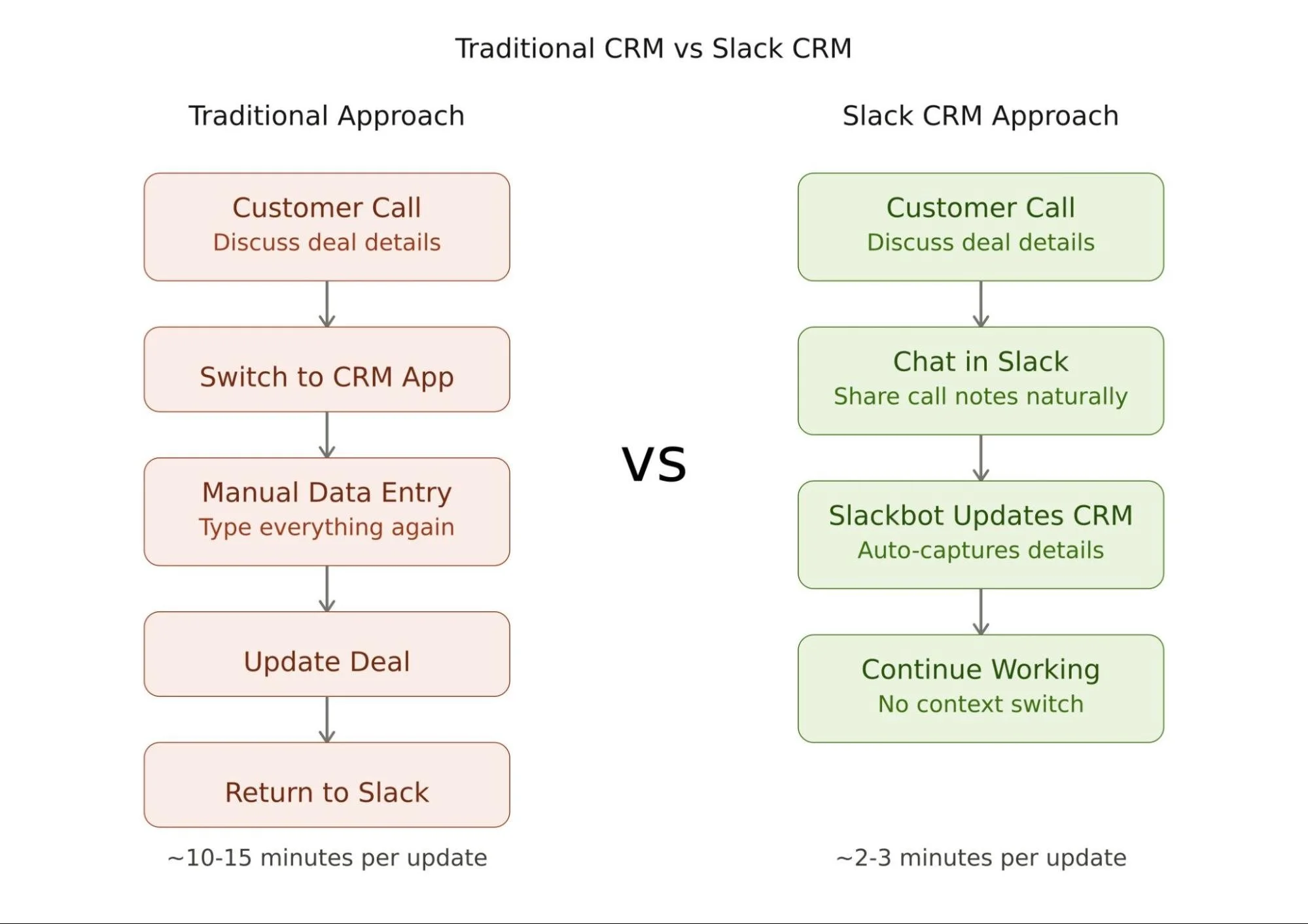
The transformative aspect of Slack CRM lies in its conversational interface. Instead of navigating through complex menus, forms, and dashboards in a separate application, users interact with Slackbot (Slack's AI assistant) to manage customer records, update deal statuses, and retrieve information.
Core Features and Capabilities
Slack CRM enables teams to turn any conversation into a customer record, with Slackbot automatically pulling relevant details from threads and populating records. This means sales reps can update their CRM simply by discussing a customer call in a Slack channel, rather than logging into a separate system and manually entering data. Here are some of the key features the platform offers:
1. Automated Record Creation: When your team discusses a customer in Slack, Slackbot can transform that conversation into structured customer data. Details like contact information, deal size, conversation history, and next steps can be extracted and organized automatically.
2. Real-Time Team Synchronization: Everyone on the team sees the same updates, follow-ups, and deal status in real time. It eliminates the information silos. Sales reps never forget to log activities, and everyone stays informed on different accounts.
3. Unified Agenda View: Slack conversational CRM provides an Agenda View that surfaces meetings, highlights, and follow-ups all in one place. It gives sales teams a consolidated view of their daily priorities.
4. Contextual Preparation: Before important customer calls or meetings, users can ask Slackbot to surface past conversations and key customer context. Therefore, teams can walk into every interaction fully prepared with relevant history and insights.
5. Lead Capture: New leads flow directly into Slack channels where the team is already collaborating, reducing the friction of getting new opportunities into the system and ensuring faster response times.
6. AI-Powered Outreach: Slackbot uses existing customer context to help draft better outreach messages faster, leveraging the wealth of conversational data. The communications can now be more personalized.
Enhanced Salesforce Integration Features
Beyond the new Slack CRM product, Slack has also deepened its Slack Salesforce integration, providing powerful enhancements for teams already using the full Salesforce platform:
Activity Timeline Integration
The Salesforce Activity Timeline is now available right inside Slack. It removes the need to toggle between multiple tabs to understand the complete customer interaction history. Sales reps can see every touchpoint with a customer without leaving their collaboration environment.
Streamlined Record View
A redesigned Salesforce record view in Slack declutters headers, reorganizes quick actions, and adds expandable field sections. This makes it easier to view customer information, take action, and move forward without information overload.
In-App Owner Changes
Teams can now reassign the owner of any Salesforce lead, case, or opportunity directly in Slack. The updates also notify the new owner. The feature enhancement helps reduce the friction during account handoffs.
Why Slack CRM Could Be a Game Changer for Sales Teams
1. Elimination of Context Switching
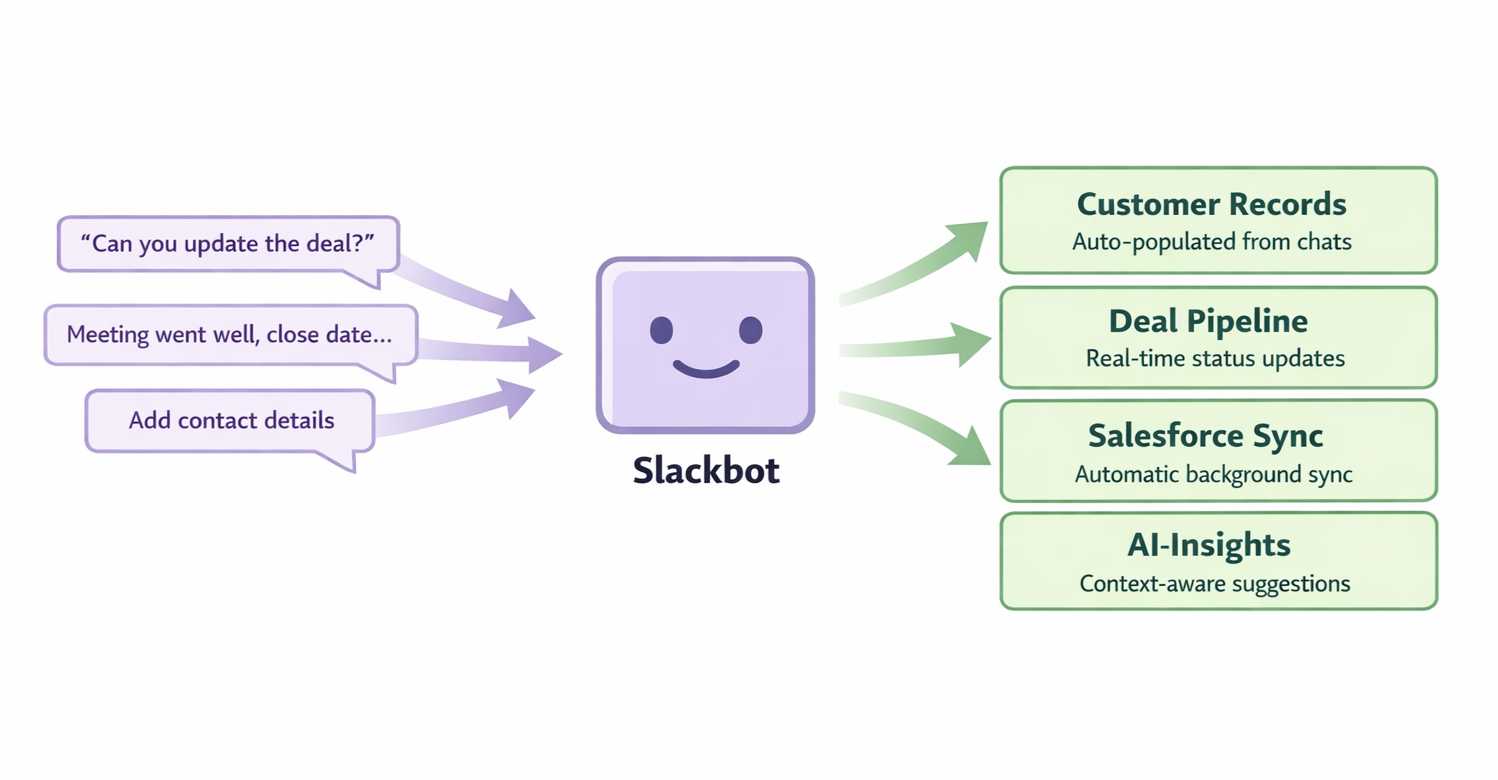
The average sales professional uses between 6 and 10 different tools throughout their workday. They need to constantly switch between email, CRM, calendar, and communication platforms. Each switch reduces the focus and efficiency. By bringing CRM functionality into Slack, sales teams can manage customer relationships in the same environment where they're already coordinating deals, sharing competitive intelligence, and collaborating on proposals.
2. Higher Data Quality Through Natural Capture
Data entry in Traditional CRM feels like overhead work that pulls salespeople away from selling. As a result, CRM databases are often incomplete, outdated, or inaccurate. When CRM updates happen naturally through conversation, data quality improves significantly. Now, discussing a customer call can generate a record rather than separate logging.
3. Accelerated Onboarding
New sales team members can start contributing to the conversational CRM almost immediately. Instead of extensive training on complex software interfaces, they simply join relevant Slack channels and start participating in customer conversations. The barrier to conversational CRM adoption for a new team drops from weeks to days or even hours.
4. Improved Team Collaboration
Sales is a team effort. Slack conversational CRM brings account managers, engineers, and marketing together in one place. Everyone gets a clear view of customer status and can share insights instantly. No separate software or extra permissions required.
5. Cost Efficiency for Small Businesses
For companies already paying for Slack Business+, Slack CRM represents zero marginal cost. It lowers the barrier to implementing structured customer management for small businesses and startups that might otherwise delay CRM adoption due to budget constraints.
Potential Considerations & Current Scope of Slack CRM
While Slack CRM offers great advantages, it's important to consider its current scope and potential limitations:
Designed for Small Business Complexity
Slack conversational CRM appears optimized for small business use cases with straightforward sales processes. Organizations with complex sales cycles, multi-stage approval workflows, territory management, quota tracking, or sophisticated forecasting needs may find Slack CRM's feature set limited as of now compared to full-featured CRM platforms.
Integration Ecosystem
While Slack CRM integrates deeply with Salesforce, questions remain about how it connects with other sales tools. The robustness of the integration ecosystem will significantly impact its utility for many organizations.
Data Governance and Compliance
For regulated industries or enterprises with strict data governance requirements, managing customer data through conversational interfaces may raise questions about audit trails, data retention policies, and compliance documentation that traditional CRM systems have matured to address.
Complementary Features: Making Slack a Complete Work Hub
Slack's March 2026 feature drop included several other enhancements that complement Slack CRM and strengthen the platform as a central work hub:
AgentExchange
AgentExchange serves as a dedicated hub for all AI agents inside Slack, allowing users to discover AI-powered apps, see installed agents, and pick up recent agent conversations. This creates an ecosystem where AI agents can augment sales workflows alongside CRM in Slack.
Work Objects Integration
Tasks, tickets, and issues from tools like OneDrive, Asana, and Jira now surface as rich, standalone results inside Slack search, organized by app. This helps sales teams track customer implementation projects, support tickets, and account health without leaving Slack.
Who Should Consider Slack CRM?
Thinking about switching to Slack CRM? It’s a great fit for teams that want to keep things simple and stay where the action is. Here’s who should give it a look:
Startups and Small Teams: If you have 10-50 people and need the basics without the big enterprise price tag, this is for you. If you’re already on Slack Business+, it’s an easy win.
Slack-First Organizations: If your team basically uses Slack already, it makes sense to manage your customers in the same place you talk to your teammates.
Teams That Don't Like Traditional CRMs: If your current CRM feels like a chore and no one is using it, Slack’s conversational style might actually get your sales team to keep their data updated.
Companies Planning to Scale to Salesforce: If you plan on moving to Salesforce later but aren’t ready yet, Slack CRM is the perfect stepping stone. Your data will be ready to move when you are.
The Future of CRM: Conversational and Contextual
The launch of the CRM in Slack shows how AI CRM tools can be a new way to manage customer relationships. While it may not replace the comprehensive CRM platforms designed for complex needs, it shows how customer data management can be simpler and more natural.
The most significant aspect of Slack CRM may not be what it is today, but what it signals about where CRM is heading. As Slackbot AI capabilities continue to advance, and as the lines between "collaboration" and "transaction" blur, the distinction between a "CRM system" and a "place where work happens" may become increasingly meaningless.
If you're tired of switching between too many apps or fighting with a CRM nobody uses, Slack CRM is worth a look. It’s a fresh approach that keeps everything in one place. Whether it’s the right "game changer" for you depends on your team's specific needs, but it’s definitely proof that CRM doesn't have to be complicated.
The Verdict: Game Changer or Incremental Improvement?
Whether Slack CRM is a game-changer depends significantly on your organization's context and needs. For small businesses and startups already using Slack, the CRM in Slack could indeed be transformative. The reduction in friction, elimination of context switching, and zero additional cost make it a compelling option that could significantly improve how they manage customer relationships.
Further Reading:
Salesforce AppExchange: How to List an App on Salesforce AppExchange
Salesforce CRM: The Org Chart Stopped Reflecting Reality. Here Is What Replaced It.
Agentforce Migration: Migrating Einstein Bots to Agentforce: Why It Is a Rebuild, Not an Upgrade?
Explore Related Blogs


Let’s Talk

Drop us a note, we’re happy to take the conversation forward 👇🏻