
How does Marc Benioff's 'Vibe Coding' model change the role of a traditional Salesforce developer in 2026?
Key takeaways:
Vibe Coding shifts developers from coding to solution design.
Enterprise AI enables secure and faster Salesforce development.
AI-assisted developers will lead the future of Salesforce innovation.
In 2026, Salesforce CEO Marc Benioff said the company plans to spend $300 million on Anthropic AI tokens, with a good chunk of that investment going to AI-assisted coding rather than adding engineers. The announcement immediately raised an important question. Are Salesforce developers being replaced by AI, or just changing their role?
We can connect this answer to Vibe Coding, an AI-led methodology that enables developers to collaborate with AI to build solutions faster by focusing on architecture, business logic and problem-solving, rather than repetitive coding.
But what does this shift mean for traditional Salesforce developers? In this article, we will delve into the mechanics of Vibe Coding and its impact on Salesforce development.
What Is Marc Benioff's 'Vibe Coding' Model?
Vibe Coding is an AI-first development approach where developers use natural language prompts to create applications, AI automations and business logic instead of manually coding every component.
This is the set of practices you can use to build your software by instructing what you want to build. Without using manual effort like typing functions and variables, a developer describes the desired outcome in plain English, then AI acts as a coding partner and generates the required code with proper syntax based on your instructions.
The Evolution of Salesforce Development: Before vs. After Vibe Coding
In traditional coding, developers focus on manual coding; they write every line of code, add features, fix bugs, and walk through tests to make sure everything behaves as expected. Every adjustment adds more time because it takes time to be written, reviewed, and verified by hand. The table below shows the comparison between traditional Salesforce development and Vibe Coding.
| Traditional Development (Before Vibe Coding) | After Vibe Coding |
|---|---|
| Manual syntax typed line by line. | Conversational prompts written in plain English. |
| Longer development cycles. | Faster prototyping and delivery. |
| Focus on implementation. | Focus on architecture and business strategy. |
| Requires deep programming and Salesforce expertise. | Requires strong problem-solving skills and the ability to write effective AI prompts. |
| Every feature is built manually from scratch. | AI generates the initial implementation, allowing developers to refine, validate, and optimize it. |
The Risks of Using Public AI Models for Vibe Coding
If you are trying to use public LLM models, it’s good for your hobby project, and you can use it for your practice work, but if you are working for a business or an organization, it creates a massive risk and vulnerability.
Let's understand with an example:
Imagine a Salesforce developer copying custom Apex code into a public AI tool to fix an issue. This could expose sensitive business information. Public AI models don't understand your company's Salesforce setup, custom objects, or business processes. Because of this, they may generate incorrect code, break integrations, or introduce security risks.
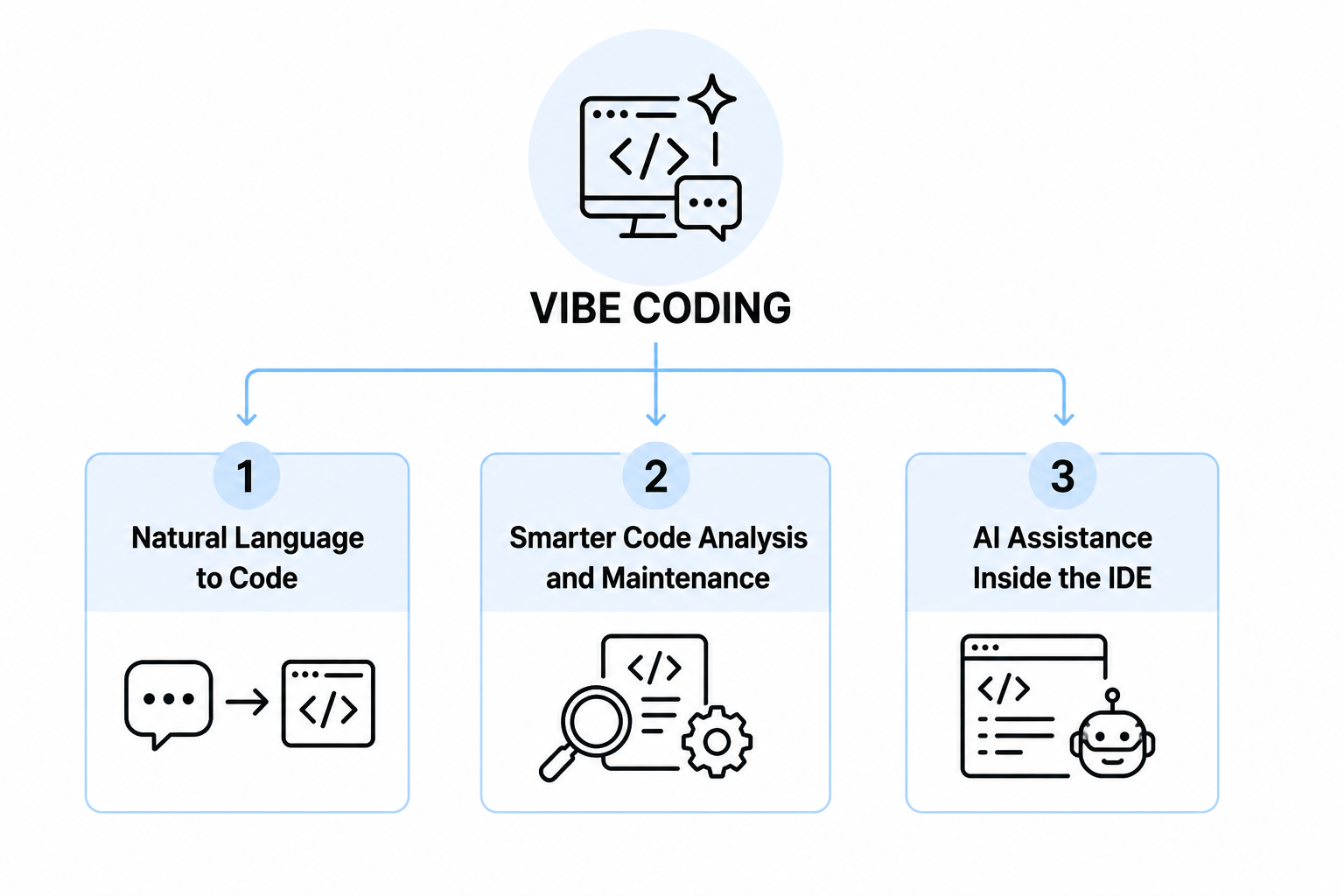
3 Ways Enterprise Vibe Coding Transforms Enterprise Development
1. Natural Language to Code
Instead of writing every line of code manually, developers can simply describe what they want to build in plain English. Whether it's a new application, API integration, or automated workflow, enterprise AI generates production-ready code based on the request. What once took hours can now be completed in minutes, allowing teams to deliver features much faster.
2. Smarter Code Analysis and Maintenance
Understanding and maintaining existing code is often more challenging than writing new code. Enterprise AI can analyze large codebases, detect security risks, identify performance issues, and explain complex logic in plain language. This helps developers troubleshoot faster, onboard more quickly, and confidently work with legacy systems.
3. AI Assistance Inside the IDE
Developers work best when they stay focused. Enterprise AI integrates directly into development environments like Visual Studio Code, enabling developers to generate, review, edit, and test code without leaving their IDE. With AI support built into the workflow, teams spend less time switching between tools and more time building high-quality software.
How to Implement Vibe Coding Securely
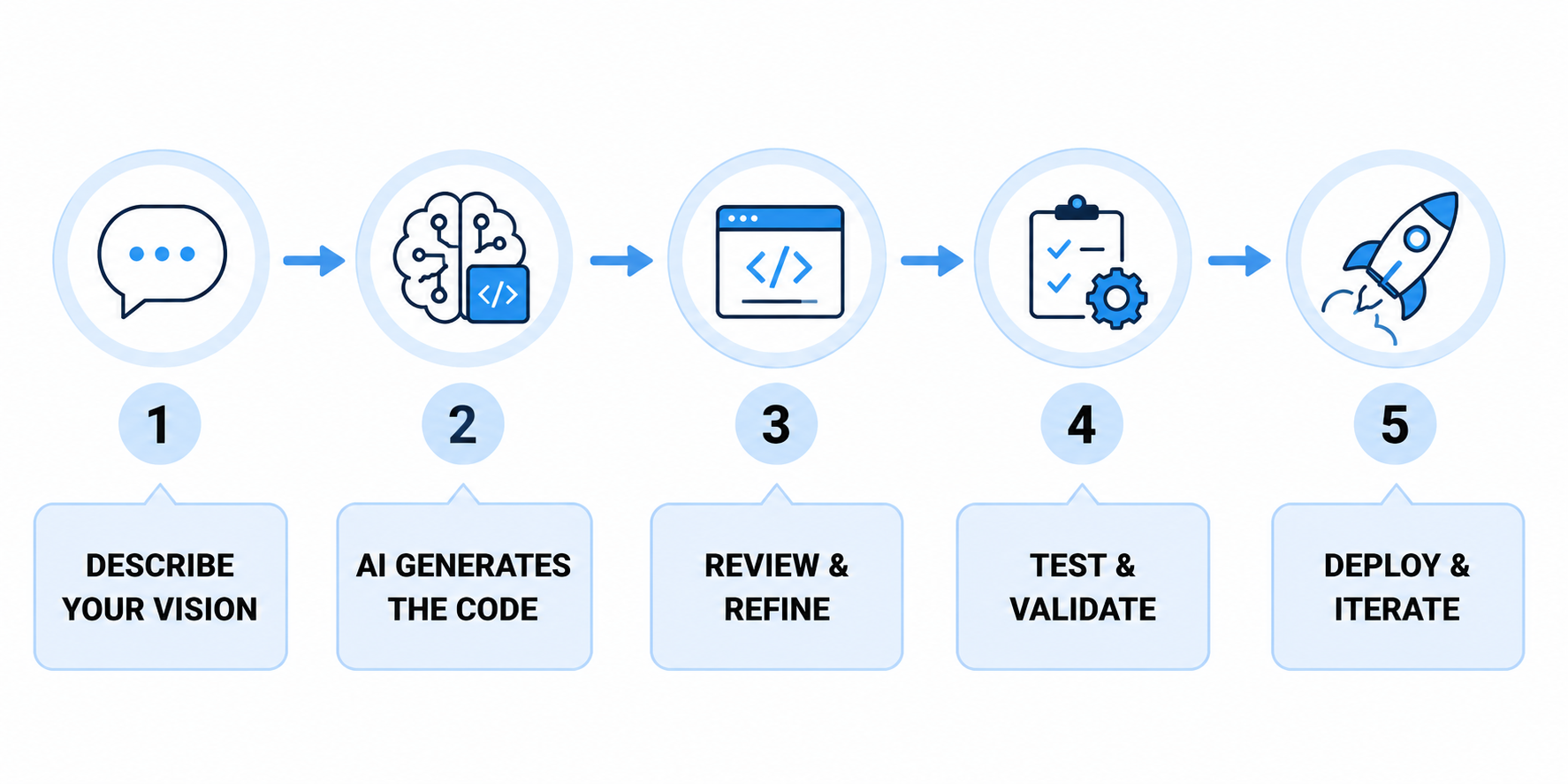
Replacing manual coding with AI-generated code doesn't eliminate the need for software engineering best practices. Secure, enterprise-grade development still requires a structured development lifecycle to ensure quality, security, and reliability.
1. Build in a Sandbox First
Always start development in a secure sandbox environment rather than a live production system. This gives developers the freedom to experiment with AI-generated code, validate functionality, and identify issues without putting customer data or business operations at risk.
2. Generate Code with Natural Language
Developers describe the application, feature, or workflow they want to create using natural language. The AI interprets the request and generates an initial codebase, providing a strong starting point instead of a blank screen.
3. Review, Test, and Refine
AI-generated code should always be reviewed by developers. Validate the output with code reviews, automated testing, security checks, and edge-case testing. If improvements are needed, refine the prompt and regenerate the code until it meets your quality standards.
4. Deploy Through Your Standard Release Process
Once the code has passed all functional, security, and performance validations, deploy it through your organization's established release pipeline. Following standard approval and deployment processes ensures AI-assisted development remains secure, compliant, and production-ready.
How Agentforce Vibes Enables Enterprise Vibe Coding
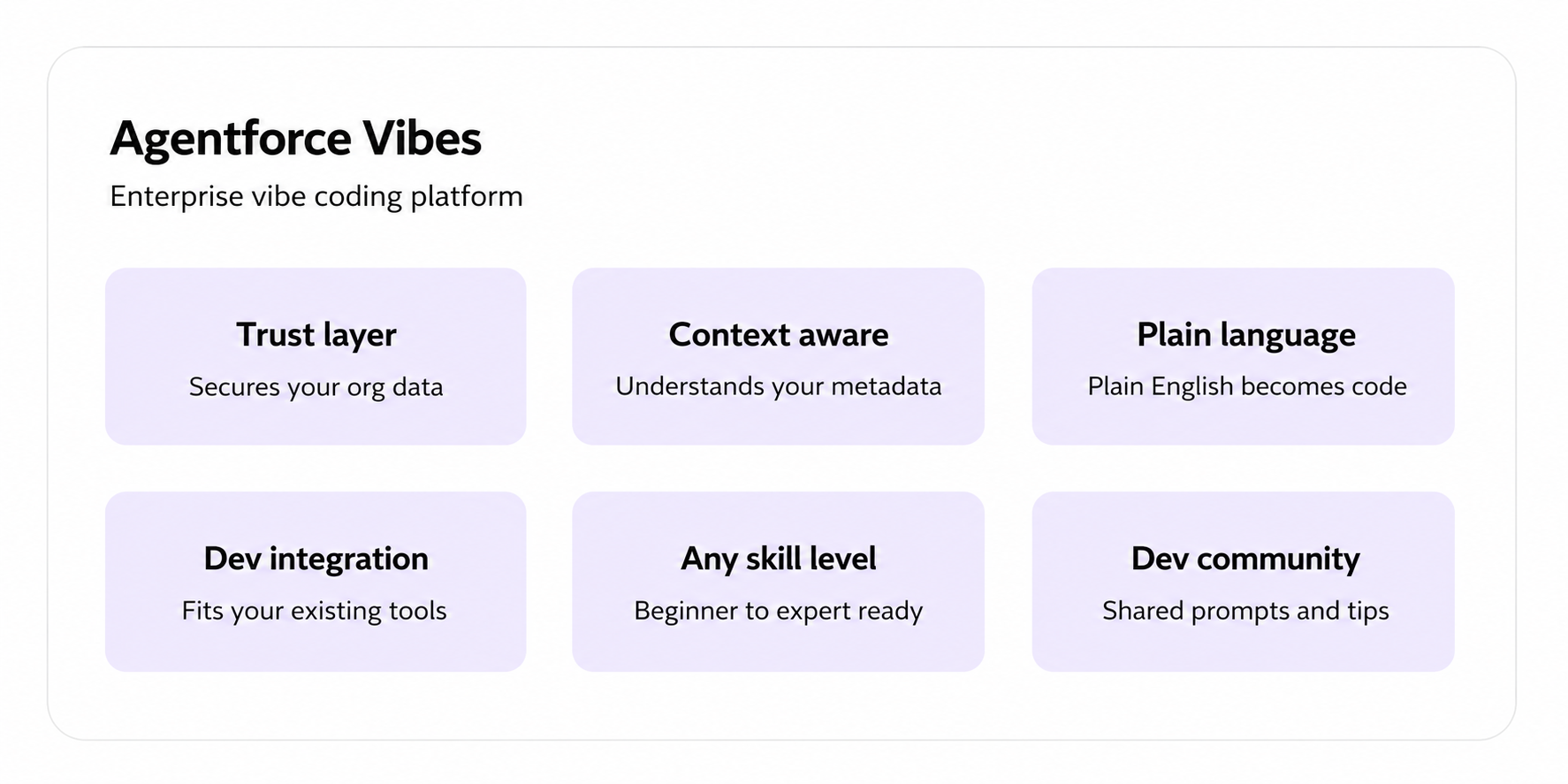
Agentforce Vibes brings the idea of vibe coding into the Salesforce ecosystem and developers turn these idea into apps, agents, and workflows sceurely. It helps generate Apex, Lightning Web Component LWC), and other Salesforce component in the reliable environment.
Agentforce Vibe operate.
1. Built on the Salesforce Trust Layer: Agentforce Vibes uses the secure Salesforce platform to safeguard your data and provide an Enterprise class level of security for your organisation.
2. Understands Your Salesforce Context: Agentforce Vibes understands your Salesforce metadata, business logic and application structure to produce code to fit within your existing environment.
3. Uses Natural Language: Developers are able to write their requirements in plain English allowing them to produce Apex classes, Lightning Web Components (LWC), Flows and other Salesforce components more simply.
4. Integrates Into Existing Development Tools: Agentforce Vibes integrates with the standard development environments that developers are used to; users can generate, review and refine their code without altering their workflow.
5. Meets the Needs of Developers of All Levels of Experience: Whether you are new to Salesforce or a seasoned professional, Agentforce Vibes will accelerate your coding process while allowing the developer to maintain control.
6. Complete Access to the Developer Community: Developers can access reusable prompts, shared examples from fellow developers and community best practices to assist them in developing effective prompts and building solutions.
Best Practices for Enterprise Vibe Coding
Enterprise Vibe Coding is more productive for organizations when AI is used alongside existing best practices in Software Development.
Use AI as a coding Assistant: Developers must, however, always review and improve upon the code AI generates.
Protect your data: Do not share your proprietary code or customer-related information with public AI applications.
Test Before Deployment: Validate the AI-generated code through code reviews, security checks, and automated tests before deploying into production.
Develop in a sandbox: Use a sandbox to build and test new features before deploying to production.
Follow your release process: Use your organization's accepted process to release AI-generated code via standard CI/CD and approval processes.
Conclusion
Vibe Coding is transforming Salesforce development by shifting the developer's role from writing every line of code to designing solutions, guiding AI, and solving business problems. Rather than replacing developers.
AI acts as a powerful coding partner that accelerates development while developers ensure quality, security, and scalability. If you're looking to adopt AI-powered Salesforce development, partnering with an experienced Salesforce consultant and AI consulting team can help you implement these innovations securely and maximize business value.
Frequently Asked Questions
-
No. Vibe Coding is designed to enhance developer productivity, not replace developers. Salesforce professionals are still responsible for architecture, security, testing, code reviews, and ensuring AI-generated code meets business requirements.
-
Agentforce Vibes is Salesforce's enterprise AI development experience that enables developers to generate Apex, Lightning Web Components (LWC), Flows, and other Salesforce components using natural language while operating within the Salesforce Trust Layer.
-
Organizations should use AI in secure development environments, generate code in sandbox environments, perform thorough code reviews and testing, and deploy changes through established DevOps and release management processes.
-
Vibe Coding helps teams accelerate development, reduce repetitive coding tasks, improve developer productivity, simplify code maintenance, and enable faster delivery of Salesforce applications without compromising quality.
Related Reading
Let’s Talk

Drop us a note, we’re happy to take the conversation forward 👇🏻