
Is HubSpot Better Than Traditional Real Estate CRMs?

Key takeaways:
Compare HubSpot with traditional real estate CRMs to find the right platform for your business.
Explore the features that simplify lead management and automate everyday real estate tasks.
See how successful real estate teams drive more leads and sales using a modern CRM.
For decades, real estate professionals have relied on basic CRMs as a digital filing cabinet. But in today’s fast-paced market, you need more than a place to store contacts; you need speed, automation, and data-driven intelligence.
Traditional platforms often fall short, but HubSpot is transforming the game into a comprehensive all-in-one marketing, sales, and analytics platform.
Why Traditional Real Estate CRMs Are No Longer Enough
The traditional CRMs for real estate are outdated because they make it difficult to manage teams with such a simplistic sales process. They provided a way to track leads, simple interactions, and handle follow-ups, but as we all know, the current market is evolving and demands significantly greater intelligence, automation, and speed to succeed.
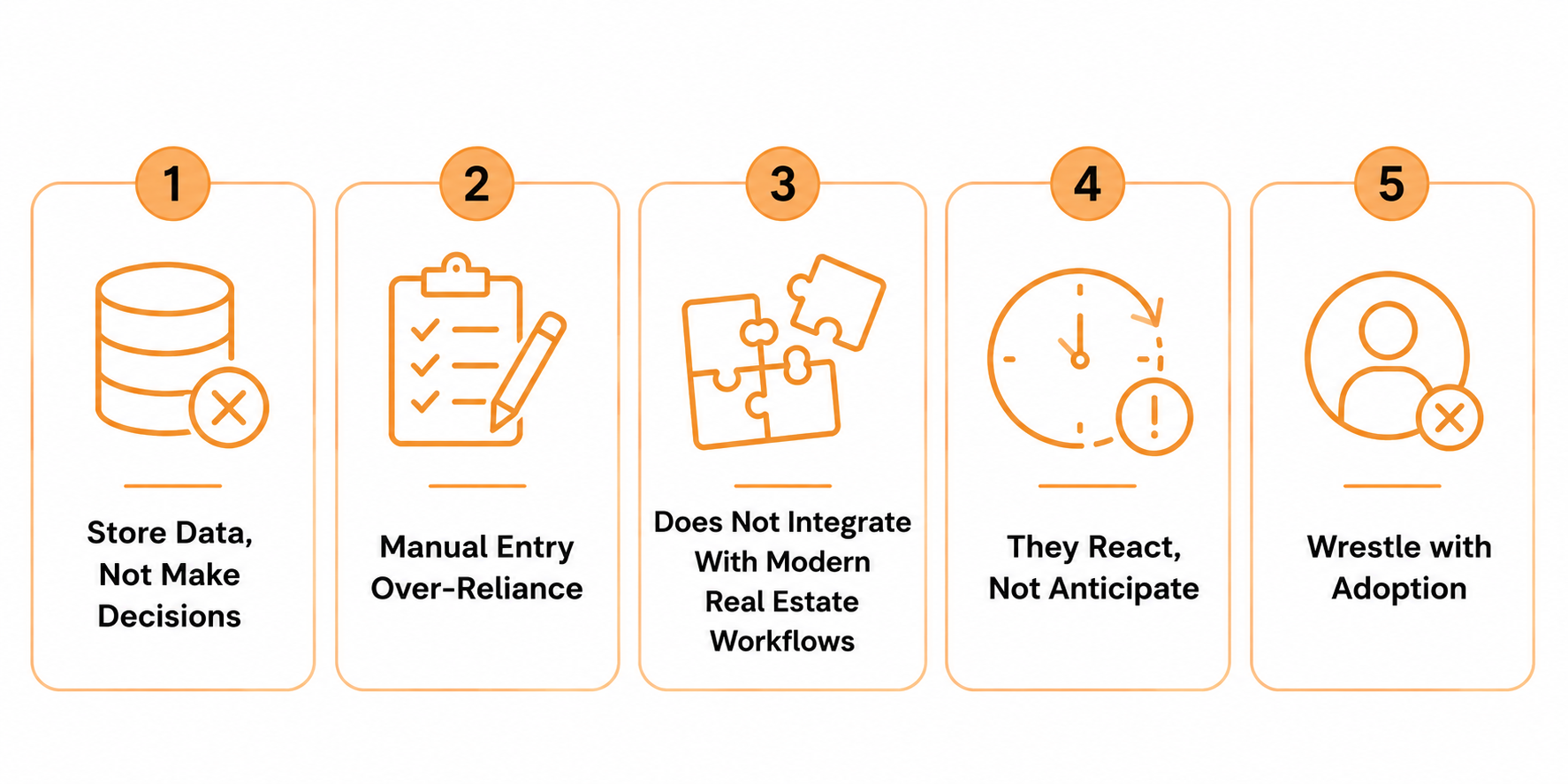
The issue is not that CRMs serve no purpose; the majority of CRMs continue to act as merely electronic filing cabinets as opposed to being functioning automation tools. Some of the major limitations of traditional CRMs are listed below.
1. Store Data, Not Make Decisions
Traditional CRMs are focused on lead information; however, they do not support agents in locating their identified intent and determining which leads need priority.
2. Manual Entry Over-Reliance
Manual Agents still have to record their calls, status of leads, and write detailed notes because the CRM does not automate any of these activities.
3. Does Not Integrate With Modern Real Estate Workflows
Work in a loosely coupled ecosystem that consists of different tools. Custom CRMs exist in their own silo, separate from the other tools in the ecosystem, and require agents to perform additional processing between the tools.
4. They React, Not Anticipate
Manage their leads as they are generated; they cannot identify intent, either to buy or sell, until the lead is generated or afterwards.
5. Wrestle with adoption
Traditional CRMs are difficult to consistently implement in their daily routine because they feel like more bureaucratic admin work and/or have a detrimental impact on the speed of customer service.
Why HubSpot Beats Traditional CRMs
Most conventional CRM software solutions are too complicated, rigid, or costly for agents working alone. HubSpot is known for its free CRM, easy-to-use interface, built-in automation, and an all-in-one platform that combines sales, marketing, and reporting.
It's free to get started, providing new agents access to the best tools without any financial risk.
The CRM has an intuitive/minimalist design that allows users to quickly become comfortable with it.
Combined with all these functions (sales, email marketing, advertising, forms, workflows), it enables solo agents and large brokerages alike to grow their companies more easily.
As a result of this functionality, HubSpot CRM is a top choice among real estate agents hoping to maintain simple operations while providing ample opportunity for future growth.
Key Features of HubSpot for Real Estate Agents
The Platform provides real estate agents with everything they need in one place to manage leads, track deals, and remain organized.
The platform enables them to gather the information they need about clients, such as their budgets, where they want to live, and how quickly they want to move, so agents can tailor their outreach and more easily move prospective buyers through the pipeline. Here are some key features of HubSpot CRM for real estate, as given below.
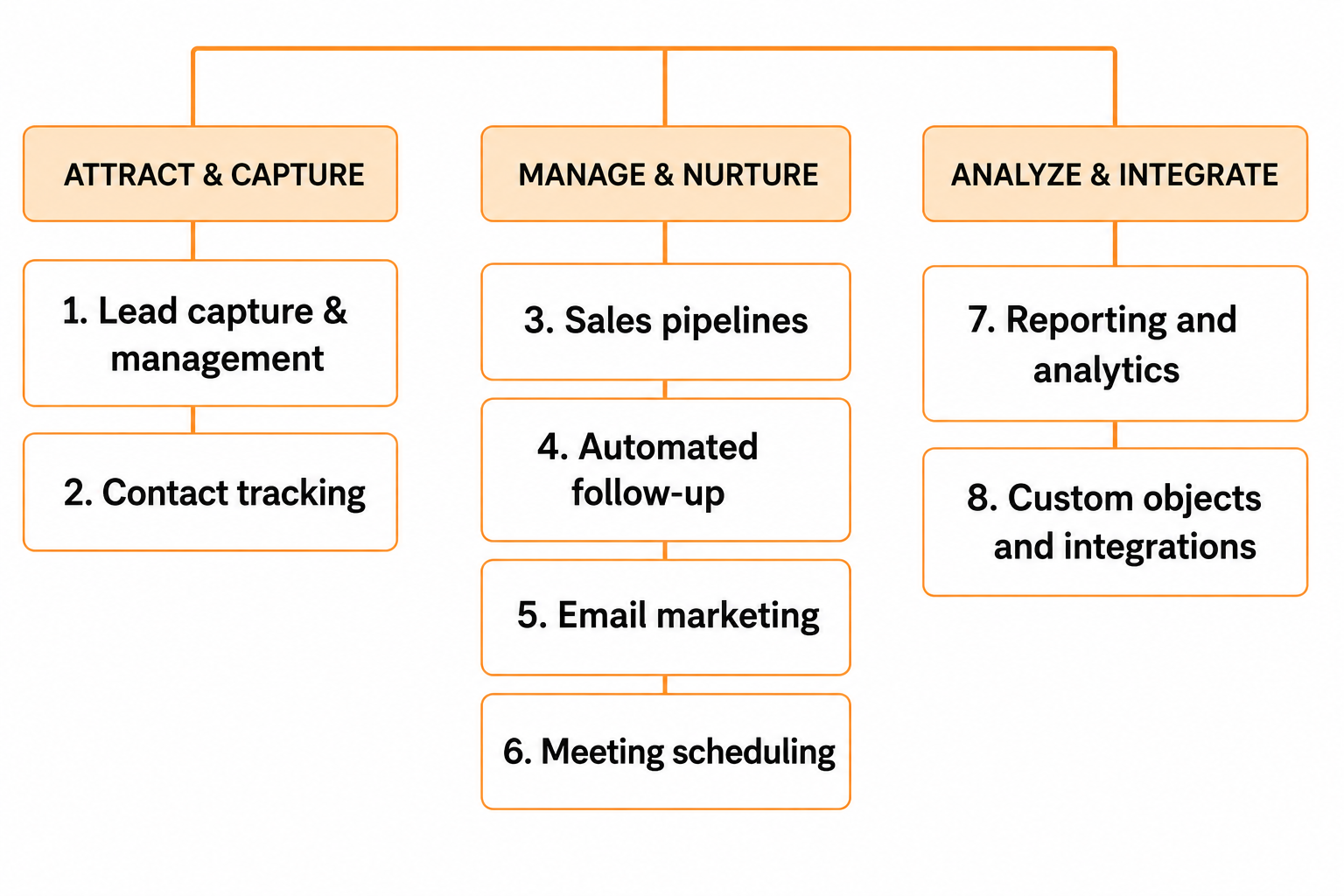
Lead capture & management: Capture leads from web forms, landing pages, ads, and website inquiries.
Contact tracking: Keep a record of all buyer/seller/renter details and interaction history.
Sales pipelines: Track each step of the process from first inquiry to closing with customizable stages for deals.
Automated follow-up: Send reminders and emails, and use automated workflows to keep prospective leads warm.
Email marketing: Use targeted email campaigns to promote listings, newsletters, and property updates.
Meeting scheduling: Clients can easily book appointments and showings online from a single system.
Reporting and analytics: Assess lead-source conversion rates, track deal progress, and evaluate your team's performance.
Custom objects and integrations: Organize properties, listings, and documents, and connect HubSpot with other software applications that you use.
HubSpot CRM is ideal for real estate agents, as it combines client management, automation, and marketing into a single system, rather than agents having to use multiple programs.
How HubSpot Aligns With Modern Real Estate Growth
Many CRMs just store leads, but HubSpot for real estate actually creates leads. Thus, real estate professionals have a systematic way of dealing with their leads (their database), and a way to communicate with and build rapport with buyers and renters.
1. Customising HubSpot for Real Estate
Custom Real Estate Data Fields: With HubSpot, agents can build custom real estate properties like budget, location, type of property, possession date, and source of leads, making it easier to group and rank their leads.
Automated Follow-Ups: HubSpot will automatically follow up on leads by sending messages via WhatsApp or email, assigning a task to the right agent, etc., so no leads get missed.
Smart Lists & Property Matching: Agents can create lists of leads based on buyer criteria and automatically send properties that meet the criteria to the leads.
Team Collaboration & Access Control: HubSpot provides managers and agents with role-based permissions. This allows managers to track team performance while agents can focus on their leads.
Real estate workflows will integrate seamlessly with HubSpot, helping agents grow their businesses.
2. Lead Generation & Marketing in Real Estate
When a customer views your listings, they download a property brochure, ask a question via live chat, or fill out a contact form. HubSpot collects their information and records the homes that interest them, as well as their interactions with your company.
But what if they are not ready to buy right now?
Rather than relying on inefficient follow-up methods, HubSpot allows you to automate your follow-up with a series of personalized emails that nurture them until they are ready to buy.
Email Series (automatically sent):
Day 1: Welcome email with brochure attached
Day 5: Schools, hospitals, and transportation near the home
Day 10: Testimonials from current homeowners
Day 15: Invitation to schedule a tour of the home
Day 20: Inventory update or price change
This way, while these emails automatically follow up with prospective buyers, you can focus your attention on buyers who wish to make a purchase.
HubSpot integrates with Google Ads and Facebook Ads so you can measure how much of your marketing dollar is spent driving leads to inquiry, site visit, and/or closing the sale of a home. This way, you do not have to guess where your marketing budget is being utilized; you can see where you have generated revenue. This makes HubSpot one of the most effective real estate marketing automation platforms for agents looking to generate and nurture leads.
3. Reporting and KPI Tracking With HubSpot
As an AI Automation Agency grows, it can be very frustrating not having insight into performance, because without data, you can’t improve campaigns, nor coach agents.
These insights help real estate businesses make faster, data-driven decisions and maximize the return on their CRM investment.
Lead-to-Visit Conversion: Indicates how effectively your team converts inquiries into visits on a property
Visit-to-Booking Rate: Indicates which projects are most appealing to buyers and how effectively your sales team closes opportunities
Average Deal Value: Provides a clearer idea of revenue potential and future growth in terms of the average value of deals
Sales Cycle Length: Indicates how fast prospects go from the first touch point with you to being a closed deal and whether or not your processes are causing delays.
Channel Attribution: Indicates which marketing channels provide leads and actual revenue, allowing you to invest your budget more confidently.
These metrics give real estate companies the ability to stop guessing and start making data-driven decisions.
Success Stories: Real Estate Teams Using HubSpot
1. RE/MAX Romania - 114% Increase in Leads
What if lead generation, marketing, and sales could all work together through one system?
RE/MAX Romania was able to answer that question when it integrated its customer journey with HubSpot. Looking for a home through marketing campaigns?
Those leads would be sent to landing pages with forms for submission. Plus, automated follow-ups were set up to keep the lines of communication open. This process has led to an increase of 114% in new leads as well as a much easier process for lead conversion to opportunities.
The easier you make it for leads to move through the funnel, the more opportunities you will create for your team.
Source: HubSpot Case Study
2. Hometeam Properties (US) - 600% Increase in Website Visitors
Hometeam created more than 180 individual landing pages for properties instead of using just a few generic property pages to drive leads to their business using HubSpot tools.
The results of this strategy were impressive. They experienced a 600% increase in website visitors, which resulted in hundreds of thousands of page views and thousands of new leads created. Most significantly, they achieved 100% occupancy in a highly competitive rental market.
The right content and landing page strategy can convert online visitors into real business success
Source: HubSpot Case Study
These two real success stories demonstrate how HubSpot CRM for real estate can drive measurable business growth.
By now, you've seen how HubSpot helps real estate businesses overcome the limitations of traditional CRMs through automation, integrated marketing, and proven customer success. The next step is understanding which pricing plan best fits your business needs.
HubSpot Pricing and Plan Options
HubSpot offers flexible pricing, making it suitable for everyone from independent agents to large real estate brokerages. Businesses can start with the Free CRM and upgrade as their lead volume, team size, and automation needs grow.
| Plan | Starting Price | Best For |
|---|---|---|
| Free | $0/month | Individuals and small teams getting started with CRM tools. |
| Starter | $7/seat/month with annual billing | Small businesses needing marketing, sales, service, content, and data management tools. |
| Professional | $1,300/month with annual billing | Growing businesses that need advanced automation, reporting, and scalability. |
| Enterprise | From $4,700/month | Large organizations requiring enterprise-grade customization, governance, and advanced features. |
For the most up-to-date pricing and feature details, check the official HubSpot Pricing Page
What's New in HubSpot, 2026
Let's take a look at HubSpot's latest features to enhance agent productivity and streamline operations:
Prospecting Agent handles the prospecting workflow, finds buying signals, sources contacts, and drafts outreach for review.
Customer Agent for Email works inside the Help Desk to handle routine inquiries.
AEO tracks brand visibility in AI answer engines like ChatGPT and Gemini
Smart Deal Progression reviews meeting transcripts, emails, notes, and deal history to suggest next steps.
Breeze Assistant helps with Loop Marketing tasks, including ICPs and campaign briefs.
Data Enrichment fills missing fields and refreshes stale contact and company data.
Buyer Intent combines website visits, research activity, company news, and job changes to identify active buyers.
TikTok organic publishing is now available inside HubSpot.
G2 MCP connects Breeze Agents to buyer behavior and customer voice data
Conclusion
Traditional CRMs can help you manage contacts, but modern real estate businesses need more than basic lead tracking. HubSpot for real estate combines CRM, marketing, automation, and analytics into one platform.
It helps agents generate more leads, improve client relationships, and scale efficiently. Whether you're just getting started or expanding your brokerage, investing in the right CRM and the right HubSpot implementation services can set your business up for long-term success.
Frequently Asked Questions
-
HubSpot helps capture leads through forms, landing pages, live chat, email marketing, and ad integrations. It also automates follow-ups to keep prospects engaged until they're ready to buy, rent, or sell.
-
Yes. Professional and Enterprise plans provide advanced automation, reporting, team permissions, and scalability features that support growing and multi-location real estate organizations.
-
While most real estate software is limited to basic text-generation shortcuts, HubSpot leverages an advanced AI suite (called Breeze AI). This includes AI Prospecting Agents that automatically enrich missing contact data, search for decision-makers, and draft hyper-personalized emails based on actual customer history. It even features Smart Deal Progression that reads meeting notes and automatically suggests next steps to keep a property transaction moving forward.
-
Unlike many traditional CRMs that focus primarily on record management, HubSpot unifies customer data, marketing, sales, service, and reporting in a single platform. This enables real estate businesses to create a more connected, scalable, and data-driven growth strategy.
-
Yes, and with much greater flexibility. Using HubSpot's Projects object, teams can move past basic pipeline stages and utilize full visual Gantt charts, internal task automation, and client onboarding portals. Whether you are coordinating with lawyers, home inspectors, or photographers, HubSpot allows you to automate these backend checklists natively, removing the need for a separate, disconnected project management tool.
Related Reading
Let’s Talk

Drop us a note, we’re happy to take the conversation forward 👇🏻