The Org Chart Stopped Reflecting Reality. Here Is What Replaced It.

$50 billion in annual contingent spend flows through workforce platforms like Beeline. None of it shows up on an org chart.
Gartner predicts 20% of organizations will use AI to flatten their org structure by 2026. More than half of current middle management positions will be gone.
That gap is not just a reporting problem. It is an execution risk. When your planning model does not reflect who actually does the work, every workforce decision is operating on incomplete data.
The org chart did not break because of remote work or flat-org fads. It broke when three forces converged simultaneously, and most leaders still have not caught up.
“The org chart didn’t break because of remote work. It broke when three forces converged: AI agents joined the workforce, the contractor-employee line dissolved, and skills replaced job titles as the unit of hiring.”
Built for a Workforce That No Longer Exists
The org chart assumes work gets done by employees in defined roles within a hierarchy. Every box is a person. Every line is a reporting relationship. Every department is a silo with clear boundaries.
But AI agents broke that assumption completely.
"The org chart was built in the industrial age to bring order, predictability, and stability to rapidly growing organizations," Aneesh Raman, LinkedIn's chief economic opportunity officer, told Fortune. "Companies need to let that go, as it's going to hold back innovation."
He is right about the diagnosis. But the framing is still incomplete. When your "workforce" includes full-time employees, fractional executives, freelance specialists, and AI agents with their own task queues, a box-and-line diagram is not simplifying reality. It is lying about it.
What Made This Unworkable: Three Concurrent Breaks
Three forces converged in 2025-2026 that made the traditional org chart structurally unworkable. Each one alone was manageable. Together, they break the model.
AI Agents Execute Tasks. No Box Exists for Them.
AI agents do not sit in a department. They execute tasks across functions: customer service, data processing, content generation, scheduling, code review.
Salesforce's Agentforce became the company's fastest-growing product ever, hitting $500 million ARR by December 2025. The 2026 Connectivity Report found 34% of enterprises now have embedded AI agents in their platforms.
For organizations running Agentforce, this is not theoretical. Agents are live in service, sales, and ops workflows, executing tasks that used to require a human queue. Understanding how Agentforce works makes clear why the org chart has no notation for it: agents operate across functions, not within them.
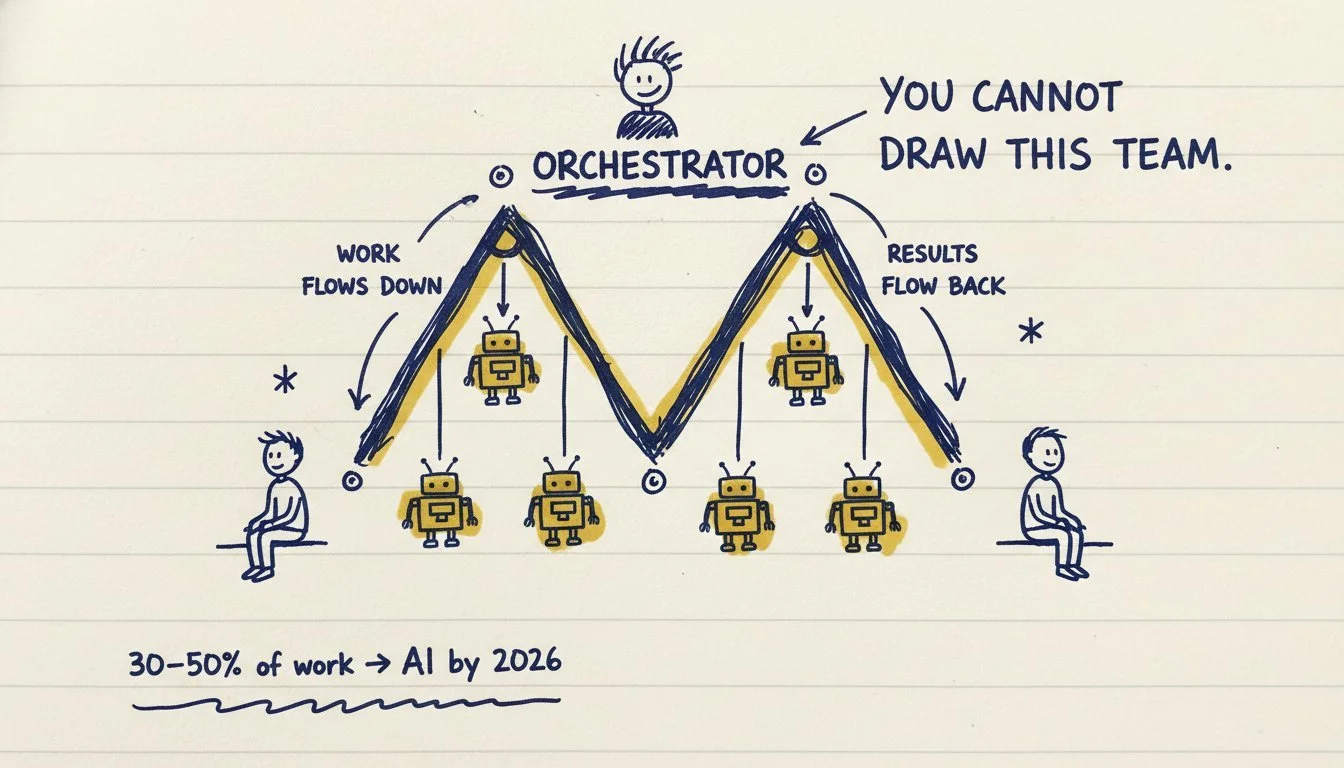
You cannot draw a box for a team that is three humans and seven agents. McKinsey calls this the "agentic organization,".
Built around "M-shaped supervisors": broad generalists who orchestrate agents and hybrid human-AI teams across domains.
One planning heuristic gaining traction: established businesses should target AI handling 30-50% of current human work by end of 2026. Not to cut headcount, but to elevate roles into supervisory positions managing agent workflows.
In my experience building Agentforce implementations, the first question from every client is not about the agent's capabilities. It's about who owns it on the org chart. There is no good answer. The chart was not built for this.
Contingent Work Is Core Work. The Org Chart Hides It.
The distinction between "employee" and "contractor" used to matter for org design. Employees appeared on the chart. Contractors did not. That separation is now a fiction.
Platforms like Beeline manage $50 billion+ in annual contingent spend for the Fortune 500. Fractional CTOs, freelance data scientists, on-demand design teams: they do a significant share of the work but exist nowhere in the official structure.
Korn Ferry's 2026 Workforce Planning report confirms the workforce is becoming "more fluid," not just more distributed.
Doug Leeby, CEO at Beeline, puts it directly: "Talent is Talent." Whether someone is full-time, fractional, or an AI agent, the question is the same: can this skill hit this task at this time? Leeby calls this Human-Agent Management: the workforce model where humans and agents are coordinated as a unified talent pool, not separate categories.
You Hire for Skills Now. The Org Chart Still Tracks Titles.
LinkedIn is pivoting to what it calls a "skills-first approach" to hiring. Employers look for specific capabilities, not job titles on a resume. Deloitte's 2026 Human Capital Trends describes this as the shift "from jobs to skills to outcomes."
The org chart is built on job titles and reporting lines. A skills graph is built on capabilities and outcomes. When you match skills to tasks instead of people to positions, the org chart becomes a historical artifact.
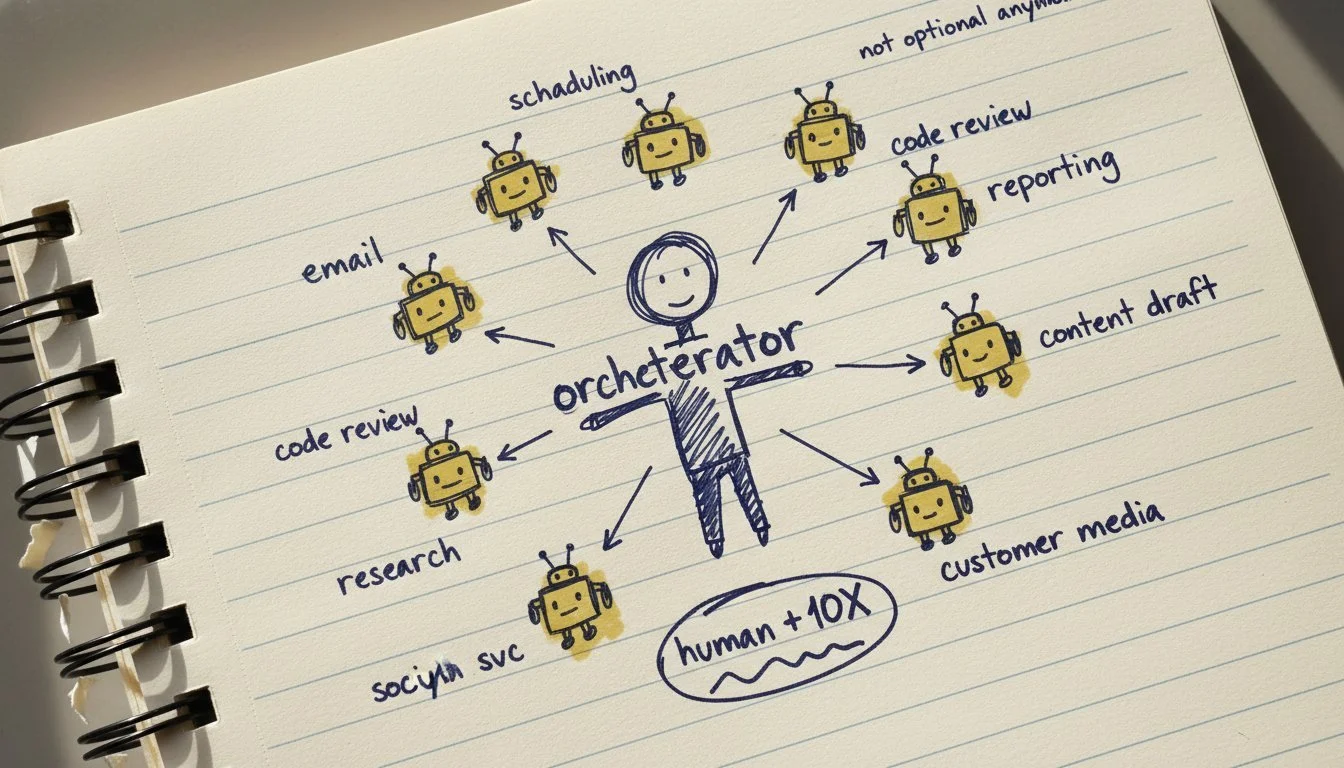
The emerging expectation is "human plus 10X": each worker supervising multiple agents, each agent extending human capability. Agent orchestration is becoming a core skill, not an optional add-on.
Fixed vs. Flow: One Table Shows the Difference
The pattern across all three breaks is the same. The old model was built on fixedness: fixed roles, fixed headcount, fixed boundaries. The new model is built on flow.
| Fixed (Old Model) | Flow (New Model) |
|---|---|
| Manage headcount | Orchestrate outcomes |
| Org chart (boxes + lines) | Capability map (skills + tasks) |
| Employee vs. contractor | Talent is talent |
| Job titles as units of work | Skills as units of work |
| Culture = proximity + perks | Culture = trust + transparency |
| Human workforce only | Humans + agents + contingent |
The Adoption Gap Is Psychological, Not Technological
Here is where the conversation gets uncomfortable. When your workforce is humans, contractors, and AI agents, culture cannot be a foosball table in the office. It cannot be a Slack channel or a quarterly offsite.
Two-thirds of Americans believe AI will decrease the number of jobs, according to CBS News. Pew Research found that 50% of Americans are "more concerned than excited" about AI, the highest share among 25 countries surveyed. Gallup's 2026 data shows AI-related job loss concerns rising through Q1.
The adoption gap is not technological. It is psychological. And that makes it a culture problem, not a tooling problem.
The reframe that changes the calculation: companies adopting AI agentically throughout their organization are not firing people. They are hiring to scale. Early adopters capture market share from non-adopters. The mindset shift from "survive" to "grow" is the real competitive advantage.
Culture in this model has to be rooted in trust. Trust that extends to every contractor and freelancer in your ecosystem. Trust that AI agents are expanding capacity, not cutting colleagues. That is not something you mandate in a policy. You have to build it into how work actually flows.
Three Operating Model Shifts for the New Workforce Reality
The Fixed-to-Flow transition requires three concrete shifts. No shortcuts.
From managing headcount to orchestrating outcomes. It is no longer about where someone sits or what their tax form says. The goal is what Leeby calls the Task-to-Talent match: the right skill, human or AI, hitting the right task at the right time. Practically, this means redefining what a team is when it includes agents. Name the agent workflows the same way you name job roles.
From org charts to capability maps. Replace box-and-line hierarchies with skills graphs. Map what your organization can do, not who reports to whom. A capability map cross-references skills (human), task catalogs (agents), and coverage gaps: that is the planning infrastructure for a blended workforce. For teams deploying Agentforce, building this map is the first step in a structured implementation: you cannot deploy agents effectively without knowing which workflows they are entering.
From culture-as-perk to culture-as-trust. When your workforce is distributed, fractional, and increasingly digital, culture is the safety net that keeps people engaged. Build it on transparency and outcomes, not proximity and perks.
The question for leaders is not whether the org chart is dead. It is whether you are still managing a headcount, or leading a community of talent.
Related Reading
Let’s Talk

Drop us a note, we’re happy to take the conversation forward 👇🏻