
How Does Agentforce Work?
Updated on: Jul 13
Trying to learn how does Agentforce works? And why do we use it in the first place? The shift from standard chatbots to autonomous AI is transforming how enterprises scale operations. At the center of this movement is Salesforce Agentforce, an AI-powered platform that deploys digital agents capable of managing routine workflows across sales, service, marketing, and operations.
Unlike traditional bots that rely on static, rigid scripts, Agentforce operates with complete context. It analyzes your business data, learns from continuous interactions, and executes complex tasks with minimal human intervention.
To understand why this technology is a game-changer, we must look at what happens behind the scenes. Here is the step-by-step breakdown of how Agentforce works. Also, Keeping in mind that Salesforce 2026 Summer, Spring & Winter Releases, it makes total sense to dive deep in this topic now.
Don’t know what Agentforce is? Check out our latest blog: Salesforce Agentforce: The Next Frontier of Enterprise AI.
How Does Agentforce work?
According to Salesforce, only three components are required for Agentforce to work: data, reasoning, and actions. Sounds simple, right? Let’s break it down step by step:
Data
Data is everything—it’s what trains agents. Think of it as the fuel that powers everything. When used effectively, it can drive exceptional performance.Reasoning
Feeding data is one thing, but its true value lies in understanding it. Reasoning enables Agentforce to analyze and process data intelligently, delivering dynamic and context-aware responses.Actions
Finally, every agent needs specific jobs or roles to be assigned. These roles define what they can and cannot do, ensuring they perform their tasks effectively and within boundaries.
Moreover, Agentforce cannot really function without Data cloud. Thus, users must be aware of how Salesforce Data Cloud powers AI forecasting with unstructured data as well. Let’s quickly review these key components to understand their role in building intelligent Agents.

Agentforce : Salesforce YouTube
Data Cloud and Agentforce
Agentforce is integrated into the Customer 360 platform and can access data from every Salesforce product. But what if the data resides outside Salesforce, such as in external data lakes? That’s where the Data Cloud steps in—it brings the external data sources into one unified location.
Whether it’s data from Salesforce itself or external systems, Agentforce has the ability to pull it all together. Thanks to the vector database, Data Cloud can now bring structured and unstructured data, making data not only accessible but also usable.
This data can then be used to train LLMs (Large Language Models)—or simply put, AI models. And here’s the best part: the more data these models get, the more accurate and effective they become.
Smart Reasoning with Atlas Reasoning Engine
The Atlas Reasoning Engine is a core component of Agentforce. This is crucial to cover while learning how does Agentforce work in reality. It orchestrates actions intelligently and autonomously, enabling AI agents to think, reason, plan, and act.
Here's how Atlas Reasoning Engine works:
ReAct Prompting: The engine uses a cycle of reasoning, acting, and observing until a user goal is fulfilled. Which allows agents to process new information, ask clarifying questions, and generate precise outcomes.
Topic Classification: It maps user inputs to specific tasks, ensuring that relevant instructions, business policies, and actions are applied. This helps the system scale efficiently while maintaining accuracy and security.
Large Language Models (LLMs): The engine allows AI agents to use LLMs for responses, enabling richer and more contextually aware conversations. By prompting LLMs to share their reasoning, the engine reduces the likelihood of errors and provides visibility into the decision-making process.
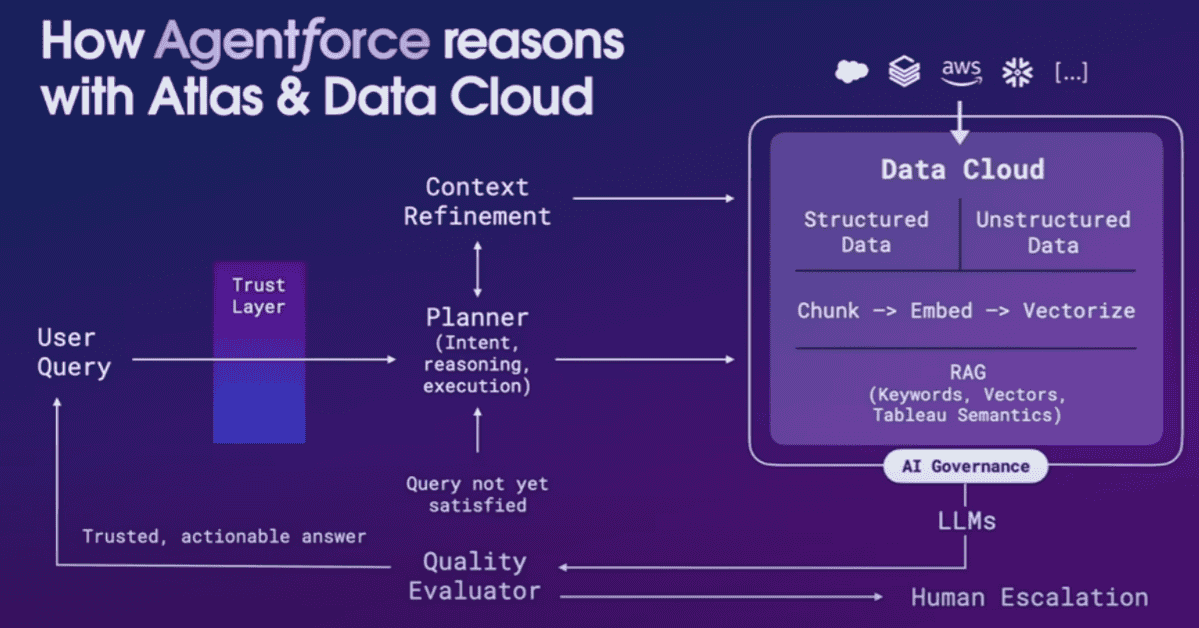
Agentforce, Altas Reasoning Engine, and Data Cloud: Salesforce YouTube
Actions
Agents need one final element to operate: topics or actions, which work as instructions to guide agents on how to perform their tasks. You can assign topics and actions in Agent Builder to define the roles and responsibilities of each agent.
With these instructions in place, agents are ready to be deployed. They will perform tasks based on the skills you assign and use only the data you permit—all while staying within the guardrails you set.
Before We Dive In: Let’s Build an Agent
Before understanding how Agentforce works and exploring the query-to-response journey, let’s Create an agent. Why? Because the process of building an agent lays the foundation for everything that follows.
Creating agents in Agentforce is a simple, no-code process thanks to the Agentforce Studio's Agent Builder. With natural language input and a user-friendly interface, you can build custom agents in no time. Here’s a step-by-step guide:
Step 1: Open Agent Builder
Start by accessing the Agent Builder in Agentforce Studio.
Step 2: Choose a Template or Build from Scratch
Prebuilt Templates: Agentforce offers a variety of templates for different roles. Select one if it fits your requirements.
Create from Scratch: For custom agents, choose this option. Simply define the agent's role by describing what you want it to do in natural language, then click Next.

Creating Agents in Agent Builder: Salesforce YouTube
Step 3: Add Topics and Actions
On the next page, you’ll be prompted to assign topics to your agent.
Suggested Topics: Agentforce will recommend topics and actions based on the role and the business data available.
Choose the Topics: You can choose from suggested topics or create new ones by providing a name, description, and detailed instructions.
Click Next when you’re done and select the preferred communication channel (e.g., chat, email).
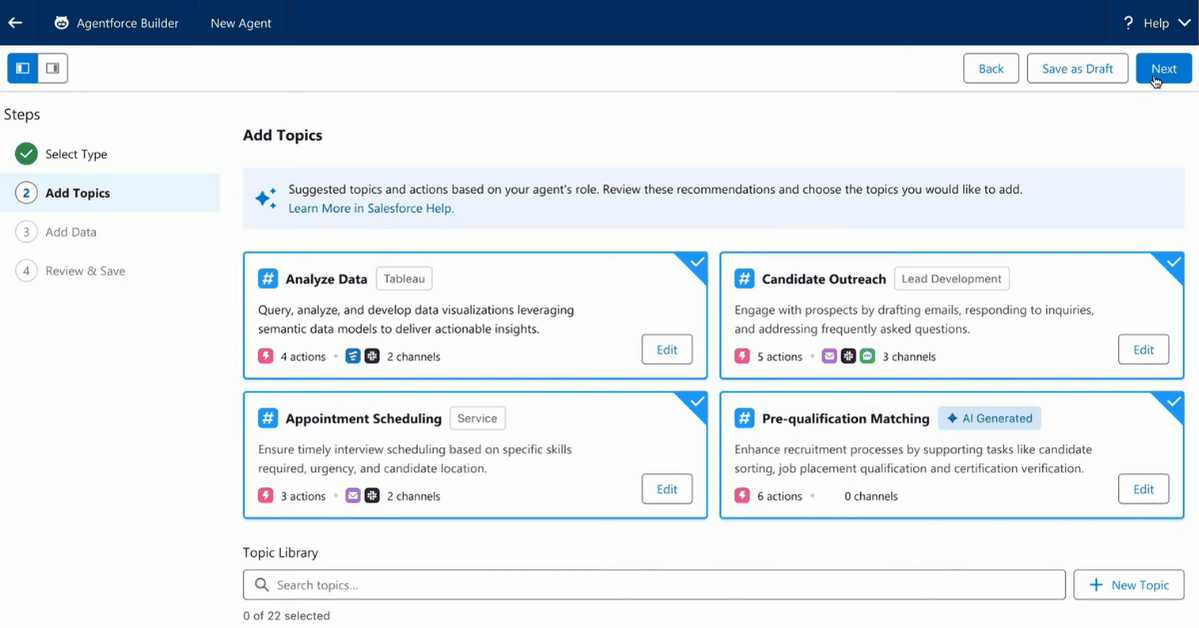
Assigning Topics and Actions to Agent: Salesforce YouTube
Step 4: Add Data
In this step, you’ll equip your agent with the necessary data.
Add both structured and unstructured data relevant to your business.
For example, upload PDF files containing your company’s policies or guidelines.
Once the data is uploaded, click Next to proceed.

Adding Data for Agents: Salesforce YouTube
Step 5: Review and Save
Review all the configurations, topics, and data you’ve added.
Save the agent.

Review and Save Agent: Salesforce YouTube
Step 6: Test and Activate
Your agent is created and ready to activate. However, we recommend testing it first.
After saving the agent, you’ll be directed to this page.

Test and Activate the Agent: Salesforce YouTube
Test Responses: In the right corner, simply enter queries as a real user to view the agent's responses, or run batch tests in the Testing Center to generate multiple test cases.

Create Test Cases in Agentforce Testing Center: Salesforce YouTube
Performance Insights: The center screen displays the agent’s reasoning and actions, giving you a view of its performance under the hood.

Preview Test conversation: Salesforce YouTube
Once you’re satisfied with the test results, click Activate to deploy your agent.
From Customer Query to Response: How does Agentforce Work
Agentforce is designed to seamlessly handle customer queries, delivering contextually accurate and efficient responses. Here's the step-by-step process on how Agentforce works.
1. Receiving & Analyzing the Query
When a customer submits a query through any communication channel (Email, Web, Mobile, Chat, etc.), Agentforce analyzes the nature of the query. Using Natural Language Processing (NLP), it identifies the intent, context, and type of information needed to address the query.
To understand this in depth, we can say that this advanced Natural Language Processing instantly reads the request. Instead of just searching for matching keywords, the system identifies the user's underlying intent, evaluates the context, and determines exactly what type of information or action is required to resolve the issue.
2. Retrieving Relevant Topics
Once the query is understood, Agentforce references the pre-assigned topics related to the agent’s role. These topics act as a guide, providing the agent with the appropriate scope and context to approach the query. If necessary, Agentforce retrieves additional data from the organization’s Data Cloud, which aggregates structured and unstructured data, as well as external systems via MuleSoft APIs and Zero Copy Data Streams.

How Agentforce Works: Salesforce YouTube
3. Retrieval-Augmented Generation (RAG)
Using Salesforce’s RAG, the system searches and retrieves relevant data needed for the query. This includes business-specific knowledge, past customer interactions, CRM records, and external data sources.
The retrieved data is then used to create a grounded prompt—a structured input sent to train the Large Language Models (LLMs).
RAG augments prompt with business data, making them more contextually detailed. These enriched prompts are then fed to LLMs, enabling them to generate accurate, context-aware responses grounded in business data.
4. Reasoning with the Atlas Reasoning Engine
The Atlas Reasoning Engine serves as the brain of Agentforce. It operates in a reasoning loop that consists of:
Planning: Based on the grounded prompt, it creates a dynamic plan of action to address the query.
Evaluating Data: It filters and validates the retrieved data to ensure relevance and accuracy.
Refining Actions: For complex queries, it breaks down the task into smaller steps and iterates until the desired outcome is achieved.
Adapting: The engine learns and adapts with each interaction, continuously improving its reasoning and responses.

Atlas Reasoning Engine: Salesforce YouTube
5. Generating a Response
With a clear plan and validated data, the LLM constructs the final response. Agentforce ensures this text adheres strictly to the guardrails, permissions, and business policies set by your administrators.
Simple informational questions are answered within milliseconds. For intricate problems that require evaluating multiple variables, the system takes an extra moment to iterate through its reasoning loop, ensuring the final message is safe, accurate, and completely aligned with your brand voice.
6. Orchestrating Actions
If the query requires more than just information retrieval—such as executing a task, updating records, or triggering workflows—Agentforce leverages Actions (e.g., Flows, Apex Classes, MuleSoft APIs) to perform the required operations. These actions are orchestrated securely and transparently by the Atlas Reasoning Engine.
7. Refinement and Learning
Thanks to the reasoning loop between data retrieval and action, Agentforce continuously refines its performance. With every interaction, the system analyzes outcomes, incorporates feedback, and maintains a continuous flow of data between the Data Cloud and the reasoning engine.
This dynamic loop enables the agent to leverage updated insights to enhance its reasoning capabilities and context awareness, ensuring that Agentforce works more accurately and reliably over time.
8. Expanding & Agentic Framework
As organizations scale their AI initiatives, the platform continues to mature. Salesforce has evolved these capabilities into a broader framework designed for interconnected workflows. To learn how businesses are connecting multiple agents across departments, explore our guide on the era of Salesforce Agentforce 360.

Agentforce Reasoning Loop: Salesforce YouTube
What Sets Agentforce Apart?
Agentforce stands out in the crowded AI landscape by combining cutting-edge features with seamless integration. Understanding Agentforce pricing plays a major role as well. Here’s why it’s a potential game-changer:
Comprehensive Data Access
Agentforce integrates both structured and unstructured data from Salesforce and external systems. This equips agents with rich, relevant information, enabling them to provide highly informed and context-aware responses.Intelligent Reasoning
Powered by the Salesforce Atlas Reasoning Engine, Agentforce intelligently plans, reasons, and adapts to any scenario. Whether handling a simple or a complex query, it consistently delivers precise and accurate responses.Retrieval Augmented Generation (RAG)
Unlike traditional chatbots, Agentforce works with RAG to retrieve relevant data. This ensures its responses are not only accurate but also grounded in the latest and most relevant business information.Prompt Builder
A powerful tool within Salesforce, the Prompt Builder enables businesses to create reusable, structured prompts. These prompts guide AI agents in retrieving the most relevant information from data sources, providing an easy way to build and manage prompts in no time with low code.

Prompt Builder: Salesforce YouTube
Secure with Trust Layer
Data security is at the core of Agentforce, thanks to the Einstein Trust Layer, which enforces strict security policies and masks sensitive data.
Available outside salesforce
With the introduction of Agentforce 2.0, it now operates outside the Salesforce ecosystem, extending its capabilities to external platforms and systems.
Suggested Read: Agentforce 2.0 is Here: Salesforce’s AI Workforce Evolution
Conclusion
Building an impactful AI model requires more than just an LLM, and Salesforce has proved this with Agentforce. Whether it’s sales, service, marketing, or any other domain, Agentforce adapts seamlessly to your business operations. By deploying these AI agents, businesses can reduce costs, save time, and drive efficiency across domains.
Creating agents using tools like Agent Builder is easy, but optimizing them for maximum impact requires expertise. As a trusted Salesforce Agentforce implementation company, we combine deep knowledge of Salesforce and AI to help you unlock Agentforce's full potential and transform your business into an AI powered enterprise.
FAQs
Q-1. How does Agentforce differ from traditional Einstein Chatbots?
Ans: Unlike Einstein Chatbots, which rely on rigid, predefined dialogue trees and require manual updates to handle new variations, Agentforce is highly autonomous. Powered by the Atlas Reasoning Engine, Agentforce agents can understand user intent, dynamically plan multi-step execution paths, and adapt in real time using your live Data Cloud architecture. While Einstein Chatbots require a human handoff for complex or unscripted queries, Agentforce can handle sophisticated workflows entirely on its own within the guardrails you establish.
Q-2. Can Agentforce access data that lives outside the Salesforce ecosystem?
Ans: Yes. Agentforce is not restricted to native CRM data. To safely fetch and utilize external data without constantly moving it, you can integrate external systems in a few ways:
MuleSoft APIs: You can add a MuleSoft API directly as an "Action" inside the Agent Builder, enabling the agent to trigger processes or fetch data from legacy systems.
Zero-Copy Architecture: Via Data Cloud, you can virtualize data from external data lakes (like Snowflake or Amazon Redshift) in real time so the Atlas Reasoning Engine can ground its responses with up-to-date external context.
Q-3. How do managers supervise autonomous AI agents to ensure they are performing correctly?
Ans: Salesforce has repurposed Omni Supervisor specifically for managing the AI workforce. Through Omni Supervisor, managers can oversee AI agents in real time, view real-time interaction trends, and even review step-by-step summaries of ongoing or closed AI conversations. Additionally, during the testing phase in the Agent Builder, developers can use the center panel to view the agent’s exact "reasoning loop" to ensure it is utilizing the correct topics and actions before going live.
Q-4. 4. What happens if an Agentforce agent doesn't have enough data or authorization to resolve a query?
Ans: Agentforce operates within strict guardrails defined by the Topics and Actions you assign to it. If a customer submits a query that falls outside the agent's defined scope, or if the system cannot find the necessary data grounded via RAG (Retrieval-Augmented Generation), the agent will gracefully fail or execute a seamless handoff to a human employee via Omni-Channel, passing along the complete interaction context so the human agent can take over without skipping a beat.
References
Let’s Talk!

Drop a note below to move forward with the conversation 👇🏻