
Maximizing ROI with Agentforce: A Strategic Guide for Business Leaders
Updated on: July 23, 2026
Salesforce Agentforce sits at the forefront of AI evolution, enabling organizations to deploy autonomous AI agents that work across sales, service, marketing, and operations.
But deploying a powerful platform is only half the equation. The real question business leaders are asking is: Is Agentforce worth the investment? And how do you ensure it delivers measurable returns?
This article explores practical, proven AgentForce ROI strategies that help you move beyond the hype and into quantifiable business value. If you are looking to boost Salesforce ROI using Agentforce at scale, this guide offers a business-first framework to maximize every dollar spent.
The Modern Shift: Consumption Models vs. Traditional Seat Licensing
Calculating ROI on autonomous AI requires moving past static per-user licensing math. Agentforce operates on a consumption-based credit model tied to conversation actions, data queries, and automated tasks.
Achieving maximum financial return depends on how efficiently your team scopes these interaction loops. If your underlying prompts are overly broad or retrieve unnecessary data rows from Data Cloud, your credit consumption velocity will spike. High-ROI implementations focus on constructing lean, focused prompt templates and precise semantic retrieval boundaries, ensuring every credit spent yields a measurable operational outcome.
Aligning Agentforce with 3 Key Business Outcomes
One of the most common mistakes organizations make is approaching Salesforce Agentforce AI as a technology project rather than a business transformation initiative. To maximize ROI with Agentforce, you must begin by positioning every deployment decision to a business goal.
The three primary business outcome pillars are:
Revenue Growth: Improving conversion rates, deal velocity, and customer lifetime value.
Cost Efficiency: Reducing manual effort, support overhead, and operational waste.
Customer Experience: Delivering faster, more personalized, and consistent interactions at scale.
Before you deploy a single agent, define what success looks like in each of these pillars. Establishing a baseline is essential for proving Salesforce ROI after implementation. That means your current conversion rates, average handle times, and CSAT scores.
Top Use Cases That Drive the Highest ROI With Agentforce
One of the most effective ways to increase productivity with Salesforce Agentforce implementation is to start with the use cases where AI can have the greatest immediate impact. Rather than automating everything at once, identify the workflows that are high-volume, repetitive, and currently hindering progress for your teams.
1. Sales:
Agentforce can autonomously qualify inbound leads, schedule follow-ups, surface deal insights, and update CRM records in real time. It can free up your reps to focus on high-value conversations. Organizations using AI-assisted lead qualification report significantly shorter sales cycles and higher win rates.
2. Customer Service:
AI agents can resolve common service requests, prioritize complex cases, and provide 24/7 support without increasing headcount. This is one of the fastest paths to measurable ROI with Agentforce, as deflected tickets directly reduce operational cost.
3. Marketing:
Personalization at scale becomes achievable when Agentforce agents can dynamically customize messaging, recommend next-best actions, and trigger campaigns based on real-time behavioral signals. Check out the practical guide to implement Agentforce in Salesforce Marketing Cloud.
4. Operations:
Internal workflows from onboarding to approvals can be automated to reduce friction, improve compliance, and speed up delivery.
Measuring What Matters: Key Performance Indicators for Agentforce
To prove business value to executive stakeholders, organizations must measure deployment health across three distinct ROI tiers:
Deflection & Resolution Rate: Measures the percentage of routine customer service inquiries or data collection tasks fully handled end-to-end by an autonomous agent without human agent escalation.
Context Window Efficiency: Tracks credit utilization per conversation. Optimizing prompt context windows minimizes token waste and keeps operational costs predictable.
Time-to-Value (TTV) on Lead Qualification: Tracks how quickly an inbound B2B inquiry is enriched, scored, and routed to an account executive by an AI sales agent compared to traditional manual triage queues.
Building the Foundation To Maximize ROI With Agentforce
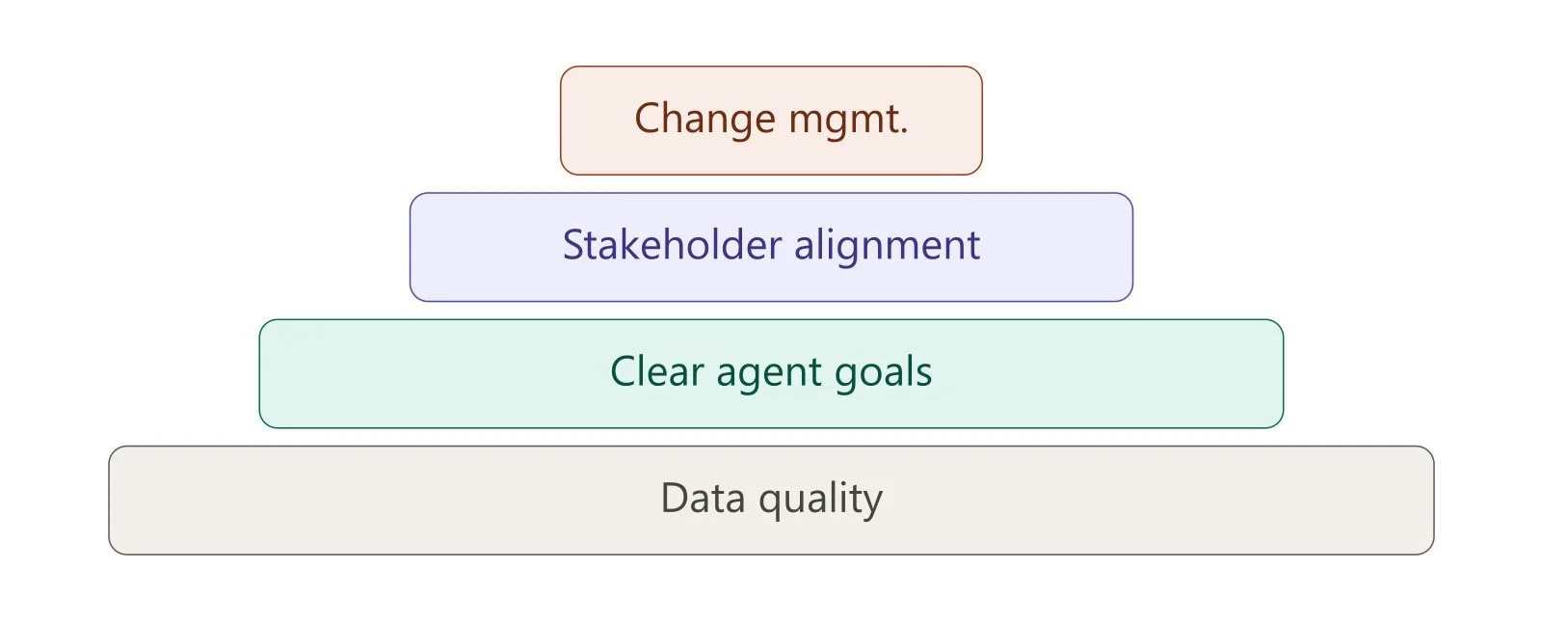
Tips to get the most out of Agentforce almost always begin with the same premise: technology alone does not create ROI, but strategy and execution do. Here is what high-performing organizations do differently when laying the groundwork.
1. Prioritize Data Quality:
Agentforce runs on Salesforce Data Cloud. Dirty, siloed, or incomplete data will directly limit AI accuracy and agent effectiveness. Invest in data hygiene before you scale the agentforce deployment.
2. Define Clear Agent Goals:
Each agent should have a well-scoped purpose, defined success criteria, and guardrails. Vague agent design leads to inconsistent outputs and poor user trust.
3. Invest in Change Management:
Lack of adoption is the silent killer of AI ROI. Build internal champions, offer training, and communicate the 'why' behind each automation to ensure teams embrace rather than resist the change.
4. Align Stakeholders Early:
Business leaders, end users, and CXOs must be aligned on goals, timelines, and expected outcomes from day one. Misaligned expectations are one of the most common reasons AI projects underdeliver.
Measuring What Matters: ROI Metrics for Agentforce
Knowing how to maximize ROI using Agentforce requires a robust measurement framework. Without clear metrics, it becomes impossible to justify continued investment or identify where to optimize. Focus on the following KPI categories:
1. Cost Savings: Track time saved per agent interaction, reduction in headcount requirements, and cost per ticket or case resolved.
2. Revenue Impact: Monitor conversion rate lift, pipeline velocity, and average deal size before and after Agentforce deployment.
3. Customer Experience: Measure CSAT scores, First Contact Resolution (FCR) rates, average response time, and customer churn reduction.
4. Operational Efficiency: Capture ticket deflection rates, average handle time, and the ratio of automated resolutions to human escalations.
Build a pre and post-deployment comparison dashboard to make ROI visible to leadership. This not only validates your investment but also helps you identify opportunities for optimization as you scale.
| Category | The "Before" (Legacy) | The Agentforce "After" | Key Metric |
|---|---|---|---|
| Service | Static FAQ/Deflection | Autonomous Resolution | Cost per Case |
| Sales | Manual Lead Scoring | Real-time AI Qualification | Pipeline Velocity |
| Ops | Human-led Data Entry | Automated CRM Updates | Accuracy / Time Saved |
Advanced AgentForce Efficiency Tips to Boost Returns
Once you have proven value in initial deployments, here are advanced ways to boost ROI using Agentforce as your organization matures with the platform.
1. Multi-Agent Orchestration: Layer multiple specialized agents to handle complex, multi-step workflows that span departments, such as an agentforce service agent that triggers a sales agent upon upsell detection.
2. Crawl-Walk-Run Approach: Start with one high-impact use case, prove ROI, then systematically expand. This incremental approach reduces risk and builds internal confidence for broader deployment.
3. Einstein AI + Agentforce Integration: Combining predictive analytics from Einstein with the autonomous capabilities of Agentforce creates a powerful loop: Einstein predicts the outcome, Agentforce acts on it. Want to migrate Einstein Bots to Agentforce? Check out the guide here.
4. Continuous Optimization via Analytics: Use Agentforce's built-in analytics to track agent performance at a granular level. Regularly review where agents are falling short and refine prompts, flows, and escalation paths accordingly.
Common Pitfalls To Avoid That Reduce Agentforce ROI
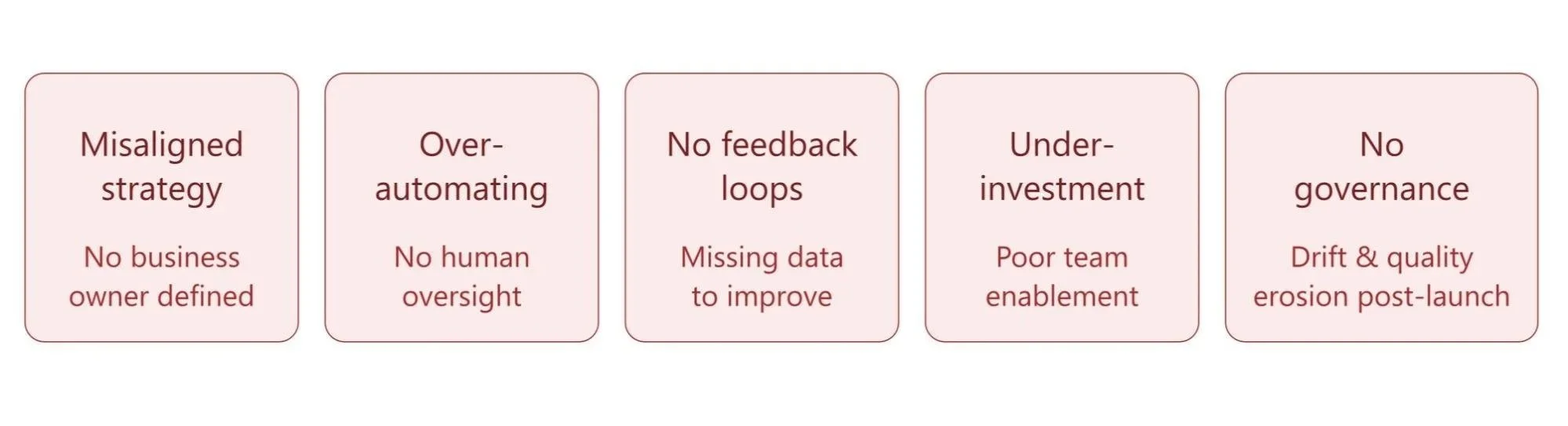
Even with the best intentions, many organizations fail to realize the full AgentForce benefits for businesses because of avoidable strategic missteps. Awareness of these pitfalls is the first step to avoiding them.
1. Misaligned Business Strategy: Deploying Agentforce without tying it to specific business outcomes leads to diffuse effort and unmeasurable results. Every agent should have a business owner, not just a technical owner.
2. Over-Automating Too Quickly: Removing human oversight too early, before agents have been validated at scale, creates trust and quality issues that are expensive to reverse.
3. Ignoring User Feedback Loops: Agents improve through feedback. Organizations that do not build mechanisms for users and customers to flag poor outcomes miss the data needed to improve performance continuously.
4. Underinvesting in Enablement: A powerful platform with an undertrained team delivers mediocre results. Budget adequately for training, internal documentation, and ongoing support.
5. Lack of Governance and Monitoring Post-Launch: Implementing Salesforce Agentforce without a structured governance framework is one of the most overlooked risks in AI implementation. Once agents go live, they need consistent tracking. That means tracking accuracy, flagging unexpected behaviors, and ensuring outputs are aligned with business and compliance standards.
Real World Results: What Top-Performing Organizations Do Differently
Across industries, the organizations achieving the highest Salesforce ROI from Agentforce share several common characteristics that go beyond technical implementation.
They treat AI adoption as a strategic capability, not a one-off project. This means dedicating resources to a Center of Excellence (CoE) that governs AI standards, monitors performance, and drives continuous improvement across the enterprise.
They also maintain a relentless focus on the customer experience. For instance, AI agents are reducing loan processing queries from days to minutes for financial companies. In retail, they are powering personalized post-purchase journeys that increase repeat purchase rates. In healthcare, they are streamlining patient intake and follow-up communications to reduce administrative burden. In each case, the ROI is tied not just to cost reduction, but to measurable improvements in customer outcomes.
Finally, top performers keep a close eye on the Salesforce Agentforce roadmap because the platform is evolving rapidly, and organizations that stay current unlock new capabilities before their competitors do.
Future-Proofing Your Agentforce Investment
Maximizing ROI with Agentforce is not a one-time effort; it is an ongoing discipline. Your strategy must evolve.
Build internal AI literacy across your organization. Teams that understand how AI agents work are better equipped to identify new use cases, provide meaningful feedback, and use the technology responsibly.
Also, evolve your thinking from automation to autonomy. The most advanced deployments are not just replacing tasks; they are enabling entirely new ways of operating. Businesses that embrace this shift will compound their ROI over time as agents become smarter, more integrated, and more capable.
Final Thoughts
Agentforce is a genuinely transformative Salesforce AI solution. Organizations that approach Agentforce with a clear business strategy, strong data foundations, robust measurement frameworks, and a commitment to continuous improvement are the ones that will answer the question 'Is Agentforce worth the investment?' with a resounding yes.
Start with a focused pilot tied to a high-priority business outcome. Measure early and often. Share results broadly to build momentum. Then scale with confidence, knowing that every expansion is grounded in proven ROI with Agentforce. With the right approach, Salesforce Agentforce implementation can be one of the most powerful services for growth, efficiency, and customer value in your Salesforce stack.
Frequently Asked Questions (FAQ)
Q-1. How long does it take to see a measurable ROI from Salesforce Agentforce?
Ans: Most organizations begin seeing operational returns—such as reduced case handle times and faster lead response rates—within 4 to 8 weeks post-launch, provided the initial deployment focuses on clearly defined, high-volume use cases.
Q-2. What is the primary cost driver when deploying Agentforce?
Ans: The primary cost driver is messaging and action credit consumption. Costs scale based on the volume of autonomous interactions, external API calls, and complex data retrievals processed from Salesforce Data Cloud.
Q-3. How does the Einstein Trust Layer protect enterprise data?
Ans: The Einstein Trust Layer prevents your private CRM data from being used to train third-party LLM models. It provides zero-data retention agreements, masks personally identifiable information (PII) before sending prompts, and runs toxicity checks on all generated outputs.
Q-4. Can Agentforce replace human customer support or sales reps?
Ans: Agentforce is designed to augment and scale human teams rather than replace them. By autonomously resolving routine tier-1 inquiries and pre-qualifying leads, AI agents free up human professionals to focus on complex negotiations, high-value deals, and relationship management.
Ready to Maximize Your Agentforce ROI?
Transforming your business with autonomous agents requires more than just the technology; it demands a clear strategy, clean data, and production-ready architecture.
As an experienced partner in Salesforce Agentforce implementation and custom AI agent development, Concretio helps you move from pilot to proven, measurable business value.
Start Your Agentforce Project Today
Frequently Asked Questions
-
Most organizations see initial ROI signals within 60–90 days of a focused pilot deployment. Full enterprise-scale returns typically materialize within 6–12 months, depending on data readiness, use case complexity, and team adoption speed.
-
Agentforce scales to fit any business size. SMBs benefit from starting with a single high-impact use case while enterprises layer multiple agents across departments, making ROI accessible regardless of organizational scale.
-
Unlike rule-based automation, Agentforce uses AI to reason, decide, and act autonomously. It handles unstructured inputs, adapts to context, and executes multi-step tasks. This goes far beyond what traditional automation tools can deliver.
-
Success requires collaboration across business stakeholders, CRM admins, IT, and end users. A dedicated AI champion or Center of Excellence owner is essential to align goals, govern performance, and continuously drive optimization post-launch.
Related Reading


Let’s Talk

Drop us a note, we’re happy to take the conversation forward 👇🏻