AI is now a standard part of businesses. Many companies use it within their CRM systems to improve customer service, automate repetitive work, and make smarter choices. Salesforce is a top platform for this, offering predictive insights, automation, and intelligent recommendations.
Using these tools is powerful, but it also requires a focus on reliability. As businesses depend more on AI, they face new risks such as data misuse, biased decisions, and legal compliance issues. This is why AI governance in Salesforce is so important.
Clearly, AI governance is a necessity. It ensures that your company uses Salesforce safely and ethically. Without the right rules in place, AI can be problematic. You might want to implement Salesforce Agentforce. However, you’ve never thought of ethics and governance. So, in this guide, we are going to cover everything you need to know about Salesforce AI governance.
What is AI Governance?
AI governance is a set of rules, processes, and controls that guide how AI systems are built, used, and monitored. It ensures that AI works in a safe, fair, and transparent way. AI governance answers questions like:
Is the AI using correct data?
Are the results fair and unbiased?
Is the system following legal rules?
Who is responsible for AI decisions?
Many businesses use AI, but not all of them manage it properly. This is the difference between just using AI and practicing AI governance. AI governance includes:
Data management rules.
Model monitoring processes.
Security controls.
Ethical guidelines.
As AI grows, governance becomes more important. Without it, businesses risk losing customer trust and facing legal issues.
AI in Salesforce: Overview of How It Transforms Experience
Salesforce has built a strong AI ecosystem. In fact, it has come a long way to build an agentic AI system called Agentforce. It helps businesses automate and improve their processes. Therefore, the teams across different cloud services for sales, marketing, or service are making the most of AI. So, it’s best to understand how Agentforce works when it comes to automation. Let's understand a few key AI capabilities in Salesforce.
Predictive lead scoring.
Sales forecasting.
Automated workflows.
AI agents to manage tasks.
Personalized recommendations.
What used to be slow and less efficient is now faster and smarter. Thanks to these features and capabilities. For instance:
Sales teams can focus on high-quality leads.
Marketing teams can create targeted campaigns.
Support teams can resolve issues quickly.
A lot of AI and agentic benefits depend on the data and algorithms. If they are not managed properly, the results can be wrong or even harmful. That is why AI compliance in Salesforce CRM is becoming a top priority for businesses.
Why AI Governance in Salesforce Is Vital
A lot of brands have started implementing AI without thinking about governance. As of a recent study, about 72% to 80% customers show concerns about AI use of personal data. Yet, only 34% of companies have the AI ethics framework in place. That shows how big a concern this is. Here are some reasons why AI Governance is important in Salesforce.
1. Biased Decisions
AI systems learn from data. The biased data can result in making the AI biased. This can lead to unfair decisions. Especially in areas like lead scoring or targeting customers. Governance ensures your training data is clean, diverse, and fair.
2. Data Privacy Issues
Salesforce stores a lot of customer data. If AI uses this data incorrectly, it could violate the rules and laws. So, proper Salesforce AI governance sets the boundaries on what data the AI can use. This ensures secure data controls.
3. Compliance Violations
Different regions have strict rules about data and AI usage. Without proper Salesforce AI compliance, businesses may face penalties. Staying compliant ensures your Salesforce setup meets local and international standards.
4. Loss of Trust
Trust is the hardest thing to build and easiest to lose. The users could lose trust in the brand if they find out the AI decisions are unfair or cannot be trusted. Governance provides transparency. As a result, users are likely to trust and stay loyal.
5. Poor Business Decisions
Agentforce by Salesforce has been automating workflows. If the system is not governed, the automation could go wrong. It could lead to wrong actions or provide wrong insights.
This is why Salesforce AI security and governance are unavoidable. In fact, the long-term success of the Salesforce projects depends on it.
Core Pillars of AI Governance in Salesforce

To implement effective AI Governance in Salesforce, businesses need to focus on five key pillars.
1. Data Governance
Data is the foundation of AI. If the data is wrong, the AI results will also be wrong. Thanks to the good data governance for keeping the data clean and accurate. It helps remove duplicate records. The more personal and sensitive information stays secure. The overall control over who can access the data has improved.
Businesses should regularly audit their data and ensure it is reliable. Strong data governance supports better AI outcomes, maintaining AI compliance in Salesforce CRM.
2. Model Governance
AI models need to be monitored and managed over time. Model governance includes:
Tracking model performance.
Updating models when needed.
Checking for bias in predictions.
Ensuring transparency.
Businesses should not treat AI models as 'set and forget'. Continuous monitoring is important for maintaining Salesforce AI Compliance.
3. Ethical AI Usage
Ethical AI is a huge part of how businesses should operate today. It’s all about making sure your systems are fair and responsible. In Salesforce, this means being completely open about how your AI makes its decisions while always respecting the privacy of your users. This approach is often called "Responsible AI".
It’s one of the best ways to build real trust with your customers and partners. When you prioritize these values, you ensure that your technology helps people rather than creating unfair advantages or privacy concerns.
4. Security and Compliance
Security is critical when working with AI. Businesses must protect both data and AI systems.
Key areas include:
Data encryption.
Access control.
Compliance with regulations.
Monitoring system activity.
Strong Salesforce AI Security and Governance ensure that AI systems are safe and compliant.
5. Access Control and Permissions
Not everyone in the organization should have the same level of access to AI tools.
Businesses should:
Use role-based access.
Limit sensitive data access.
Control who can modify AI models.
This reduces the risk of misuse and improves overall governance.
Salesforce AI Ethics and Governance According to the Region
| Country/Region | Key Regulations and Governance Approach | Features of Salesforce AI Governance | |
|---|---|---|---|
| United States (US) | State-level privacy laws (CCPA/CPRA), NIST AI RMF | Consent Management, Audit Trails, Einstein Predictions | |
| European Union (EU) | GDPR compliance, EU AI Act (risk-based AI regulation) | Einstein AI Explainability, Data Cloud Privacy Controls | |
| United Kingdom (UK) | UK GDPR, Principles-based AI governance | Human-in-the-Loop AI, Ethical AI Dashboards | |
| India | Digital Personal Data Protection Act (DPDP), data localization | Consent Tracking, Data Classification, Einstein Analytics |
Salesforce Tools That Support AI Governance
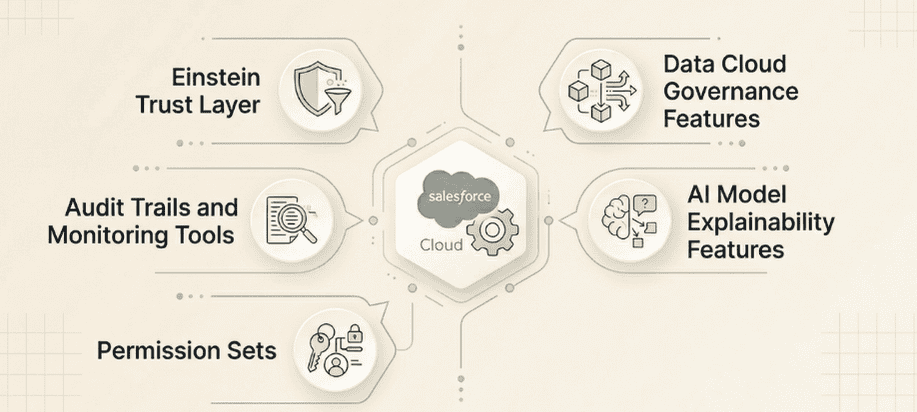
Salesforce comes with several built-in tools to help businesses manage AI responsibly.
1. Einstein Trust Layer
This is the most important tool for safety. The trust layer ensures the AI outputs are secure and reliable. It acts like a filter between your company data and the AI. It protects sensitive data and ensures safe AI usage.
2. Data Cloud Governance Features
AI is only as good as the data you give it. Data Cloud helps you organize your information in one place. Its governance features allow you to control which data is "clean" and ready for AI to use. So, the AI isn't learning from old and incorrect files.
3. Audit Trails and Monitoring Tools
Audit logs track user activity. They help businesses monitor changes and ensure compliance. These tools keep a record of every action the AI takes and every piece of data it accesses. If something goes wrong, you can look back at the logs to see exactly what happened and when.
4. Permission Sets
Not everyone in a company needs access to every AI tool. Salesforce uses Permission Sets to decide who can access AI features. It ensures authorized users have access to the data necessary for their specific task. So, the crucial tools go into the hands of the right person.
5. AI Model Explainability Features
Explainability tools break down the logic behind the AI's decision. These features help users understand how AI decisions are made. It shows you which factors (like a customer's location or purchase history) influenced the result. So, you can trust the outcome, supporting AI ethics in Salesforce.
Best Practices for Implementing AI Governance
It doesn’t have to be complicated to implement AI governance in Salesforce. Right? Using some of the best practices can help you.
1. Start with a Clear Framework:
Strategize your governance strategy. Create policies for data, models, and AI usage. Having a clear framework would keep you on track.
2. Assign Ownership:
Assign a specific person or a small team to be responsible for your AI governance. Governance works best then. This way, if someone has a question or something looks off, they know exactly who to ask.
3. Do Regular Monitoring:
AI isn't a "set it and forget it" tool. Every now and then, monitor to keep it responsible. Make sure the AI is still helpful and that your data stays clean and accurate.
4. Get Everyone on the Same Page With Training:
Your team is your best defense. Take the time to explain not just how the AI works but how to use it responsibly. When everyone understands the "why" behind the rules, they’re much more likely to follow them.
5. Use Native Tools:
Don’t use complicated workarounds. Salesforce has built-in tools specifically designed for this. Using these native features is the easiest way to stay secure and compliant.
6. Document Everything:
Keeping a record of your AI journey makes it much easier to show you're doing things the right way. This helps in audits and compliance checks.
Following these best practices helps build a strong and scalable AI governance framework in Salesforce.
Future of AI Governance in Salesforce
AI is evolving quickly. So, governance will become even more important in the future. Here are some key trends:
Increased Regulations: Governments are creating new rules for AI. Businesses must stay updated to ensure Salesforce AI Compliance.
Focus on Explainable AI: Companies want to understand how AI makes decisions. Transparency will become a key requirement.
Growth of AI Agents: AI agents by Agentforce will handle more tasks independently. This will require stronger governance controls.
More Automation in Governance: AI tools will also help manage governance processes, making them more efficient.
Stronger Emphasis on Ethics: Businesses will focus more on Responsible AI in Salesforce to build trust and avoid risks.
Final Thoughts
AI is changing the way we all work, and Salesforce makes it easier than ever to bring these tools into your daily routine. But using AI without a plan can lead to some pretty big risks.
That’s why AI governance in Salesforce is so important. It’s essentially a safety net that ensures your AI is being fair, safe, and following the rules.
It focuses on things like data security and ethics. So, you can build a solid foundation. Salesforce gives you the tools to do this. But the key is using them the right way.
Businesses that invest in Salesforce AI Governance today will be better prepared for the future. They will gain customer trust, avoid compliance issues, and make smarter decisions.
At the end of the day, governance isn't just about controlling technology. It’s about making sure you’re using AI responsibly. Struggling to implement Salesforce? Concret.io is here to help. Hire a dedicated team of consultants and developers to not only integrate Salesforce but also customize it.
Frequently Asked Questions
-
Having responsible AI in Salesforce is important. Businesses must ensure they have clean data, clear access controls, and consistent monitoring of AI models. The ethical guidelines must be followed. Finally, train your team on ethical guidelines to keep everyone in the loop.
-
AI compliance in Salesforce CRM acts as a digital guardrail. It ensures your AI tools follow global privacy laws and internal company policies. This keeps customer data protected and keeps your business audit-ready.
-
Salesforce AI ethics ensure your AI systems are fair. That means they should make unbiased decisions. It focuses on transparency so you can explain why the AI took a specific action. This prevents discriminatory outcomes and builds long-term customer trust.
-
Without it, you risk biased results, data leaks, and compliance violations. Inaccurate AI hallucinations can lead to bad business decisions and a total loss of brand credibility.
-
To meet UK GDPR rules, you must protect personal data and be able to explain how your AI makes decisions. Use Salesforce’s Einstein Trust Layer to hide sensitive customer info so the AI can’t see or store it improperly. This keeps your data use legal and transparent.
-
Responsible AI in the US requires granular "Opt-Out" capabilities for AI-driven profiling. Businesses should leverage Salesforce’s Data Cloud to centralize consent management. It ensures that AI-driven insights in one state don't inadvertently violate the privacy statutes of another.
Let’s Talk

Drop a note below to move forward with the conversation 👇🏻