
What Is the True Opportunity Cost of an AgentExchange Security Review Failure on Your Go-to-Market Timeline?
Key takeaways:
An AgentExchange listing rejection resets the review process. Expect another full 6-9 week review cycle.
The true cost of failure extends beyond the calendar: you face a stale pipeline, wasted marketing spend, and a lost first-mover advantage.
Failure prevention is far more affordable than repair. Building security in from day one beats fixing it after rejection.
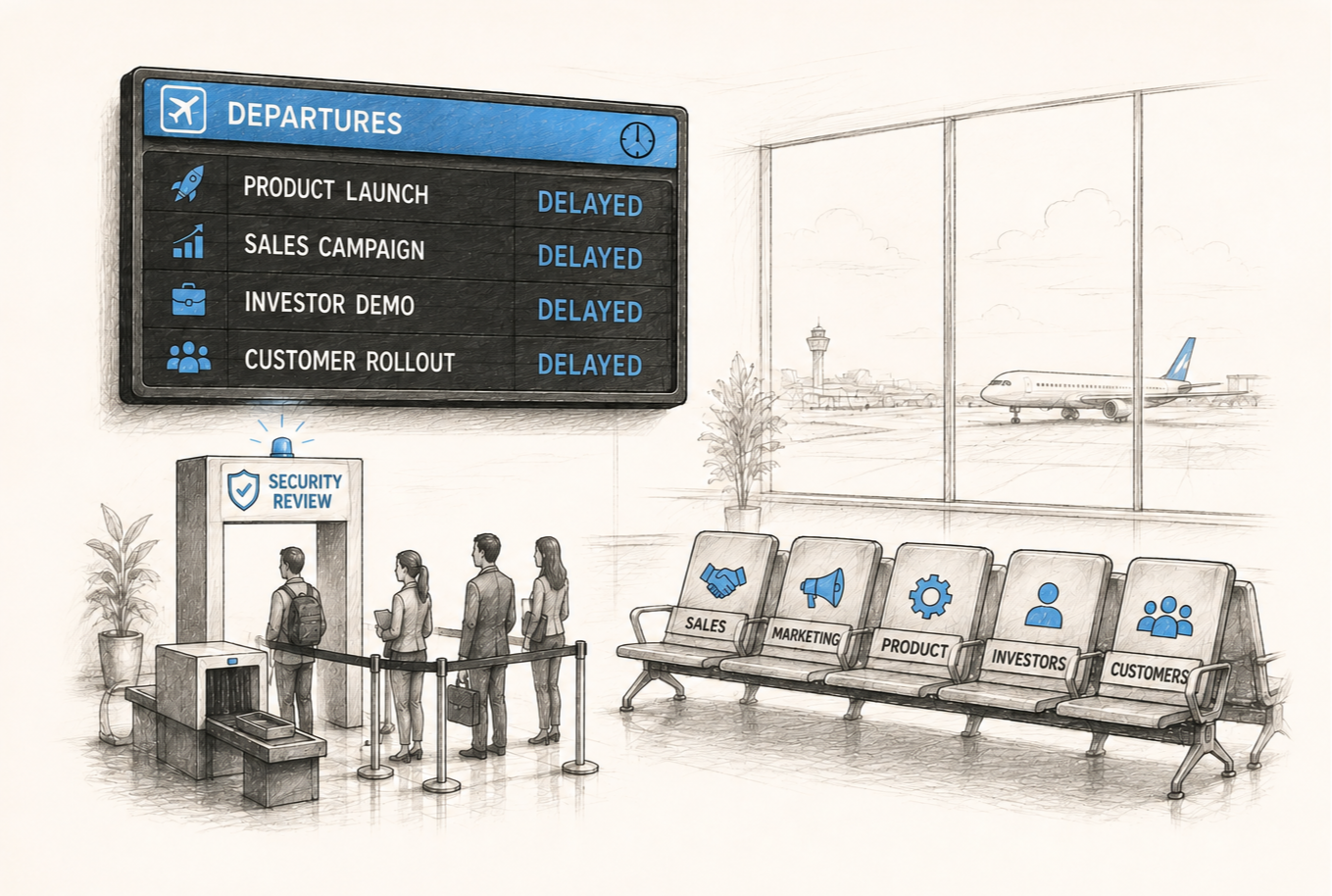
Think about this: your app is built, your demo is fine, your sales deck is ready, and your launch date is circled on the calendar. You submit for the AgentExchange (Salesforce's AppExchange marketplace) security review, expecting a formality. Then the rejection email lands. Suddenly your "formality" has turned into a six-to-nine-week detour, and your go-to-market plan is quietly falling apart in the background.
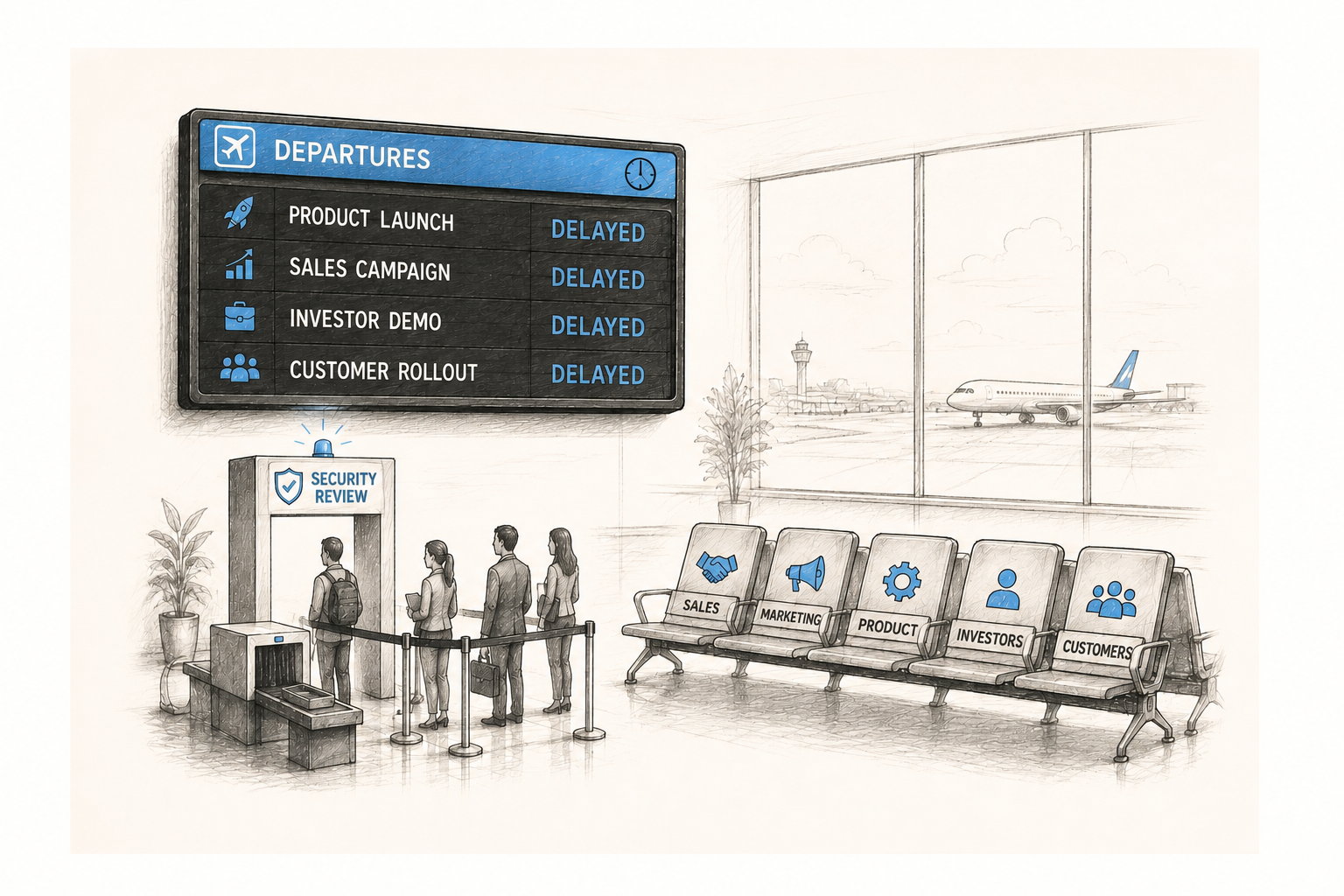
If you've been through this, you already know the pain isn't just the delay itself. It's everything the delay drags down with it, like sales momentum, investor confidence, marketing spend, team morale, and sometimes your first-mover advantage. Let's talk about what a failed AgentExchange security review really costs you, beyond the obvious calendar slip.
Why the AgentExchange Security Review Feels Like an Afterthought
Most ISVs and app builders treat the AgentExchange security review as a checkbox near the end of development. It's easy to see why: the review sits after the "real work" of building the product, so it gets scheduled like a formality.
But Salesforce's own guidance is blunt about this. According to Salesforce's developer blog, the review exists to validate that a package meets current security best practices, has no known vulnerabilities, and is safe to promote to the AppExchange. And, it's explicitly not designed to find all your security issues for you. That last part matters. Salesforce expects security to already be built into your development process; the review is a gate, not a QA pass.
Once a submission clears initial checks, it enters the main security review queue, which Salesforce says typically runs six to nine weeks. Other industry guides estimate that the full process, including business plan approval and any resubmissions, takes several months overall, since only two primary approvals are required to list an app publicly: Business plan approval from Salesforce Legal, and Security Review approval. But both still have to happen, and neither one is instant.
A rejected submission doesn't just pause the clock; it resets a meaningful chunk of it. You fix the flagged vulnerabilities, re-test, re-document, and re-submit and re-enter the queue. That's not a one-week fix. That's another six-to-nine-week cycle, stacked on top of the one you already spent.
The Direct Cost: Calendar Slippage
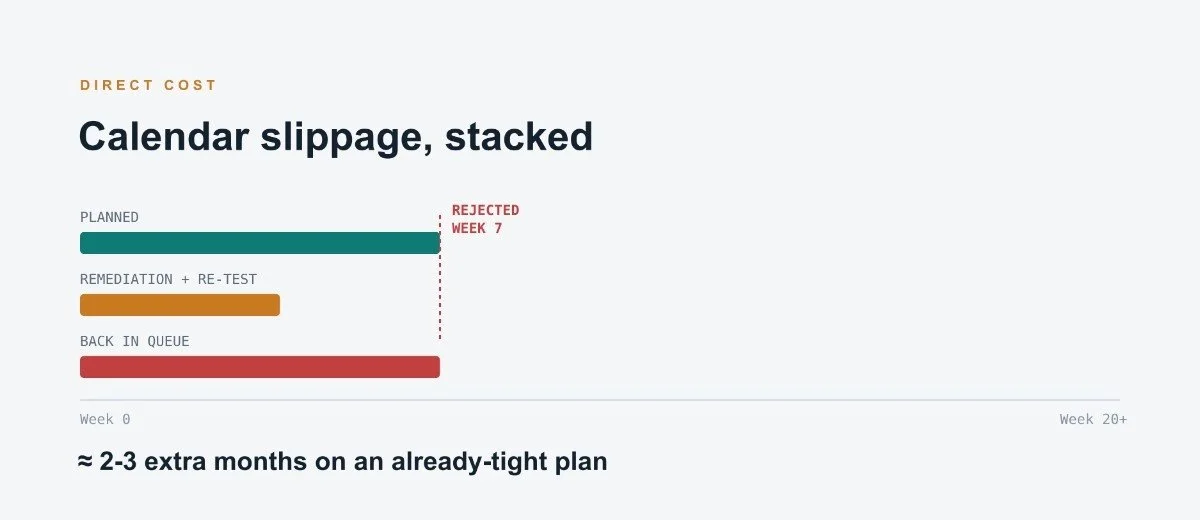
Let's start with the cost everyone sees immediately: time. If your original plan was a Q1 launch and your first submission gets rejected in week seven of a nine-week review, you're not looking at a two-week fix. You're looking at:
Time to diagnose and remediate every flagged issue.
Time to re-test internally (because nobody wants a second rejection).
Time to rebuild documentation, dependency lists, and justifications for any false positives.
A full second pass through the queue.
Realistically, that's another two to three months added to a timeline that was probably already tight. Most rejections trace back to the same handful of gaps. The issues that are entirely avoidable with the right prep work upfront
The Hidden Cost of AgentExchange Security Review Failure
Here's where the "true" opportunity cost starts to show up. The costs that don't appear on a project timeline but absolutely appear on your P&L and your competitive position.
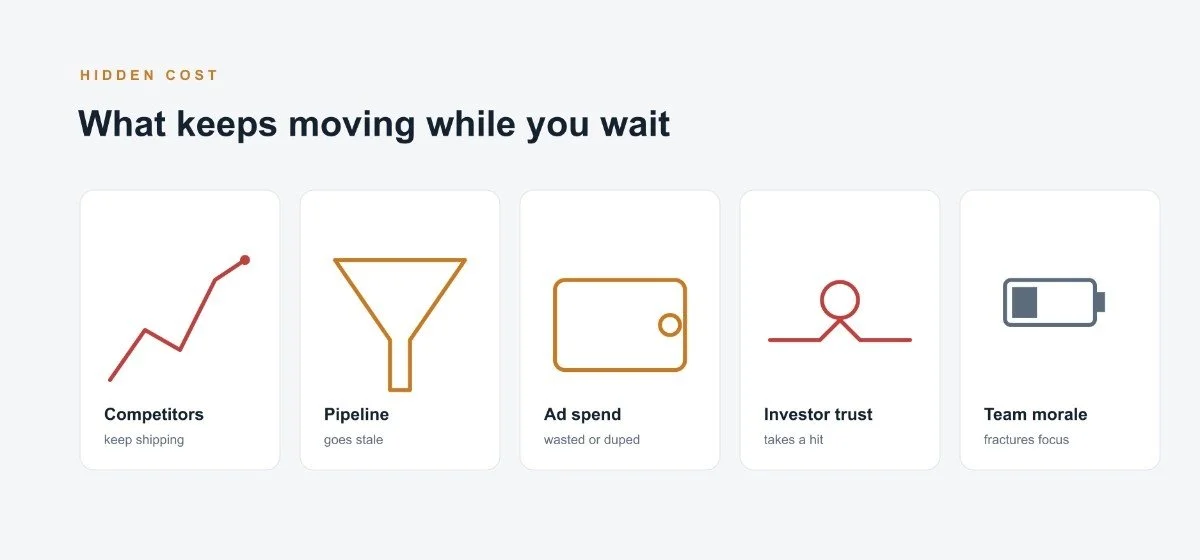
1. Competitors don't wait for you. While your resubmission sits in queue, competing apps keep shipping, keep collecting reviews, and keep building the kind of AgentExchange listing credibility that's hard to unseat later. In a marketplace where buyers often shortlist based on ratings and reviews, being second to market with a similar solution is a real disadvantage, and it compounds the longer the delay runs.
2. Sales pipeline goes stale. Any prospect conversations, pilot commitments, or partner integrations you lined up around your original launch date now sit in limbo. Buyers who were ready to move in Q1 may have solved the problem another way, allocated the budget elsewhere, or simply lost urgency by the time you're cleared for listing.
3. Marketing and demand-gen spend gets wasted or wrongly timed. If you've already booked webinars, sponsored content, or a launch campaign tied to your original date, you're either pulling that spend forward into a dead zone or paying twice to re-run it later.
4. Investor and board confidence takes a hit. For funded startups, a go-to-market slip tied to a security failure is a hard conversation. It raises questions not just about the delay, but about whether the engineering process has deeper gaps. This can affect the next funding conversation more than the missed quarter itself.
5. Team morale and focus fracture. Nothing drains a product team faster than pouring energy into a launch, hitting a wall, and having to context-switch back into remediation mode while still trying to hit other commitments. That's a real cost in productivity and attrition risk, even if it's hard to put a number on it.
Quantifying the Cost: A Simple Way to Think About the Number
You don't need a complex model to get a directional sense of the cost. A useful back-of-envelope approach:
(Weeks of delay) × (Average weekly recurring revenue you expected post-launch) + (Wasted marketing spend) + (Cost of re-engineering and re-testing) + (Estimated pipeline lost to competitors)
Even a conservative estimate. Say, 8 extra weeks of delay on a product expecting modest early traction can turn into a six-figure opportunity cost once you add in wasted spend, stalled pipeline, and the engineering hours spent on remediation instead of the next feature. For a well-funded ISV building a flagship AgentExchange listing, that number climbs fast.
How to Avoid Paying Security Failure Cost in the First Place
The good news is that a failed security review is almost always preventable, because Salesforce publishes exactly what it's checking for. The teams that pass on the first attempt tend to do a few things consistently:
Build security in from day one, not as a pre-submission scramble. Secure coding guidelines and Salesforce's static analysis tooling should be part of your regular dev cycle, not a last-minute audit.
Leverage specialized Salesforce development services. Many rejections stem from architectural gaps that are difficult to spot internally. Engaging developers with specific experience in AppExchange security standards allows you to build with compliance in mind from day one, rather than trying to retrofit security after a rejection.
Document everything before you submit. Reviewers need to test your solution the way an attacker would, so incomplete environments, missing credentials, or thin documentation are common (and avoidable) causes of rejection.
Get an independent pre-review. A second set of eyes that knows what Salesforce's review team specifically looks for can catch issues your internal team has gone blind to.
Plan your timeline around the real queue, not the optimistic one. If you're budgeting six weeks for review, budget nine, and build in a buffer for at least one round of remediation.
Getting the Review Right the First Time
The real opportunity cost of a failed AgentExchange security review isn't the six-to-nine weeks on the calendar. It's the pipeline that goes cold, the competitors who don't wait, and the internal confidence that takes months to rebuild. The teams that treat security review as a core part of the build are the ones who launch on time and don't have to explain the delay to their board.
If your team is currently focused on product innovation, consider bridging the expertise gap by hiring dedicated Salesforce developers. By integrating specialized development into your workflow, you ensure that your security and compliance standards match Salesforce’s rigorous expectations. Ultimately, investing in expert support early on is significantly more cost-effective than absorbing the opportunity cost of a delayed go-to-market timeline.
Further Insightful Readings
Frequently Asked Questions
-
Once a submission clears initial checks, it typically sits in the main review queue for six to nine weeks. The full path to listing can run several months, especially if any resubmission is needed.
-
On failure, you have to remediate the flagged issues, re-test and re-submit, which puts you back into a fresh six-to-nine-week review cycle on top of the time you already spent.
-
Common reasons AgentExchange apps fail the security review include missing CRUD/FLS or sharing enforcement, injection and XSS vulnerabilities, hardcoded credentials, insecure authentication or API integrations, unresolved security scan findings, and incomplete security documentation or testing evidence.
-
Not through the queue itself. Resubmissions go through the same review process as a first submission. The only real lever you have is minimizing back-and-forth by fixing every flagged issue thoroughly the first time, rather than resubmitting with partial fixes.
-
Yes, for most ISVs. An independent pre-review from a team that knows Salesforce's specific review criteria tends to catch the issues internal teams have gone blind to. It's almost always better than absorbing a second six-to-nine-week delay.
Related Readings
Let’s Talk

Drop us a note, we’re happy to take the conversation forward 👇🏻