
Salesforce Rolls Out AI Agents Across Commerce Platform With ChatGPT And Google Integrations
Key takeaways:
AI Discovery: AI drives discovery; retailers keep orders and customer data.
Unified Data: Direct catalog and order sync from Business Manager.
Flexible Integration: ACP and AP2 support multiple AI commerce platforms.
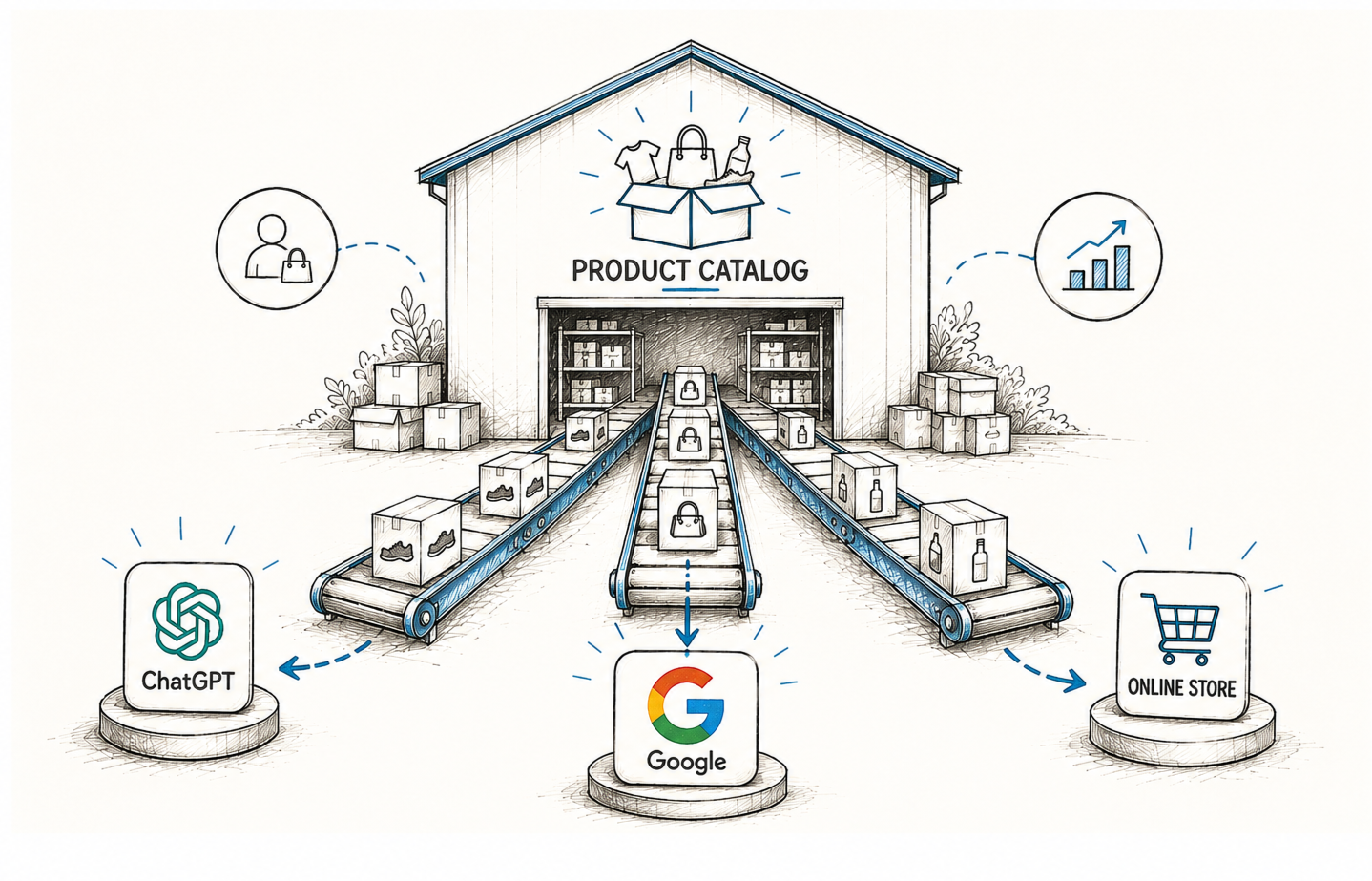
Salesforce has expanded Agentforce Commerce with a new wave of AI agents for B2B and B2C retail, plus native integrations that plug merchants' product catalogs directly into ChatGPT and Google's AI surfaces.
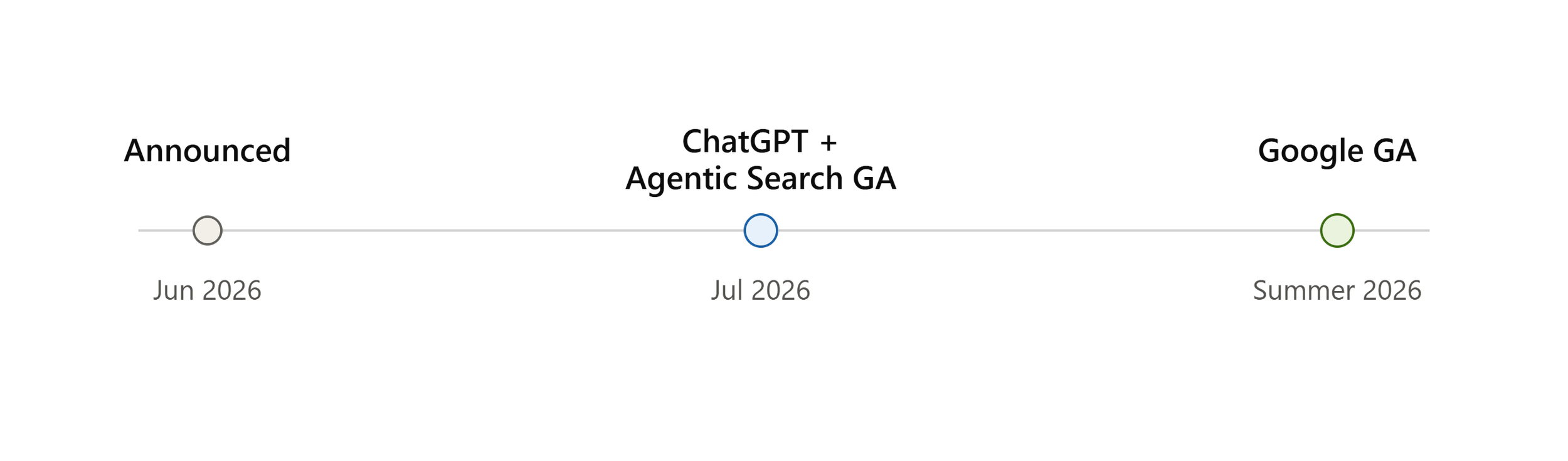
The OpenAI integration reaches general availability in July 2026, letting retailers sync catalogs to ChatGPT straight from Business Manager with no third-party middleware.
A parallel Google integration, landing later this summer, extends discovery and purchase into Google Search (including AI Mode) and the Gemini app. In both cases, the retailer stays the merchant of record, and order data still flows back into the same Salesforce instance that runs service, loyalty, and marketing.
We've had three clients ask us the same question in the last two weeks:
"Do we need to rebuild our catalog to show up in ChatGPT?" The honest answer, at least based on what Salesforce has shipped so far, is no. If you're already running Agentforce Commerce, this is closer to flipping a switch than a re-platform. That's the whole pitch, and for once it roughly holds up.
Salesforce announced the update on June 24, 2026, bundling B2B agents, headless commerce flexibility, and the ChatGPT/Google integrations into what it's calling its biggest Agentforce Commerce release yet. Here's what's actually in it, what's still coming, and where the rough edges are.
What Did Salesforce Actually Announce?
Three things shipped or were confirmed with dates, and they don't all belong to the same workstream:
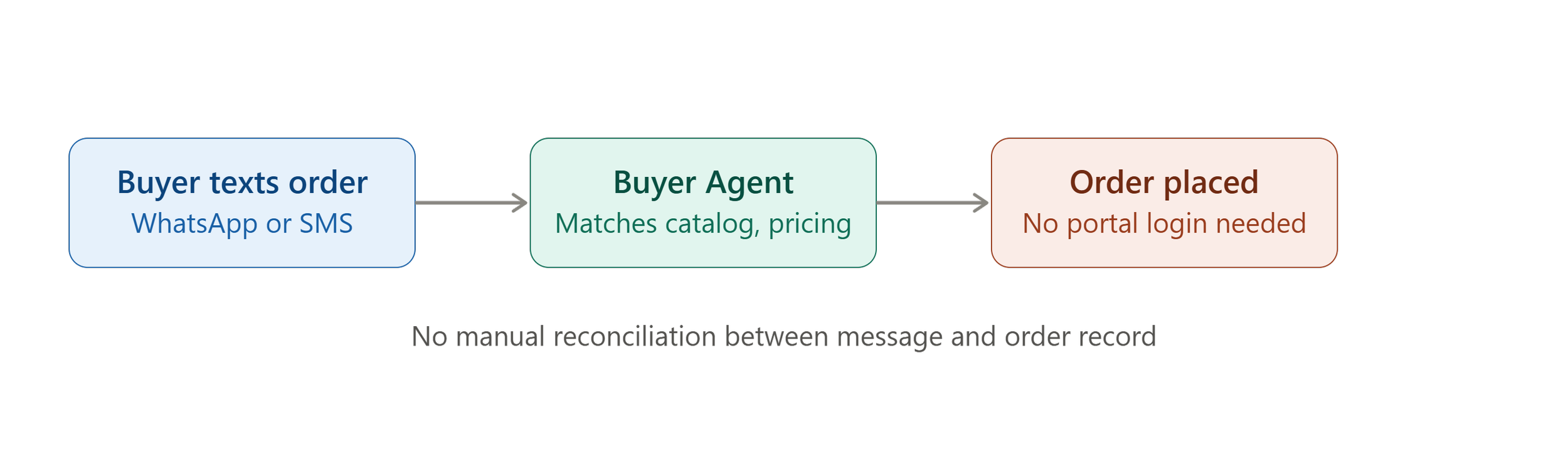
B2B AI agents. A Buyer Agent that works inside WhatsApp and SMS conversations, letting procurement teams place orders by text without logging into a portal. A Merchant Agent that sits on the seller side, handling catalog, inventory, and order reconciliation without manual cleanup.
Headless commerce. The platform can now run fully decoupled from its front end, so the same catalog, pricing, accounts, and Buyer Agent power a headless storefront as easily as a Salesforce-hosted one. B2B Search also picked up synonym management, weighted attributes, and predictive discovery, with extensible endpoints for developers who want to customize ranking logic.
Agentic Commerce Channels. This is the piece getting the headlines. It connects a retailer's product catalog directly to external AI platforms, starting with OpenAI and Google.
None of these are separate products bolted on after the fact. Salesforce is positioning them as one release because the same catalog and order data underpins all three. Whether that data model actually holds up once catalogs start syncing to three or four external surfaces at once is the part worth watching over the next two quarters.
How Does the ChatGPT Integration Actually Work?
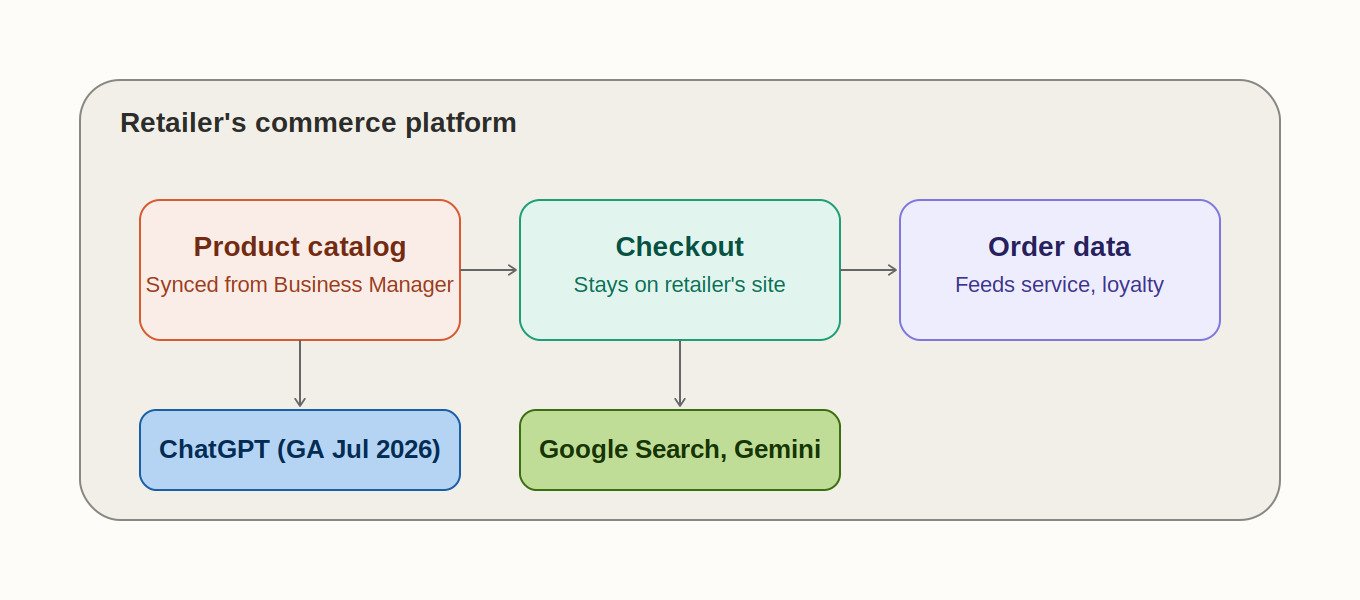
The OpenAI integration reaches general availability in July 2026. Retailers sync their product catalog to ChatGPT directly from Salesforce's Business Manager, and Salesforce is explicit that this doesn't require third-party tools or custom development on the merchant's side.
That's a meaningful change from where things stood in late 2025 and early 2026. The earlier version of this partnership ran through Cimulate's CommerceGPT layer and the Agentic Commerce Protocol (ACP), an open standard OpenAI co-developed with Stripe to make chat-based transactions secure.
Under the current setup, Salesforce's Evans (speaking on the integration) described the arrangement plainly: the partnership is built around product catalog syndication, and checkout still happens on the merchant's own site. In other words, ChatGPT surfaces the product; Salesforce keeps the transaction.
That distinction matters more than it sounds. Retailers who were nervous about handing checkout to a third party get to keep the sale, the customer relationship, and the order data on their own platform, while still showing up wherever the shopper happens to be searching.
It's a materially different bet than Etsy's or Shopify's approach, where Instant Checkout in ChatGPT lets the transaction complete inside the chat window itself via Stripe.
What About the Google Integration?
The Google side is less finished, and Salesforce has been upfront about that. General availability is pegged to "summer 2026" without a firm date, versus the hard July commitment for OpenAI. Once live, it will let shoppers discover and purchase products across Google Search, including AI Mode, and inside the Gemini app.
Google's own contribution here is its Agent Payments Protocol (AP2), an open protocol for securely initiating and transacting agent-led payments.
Salesforce integrating against AP2 rather than building a proprietary bridge suggests it's trying to avoid locking retailers into a single AI channel's plumbing, a sensible hedge given how quickly the "which AI platform matters" conversation has shifted over the past year.
Does the Retailer Lose Control of the Sale?
This is the question every retail ops team we've talked to asks first, and it's the one Salesforce has clearly built its messaging around.
Both integrations run on the retailer's existing commerce infrastructure. The retailer remains the merchant of record. Order data flows back into the same platform that already handles service, loyalty, and marketing, rather than spinning up a parallel data silo inside ChatGPT or Gemini.
Nitin Mangtani, EVP and GM of Agentforce Commerce at Salesforce, framed the strategic logic behind that architecture directly: referral traffic to brand sites will increasingly come from AI platforms like Gemini, ChatGPT, and Anthropic, along with social apps like Instagram and TikTok, but the actual commerce will keep happening on properties the retailer owns and operates, whether that's the website, the app, messaging channels, or physical stores.
Read plainly, Salesforce's bet is that AI platforms become discovery and referral layers, not the transaction layer. That's a defensible position today. Whether it survives once OpenAI and others push harder on in-chat checkout for more categories of merchant is a separate question, and one Salesforce doesn't fully control.
Is Any of This Actually Moving Revenue Yet?
Early numbers, at least the ones Salesforce is willing to publish, are more than a rounding error. The company has attributed a meaningful share of global online sales to AI-influenced discovery, and reports that retailers running their own commerce agents are seeing sales grow faster than peers who aren't.
PacSun's Chief Digital and Information Officer, Shirley Gao, pointed specifically at the OpenAI integration as a way to turn ChatGPT conversations into lasting relationships with Gen Z and Gen Alpha shoppers, rather than one-off transactions.
Salesforce also folded in its Cimulate acquisition here, relaunching that technology as Agentic Commerce Search, also targeting July 2026 general availability. Instead of keyword matching, it's built to surface products based on inferred shopper intent, and it's designed to run on non-Salesforce storefronts as well as Salesforce-hosted ones.
Early customers are reportedly seeing double-digit gains in both conversion and add-to-cart rates, though Salesforce hasn't published the methodology behind that figure, so treat it as directional rather than audited.
What Should Retailers Actually Do Right Now?
If you're already on Agentforce Commerce, the practical checklist looks like this:
Confirm your product catalog is clean before July. The ChatGPT sync pulls directly from Business Manager. Attribute mapping issues that were cosmetic on your own storefront become visible the moment an AI agent is summarizing your listing to a shopper.
Don't wait on the Google timeline to start planning. "Summer 2026" is soft. Treat the OpenAI GA date as the forcing function and let Google integration work follow the same catalog hygiene effort.
Decide where headless fits your roadmap. If you're not already running a decoupled front end, this release doesn't force your hand, but it does mean the option is now fully supported rather than a workaround.
Watch checkout ownership closely. Salesforce's current architecture keeps checkout on the merchant's site. That's good for data ownership today. Build your integration in a way that doesn't assume it stays that way indefinitely.
The Bottom Line
Salesforce isn't reinventing commerce with this release so much as wiring its existing commerce data into the places shoppers are increasingly starting their search. The B2B agents and headless flexibility are solid, incremental product work. The ChatGPT and Google integrations are the strategic bet: that AI platforms become the front door, while Salesforce retains the register.
That bet is reasonable today because Salesforce built it on open standards (ACP, AP2) rather than closed pipes, and because it doesn't ask retailers to give up the merchant-of-record position to participate. Whether it holds in twelve months depends less on Salesforce's execution and more on how aggressively OpenAI and Google push in-platform checkout for categories beyond Etsy-style marketplace sellers.
For now, if your catalog is on Agentforce Commerce, the July GA date is the one to plan around. Everything else is still in motion.
Frequently Asked Questions
-
The OpenAI integration is set for general availability in July 2026. Retailers sync their product catalog to ChatGPT directly from Business Manager, without needing third-party tools or custom development.
-
Yes. Both the OpenAI and Google integrations run on the retailer's existing commerce infrastructure. The retailer remains the merchant of record, and checkout, along with the resulting order data, stays on the retailer's own platform rather than moving into the AI platform.
-
Agentic Commerce Search is built on technology Salesforce acquired through Cimulate. Rather than matching keywords, it's designed to surface products based on inferred shopper intent, and it can run on non-Salesforce storefronts as well as Salesforce-hosted ones. It's targeting general availability in July 2026 alongside the ChatGPT integration.
Related Reading
Let’s Talk

Drop us a note, we’re happy to take the conversation forward 👇🏻