
The Enterprise Re-Architecture Blueprint: Upgrading Rigid Chatbots to Autonomous Agents
Key takeaways:
Rigid chatbots hit a ceiling. Rule-based chatbots can't handle multi-step, context-heavy requests, which is why enterprises are shifting to autonomous AI agents built on real reasoning, not scripts.
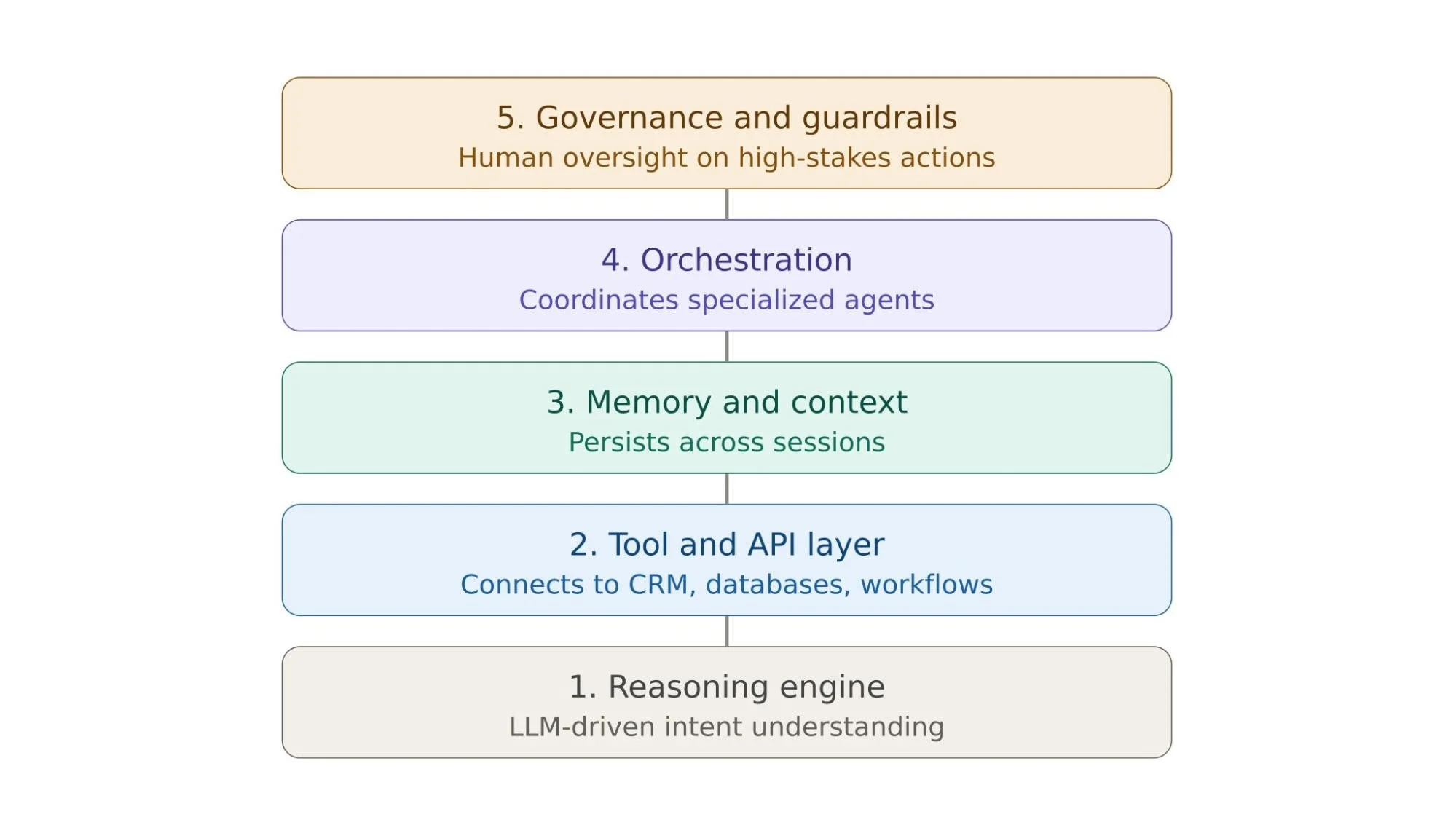
Re-architecture beats retrofitting. A true agent upgrade requires five layers working together.
Migration is phased, not instant. Successful chatbot-to-agent migration starts with one high-value use case and expands gradually.
If you've spent any time managing a customer-facing chatbot, you know the frustration. It works fine until someone asks a question that falls outside its decision tree, and then it just... breaks. It loops back to "I'm sorry, I didn't understand that" or hands the customer off to a human anyway, defeating the entire purpose of having a bot in the first place. This is the reality for thousands of enterprises still running on first-generation conversational AI, and it's exactly why the conversation has shifted from chatbots to something far more capable: enterprise AI agents.
The shift from scripted chatbots to autonomous AI agents represents a genuine architectural transformation, and if you're responsible for your company's digital infrastructure, understanding this blueprint matters more than you might think.
Why Traditional Chatbots Fail Enterprises
Traditional chatbots operate on a simple premise: if the user says X, respond with Y. They're built on decision trees, intent classification, and pre-written scripts. This works beautifully in narrow, predictable scenarios, checking an order status, resetting a password, answering FAQs.
But enterprises don't run on narrow, predictable scenarios. Real business problems are messy. A rigid chatbot can't handle that kind of multi-step reasoning because it has:
no memory of context beyond the current script node,
no ability to take independent action,
no capacity to adapt when the conversation veers off its predetermined path.
This is the core limitation driving enterprise AI transformation right now. Companies aren't abandoning chatbots because the technology failed; they're abandoning them because business needs have outgrown what scripted logic can deliver.
What Are Autonomous AI Agents?
The term "autonomous AI agents" gets thrown around a lot, so let's be precise about what it actually means in practice.
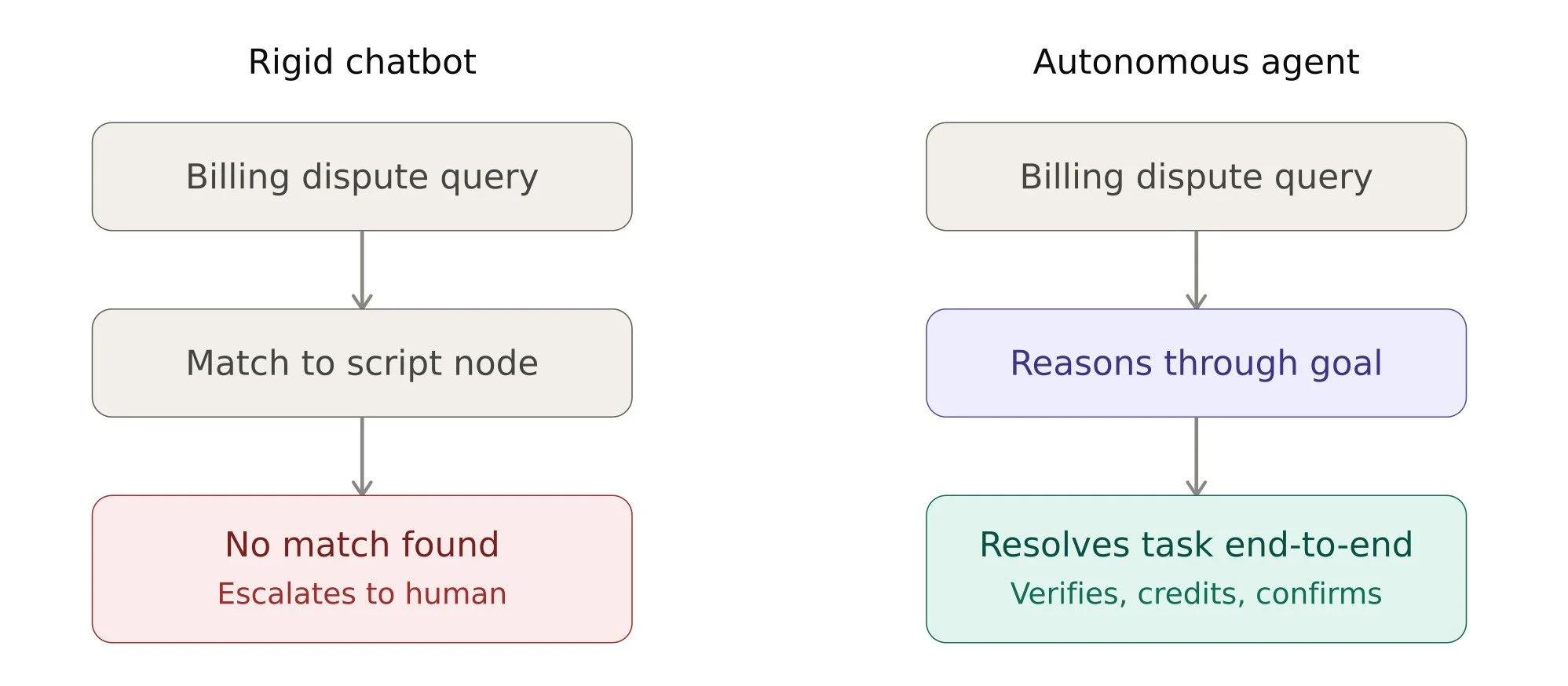
An autonomous agent doesn't just respond to inputs, it reasons through a goal, breaks it into sub-tasks, decides which tools or systems it needs to interact with, executes those actions, and evaluates whether the outcome actually solved the problem. If it didn't, the agent can try a different approach without a human rewriting its logic.
Key Differences from Rule-Based Chatbots
Think of the difference this way: a chatbot is like a vending machine. You press a button, it dispenses exactly what's programmed for that button, nothing more. An agent is more like a capable employee. You give it an objective ("resolve this customer's billing dispute"), and it figures out the steps: pull the billing history, check the refund policy, verify eligibility, issue the credit, and send a confirmation email. All without someone manually orchestrating each step.
This is possible because of a few technical shifts happening simultaneously:
large language models with genuinely strong reasoning capabilities,
tool-calling frameworks that let models interact with APIs and databases,
and memory systems that maintain context across long, multi-turn interactions.
Put together, these components form the foundation of modern agentic system design.
The 5-Layer Blueprint for Enterprise Re-Architecture
Moving from a rigid chatbot to an autonomous agent isn't a single upgrade; it's a re-architecture. Here's how the transition typically breaks down.
1. Rethinking the Core Reasoning Engine
The first step is replacing rule-based intent matching with an LLM-driven reasoning layer. Instead of the system asking "which pre-written response matches this input," it now asks "what is the user actually trying to accomplish, and what's the best path to get there?" This single change is what unlocks flexibility, but it also means enterprises need robust prompt engineering, guardrails, and evaluation pipelines to keep the reasoning grounded and reliable.
2. Building the Tool and API Layer
A chatbot with no hands is just a conversation. An agent needs hands like the ability to query a CRM, update a database, trigger a workflow, send an email, or check inventory in real time. This is where AI agent architecture becomes critical. You're essentially building a permission-controlled interface layer that lets the agent safely interact with your existing enterprise systems (Salesforce, SAP, ServiceNow, internal databases, whatever your stack includes) without giving it unchecked access that could cause damage.
3. Adding Memory and Context Persistence
Rigid bots forget everything the moment a session ends. Agents need persistent memory: knowledge of past interactions, user preferences, ongoing tasks, and organizational context through RAG. This is what allows an agent to pick up a conversation three days later and still know exactly where things left off, which is a massive leap for customer experience and internal productivity tools alike.
4. Orchestration and Multi-Agent Collaboration
Here's something a lot of enterprises don't anticipate: the most powerful setups aren't single agents doing everything. The multi-agent orchestration creates networks of specialized agents working together. One agent might handle customer intent detection, another handles data retrieval, another handles compliance checks, and an orchestrator agent coordinates the whole thing. This modular approach makes the system easier to audit, debug, and scale, and it's quickly becoming a standard pattern in agentic system design.
5. Governance, Guardrails, and Human Oversight
Autonomy sounds great until an agent takes an action nobody wanted. That's why the re-architecture blueprint always includes governance layers: approval checkpoints for high-stakes actions, audit logs, rate limits, and fallback protocols. The goal isn't to remove humans entirely, it's to let humans supervise at the decision level rather than the task level.
Chatbot to Agent Migration
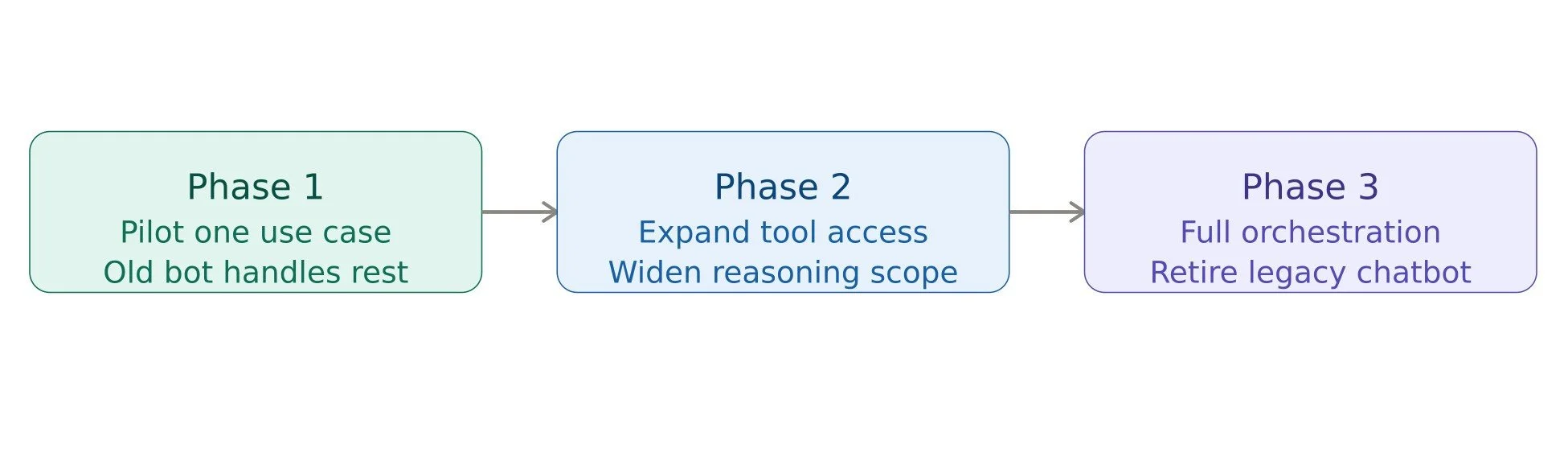
One thing worth being honest about: chatbot to agent migration is rarely a clean rip-and-replace. Most enterprises run a phased approach.
Phase one usually involves identifying a narrow, high-value use case, something like internal IT support tickets or a specific customer service workflow, and building an agent for that single function while the existing chatbot handles everything else.
Phase two expands the agent's tool access and reasoning scope based on what's learned.
Phase three integrates multiple agents into a broader orchestration layer, gradually retiring the older rule-based system as confidence grows.
This phased approach matters because it lets teams catch failure modes early, in a low-risk environment, before the agent is handling anything business-critical. Also, it gives stakeholders time to adjust internal processes, because adopting AI agents for enterprises isn’t just a technical shift but an organizational shift. Teams need to trust the system, understand its limitations, and know when to intervene.
Common Mistakes When Deploying AI Agents
A few recurring mistakes show up across failed agent rollouts, and they're worth flagging.
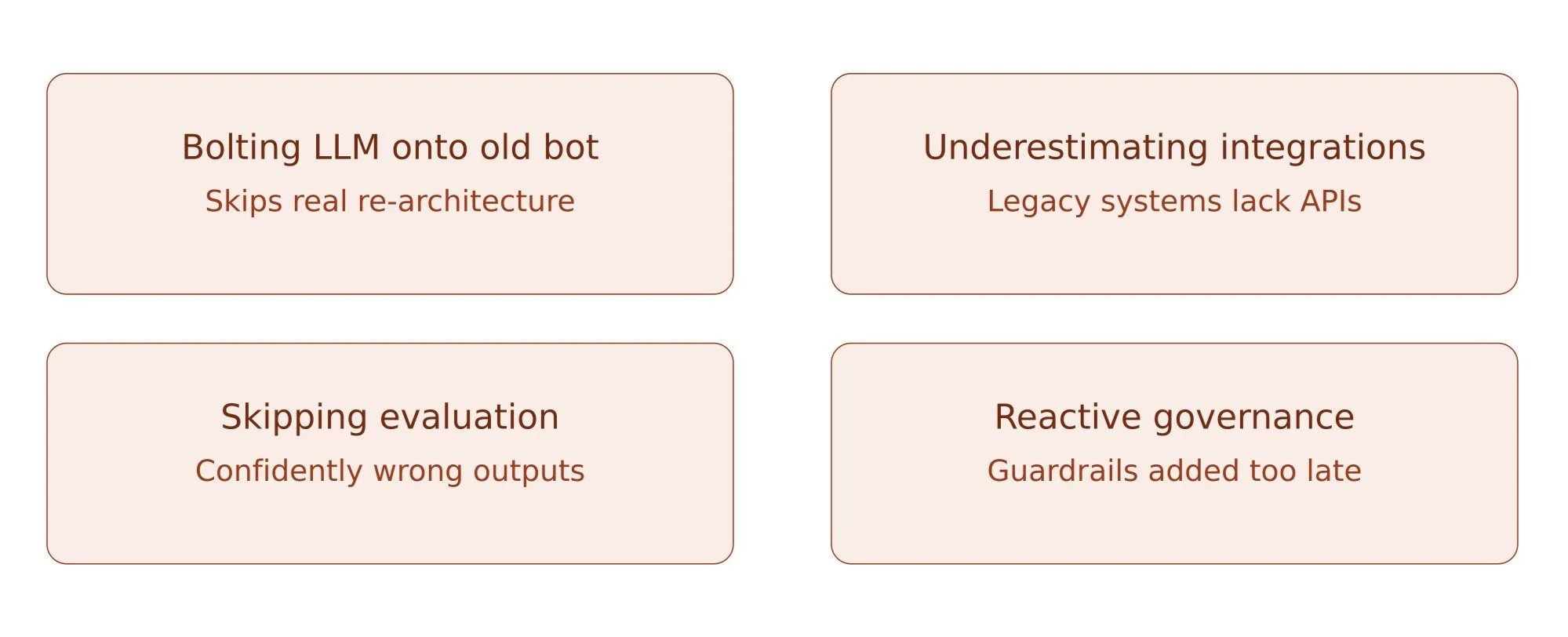
Treating agents like chatbots with extra steps. Some teams essentially add an LLM onto their existing chatbot infrastructure without rethinking the underlying architecture. This produces something that looks agentic on the surface but still fails the moment it hits a scenario the old logic didn't anticipate.
Underestimating the tool integration effort. The reasoning model is often the easy part. Building secure, reliable connections to legacy enterprise systems, especially older ones without modern APIs, is usually where the real engineering work lives.
Skipping evaluation frameworks. Without proper testing for hallucination, task completion accuracy, and edge-case handling, enterprises end up deploying agents that are confidently wrong, which is arguably worse than a chatbot that simply says "I don't understand."
Ignoring governance until something breaks. Guardrails need to be designed in from the start, not added reactively after an agent takes an unwanted action.
Why Enterprises Partner with AI Agent Development Experts
Given how much is involved, it's no surprise that many companies are partnering with specialized AI consulting services rather than building this transformation entirely in-house. The learning curve around agentic system design, tool orchestration, and governance frameworks is steep, and mistakes at the architecture stage tend to compound expensively later.
Working with an experienced AI agent development company can avoid many of the time-consuming or unnecessary steps. These experts have typically already solved the recurring integration headaches, built reusable governance frameworks, and developed testing methodologies that would otherwise take an internal team months to figure out through trial and error. For enterprises that want to move quickly without accumulating technical debt, this kind of partnership often pays for itself.
Looking Ahead
The shift toward enterprise AI agents isn't a trend that's going to reverse. As reasoning models keep improving and tool ecosystems mature, the gap between what rigid chatbots can do and what autonomous agents can do will only widen.
Enterprises that treat this as a partial update to their existing chatbot will likely find themselves rebuilding from scratch within a couple of years. Those that approach it as a genuine architectural transformation, with proper reasoning layers, tool integration, memory, orchestration, and governance, will be building systems that actually scale with the business.
The blueprint isn't complicated in concept: rethink the reasoning core, give the system real capabilities, let it remember context, coordinate multiple specialized agents, and keep humans in the loop where it counts. The execution is where the real work happens, and that's exactly why this re-architecture deserves the same rigor enterprises apply to any other major infrastructure decision.
Frequently Asked Questions
-
A chatbot follows pre-written scripts and breaks outside them. An autonomous agent reasons through goals, takes independent multi-step actions using real tools, and adapts when the situation changes without needing a human to rewrite its logic.
-
No. Most enterprises follow a phased chatbot to agent migration; piloting one use case while the existing chatbot handles the rest, then expanding tool access and scope before fully retiring the legacy system.
-
An LLM-driven reasoning engine, a tool/API layer for real actions, persistent memory across sessions, an orchestration layer coordinating multiple agents, and governance guardrails ensuring human oversight on high-stakes decisions.
-
Treating agents like chatbots with extra steps, adding an LLM without rethinking the architecture. This creates a system that looks agentic but still fails on scenarios the original rule-based logic never anticipated.
Related Readings
Let’s Talk

Drop us a note, we’re happy to take the conversation forward 👇🏻