
HubSpot RevOps Strategy: The Future of Revenue Growth
Key takeaways:
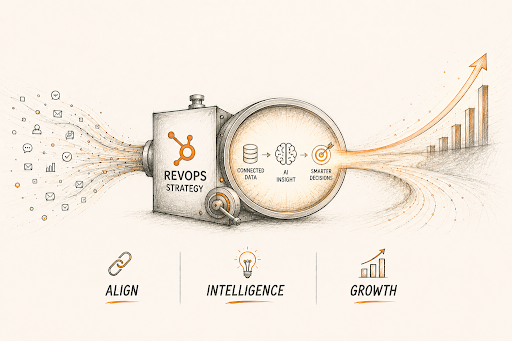
HubSpot RevOps is evolving from workflow automation to revenue intelligence, using connected data and AI for smarter decisions.
Revenue alignment is the real advantage shared KPIs, standardized processes, clean handoffs, and one source of truth connect every revenue team.
Future-ready RevOps focuses on outcomes, helping businesses improve forecasting, identify opportunities, and scale revenue more predictably.
Revenue does not break overnight. It slows down quietly,Marketing generates leads. Sales closes deals. Customer success reduces churn. But somewhere between those three functions, HubSpot RevOps often falls out of sync. The problem isn't a lack of automation or data; most teams have plenty of both. What’s missing, the ability to translate that data into timely, revenue-driving decisions before the moment passes.
This marks the new era, or you can say the future of HubSpot RevOps, less about managing workflows, more about real revenue intelligence: spotting opportunities faster, forecasting better, and making the calls that actually drive long-term growth.
The RevOps Playbook That Built Yesterday's Growth Is Breaking Today
The old RevOps playbook wasn't wrong. It was just built for a different market.
For years, HubSpot RevOps helped businesses align marketing, sales, and customer success around a shared CRM, standardized processes, and AI automation. That approach worked; it made revenue operations more efficient and a lot more predictable.
But growth doesn't look the same anymore.
What Changed?
Buyers now do most of their research before a sales rep ever gets involved.
AI is speeding up how and how fast decisions get made.
Customer data is scattered across dozens of touchpoints, not one clean funnel.
Leaders want real-time insight, not a report on what already happened.
The issue was never that RevOps stopped working. It's that the market moved faster than the playbook did.
The New Role of HubSpot RevOps
Traditional RevOps kept asking one question: "How can we automate this process?"
Modern HubSpot RevOps asks something different: "How do we make the next revenue decision smarter?"
That's the real shift from process automation to revenue intelligence.
Instead of just connecting teams and workflows, future-ready RevOps connects customer data, AI insights, and business decisions, helping companies spot opportunities sooner, forecast with more confidence, and grow in a way that actually holds up.
Future-Proofing Your HubSpot RevOps Strategy: A 6-Step Roadmap
A modern HubSpot RevOps strategy begins with the right foundation. Here are six steps to building a revenue engine that works.
Step 1: Clean up your CRM.
Start with an audit of your HubSpot CRM: remove duplicate records, align lifecycle stages, check custom properties, and keep uniform data quality across contacts, companies, and deals. Even three different spellings of the same company name can skew attribution reports down the road.
Step 2: Develop Your Revenue Pipeline.
Create your deal pipelines, automate your lead routing, define clear stage exit criteria, and implement lead scoring so that every opportunity moves through a consistent sales process, not whatever a rep happens to remember to do.
Step 3: Automate the customer lifecycle.
HubSpot Workflows can automate lead nurturing, deal creation, task assignments, lifecycle stage updates, and new customer onboarding, so nothing is left to someone remembering to update a field. With lead nurturing automation, HubSpot can send the right message to the right lead at the right stage, without a rep having to remember to follow up.
Step 4: Connect Your Revenue Stack
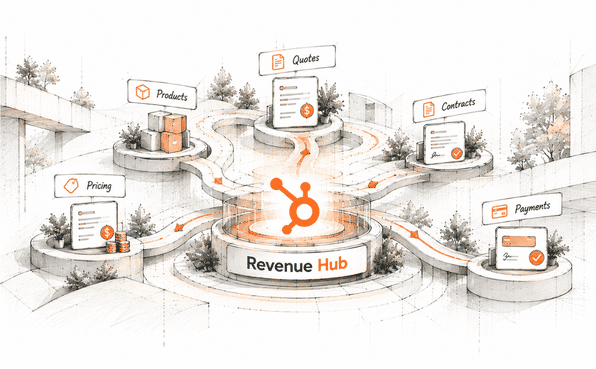
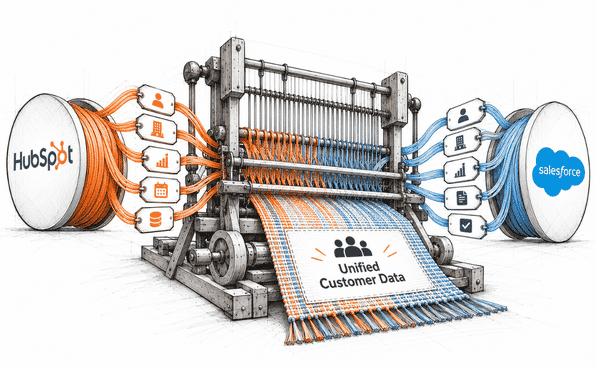
Integrate HubSpot with Salesforce, your ERP, customer support tools, and marketing platforms so every revenue team is working from a single source of truth, instead of three teams pulling three different numbers into a Monday meeting. HubSpot Revenue Hub brings marketing, sales, and customer success data into one place, so teams stop reconciling three different numbers before every leadership meeting.
Step 5: Build Revenue Intelligence Dashboards
Track pipeline velocity, conversion rates, forecast accuracy, CAC, and revenue by lifecycle stage all through custom dashboards and attribution reports that leaders can actually check without asking someone to pull a report first.
Step 6: Enable AI-Powered RevOps
Put AI to work for predictive lead scoring, pipeline risk analysis, next-best-action recommendations, and sales forecasting, so revenue decisions get sharper over time instead of relying on gut feel alone.
The New HubSpot RevOps Framework for Modern Growth
Modern HubSpot RevOps isn't about adding more automation; it's about building a revenue engine where every team works from the same strategy. That starts with four core capabilities.
1. Operational Excellence
Define standardized lifecycle stages, pipeline rules, ownership, and handoff processes so every revenue team is actually following the same playbook.
2. Revenue Enablement
Equip Marketing, Sales, and Customer Success with the right CRM data, automation, and processes so they can execute consistently at every customer touchpoint.
3. Revenue Insights
Turn CRM data into intelligence you can act on through forecasting, attribution reporting, pipeline analytics, and KPIs everyone's actually looking at.
4. Connected Technology
Integrate HubSpot with the rest of your revenue stack to eliminate data silos and build a real single source of truth across the customer lifecycle.
“When these four capabilities work together, HubSpot RevOps stops being just an operational function. It becomes a scalable revenue system.”
Five Growth Signals That Your HubSpot RevOps Strategy Needs an Overhaul
Not every RevOps problem is obvious.
Revenue doesn’t drop off a cliff. Instead, it’s the tiny inefficiencies adding up across marketing, sales, and customer success until the growth begins to slow, forecasting gets less reliable, and scaling begins to feel harder than it should.
If these signals sound familiar, it might be time to rethink your HubSpot RevOps strategy.
1. Your CRM Stores Data, Not Creates Insights
Your teams are collecting customer data every single day. But are they using that data to make better decisions?
If your reports only tell you what happened, instead of what to do next, your CRM is acting like a database. Not a revenue engine.
2. Marketing and Sales Don't Agree on Lead Quality
Marketing celebrates lead volume. Sales questions lead to quality.
When both teams measure success differently, opportunities get lost long before they ever reach the pipeline.
3. Automation Has Become a Maintenance Task
More workflows don’t always mean better outcomes.
If your team spends more time on updating automations than on actually improving customer experiences, you have optimized your processes, not your growth.
4. Revenue Forecasts Still Depend on Historical Reports
Looking at last month's dashboard isn't going to help you respond to today's pipeline risks. Modern HubSpot RevOps should surface opportunities and risks in real time, giving leaders the confidence to act before revenue actually takes a hit.
5. Every Team Has KPIs, But No One Owns Revenue
Marketing tracks campaign performance. Sales tracks closed deals. Customer Success tracks retention. But if each department is chasing a different goal, the revenue accountability gets fragmented.
RevOps should align every team to a single common outcome: predictable, sustainable revenue growth.
Quick Check: If your business checks off three or more of these signals, your HubSpot RevOps strategy is likely optimized for efficiency, not modern growth.
The Biggest RevOps Mistakes That Will Hold Businesses Back in the Next Five Years
The biggest RevOps mistakes usually aren't about picking the wrong HubSpot feature. Most of the time, it's the right tech, wrong operating model. That distinction matters more than people give it credit for.
01. Turning RevOps Into a CRM Project
The mistake: treating HubSpot as if it were the RevOps strategy.
Why it hurts: a CRM connects data. It doesn't fix a sales team that hates talking to marketing, or a process nobody agreed on in the first place.
The better approach: align people, process, data, and tech around one shared revenue goal, not around the software.
02. Buying Tools Before Fixing Processes
The mistake: every time something breaks, buy another platform to patch it.
Why it hurts: now you've got more integrations, more silos, more stuff to maintain, and the original problem's still there, just better hidden.
The better approach: fix the process first. Let the tech scale what already works.
03. Letting Data Quality Become an Afterthought
The mistake: assuming the CRM just... takes care of itself.
Why it hurts: it doesn't, and bad data quietly poisons everything downstream reporting, automation, forecasting, whatever AI you're trying to layer on top.
The better approach: decide who owns the data, set the standards, do it early. Not after things break.
04. Optimizing Teams Instead of Revenue
The mistake: Marketing chases leads. Sales chases deals. CS chases retention. Everyone's busy.
Why it hurts: all three can hit their numbers, and revenue still stalls. That's the trap: local wins, no global win.
The better approach: shared KPIs. Pipeline, revenue, retention, growth: one scoreboard, not three.
05. Waiting for AI to Become "Ready"
The mistake: treating AI like a someday project.
Why it hurts: someday's already here for a lot of teams; they're using it right now to prioritize deals, surface risk, and cut the busywork.
The better approach: pick one or two focused use cases. Start there. Expand once it's actually working.
The companies that fall behind in the next five years probably won't have the worst tech in the room. They'll just be the ones who never bothered connecting it to how revenue actually moves.
What’s Fueling the Future of HubSpot RevOps?
The future of HubSpot RevOps is not one single innovation, but several shifts happening at the same time.
| Now | Then |
|---|---|
| Automation increased efficiency. | AI helps teams make smarter revenue decisions. |
| Customer journeys were a well-known funnel. | Before purchasing, buyers go through several channels. |
| Teams had separate reports. | Every team needs one source of truth. |
| Their past performance was responded to by businesses. | Leaders want predictive insights in real time. |
| Static workflows were for repetitive tasks. | Automation responds to customer behavior and intent. |
Collectively, these changes are transitioning HubSpot RevOps from an operational function to more of a strategic growth driver.
Where HubSpot Fits Into the Future of Revenue Operations
The value of HubSpot RevOps isn't in how many features you're using. It's in how those capabilities actually solve revenue problems.
| Business Challenge | HubSpot Capability | Business Outcome |
|---|---|---|
| Fragmented customer data | Smart CRM & Data Sync | One view of the customer |
| Manual processes | Workflows & Automation | Faster execution |
| Limited revenue visibility | Custom Reports & Forecasting | Better decisions |
| Slow lead response | Lead Routing & Automation | Faster sales follow-up |
| Disconnected teams | Shared CRM & Lifecycle Management | Better handoffs |
| Complex tech stack | Integrations & Operations Hub | Connected revenue operations |
Here's another pass with more human texture, more fragments, contractions, a bit of attitude, less symmetrical structure:
Conclusion
The future of HubSpot RevOps is not just more automation. It’s smarter, data-driven revenue decisions. Businesses that get their teams, processes, and technology genuinely aligned are the ones positioned to scale predictably, not just efficiently.
Whether you're refining what you already have or planning a HubSpot-Salesforce integration, the right HubSpot consulting services can help turn RevOps into something closer to a real revenue engine, not just another system to maintain.
Frequently Asked Questions
-
No. Businesses of any size can use HubSpot RevOps to align Marketing, Sales, and Customer Success, improve data quality, and build a more predictable revenue process.
-
AI helps prioritize leads, identify pipeline risks, automate routine tasks, and improve revenue forecasting using real-time customer data.
-
Poor CRM data quality and disconnected teams. Without clean data and shared processes, automation and reporting become less reliable.
-
Yes. HubSpot integrates with Salesforce and other business systems to create a unified view of customers and improve cross-team collaboration.
-
The focus is shifting from workflow automation to AI-powered revenue intelligence, helping businesses make faster and more informed revenue decisions.
-
Review it quarterly or whenever your sales process, customer journey, or revenue goals change to keep your CRM, automation, and reporting aligned with business growth.
Related Readings
Let’s Talk

Drop us a note, we’re happy to take the conversation forward 👇🏻