
The Modern Enterprise AI Stack: What Every CTO and Enterprise Architect Should Build in 2026
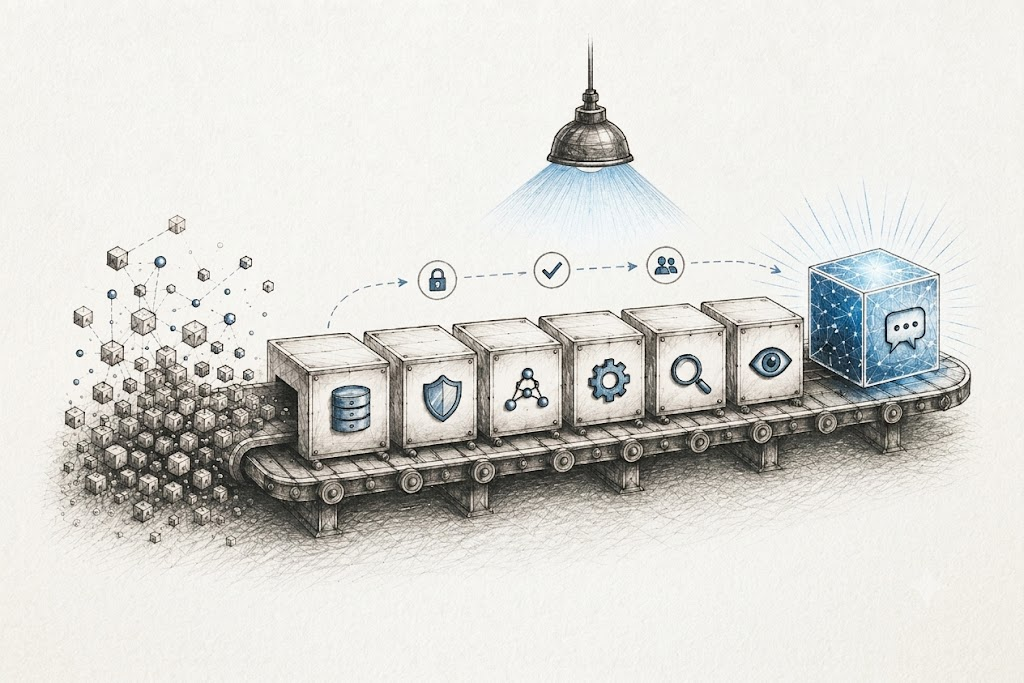
Key takeaways:
Enterprise AI requires more than a powerful model. A production-ready AI stack needs strong foundations for model access, knowledge retrieval, security, evaluation, and governance.
Use workflows for predictable tasks and AI agents for dynamic, multi-step work where flexibility provides clear value.
Security and governance must be built in. Apply least-privilege access, protect sensitive data, maintain audit trails, and define clear ownership for AI risk management.
Every enterprise now has an AI initiative. Fewer have an AI architecture.
Walk into most organizations that shipped a generative AI feature in the last two years and you will find the same pattern underneath the demo: a chat UI, an API call to a foundation model, maybe a document search bolted on the side. It works well enough to survive a pilot. It falls apart the moment real users, real data, and real compliance teams show up.
That gap between "we called an LLM API" and "we run a production AI platform" is where most enterprise AI budgets are currently being spent, and where most of them are quietly failing. This piece is about what actually needs to sit between your business and the model to make AI dependable, governable, and worth the spend.
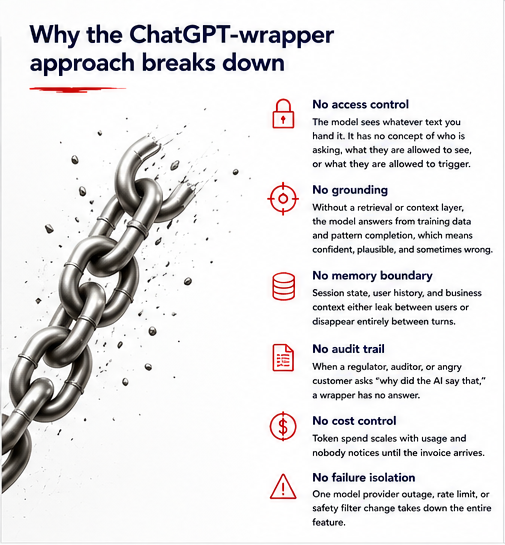
Why the ChatGPT-wrapper approach breaks down
A "wrapper" in this context means: prompt in, model call, response out, with little else in between. It is the fastest way to get a demo working and the fastest way to accumulate technical debt you cannot see yet.
Wrappers fail in production for structural reasons, not because the underlying model is weak.
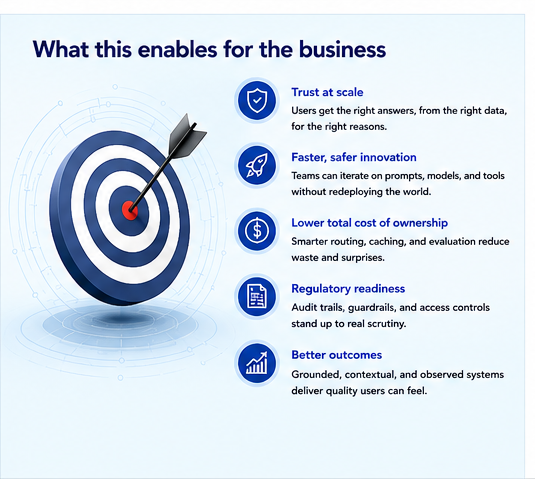
What this enables for the business
The point of building these layers is not architectural tidiness for its own sake. Each one removes a specific, previously invisible risk, and the combined effect shows up directly in what the business can do with AI.
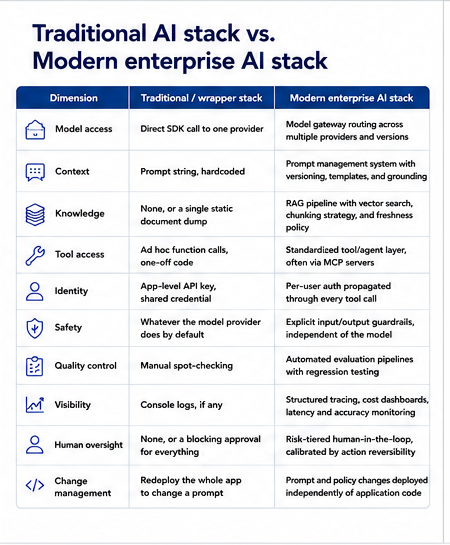
Traditional AI stack vs. modern enterprise AI stack
The right-hand column below is not "more technology for its own sake." Every row exists because a specific enterprise failure mode showed up in production and someone had to build a layer to stop it from happening again.
The reference architecture
Below is the shape of a production AI platform as we build it at Concretio. It is a set of layers, not a single service, and each layer has a distinct owner, failure mode, and reason to exist.
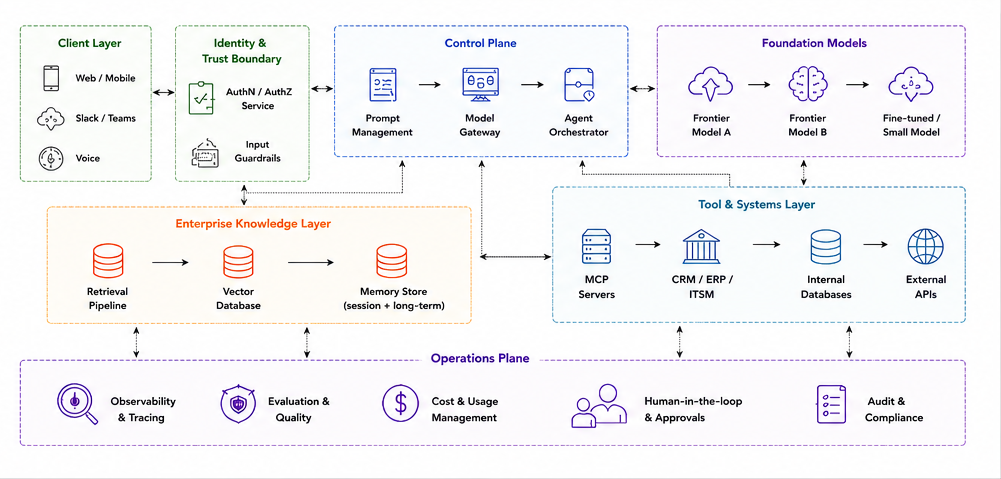
Notice what sits around the model: identity and trust on the way in, guardrails and human review on the way out, and an operations plane watching everything continuously. The foundation model is one box among many, not the whole architecture.
Layer 1: Foundation models and the model gateway
Why it exists: No single model consistently delivers the best quality, cost, latency, or availability for every task. Model capabilities, pricing, and availability change frequently, so an architecture tied to one provider can inherit its roadmap, pricing changes, and outages.
What a gateway solves: A model gateway creates an abstraction layer between application code and model providers. It standardizes requests and responses, manages authentication, rate limits, retries, logging, and cost tracking. Tools like LiteLLM provide a common interface across multiple backends.
Enterprise considerations: Route workloads based on regulatory and regional requirements, use smaller models for simple tasks, reserve frontier models for complex reasoning, and enable provider failover without changing application code.
Common mistakes:
Hardcoding model names and versions instead of using a gateway.
Treating the gateway as a one-time setup rather than continuously optimizing routing and costs.
Assuming model behavior remains consistent across versions instead of testing for regressions.
Best practice: Implement a gateway before multiple teams create separate model integrations.
Layer 2: Prompt management and the Model Context Protocol
Why prompt management exists: Hardcoded prompts create governance and iteration challenges. Every change may require a deployment, version history can be difficult to track, and teams may not know which prompt produced a specific output. Prompt management systems, such as Salesforce's Prompt Builder, treat prompts as versioned and testable artifacts separate from application logic.
What MCP solves: The Model Context Protocol standardizes how AI applications connect to external tools and data sources through a consistent interface, reducing the need for custom integrations.
Enterprise considerations: Each MCP server adds a permission scope and attack surface. Use direct function calls when no reuse is needed, and treat prompts accessing live business data as data access patterns requiring appropriate controls.
Common mistakes:
Granting MCP tools broader permissions than the task requires.
Leaving prompts undocumented and difficult to audit.
Building MCP servers for tools with no reuse value.
Best practice: Version prompts like API contracts and apply least-privilege access to every MCP tool and credential.
Layer 3: Agents, orchestration, and tool calling
Why this layer exists: An agent is more than a single model call. It dynamically decides which tools to use, how to interpret results, and when a task is complete. Workflows follow predefined code paths, offering predictability, while agents direct their process dynamically, offering flexibility. The right choice depends on the task, not a maturity hierarchy.
Enterprise considerations:
Workflows give you predictability: the same input takes the same path every time, which auditors, compliance teams, and QA processes prefer.
Agent development gives you flexibility for open-ended tasks where the number of steps cannot be predicted in advance.
Multi-agent orchestration, where a coordinator delegates to specialized sub-agents, is useful when a task genuinely decomposes into independent sub-problems. Salesforce's Agentforce platform illustrates both layers of this.
Industry example of manufacturing: Predictive maintenance with known steps fits a workflow. Diagnosing an unfamiliar equipment failure, where each result determines the next action, is better suited to an agent with access to manuals, historical tickets, and sensor APIs.
Common mistakes:
Using complex multi-agent systems when a single model or workflow is enough.
Giving agents broad tool access instead of task-specific permissions.
Allowing agents to take irreversible actions without sandbox testing.
Best practice: Start with the simplest architecture and use agents only when tasks require dynamic, multi-step decision-making.
Layer 4: Enterprise knowledge, vector databases, and memory
Why RAG exists: Foundation models do not know your company’s data by default. Retrieval-Augmented Generation (RAG) retrieves relevant information from external sources and uses it to ground the model’s response. This helps models answer questions about product catalogs, case histories, and policies instead of relying only on general knowledge.
Vector databases: They store content as embeddings and retrieve semantically similar information, allowing queries to find relevant results even without exact keyword matches. The trade-off in choosing a vector store is mostly about where your data already lives and how much operational overhead you want:
| Option | Best Fit | Trade-off |
|---|---|---|
| Postgres + pgvector | Teams already running Postgres who want one fewer system to operate. | Scales less elastically than purpose-built vector stores at very high dimensionality and volume. |
| Managed vector database (e.g., Pinecone) | Teams that want retrieval performance and scaling handled for them. | Adds a new vendor and raises data residency considerations in your architecture. |
| Platform-native vector search (e.g., Salesforce Data Cloud) | Teams whose knowledge already lives inside that platform's data model. | Retrieval quality and coverage are limited by the data the platform ingests. |
Memory systems: RAG retrieves facts, while memory retains context across conversations or sessions. Short-term and long-term memory should be managed separately because they have different privacy, retention, and consent requirements.
Enterprise considerations: Retrieval quality depends on chunking and metadata, vector index must stay current, and long-term memory requires the same consent, deletion, and access controls as other customer data.
Common mistakes:
Uploading entire documents without a clear chunking strategy.
Treating RAG as a one-time setup instead of maintaining source freshness.
Storing long-term memory without a data deletion process.
Layer 5: Identity, security, and governance
Why this layer exists: An AI agent that can access CRM data or create support tickets is effectively a new type of user. It needs the same controls as human and service accounts: least privilege, auditable actions, and clear limits on what it can do.
Authentication and authorization: Propagate the requesting user’s identity and permissions through every tool call instead of using one broad service credential. Salesforce’s Einstein Trust Layer illustrates this by grounding prompts only with data the user is authorized to access, while respecting existing field-level security and sharing rules.
Guardrails and governance frameworks: OWASP highlights risks such as prompt injection, sensitive information disclosure, supply chain vulnerabilities, improper output handling, and excessive agency. Its Agentic Security Initiative also addresses risks such as memory and context poisoning. NIST’s AI Risk Management Framework provides a voluntary Govern, Map, Measure, and Manage structure for managing AI risk.
Enterprise considerations:
Use data masking and zero-data-retention agreements when sensitive data reaches external models.
Assign clear ownership for running the organization’s AI governance process.
Regulated industries need audit trails covering outputs, retrieved context, and tool calls.
Industry example - banking: A credit underwriting assistant should attribute every retrieval and tool call to a specific user session, mask sensitive financial data before sending it to external models, and maintain a complete record of the information supporting each recommendation.
Common mistakes:
Using shared, over-privileged accounts for AI agents.
Sending unmasked sensitive data to external models without retention agreements.
Relying on provider safety filters instead of implementing access controls and audit logs.
Layer 6: Guardrails, evaluation, and observability
Why this layer exists: A model that performs well in testing may behave differently with real user inputs, at scale, or after a provider updates the model. Without independent measurement, production regressions may be discovered by customers instead of monitoring systems.
Guardrails: Input guardrails filter requests before they reach the model, while output guardrails check responses before they reach users or trigger actions. These checks should be independent of the model to avoid relying on the model to judge its own behavior.
Evaluation frameworks: Evaluation pipelines test common and edge-case inputs against every prompt or model change, scoring results against defined criteria. This makes quality decisions repeatable and helps detect regressions.
Observability: Tracing retrievals, reasoning steps, and tool calls makes production issues easier to diagnose.
Enterprise considerations:
Use realistic production-like data in evaluations.
Treat logged prompts and responses as data requiring privacy governance.
Balance guardrail latency and cost against the risks they mitigate.
Common mistakes:
Releasing prompt or model changes without regression testing.
Adding observability too late to trace agent behavior during incidents.
Relying only on provider content filters for domain-specific evaluation.
Best practice: Build evaluation and tracing systems before scaling production traffic.
Layer 7: Human-in-the-loop, deployment patterns, and feedback loops
Why human-in-the-loop exists: Full automation and full manual review are rarely the right defaults. Human oversight should depend on how consequential and reversible an action is.
A practical way to tier this:
| Risk Tier | Example Action | Oversight Pattern |
|---|---|---|
| Low, reversible | Drafting a reply for a human to send. | No gate; a human reviews the draft before sending. |
| Medium | Updating a CRM record or routing a case. | Post-hoc audit sampling rather than per-action approval. |
| High, hard to reverse | Issuing a refund, modifying financial records, or generating patient-facing clinical content. | Explicit approval gate before the action is executed. |
Deployment patterns: Enterprises commonly use shadow deployments for comparison, canary rollouts to limited traffic, and staged rollouts by business unit or geography. These approaches help validate AI systems before broader deployment.
Feedback loops: Production failures should become new evaluation cases, while user corrections should inform prompt and retrieval improvements through a structured review process.
Enterprise considerations:
Escalation paths must be practical for humans under time pressure.
Feedback loops need clear ownership and a regular review cadence.
Shadow and canary deployments help build confidence before reducing human oversight.
Industry example - customer support: An AI support agent can draft responses for human approval across channels, while requiring explicit approval for higher-risk actions such as billing disputes or account cancellations.
Common mistakes:
Requiring human approval for every action, regardless of risk.
Removing human oversight after a successful pilot without staged validation.
Collecting user feedback without using it to improve evaluations or prompts.
Cost optimization: the line item nobody budgets for
Token costs, retrieval infrastructure, vector database storage, and evaluation runs all scale with usage, and enterprises that skip this layer discover it the hard way, on an invoice.
What actually drives cost in production:
Model selection per task. Routing simple classification or extraction tasks to smaller, cheaper models and reserving frontier models for genuinely hard reasoning tasks is the single biggest lever most teams have not pulled yet.
Context size. Every token of retrieved context, conversation history, and tool output definitions is a token you pay for on every call; trimming unnecessary context is a cost decision, not just a quality one.
Retry and agent loop behavior. An agent that takes many turns to complete a task multiplies cost per completed task; this is part of why Anthropic's guidance frames agent autonomy explicitly as a cost and latency trade-off, not a free upgrade.
Evaluation and guardrail overhead. Every additional check that itself calls a model adds cost; this needs to be weighed against the risk it mitigates, not applied uniformly to every request.
Best practice: Put cost dashboards next to your quality dashboards from day one. A cheaper model that passes your evaluation bar is a better engineering decision than a more expensive model that passes it by a slightly wider margin.
Enterprise architecture checklist
Model access goes through a gateway abstraction, not direct provider SDK calls scattered through the codebase.
Prompts are versioned artifacts, deployable independently of application code.
Tool and MCP server access is scoped to least privilege per task, not granted broadly for convenience.
User identity and permissions propagate through every agent tool call.
Sensitive fields are masked or excluded before reaching any external model provider, with a data retention agreement in place.
RAG pipelines have a defined chunking strategy and a freshness/refresh policy, not a one-time ingestion.
Long-term memory storage has a deletion and consent mechanism.
Input and output guardrails are independent of the model's own judgment.
An evaluation suite runs against every prompt or model change before it ships.
Every agent step, retrieval, and tool call is traceable, not just the final output.
Human review is tiered by action risk and reversibility, with genuinely usable escalation paths.
Cost and quality dashboards are reviewed together, not cost alone or quality alone.
A feedback loop turns production failures and user corrections into new evaluation cases.
Future Outlook
Two trends are shaping the enterprise AI landscape. MCP is expanding beyond chat assistants into agent-to-agent and enterprise system integrations, driving greater standardization across AI tools and integrations. Meanwhile, OWASP’s agentic security guidance highlights that AI systems with memory and autonomous actions create risks beyond those of single-turn chat applications.
These trends do not change the core argument. Models will continue to improve, but identity, grounding, evaluation, and human oversight are what make enterprise AI reliable, secure, and ready for production.
Sources
Anthropic — Building Effective Agents: https://www.anthropic.com/research/building-effective-agents
OWASP Gen AI Security Project: https://genai.owasp.org/llm-top-10/
NIST — AI Risk Management Framework: https://www.nist.gov/itl/ai-risk-management-framework
Salesforce Help — Einstein Trust Layer, Designed for Trust: https://help.salesforce.com/s/articleView?id=ai.generative_ai_trust_arch.htm&language=en_US&type=5
Salesforce Developers — Agentforce Developer Guide: https://developer.salesforce.com/docs/ai/agentforce/guide/get-started.html
Related Reading
Let’s Talk

Drop us a note, we’re happy to take the conversation forward 👇🏻