How to Measure AI Voice Agent Quality (Beyond CSAT and Call Duration)
Key takeaways:
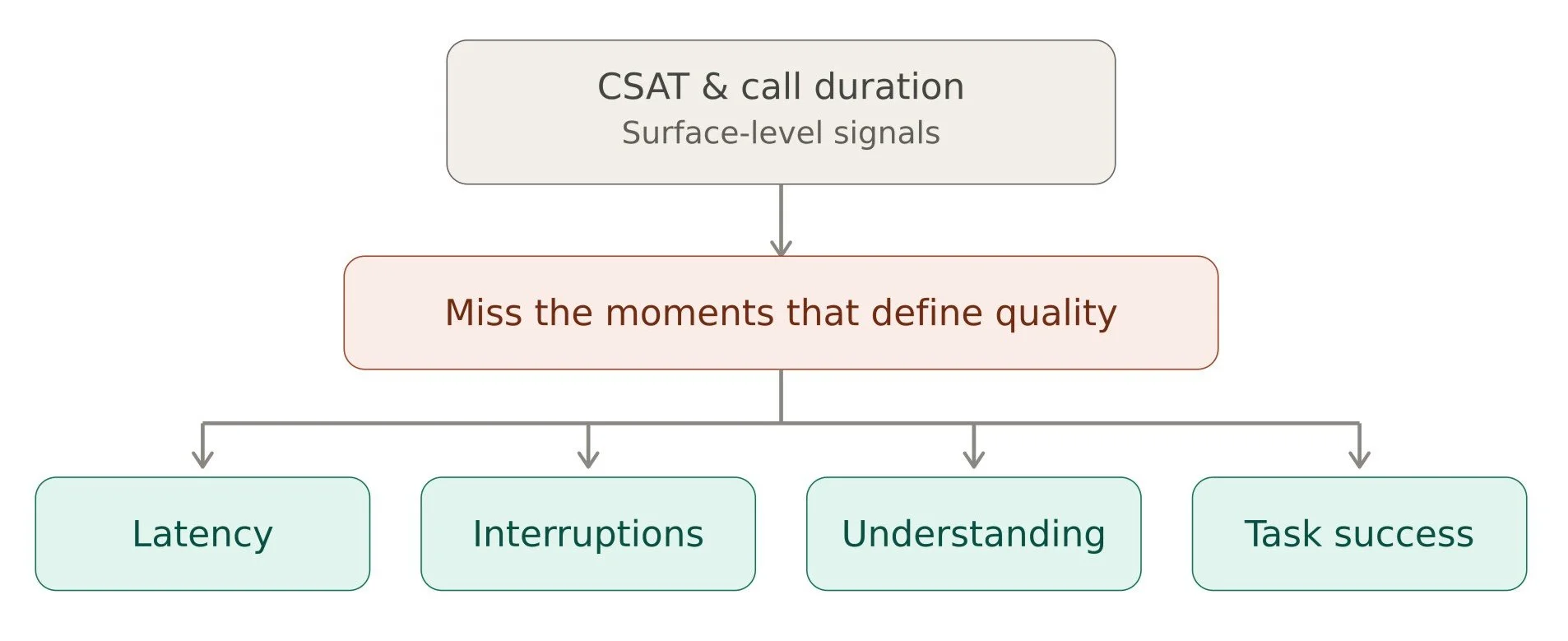
CSAT and call duration are easy-to-pull signals. They can't tell you whether the agent understood the caller, handled interruptions well, or actually completed the task.
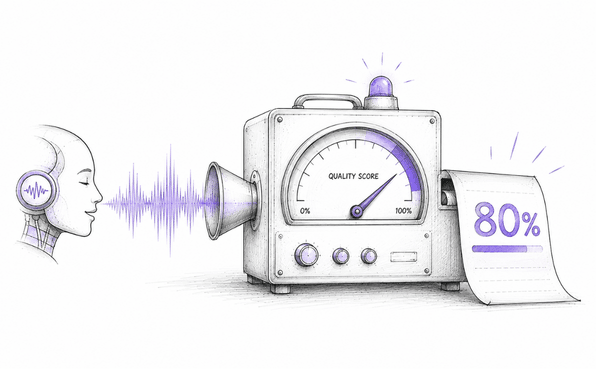
Real voice agent evaluation tracks understanding accuracy, conversational quality, task completion, and business outcome.
Combine automated scoring on every call with human review, test against adversarial scenarios before each deployment, and segment results by call type to see where quality is actually breaking down.
If you're running a voice AI program, you already know the dashboard trap. CSAT looks decent. Average handle time is down. Everyone in the weekly review nods and moves on. Then a customer posts on Twitter that your bot argued with them for four minutes about a refund it had no authority to issue, and nobody saw it coming because the metrics that were supposed to catch it never do.
This is the core problem with how most teams approach voice agent quality: they borrow metrics from human contact centers and call it a day. CSAT and call duration were built to measure people, not language models making real-time decisions on live audio. They're not useless, but they're nowhere near enough. If you actually want to understand voice agent quality, you need an evaluation approach built for how these systems actually fail.
This article walks through what to measure instead, why the old scorecards fall short, and how to build a voice agent evaluation framework that catches problems before your customers do.
Why CSAT and Call Duration Don't Capture Voice Agent Quality
Let's start with the honest version of why these two metrics stick around. They're easy to pull, everyone already understands them, and they came bundled with your existing reporting tools. None of that makes them good indicators of voice agent quality.
CSAT is a lagging, self-reported signal. It only captures customers who bother to respond; it's heavily skewed by the outcome of the call rather than the quality of the interaction, and it says nothing about why a call went well or badly. A voice agent can misunderstand a customer twice, recover gracefully, and still get a 5-star rating because the issue got resolved. That's a near-miss, not a success, and CSAT will never tell you the difference.
Call duration has the opposite problem. It's precise but meaningless in isolation. A short call could mean the agent was efficient. It could also mean the agent got confused, gave a wrong answer, and the customer hung up frustrated. A long call could mean the agent patiently walked through a complex issue, or that it got stuck in a repetition loop asking the same clarifying question five times. Duration alone can't tell these apart, and treating it as a proxy for quality actively rewards agents for cutting corners.
The bigger issue is that neither metric touches the things that are unique to voice, including latency, interruption handling, turn-taking, tone under pressure, or whether the agent actually understood what was said versus what it merely transcribed. That's where real voice agent evaluation needs to start.
Voice Agent Success Metrics To Actually Measure Quality
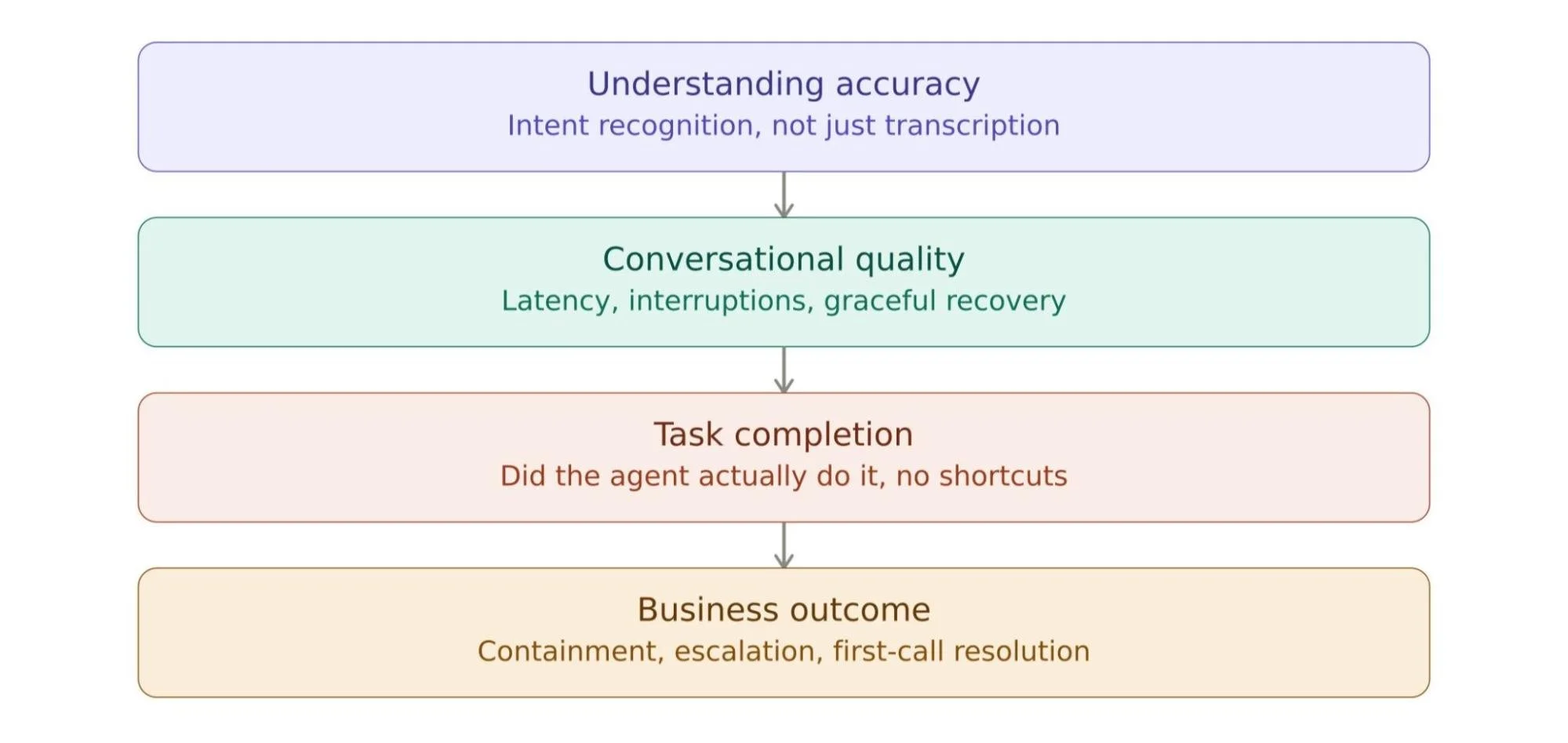
A more complete voice agent evaluation framework looks at quality across four layers: understanding, conversation flow, task execution, and business outcome. Each layer answers a different question, and skipping any one of them leaves a blind spot.
Understanding accuracy: Did the agent correctly transcribe and interpret what the caller said? This isn't just word error rate; it's whether intent recognition held up under accents, background noise, interruptions, and code-switching. A voice AI evaluation that only checks transcription accuracy and ignores intent accuracy is measuring the wrong layer.
Conversational quality: This is where a lot of the customer experience actually lives. Did the agent handle interruptions naturally? Did it wait an appropriate amount before responding, or did it talk over the caller? Did it recover smoothly when it misheard something, or did it spiral into a loop of "I'm sorry, I didn't catch that"? Latency matters enormously here. Even a technically correct response feels broken if it arrives two seconds too late.
Task completion: Did the agent actually do the thing it was supposed to do, i.e., book the appointment, process the return, escalate to a human when needed, without shortcuts or hallucinated confirmations? This is one of the most important voice agent success metrics because it's the one most directly tied to whether the call needed a human follow-up at all.
Business outcome: Containment rate, escalation rate, first-call resolution, and downstream cost per resolved issue. These are lagging indicators, similar in spirit to CSAT, but they matter more when they're measured alongside other metrics rather than instead of them.
Tracking all four layers together is what separates a real voice AI agent performance metrics program from a vanity dashboard. Skip the middle two layers, and you'll keep optimizing for outcomes without understanding what's actually driving them.
Building a Voice Agent Evaluation Framework That Works
A good voice agent evaluation framework isn't a single score. It's a layered system that combines automated checks with structured human review, tested against real and adversarial conditions before problems reach production.
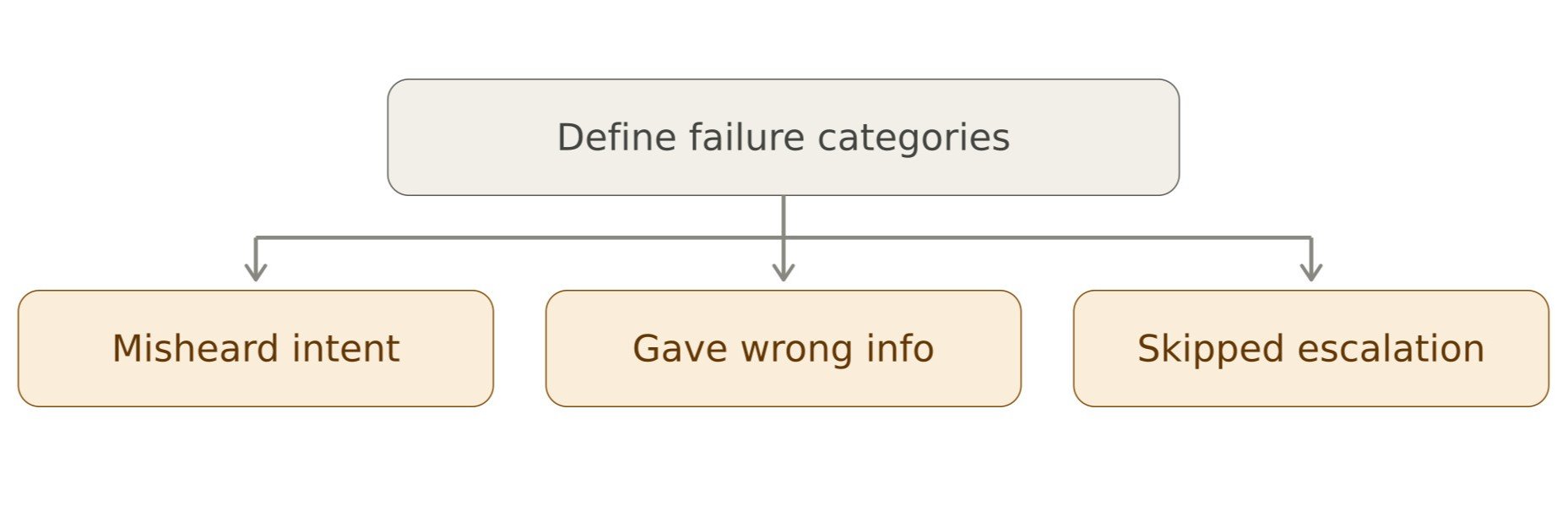
1. Start with a classification of failure modes.
Before you can measure quality, you need to define what "bad" looks like for your specific use case. Common categories include: misunderstood intent, incorrect information given, failure to escalate when it should have, unnatural pacing or interruptions, tone mismatches (sounding cheerful during a complaint call), and silent failures where the agent thinks it succeeded but didn't. Build your evaluation criteria around these categories instead of a generic 1-5 quality score. Specificity is what makes the data actionable.
2. Use a mix of automated and human evaluation.
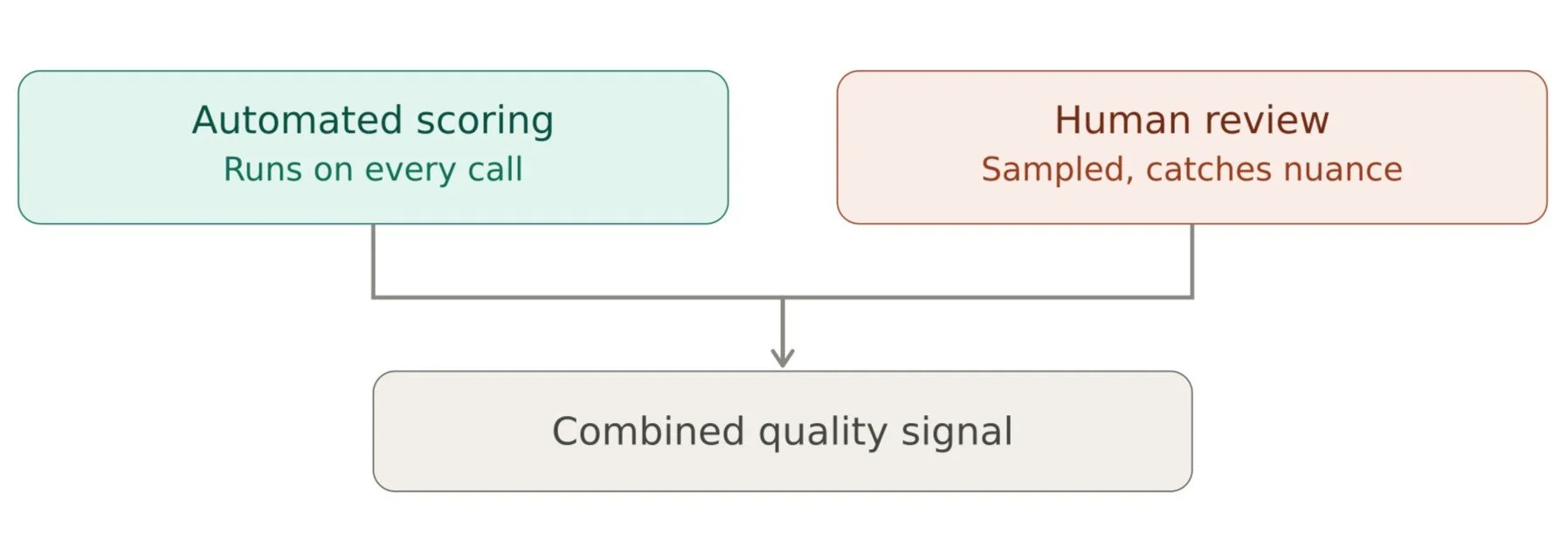
Automated scoring, i.e., measuring latency, interruption rate, silence gaps, and intent accuracy against a labeled test set, can run on every call and jalntij catch systemic drift. But automated scoring alone will miss nuance, like an agent that's technically correct but comes across as condescending. Human review, even on a sampled basis, is still necessary to catch these softer failures. Many teams building this out lean on LLM-as-judge scoring to bridge the gap: using a separate model to grade transcripts against your criteria at scale, with periodic human audits to keep the judge honest.
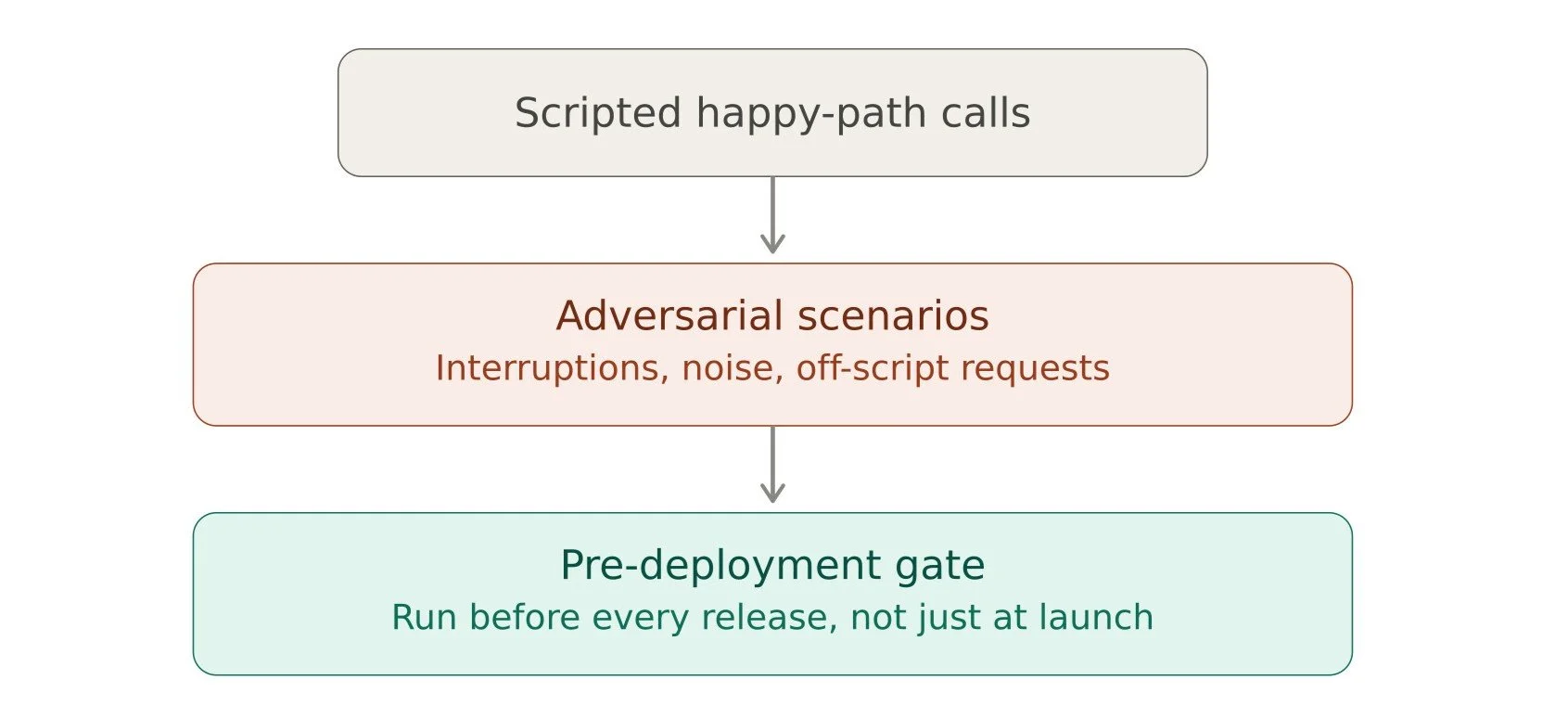
3. Test with adversarial and edge-case scenarios, not just happy paths.
Most voice agent problems don't show up in clean, scripted test calls. They show up when a customer talks over the agent, changes their mind mid-sentence, has a noisy background, or asks for something the agent can't handle. A strong voice AI evaluation process should include realistic calls designed to find where the agent fails before every deployment, not just when the agent is first launched.
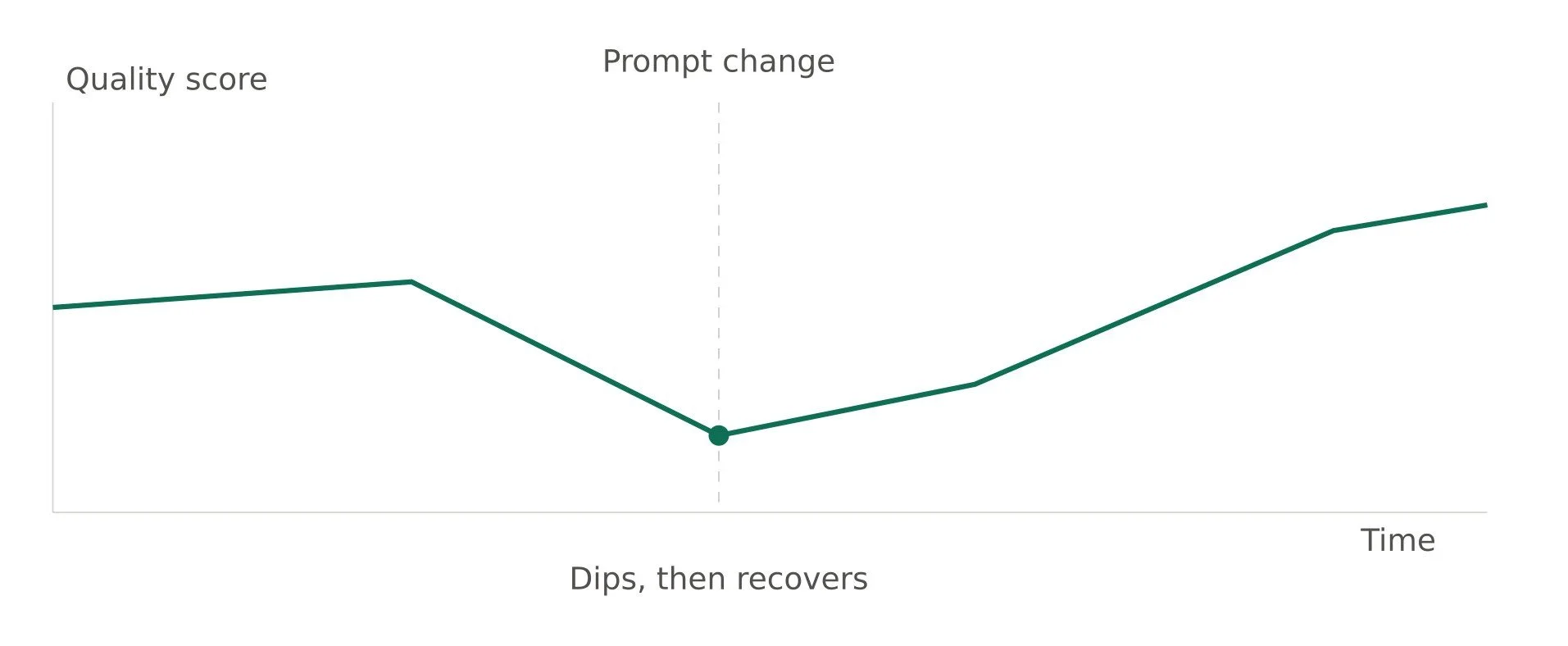
4. Track metrics over time, not just at a point in time.
Voice agent quality isn't static. Model updates, prompt changes, new call routing logic, even shifts in customer phrasing over a season can all move the needle. Treat evaluation as continuous monitoring, not a one-time certification
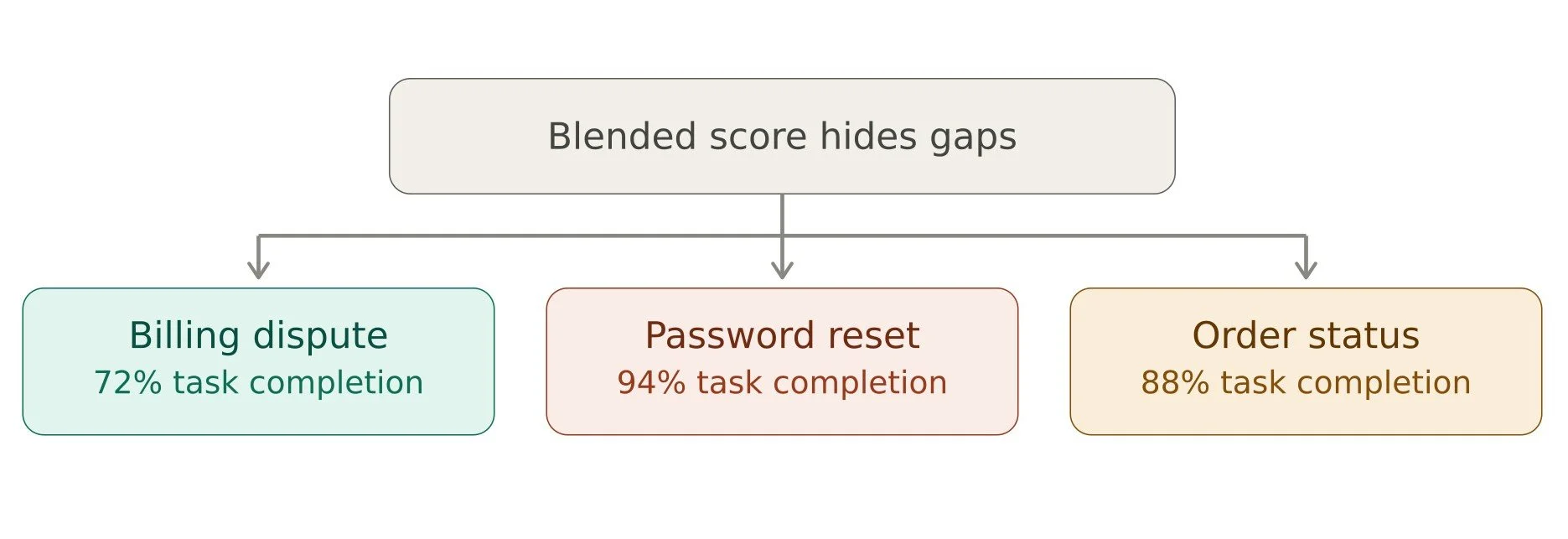
5. Segment your metrics by call type.
A single blended score across all call types hides more than it reveals. A billing dispute and a password reset have completely different definitions of a "good" call. Break your voice agent success metrics down by intent category so you can see exactly where quality is strong and where it's quietly degrading.
Final Thoughts
None of this requires throwing out CSAT and call duration entirely. They're useful, easy-to-read signals, but they're not enough. A strong voice agent evaluation uses them as a starting point, then measures understanding accuracy, conversational quality, task completion, and failure modes to show what's really happening.
Building that system in-house takes real engineering work: instrumenting call logs, creating labeled test sets, setting up automated scoring pipelines, and training reviewers on consistent evaluation criteria. That's a significant investment beyond building the agent itself, which is why many teams bring in experienced AI voice agent development partners. They can provide proven scoring infrastructure and failure frameworks instead of forcing your team to build them from scratch.
The principle is simple: voice agent quality is multidimensional. Latency, recovery from misunderstandings, conversational quality, and successful task completion all matter. CSAT and call duration tell you how the interaction ended. Everything in between is what a real evaluation framework is built to catch.
Frequently Asked Questions
-
There's no universal number. It depends on call complexity and industry. A better approach than chasing a single benchmark is tracking task completion rate, escalation rate, and understanding accuracy segmented by call type, then improving your own baseline over time rather than comparing to an industry-wide figure that may not reflect your use case.
-
Continuously, not periodically. Automated scoring should run on every call, with human review on a weekly basis or per release basis, and a full adversarial test pass before any model, prompt, or routing change goes to production.
-
Automated and LLM-as-judge scoring can catch most systemic issues at scale, but human review is still needed to catch tone, empathy, and context misses that automated scoring tends to miss. Most mature programs use both rather than relying on either alone.
-
Relying on a single blended score across all call types. It hides exactly where quality is breaking down. Segmenting by intent category is usually the single biggest improvement teams can make to their evaluation setup.
Related Readings