The Best AI Voice Agent for Recruitment & What to Look For
Key Takeaways:
Judge the agent on more than voice quality. Interview depth, fairness, integrity, transparent scoring, and integrations decide whether a tool is worth it.
Keep recruiters in charge of decisions. The best AI voice agents never auto-reject candidates. They leave the final review to recruiters.
Pilot before you commit. Test any tool on a real role, and avoid apps with black-box scoring, weak identity checks, or hidden costs.
A single open role can attract hundreds of applications, and every recruiter knows what comes next. Resumes pile up, phone screens eat entire afternoons, and strong candidates slip away while the team works through the backlog. Traditional screening just doesn't scale.
That's why more HR teams and recruiters are turning to AI voice agents for recruitment. These tools run spoken first-round interviews on their own, ask every candidate the same structured questions, and hand back scored, reviewable results. Not every tool is built the same way, though, and choosing the wrong one can hurt candidate experience, fairness, and trust in your process.
This guide covers what an AI hiring agent does, why recruiters are adopting them, and the criteria that separate the best AI voice agent for recruitment from the rest.
What Is an AI Voice Agent for Recruitment?
An AI voice agent for recruitment is software that conducts spoken screening interviews with candidates. It asks questions, listens to the answers, responds to what it hears, and produces a structured evaluation for the hiring team.
An AI voice recruiting agent differs from other recruiting tech in a few ways:
Chatbots handle text-based FAQs and basic pre-screening forms. A voice agent has a real conversation, which reveals communication skills, clarity of thought, and depth of knowledge that a form never will.
Resume parsers extract and rank information from documents. They tell you what a candidate claims, not how they explain it.
Human phone screens are valuable but hard to scale, and quality varies with the interviewer, the time of day, and how many calls came before.
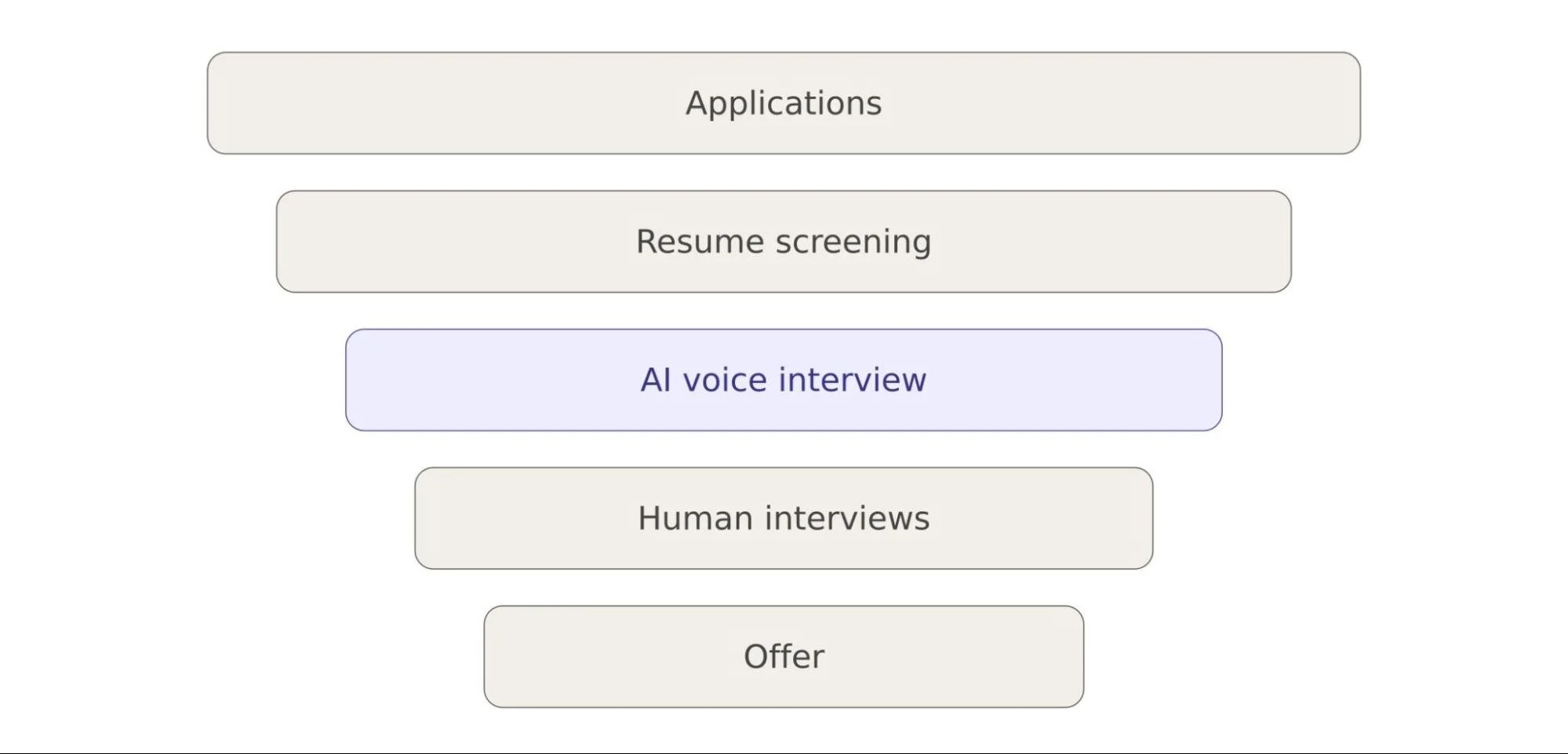
In the hiring funnel, an AI interviewer typically sits after resume screening and before human interviews. It narrows a large pool to a confident shortlist, so recruiters spend their time on the conversations that matter most.
Why Recruiters Are Turning to AI Voice Interviewers
The shift toward AI-powered recruitment isn't hype, but it comes from a few persistent problems in hiring. Here’s why recruiters are using AI voice agents for recruitment.
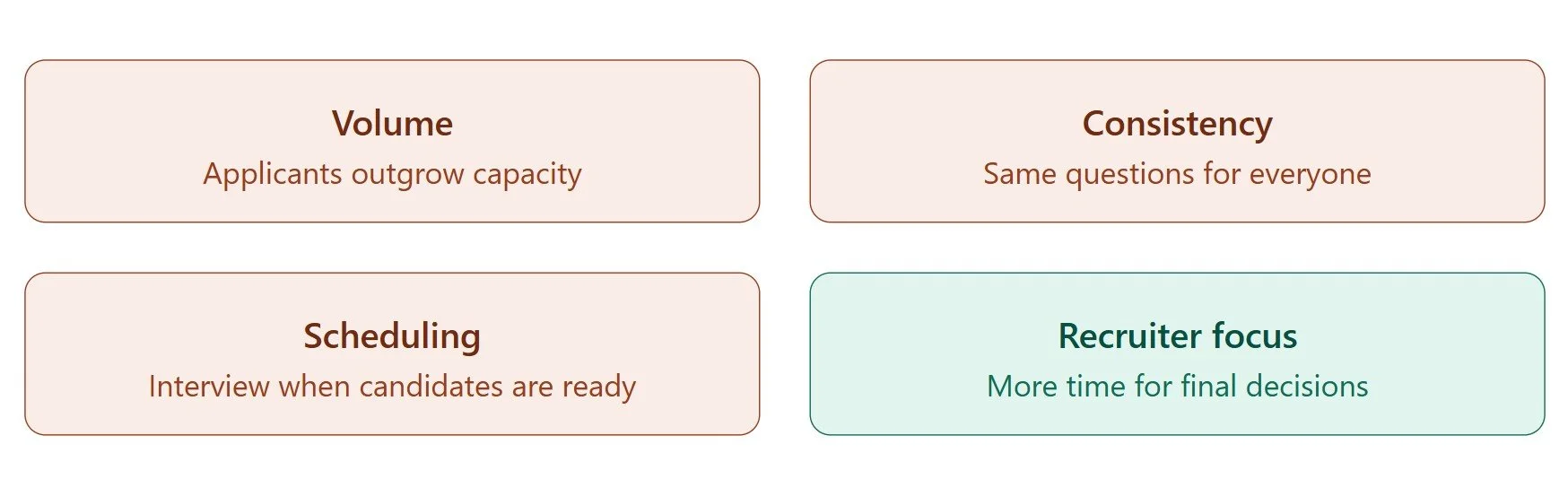
Volume has outpaced capacity. Online job boards and one-click applications mean every posting draws more applicants than a team can reasonably phone-screen. Adding headcount isn't always possible, and burning out recruiters isn't a strategy.
Consistency is hard to achieve manually. When ten different people run first-round calls, ten different interview experiences result. Candidates get different questions, different follow-ups, and different levels of attention. A structured AI conversation applies the same standard to everyone, which makes comparisons far easier and defensible.
Scheduling eats time on both sides. Coordinating calendars across time zones can delay a first conversation by days. With an AI interviewer, candidates can interview when they're ready, which keeps momentum and reduces drop-off.
Recruiters should spend time where they add the most value. Relationship-building, assessing culture fit, selling the role, and negotiating offers are human strengths. Repetitive first-round screening is not.
Candidate expectations are changing. Job seekers increasingly expect fast responses. Waiting two weeks to hear back after applying is a common frustration, and a faster, more responsive process can make an employer look better.
What to Look for in the Best AI Voice Agent for Recruitment
If you're evaluating tools, this is the checklist to use. Not every point carries equal weight for every team, but each one is worth a direct question to any vendor.
1. Interview Quality
A good AI interviewer doesn't read from a script like a form. It should ask one question at a time, listen to the full answer, and probe when a response is vague or incomplete. It should also be configurable, so you can set the competencies, role-specific questions, and must-cover topics for each position. Ask to hear or see a demo interview before you commit.
2. Natural Voice and Conversational Ability
Voice quality shapes candidate perception of your brand. Look for natural pacing, low latency (long pauses feel awkward), and the ability to handle interruptions, accents, and background noise gracefully. Strong conversational AI for recruitment should feel professional and human enough to put candidates at ease, without pretending to be a person.
3. Fairness and Human Oversight
This is the most important criterion. The best AI voice systems support human decision-making rather than replace it. Look for tools that don't auto-reject candidates, that explain how scores are produced, and that keep a human in the loop for final decisions. Regulations on automated hiring decisions are evolving in many regions, so compliance readiness matters too.
4. Integrity and Security Safeguards
Remote interviews raise legitimate concerns about impersonation and misconduct. A solid AI hiring platform and agent should verify candidate identity, check that the candidate's camera, microphone, and audio setup actually work, and flag unusual behavior for review. It should also protect candidate data with proper encryption, retention controls, and clear privacy practices.
5. Candidate Experience
A tool that frustrates candidates damages your employer brand. Look for clear instructions, automated reminders, simple access (ideally without app downloads), and accessibility accommodations. Candidates should know they're speaking with an AI, understand what to expect, and have a path to ask for help if something goes wrong.
6. Scoring, Reporting, and Transparency
Results should be usable, not just a number. The best AI recruiting software provides rubric-based scores, a readable summary, and a full transcript so hiring managers can verify the evaluation themselves. Consistent scoring criteria you can adjust to match your own hiring standards are essential.
7. Automated Candidate Screening Upstream
The interview works best as part of a pipeline. Automated candidate screening at the resume stage, including matching candidates to a job description and removing duplicate applications, ensures you're interviewing the right people. An AI-powered recruitment tool that does both avoids the friction of combining separate products.
8. Integrations
Your AI hiring platform shouldn't live on an island. Check how it connects with your applicant tracking system, HRIS, calendar, and email. Poor integrations create manual work that cancels out the efficiency gains.
9. Admin Controls and Access Management
Hiring data is sensitive. Role-based permissions let you control who can view candidates, edit rubrics, or manage settings. This matters most for larger teams, agencies, and anyone handling multiple clients.
10. Cost Transparency
Voice AI involves real usage costs, such as speech processing and language models, and some vendors obscure them. Ask how pricing works, what happens when interview volumes increase, and whether you can see costs per interview.
Red Flags to Avoid When Choosing AI Voice Agents For Recruitment
Not every AI recruitment agent deserves a spot on your shortlist. Watch for these warning signs.
Automatic rejections with no human review. If the system decides who is out without anyone checking, you're taking on legal, ethical, and reputational risk.
Black-box scoring. If a vendor can't explain how candidates are evaluated or won't share transcripts, you can't verify or defend your hiring decisions.
No bias testing or compliance story. Vague claims of "fair AI" without documentation, audits, or clear policies are a problem, especially as AI hiring regulations tighten.
Robotic, laggy conversations. Long pauses, talking over candidates, or an inability to handle accents will frustrate applicants and skew your results.
Easily manipulated interviews. If a candidate can talk the AI into skipping questions or giving a favorable score, the process isn't reliable.
Weak identity and integrity controls. Without verification, you can't be sure who you interviewed.
Unclear data practices. You should know where candidate recordings and transcripts are stored, how long they're kept, and who can access them.
Hidden or unpredictable costs. Per-minute fees, overage charges, and add-on modules can turn an attractive quote into a budget problem.
No pilot option. A vendor confident in its product should let you test it on a real role before a long-term commitment.
The 5 Best AI Voice Agents for Recruitment
The market is crowded, and nearly every tool claims to be built for hiring. To narrow it down, this list focuses on the best voice AI recruiting tools whose core experience is a spoken AI interview or screening call.
1. Hire: Best Overall AI Voice Agent for Recruiters
Hire is an AI hiring platform that connects resume screening and voice interviewing in one workflow. It scores every resume against the job description and gives a match band. Shortlisted candidates then meet an AI interviewer with its own voice and style.
What sets it apart is the safeguards around the call. Candidates verify their identity with a one-time email code and complete a device check first. During the interview, the voice AI asks one question at a time, follows up on vague answers, and works through a required checklist. It never auto-rejects, and flagged calls are held for human review.
When it comes to post-interview analysis, each call is scored on communication, technical, and behavioral skills using an admin-controlled rubric, with a full transcript and a per-call AI cost shown.
Best for: High-volume recruiting teams and companies that want screening and interviewing in one place, with humans making the final decision.
AI voice agent for recruitment | Product Demo
2. HeyMilo: Best for Adaptive Voice Screening
HeyMilo is an AI interviewer that runs screening conversations over voice, video, or phone, scores them, applies integrity signals with an ID check, and lets candidates self-schedule next steps. It builds an interview framework from the job description in your ATS and asks adaptive follow-up questions rather than following a fixed script. It is also multilingual by default.
Best for: Staffing firms and lean teams that want an adaptive AI interviewer inside their existing ATS.
3. Alex (formerly Apriora): Best for Multi-Channel Outreach
Alex rebranded from Apriora in 2026 and reaches candidates by phone, video, SMS, and WhatsApp, with fraud and identity detection built in. It also supports 30+ languages and coordinates scheduling against live calendars. That wider reach helps when you hire frontline or international candidates who may not take a video call.
Best for: Teams that want one agent handling outreach, interviews, and scheduling across several channels.
4. Ribbon: Best for Natural Voice Conversations
Ribbon is a voice-first AI interviewer that screens candidates round the clock through natural voice conversations in over 10 languages and integrates with applicant tracking systems. It stands out by publishing its pricing upfront with annual plans begin at $499 per month for 100 interviews, with a seven-day trial available.
Best for: Teams that want predictable, published pricing for first-round voice screening.
5. Tenzo: Best for Voice and Video with Compliance Focus
Tenzo is an AI recruiter that screens over voice and video, applies behavioral integrity signals and an identity check, coordinates calendars, and is compliance focused. It integrates with many ATS platforms, so it fits teams on mainstream systems that care about security documentation.
Best for: Security-conscious teams that want voice and video screening on a mainstream ATS.
Who Benefits Most from AI Voice Agents for Recruitment
High-volume hiring teams that receive far more applications than they can screen by phone.
Staffing and recruitment agencies that run many searches at once and need consistent screening across clients.
Growing companies without a large talent acquisition team, where recruiters or founders handle hiring on top of other work.
Roles that benefit from structured first rounds, such as customer support, sales, operations, and technical screening, where communication and baseline knowledge matter.
Conclusion
The best AI voice agent for recruitment isn't the one with the flashiest demo. It's the one that holds up on the criteria that matter, such as interview quality, fairness, integrity, transparency, integration, and cost clarity. Treat any tool that removes humans from the decision, hides how it scores, or can't explain its data practices with caution.
When AI voice agent development is done well, AI-powered recruitment gives recruiters their time back, gives candidates a faster and more consistent process, and gives hiring managers better information when they decide. Start with a clear checklist, pilot on a real role, and keep people at the center of the final decision.
Ready to see it in action? Book a demo of Hire with us and watch an AI interviewer run a candidate screening call end to end.
Frequently Asked Questions
-
No. It handles repetitive first-round screening, but recruiters still make final decisions, build relationships, sell the opportunity, and assess fit. The best way to think about it is as an assistant that frees recruiters for higher-value work.
-
AI voice agent can reduce manual calling, speed up candidate screening, automate interview scheduling and follow-ups, and help recruiters spend more time on high-value candidate interactions.
-
Yes. AI voice agents can ask predefined or dynamic screening questions, evaluate responses against job criteria, collect candidate information, and provide recruiters with structured screening results.
-
Many AI voice agents can integrate with applicant tracking systems (ATS) and other recruitment platforms through APIs or native integrations, allowing candidate information and call outcomes to flow into existing workflows.
-
Yes. One of their biggest advantages is scalability. They can handle large numbers of screening and follow-up calls simultaneously. This makes them particularly useful for high-volume or seasonal hiring.
-
By using AI output as one input among several. Scores, summaries, and transcripts help your team decide, but a human makes the call, especially on flagged or borderline cases.
Related Readings
Let’s Talk
Drop us a note, we’re happy to take the conversation forward 👇🏻