
Everything You Need to Know About AI Voice Agents in 2026
Key takeaways:
Latency is everything. Sub-second, stage-by-stage response time is critical to keeping voice interactions natural.
Voice agents aren’t just faster chatbots; they are a new category. They handle open-ended speech, interruptions, and multi-step actions in real time, not just faster chat.
Compliance must be built in. Disclosure and consent need to be engineered into voice agents from day one.
Voice AI has quietly crossed a threshold. What used to be "press 1 for billing" is now a system that understands context, holds a real conversation, takes actions inside your CRM, and sounds close enough to human that callers sometimes forget they're talking to software. Analysts now put the voice AI market above $22 billion for 2026, and Gartner's longer-range forecast has agentic AI handling as much as 80% of customer service resolutions on its own by 2029.
The shift is already visible in day-to-day operations. Forrester expects AI to be managing half of all customer service phone calls in developed markets by 2027 and predicts that by 2028, voice AI will be the first point of contact for most North American and Western European businesses that still take calls.
This guide walks through everything worth knowing in 2026: how voice agents actually work under the hood, how they differ from IVR and chatbots, where they're delivering real results, how to tell whether yours is actually performing well, the regulations you can't skip, and how to choose or build the right one for your business.
What Are AI Voice Agents
An AI voice agent is software that carries on a spoken, two-way conversation with a person over the phone or through a voice interface, understanding open-ended speech, reasoning about what the caller actually wants, and often taking real action, like rebooking an appointment or pulling up an account, mid-call.
That's a different technology from the "voicebots" of a decade ago, which just matched keywords against a script. Because today's AI voice agents run on large language models, they can tolerate ambiguity, chase a tangent, ask a follow-up question, and change course mid-sentence instead of herding every caller down the same fixed decision tree.
Two broad categories are worth knowing:
Real-time (synchronous) voice agents: live phone or app conversations where every extra millisecond of delay is felt by the person on the other end.
Asynchronous voice agents: used for things like sorting through voicemails, sending outbound message drops, or other workflows that don't need an instant back-and-forth.
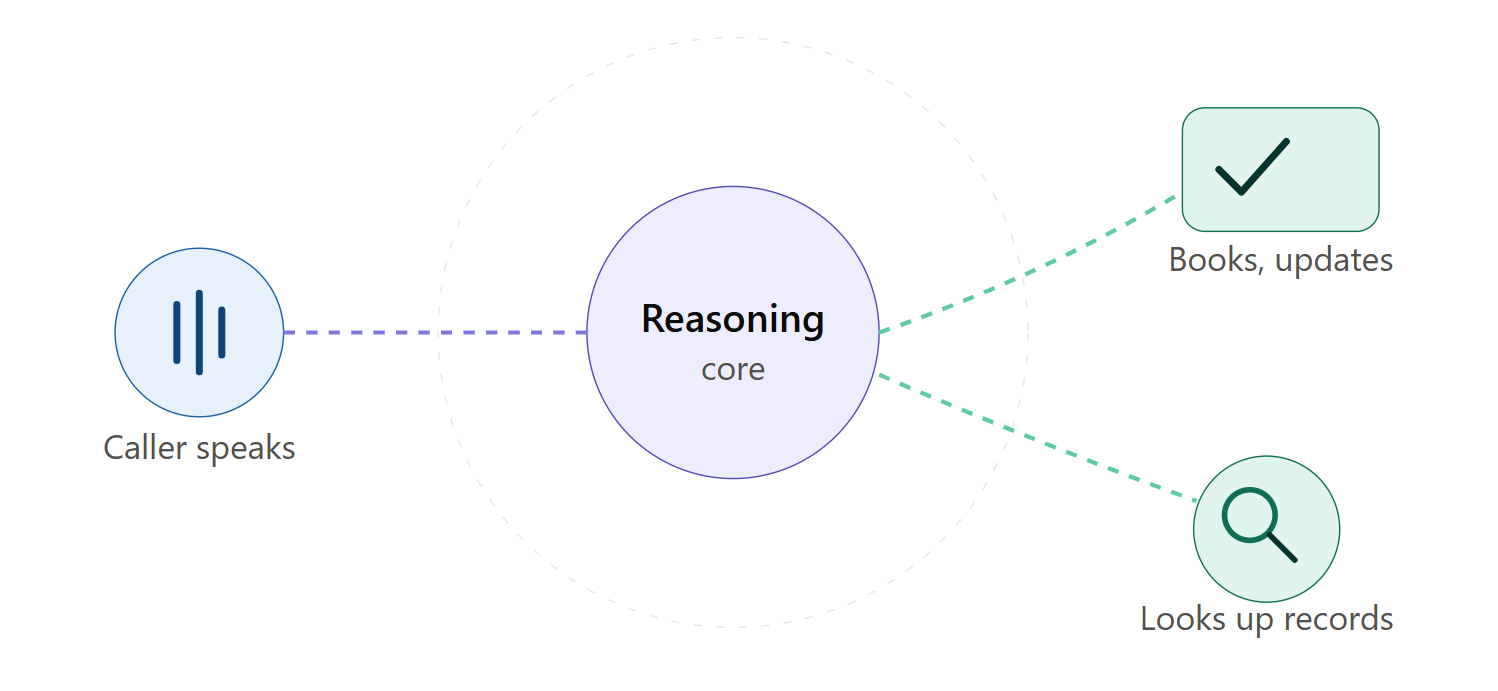
How Do AI Voice Agents Work
Most voice agents today run on a chain of specialized components working together in real time, though a newer generation of models is starting to collapse that chain into a single step.
The standard pipeline:
Voice activity and turn detection: the system works out when a caller has genuinely finished a thought versus just paused to breathe.
Speech-to-text (ASR): spoken audio gets converted to text on the fly, often streaming a rough transcript before the caller has even stopped talking.
The reasoning layer (LLM): that transcript goes to a language model that figures out intent, checks context, and calls outside tools when needed, like a calendar API, an order lookup, or a CRM record.
Text-to-speech (TTS): the model's reply gets synthesized into audio and streamed out, so the caller starts hearing a response before the full sentence has even finished generating.
Orchestration: the layer managing state, handling interruptions, routing to a human agent when things get complicated, and logging what happened.
The alternative gaining ground: end-to-end speech-to-speech models. Rather than routing audio through three separate systems, these models take audio in and put audio out directly, cutting several network round-trips out of the process and keeping tonal and emotional cues that typically get lost once speech is flattened into plain text. Some newer speech-to-speech systems are already reporting sub-400-millisecond response times while holding onto that vocal nuance. A meaningful jump from the cascading-pipeline norm.
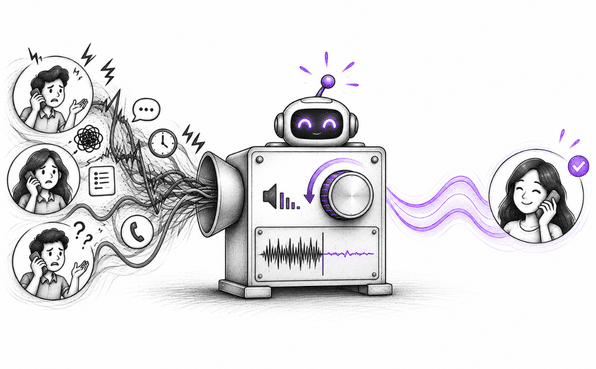
Why should a business buyer care about any of this? Because each stage adds its own slice of delay, and total delay is the single biggest factor separating a voice agent that feels like a real conversation from one that feels like talking to a machine.
AI Voice Agents vs. IVR vs. Traditional Chatbots
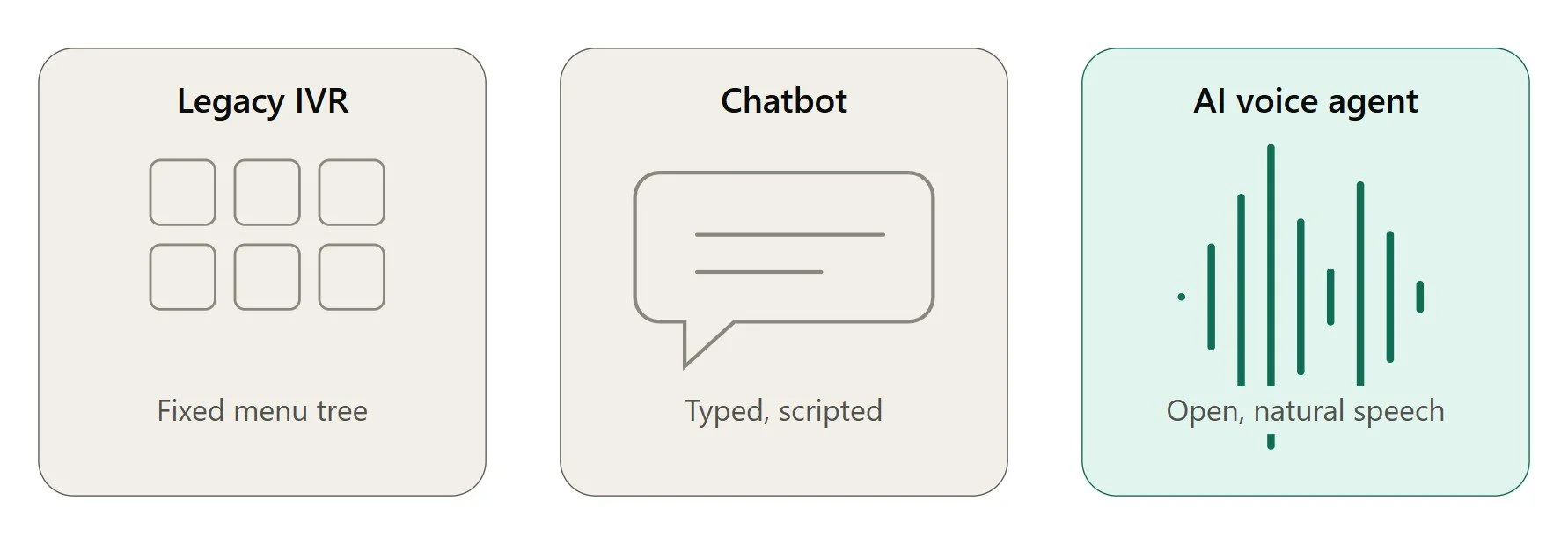
These three technologies group together constantly, but they solve different problems and break down in different ways.
| Feature | Legacy IVR | Traditional Chatbot | AI Voice Agent |
|---|---|---|---|
| Input | Keypad tones / fixed menu | Typed text | Open, natural speech |
| Conversation style | Rigid decision tree | Scripted, sometimes LLM-assisted | Dynamic, context-aware, handles tangents |
| Channel | Phone only | Web/app chat window | Phone, app, IoT, smart devices |
| Handles interruptions | No | Not applicable (turn-based) | Yes, via barge-in detection |
| Tone/emotion awareness | None | None | Growing, via emotion-aware voice models |
| Caller experience | Widely disliked | Mixed | Generally strong when latency is low |
The IVR gap is the obvious of the three. Roughly six in ten consumers describe legacy phone menus as a bad experience, and more than half say a poor IVR encounter has driven them to abandon a company completely. That's not a minor UX complaint; it's lost revenue sitting inside phone systems most companies haven't touched in a decade.
Chatbots aren't disappearing, but the boundary between "chatbot" and "voice agent" is fading fast. Analysts expect that distinction to essentially vanish by 2028, as unified platforms handle both text and voice from the same conversational engine. The practical implication: don't treat voice as a separate build from your chat AI; treat it as one more channel sitting on the same backbone.
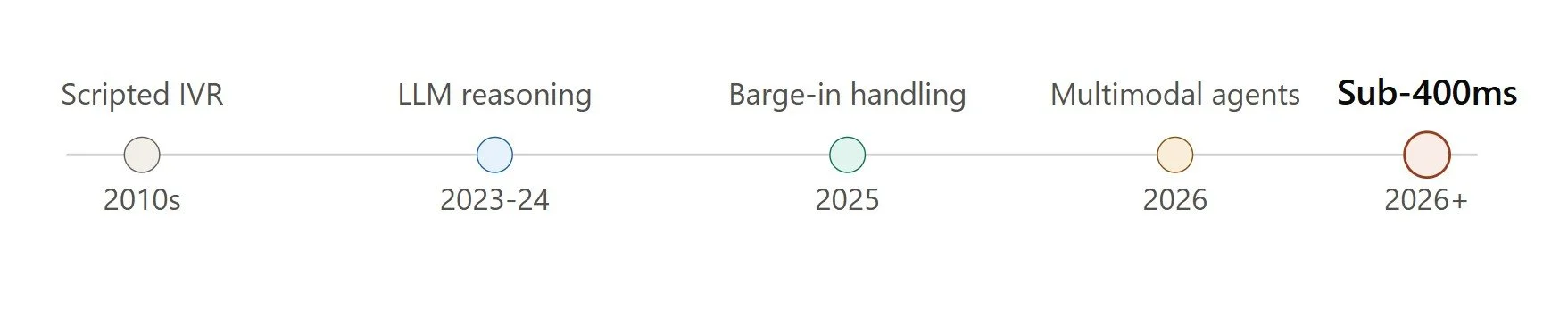
How the Technology Behind Voice AI Has Evolved
A handful of shifts converged to turn 2026 into the year AI voice agents graduated from impressive demos to production infrastructure:
Latency finally landed in the natural range. Human conversation typically has a 200-300ms gap between turns; voice AI has historically been far slower than that. One large-scale study analyzing 4 million live calls found the industry's typical end-to-end latency still sits around 1.4-1.7 seconds, roughly five times the natural human baseline. The leading platforms have closed a large chunk of that gap through streaming every stage of the pipeline instead of processing it in sequence.
Interruption handling grew up. Agents can now be talked over mid-sentence, register what just changed, and adjust instead of freezing or steamrolling the caller.
Multilingual and accent handling improved sharply, making global rollouts realistic rather than English-only pilots.
Multimodal capability arrived. 2026 marks the shift from audio-only agents to ones that can see what's on a customer's screen during a web session, guide them through a setup step visually, and drop back into voice. Early banking and SaaS pilots are reporting 40-60% gains in first-contact resolution on setup-related calls.
The market is consolidating fast. Meta's 2025 acquisitions of voice AI startups Play AI and WaveForms signaled that larger players are racing to own the full voice stack completely rather than assembling it from third-party vendors.
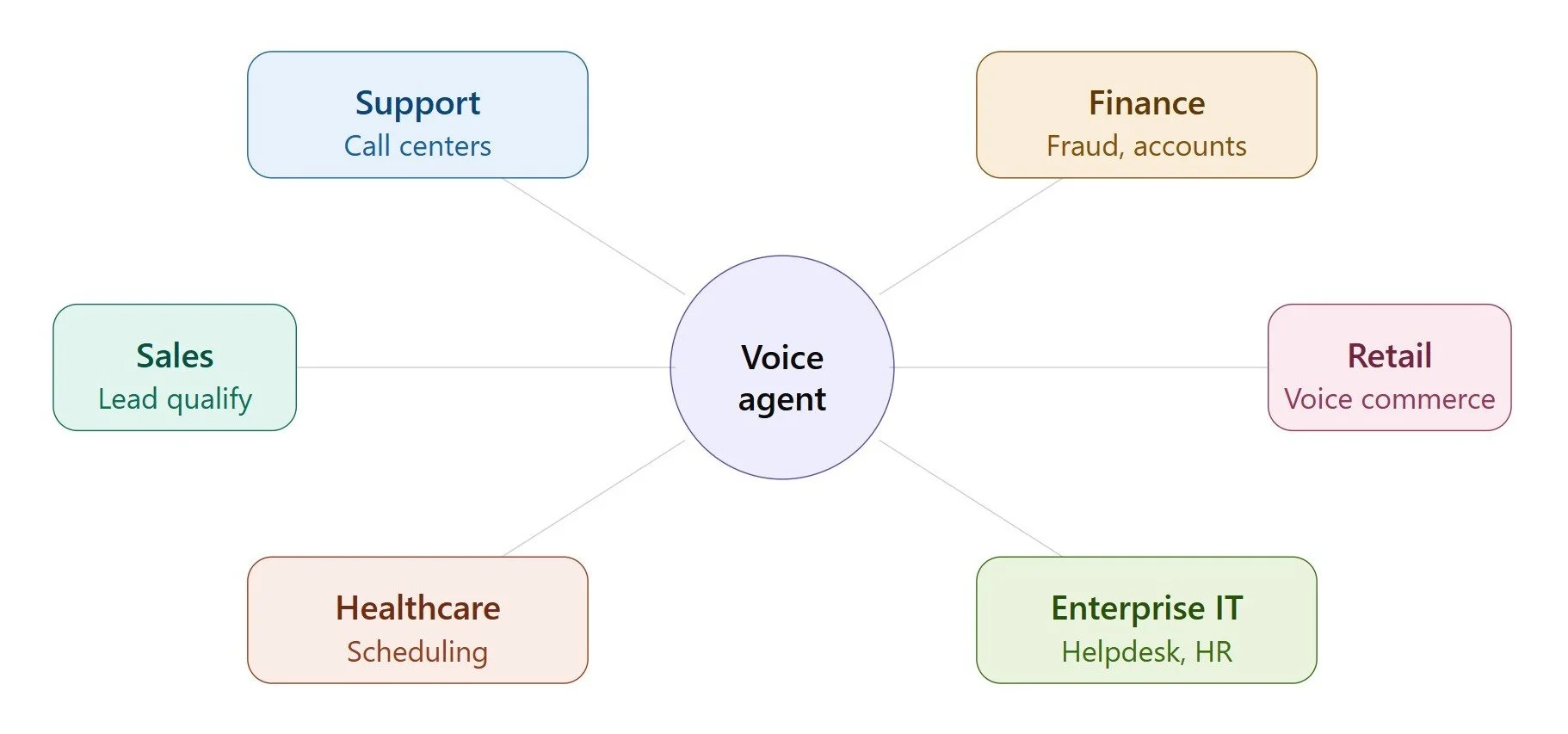
Key Use Cases of AI Voice Agents in 2026
1. Customer support and call centers remain the top use case of AI voice agents by volume. Gartner estimates conversational AI will strip roughly $80 billion out of contact center labor costs in 2026, with automated handling now covering close to 1 in 10 interactions. A sharp jump from under 2% just a few years earlier. Real deployments back this up: one hospitality brand reportedly cut average handle time by 30-50% after best AI voice agents took over roughly 28% of incoming call volume.
2. Sales and outbound lead qualification. Voice AI agents increasingly handle the first qualifying call, freeing human reps to focus on the conversations that actually need a closer.
3. Appointment scheduling and reminders are especially strong in healthcare and services. Industry estimates put the annual savings from voice AI in U.S. healthcare at around $150 billion by 2026 through scheduling, symptom triage, and follow-up. A large majority of consumers report that they've already interacted with a healthcare bot or voice agent.
4. Financial services. Banking and insurance lead adoption by market share, deploying voice AI agents for fraud checks, account servicing, and live transaction support, with reported operational cost cuts in the 20-30% range.
5. Retail, voice commerce, and IoT. Voice is turning into a genuine sales channel, not just a support one. The global voice commerce market is projected to roughly triple between 2024 and 2030.
6. Internal enterprise tools. Voice-driven IT helpdesk triage and HR query handling are spreading quietly inside larger organizations, often built as an extension of an existing chat copilot rather than a standalone project.
The Technology Stack Behind Voice AI Agents
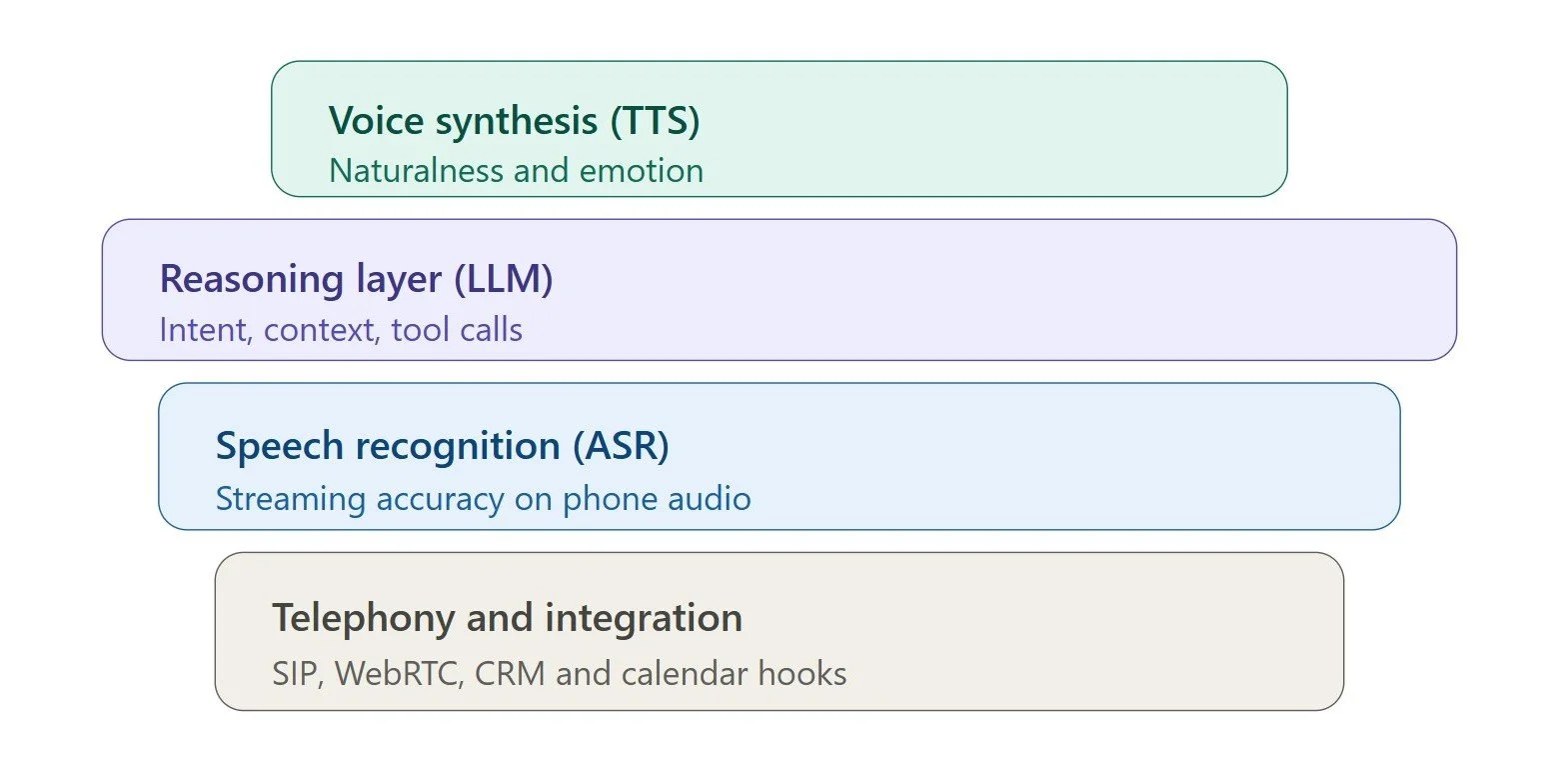
Building or evaluating a voice agent means understanding four layers:
Speech recognition (ASR). How well it holds up on real phone-quality audio matters more than a headline accuracy number. Once a system can surface a stable partial transcript in roughly 200 milliseconds, conversation starts to feel fluid. And a transcript that keeps rewriting itself mid-sentence is one of the most common reasons an agent interrupts or hesitates unnaturally.
The reasoning layer. This is where intent detection, tool calls, and personality live, and it typically needs to produce its first token in roughly 200-300ms to stay inside a sub-500ms total response budget.
Voice synthesis (TTS). Naturalness and emotional range are both improving fast, alongside real consent and disclosure questions around voice cloning, covered further down.
Telephony and integration. SIP trunking, WebRTC, and hooks into CRMs or calendars determine how well an agent slots into existing systems and how much delay gets tacked on before the AI even starts thinking.
Benefits of AI Voice Agents for Businesses
Cost. AI-handled voice minutes can run under a dime, versus an average cost of over $7 for a human-handled inbound call.
Round-the-clock coverage. A large majority of consumers now expect always-on service simply because AI has made it possible, and in one live test, an AI receptionist picked up every single inbound call without exception.
Speed is a revenue lever, not just a satisfaction score. Most consumers say they'll switch to a competitor that responds faster, and a large share have hung up after being left on hold too long, meaning slow service doesn't just annoy people; it actively loses business.
ROI shows up quickly. Independent research on enterprise deployments points to ROI of more than 300% over three years, often paying for themselves within roughly three months. The vast majority of companies that have run AI voice call agents for a year or more say they'd invest again.
Better data. Every call becomes structured, searchable data, something that legacy phone systems never gave businesses in the first place.
Common Challenges With AI Voice Agents
The same body of research that documents the wins is equally candid about the rough edges:
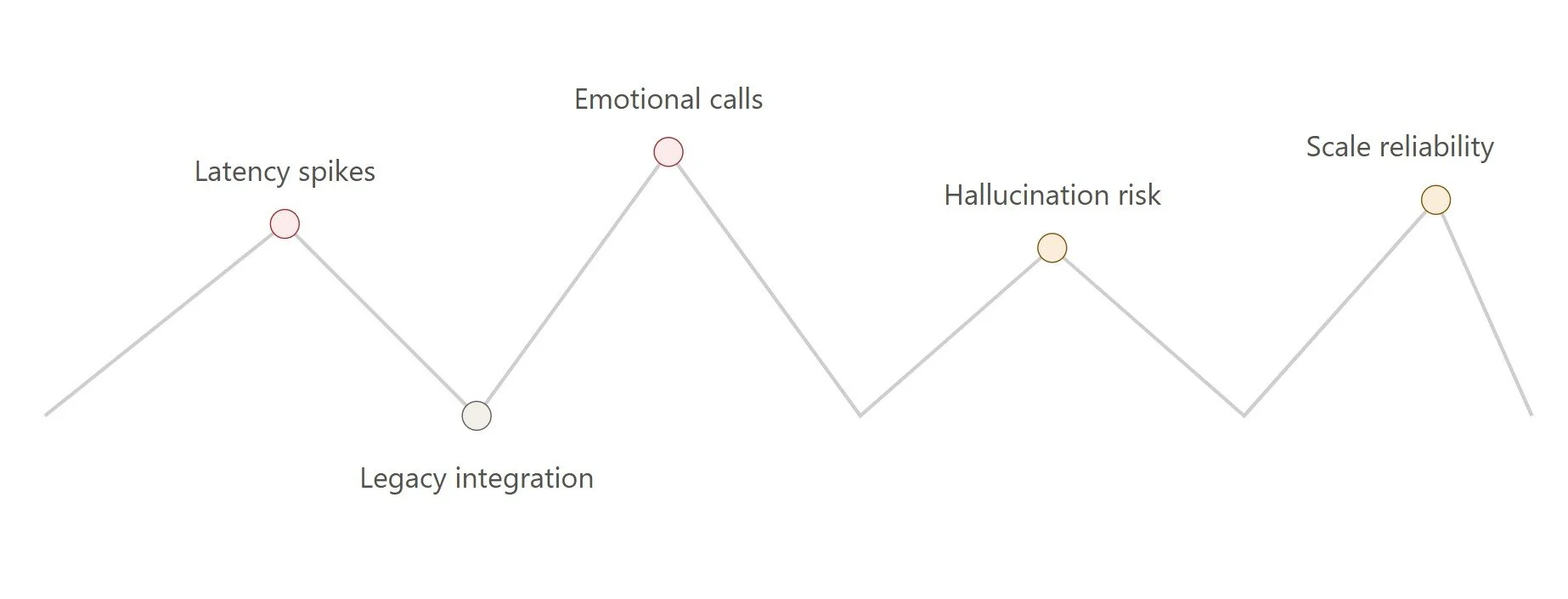
Latency still breaks conversations. Once total response time crosses roughly 800ms, callers start noticing. They say "hello?", repeat themselves, or talk over the agent; past a second and a half, the interaction genuinely falls apart.
High-stakes, emotionally loaded calls remain hard. Collections, bereavement, crisis lines, anything requiring real human judgment and warmth is still an area where voice AI agents lag.
Accuracy and hallucination risk, particularly when an agent is given broad access to tools without tight guardrails around what it's allowed to do.
Scale exposes weaknesses a demo hides. A system that performs flawlessly with one test caller can behave very differently across thousands of simultaneous, noisy, accented real-world calls.
Legacy integration is often the actual bottleneck. Connecting a modern voice agent to a fifteen-year-old CRM or phone system tends to be harder than building the AI itself.
How to Measure AI Voice Agent Performance
You can't manage what you don't measure, and voice AI comes with a few metrics that won't show up on a typical software dashboard.
Break latency down by stage, don't just average the whole call. A single end-to-end timer hides exactly which layer is slow. A workable approach for 2026 is to set a target 95th-percentile turn latency by use case. Around 500ms for sales and support, 800ms for general conversation, and up to 1,500ms for complex or clinical tool-calling turns, then hold each stage to its own slice of that budget: roughly 100-300ms for speech recognition, 200-600ms for the model's first token, 150-400ms for the first audio out, and the rest split between network and orchestration overhead. Track the 95th and 99th percentiles, not the average.
Containment and resolution rate. The share of calls the AI closes out completely without looping in a human.
First-contact resolution, which matters even more now that multimodal agents are in the mix; early pilots that let an agent see a customer's screen mid-call report 40–60% gains in resolving setup-type issues on the first try.
Handle time. One enterprise case study reported a 30- 50% cut in average handle time after an AI voice call agent took over roughly a quarter of call volume.
CSAT and conversion are tracked against latency directly. Sales teams have seen measurable drops in lead conversion once first-response time passes 600ms, and support deflection can fall by 20-30% once latency crosses 800ms, which makes latency a revenue metric, not just a technical one.
Speech recognition accuracy on real phone audio, not clean studio recordings. Error rates on noisy, accented, low-bandwidth calls are what actually predict how a system performs in the field.
Learn more about measuring AI voice agent quality beyond CSAT and call duration
Security, Privacy, and Governance for AI Voice Agents
As AI voice agents gain access to CRM data and business systems, security and governance become essential. Businesses need controls over what data agents can access, what actions they can perform, and when they should involve humans.
Data Privacy and Call Data Protection
Voice calls and transcripts may contain sensitive customer information. Businesses should define clear policies for:
Data collection and storage.
Recording and transcript retention.
Encryption.
Access permissions.
Sensitive-data redaction.
Third-party data sharing.
Authentication and Access Control
Agents should verify a caller's identity before revealing sensitive information or performing account-level actions. They should also follow least-privilege access, using only the data, systems, and APIs required for their specific workflows.
Guardrails for Agent Actions
AI agents that can trigger real-world actions need strict boundaries. Routine tasks such as creating cases or scheduling appointments can be automated, while high-risk actions such as refunds, account changes, or sensitive-data access may require additional verification or human approval.
Human-in-the-Loop Controls
Not every interaction should be fully automated. Agents should escalate conversations involving sensitive requests, uncertainty, repeated failures, or situations outside their defined permissions.
Monitoring and Auditability
Organizations should track important agent activity, including: Data accessed, API and tool calls, Actions performed, Errors and escalations, and Guardrail violations. This provides visibility into how the agent behaves and helps teams investigate issues.
Continuous Governance
Security shouldn't stop after deployment. Regular testing, access reviews, prompt and workflow evaluations, model updates, and compliance checks help ensure the agent remains secure, controlled, and reliable as it evolves.
How to Choose the Right AI Voice Agent for Your Business
Choosing an AI voice agent should go beyond how natural its voice sounds. Evaluate it based on your business workflows, integration needs, security requirements, and expected scale.
Consider these key factors:
Use case: Can it handle the specific tasks you want to automate?
Conversation quality: Does it understand context, interruptions, accents, and complex requests?
Integrations: Can it connect with your CRM, help desk, APIs, and other business systems?
Customization: Can you control its workflows, knowledge, tools, and escalation rules?
Security: Does it provide appropriate data protection, access controls, and auditability?
Scalability: Can it support your expected call volume without compromising performance?
Analytics: Can you track resolution rates, transfers, latency, errors, and other business metrics?
Human handoff: Can it smoothly transfer complex or sensitive conversations to human agents?
Ultimately, the right AI voice agent platform is one that fits your specific workflows and technical environment, rather than simply offering the most features.
What's The Future of Voice AI
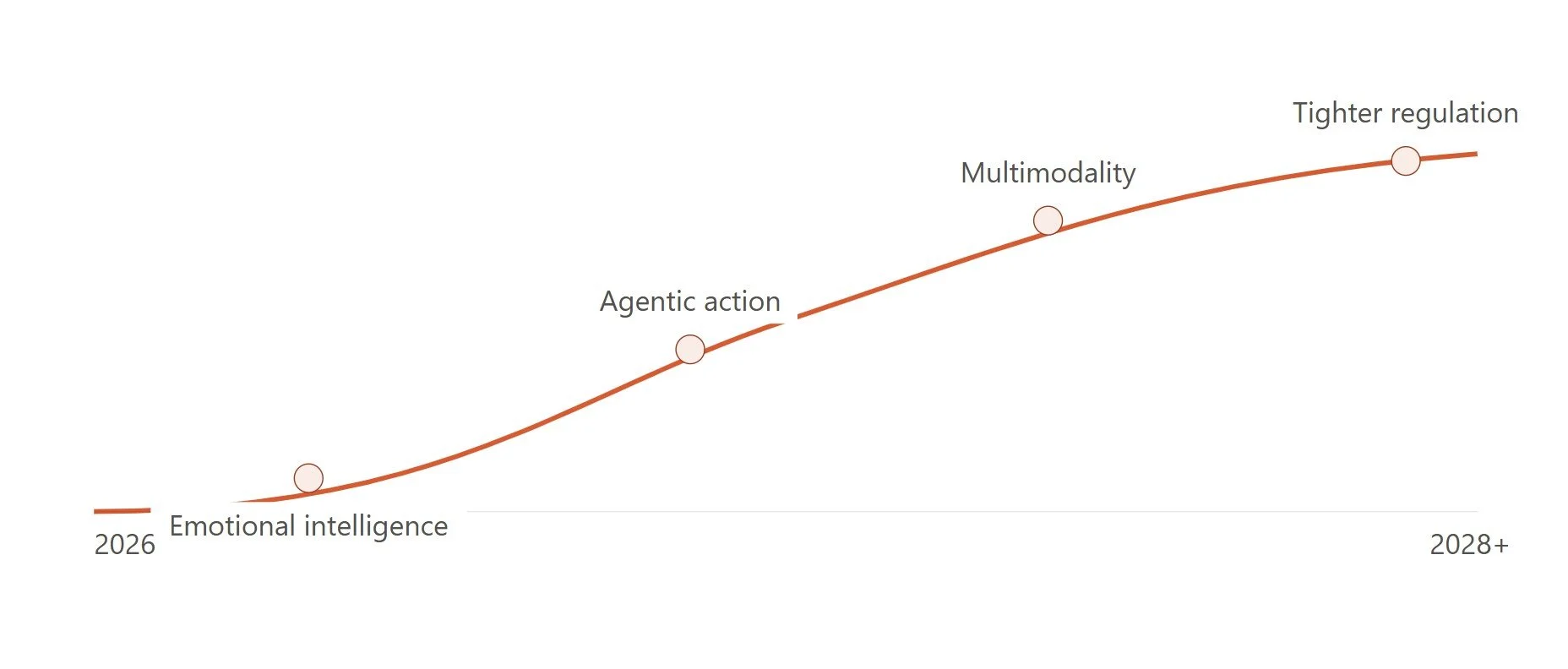
Agentic action, not just conversation. The next leap isn't better talk; it's agents that actually do things across multiple systems, with proper audit trails and approval steps for anything sensitive. Enterprise adoption of task-specific agents is expected to jump sharply by the end of 2026, up from a small fraction of applications just a year earlier.
Emotional intelligence keeps improving as emotion-aware speech models move from novelty to a genuine differentiator on high-stakes calls.
Multimodality becomes the default, not a premium add-on. Agents can see a screen, a document, or a product image mid-conversation.
Regulation keeps getting stronger, and companies that build disclosure and consent into their architecture now will be in a far better position than those retrofitting it under a deadline later.
Conclusion
2026 is the year AI voice agents stopped being a pilot project and became core infrastructure. Not because the marketing got louder, but because latency finally dropped into a range where conversations feel genuinely natural, and the return on investment became too large to keep ignoring. The businesses getting real value out of voice AI agents aren't the ones with the flashiest demo; they're the ones treating latency, compliance, and measurement with the same seriousness as the conversation design itself.
If you're evaluating voice AI for your business, start small: pick one high-volume, well-defined use case, measure real latency and containment rate against live call data, and expand from there.
If you want to build agentic voice agents from scratch, let our conversational AI agent development experts help you out. With a decade of experience in the industry, the team of experts at Concretio can take your idea to execution. Stop waiting another day and connect with experts today.
Related Readings
Let’s Talk

Drop us a note, we’re happy to take the conversation forward 👇🏻