DTMF Is Dead: Why Agentic Voice AI Replaces IVR, Not Just Upgrades It
Key Takeaways:
Traditional IVR is built to route callers into predefined menu paths; agentic voice AI is built to resolve the request by taking real action across connected systems.
The real shift isn't DTMF → NLU. It's NLU → reasoning → execution. Understanding what a customer wants is different from determining and performing the steps needed to fix it.
A true IVR replacement needs natural conversation, context awareness, system integration, multi-step execution, controlled autonomy, and intelligent escalation.
For decades, customer service calls have started the same way. This model worked when automated phone systems had one main job: route callers to the right place.
But customer expectations have changed. People do not want to navigate a company's organizational structure just to solve a simple problem. They want to explain what they need and get it resolved.
That is where agentic AI voice changes the conversation. Unlike traditional IVR, an agentic voice system can understand a customer's request, determine what needs to happen, access connected systems, take action, and escalate when necessary.
This is more than adding speech recognition or AI to an existing IVR. It changes the role of the voice system from call routing to task resolution. And that is why businesses should start thinking about IVR replacement, not just IVR modernization.
The End of the Traditional IVR Model
Traditional IVR was designed around a simple assumption: customer requests can be organized into predefined categories. The caller selects an option, follows another menu, provides some information, and eventually reaches a workflow or human agent.
The model looks like this: Customer input → menu selection → predefined path → routing. The problem is that customers do not always think in predefined categories.
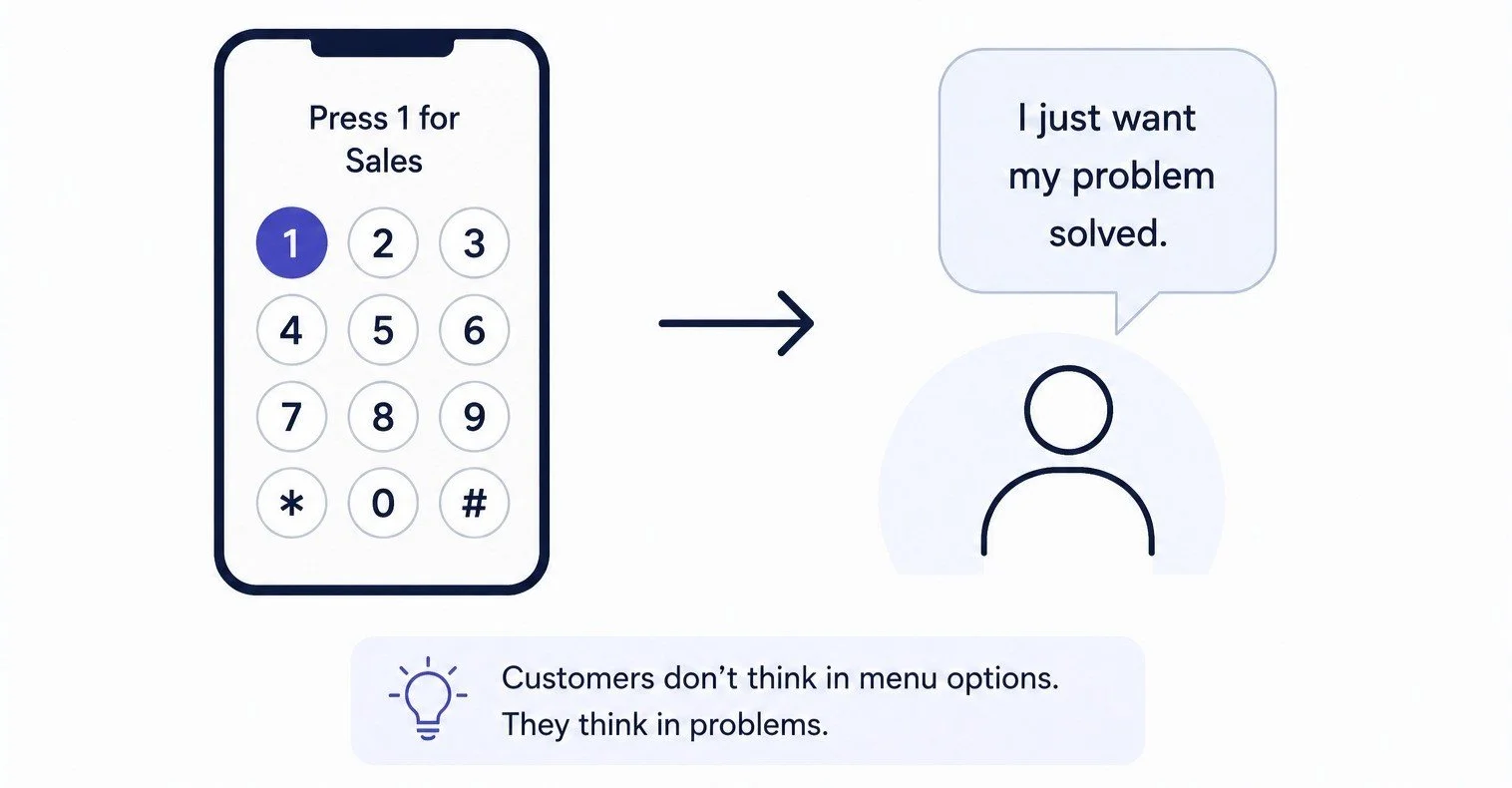
A customer might say: “I was charged twice for my subscription and want to know when I'll get my money back.” What should they press? Billing? Payments? Subscriptions? Refunds? The customer knows the problem. They should not have to figure out how the company's phone system categorizes it. This is the fundamental weakness of menu-first automation.
Modern conversational voice AI changes the interface by allowing customers to describe their problems naturally. But the bigger opportunity comes when the system can go beyond understanding the request and actually resolve it. That is where agentic voice AI enters the picture.
IVR Is Built to Route Calls. Agentic Voice AI Is Built to Resolve Them
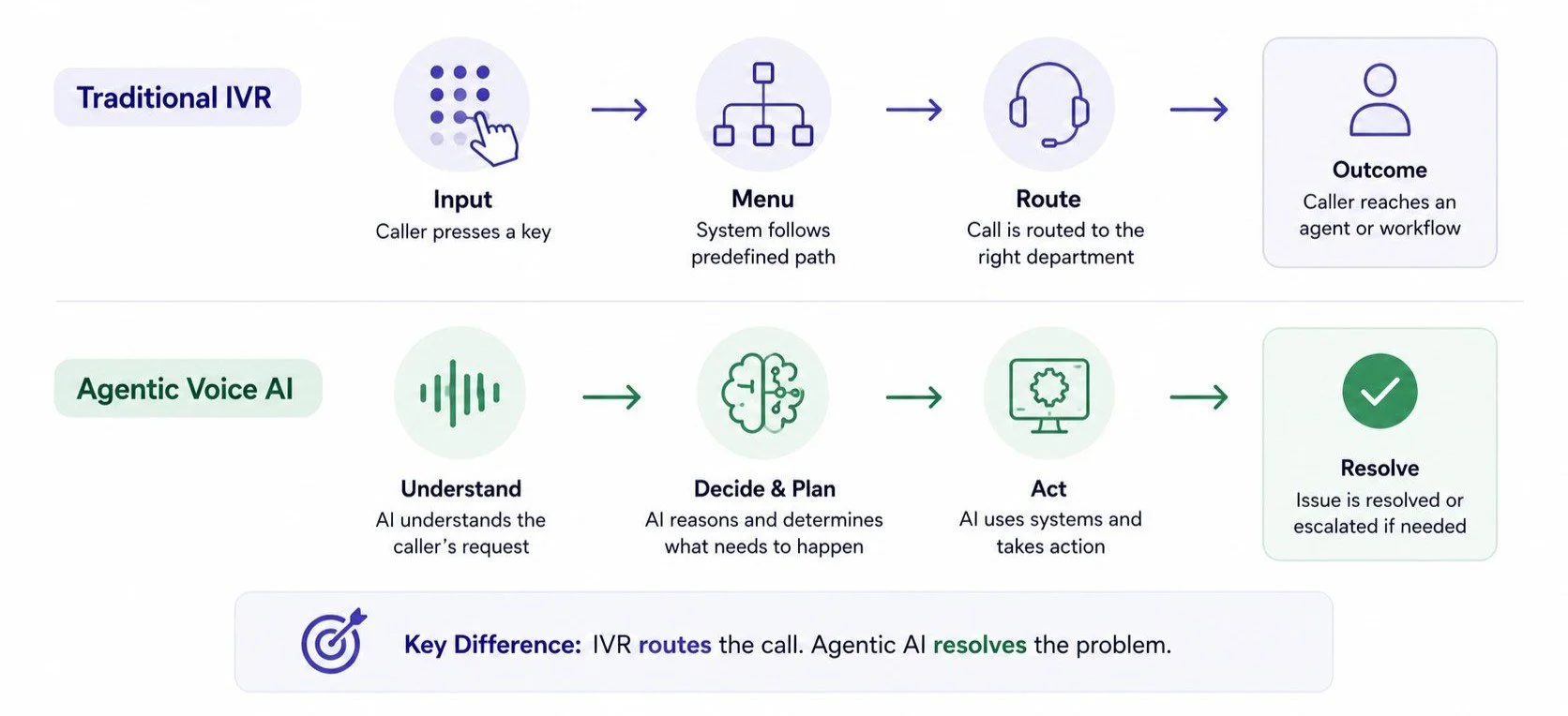
The easiest way to understand the difference is to compare what each system is designed to accomplish. Traditional IVR is designed for routing: Customer input → menu option → predefined branch → department or workflow.
Even an AI IVR system can follow a similar model: Customer speaks → AI identifies intent → workflow is selected → caller is guided or routed.
The experience becomes more natural, but the fundamental purpose may remain the same. The system is still deciding where the caller should go. Agentic voice AI works toward a different objective: Customer explains problem → AI understands context → AI determines required actions → AI uses tools → AI resolves or escalates.
Consider a customer saying: “My delivery is scheduled for tomorrow, but I need to change the address.” A traditional IVR might ask the caller to navigate to orders, deliveries, or account changes. A conversational IVR could understand the request and send the caller to the correct workflow.
An agentic voice system could:
Verify the caller.
Find the relevant order.
Check whether the delivery address can still be changed.
Ask for the new address.
Update the order.
Confirm the change.
The difference is simple. IVR routes the customer to work. Agentic AI can perform the work. That is the foundation of the argument for replacing IVR rather than simply upgrading it.
NLU vs DTMF vs Agentic AI Voice
The evolution from DTMF to NLU is important, but it does not tell the entire story.
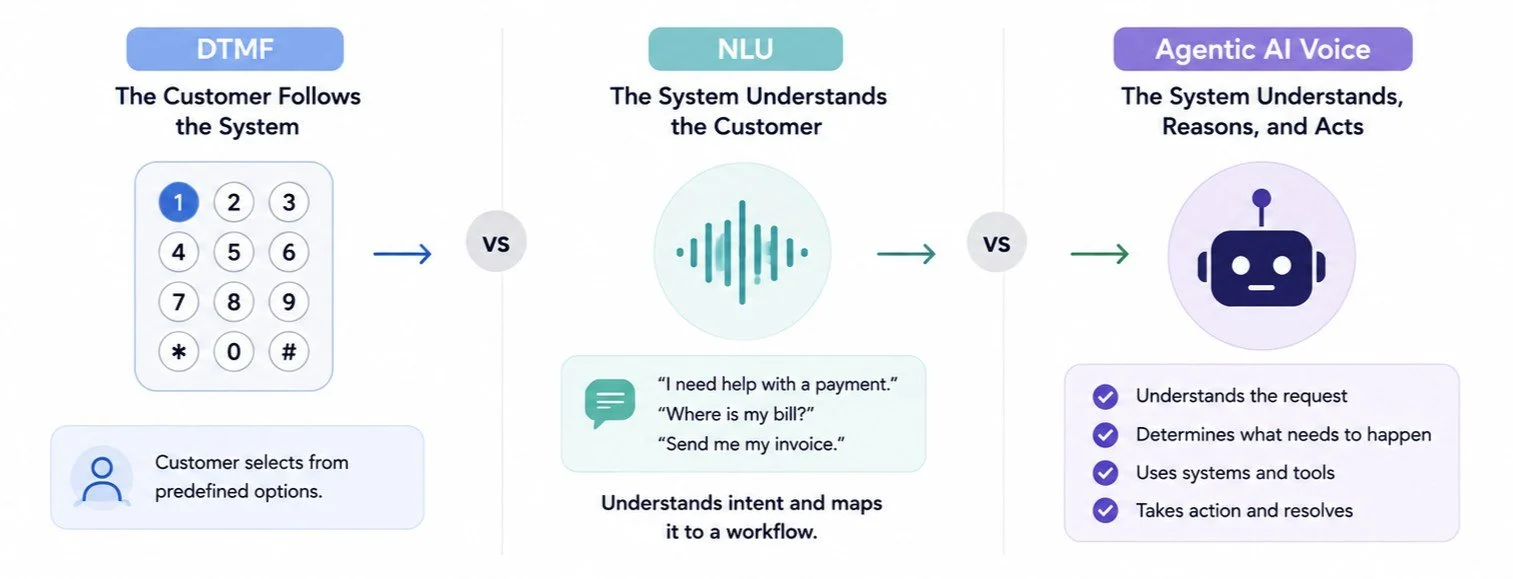
DTMF: The Customer Follows the System
DTMF requires the customer to select predefined options. “Press 1 for sales. Press 2 for support.” The system knows exactly what each number means, but the customer has to adapt to the system.
NLU: The System Understands the Customer
Natural Language Understanding allows the caller to speak naturally. Instead of pressing a button, they can say: “I need help with a payment that failed.”
The system can identify the likely intent and determine which workflow applies. This is a significant improvement. But NLU primarily answers: “What does the customer want?”
Agentic AI Voice: The System Determines What to Do
Agentic AI goes another step. It asks: “What needs to happen to resolve this request?”
The system can use customer context, business rules, connected tools, and available actions to determine the next steps. For example, if a customer says: “My payment failed, but the money has already been deducted from my account.”
The system may need to:
Verify the customer.
Check the transaction.
Determine its current status.
Check whether the payment was captured or reversed.
Explain the result.
Initiate an approved action if necessary.
This is not just language understanding. It is reasoning and execution. The progression therefore looks like this: DTMF → NLU → reasoning → action → resolution. That is the larger shift behind agentic voice AI.
The Key Difference: From Understanding Intent to Taking Action
Understanding intent is useful. But understanding a problem does not necessarily solve it. Imagine a customer calls and says: “I moved to a new address, and my order is supposed to arrive tomorrow. Can you make sure it gets delivered to the new address?”
A basic AI IVR system may recognize: Delivery issue. Address change. Order inquiry.
It can then select the relevant workflow. But an agentic voice system can determine what needs to happen next. It may:
Verify the customer's identity.
Retrieve the order.
Check the delivery status.
Determine whether the address can still be modified.
Ask for the new address.
Update the order.
Confirm the change.
The customer does not need to understand the internal workflow. The AI handles the complexity behind the conversation. This is one of the biggest differences between a conversational interface and an agentic system.
NLU identifies the request. Agentic AI works toward the outcome. For businesses, this means voice automation can move from answering and routing calls to actually completing customer workflows.
Why Agentic Voice AI Breaks the IVR Decision-Tree Model
Traditional IVR relies heavily on decision trees. Every possible customer path has to be anticipated and mapped. That works when interactions are predictable. But every new scenario adds another branch. Every exception creates another condition. Every additional workflow makes the system more difficult to maintain.
Consider this request: “I want to cancel my service, but I was charged yesterday for the next billing cycle. Can I get that charge reversed too?” This involves several related tasks:
Account identification.
Service cancellation.
Billing status.
Refund eligibility.
Business policies.
Potential retention workflows.
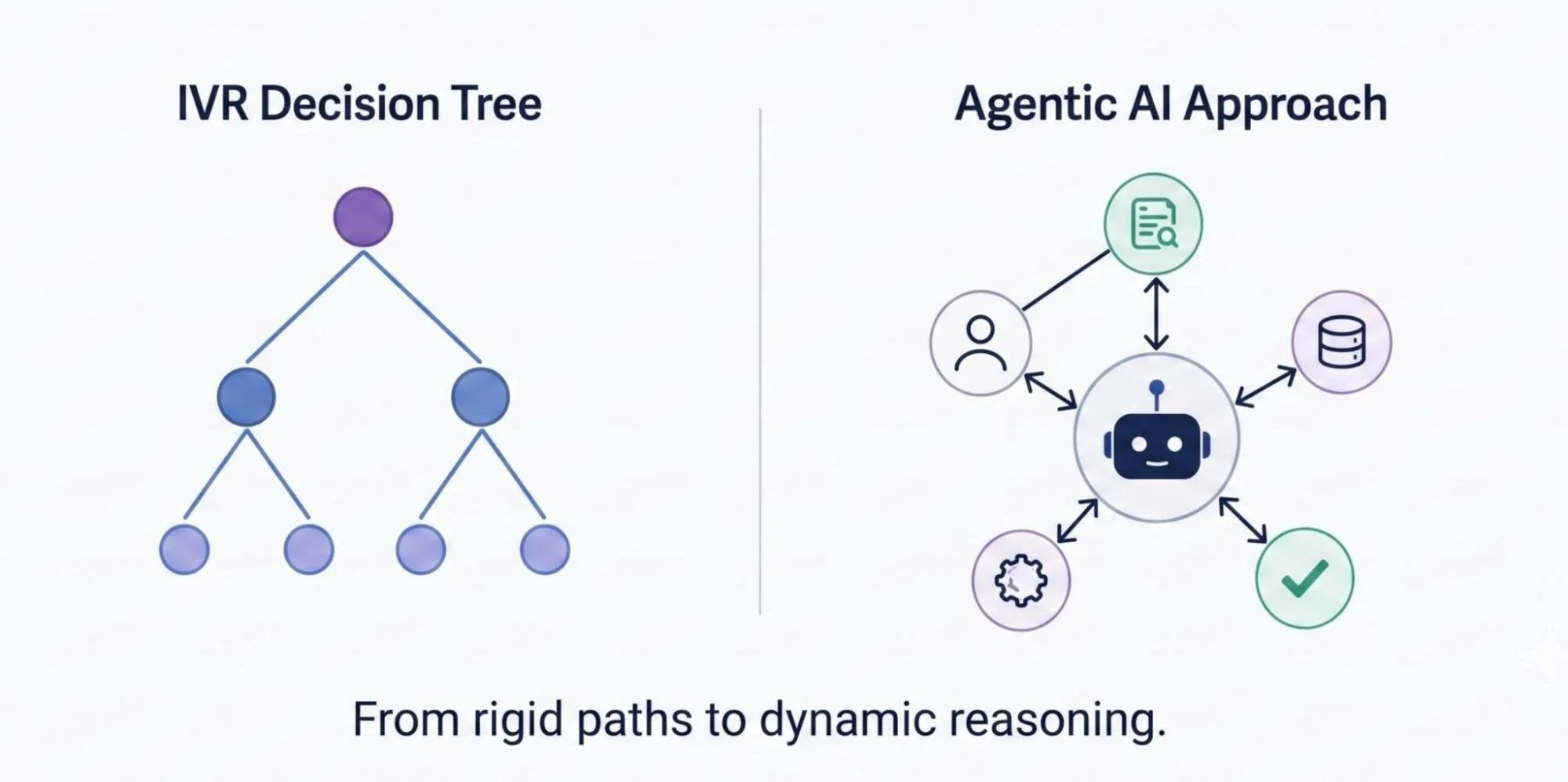
A traditional IVR may need separate branches for each part of the conversation. An agentic system can approach the request as one customer objective and determine which actions are required. It can combine:
Customer context.
Conversation history.
Business rules.
Knowledge sources.
APIs and tools.
Workflow objectives.
This does not mean removing structure. An effective agentic AI call center still needs clear rules, permissions, safeguards, and escalation conditions. The difference is that those controls guide the agent's decisions instead of forcing every conversation through a rigid menu. The architectural question changes from: “Which branch should this customer follow?” to: “What actions are required to resolve this request?” That is why agentic voice AI represents more than an IVR upgrade.
What Agentic Voice AI Can Do That IVR Cannot
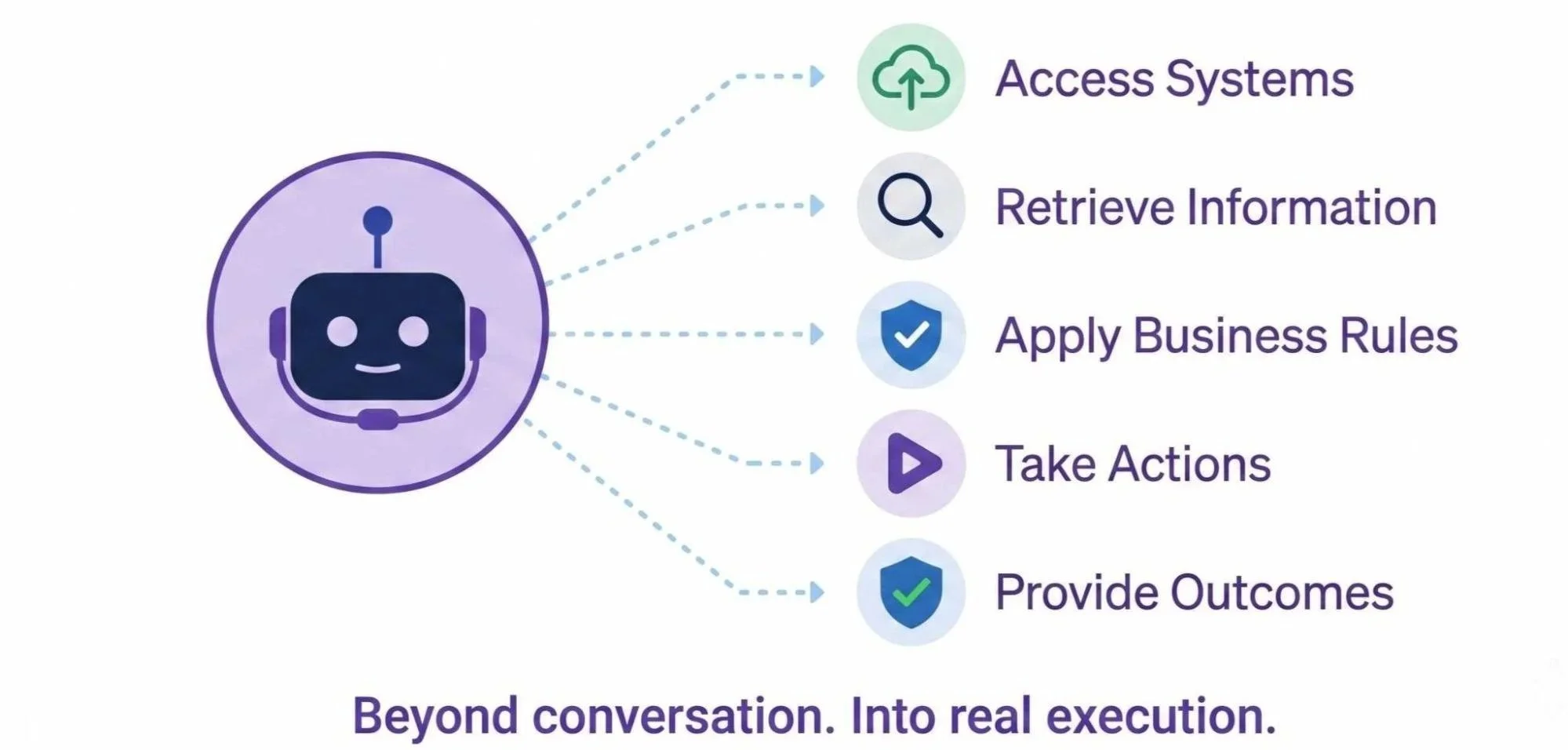
The real value of agentic voice AI becomes clear when it is connected to the systems where customer work actually happens. Depending on the implementation, AI voice agents can interact with:
CRM platforms.
Billing systems.
Order management systems.
Scheduling platforms.
Ticketing systems.
Knowledge bases.
ERP systems.
Internal APIs.
This allows the agent to do more than provide information. It can perform approved actions. For example, a customer might say: “Can you move my appointment to Friday afternoon and send me the confirmation?” That sounds like one simple request. Behind the scenes, the system may need to:
Identify the customer.
Find the existing appointment.
Check available time slots.
Apply scheduling rules.
Offer suitable options.
Update the appointment.
Trigger a confirmation message.
A traditional IVR is not designed to dynamically coordinate all of these actions. An agentic system can treat them as steps toward a single objective. This makes agentic AI particularly useful for customer workflows that are repetitive but involve multiple systems or decisions.
From Call Routing to End-to-End Resolution
The biggest shift is moving from call containment to task completion. Consider a customer calling because a technician never arrived. With traditional IVR, the customer might:
Select support.
Select appointments.
Enter account information.
Explain the missed appointment.
Wait for a representative.
Repeat the issue.
Reschedule the appointment.
A conversational IVR can reduce some of that friction by understanding the request earlier. An AI call center voice agent can potentially handle the entire process. It could verify the customer, retrieve the missed appointment, check the service record, find available appointment slots, offer options, confirm the customer's choice, reschedule the appointment, record the missed visit, and send confirmation.
The customer experiences one conversation. The system handles multiple backend actions. This is the difference between automating the conversation and automating the work behind the conversation. And that distinction is critical when evaluating an IVR replacement.
The goal should not simply be: “How many calls did we keep away from human agents?” It should also be: “How many customer problems did we actually resolve?”
What an Agentic AI Call Center Changes for Businesses
Moving from traditional IVR to agentic voice AI can change more than the customer experience.
Faster Resolution
Customers can explain their problem once and move directly toward a solution without navigating several menu layers.
Higher Automation Rates
Routing a customer to the right department is useful, but completing the request is more valuable. Agentic systems can automate entire workflows when the task is suitable for automation.
Fewer Transfers
If the agent can access multiple systems and complete approved actions, fewer calls need to move between departments.
Better Context Continuity
The agent can retain the conversation context throughout the interaction. If a human needs to take over, the AI can pass along the relevant information instead of making the customer start again.
More Efficient Human Agents
Human agents can spend more time on complex cases, exceptions, sensitive conversations, and situations requiring judgment. The goal is not necessarily to eliminate human agents. It is to stop using expensive human time for tasks that an AI agent can reliably complete.
Better Operational Insights
A modern voice AI system can also reveal patterns in customer interactions. Businesses can identify:
Frequently requested services.
Repeated customer problems.
Common escalation triggers.
Failed automation workflows.
Questions that knowledge systems do not answer well.
These insights can improve both the voice experience and the underlying business processes.
What IVR Replacement Actually Looks Like
Replacing IVR does not mean removing every automated rule or forcing every call into an AI conversation. Some customers may still prefer keypad input. Some processes may require structured numeric information. Some situations may require a fallback mechanism.
The point is to stop treating the IVR menu as the primary intelligence layer. A practical IVR replacement should be capable of:
Natural Conversation: Customers should be able to explain their needs in normal language rather than memorizing menu options.
Context Awareness: The system should remember relevant information gathered earlier in the conversation.
System Integration: The agent needs access to the systems required to retrieve information and complete tasks.
Multi-Step Execution: The system should be able to coordinate multiple actions toward one customer objective.
Controlled Autonomy: The agent should operate within defined permissions, business rules, and security boundaries.
Intelligent Escalation: When the agent cannot safely or confidently resolve an issue, it should involve a human and transfer the relevant context.
This is what separates an actual IVR replacement from a voice-enabled version of the same old decision tree.
The Role of AI Voice Agent Development
Building this type of system requires more than connecting a phone number to a language model. Effective AI voice agent development starts with the customer workflows the business wants to automate. For example, “reschedule an appointment” may sound like a simple voice command. But a production agent may need to:
Authenticate the customer.
Retrieve the appointment.
Check availability.
Validate eligibility.
Apply scheduling rules.
Update the CRM or scheduling system.
Confirm the new appointment.
Trigger a notification.
The conversation is only the interface. The real value comes from connecting the conversation to the workflow. That is why successful AI voice agent development should focus on what the agent can accomplish, not simply what the agent can say.
Final Thoughts
Traditional IVR was built for a world where automation meant guiding customers through predefined options. DTMF made that possible. Natural language made the interaction easier. But agentic AI voice changes the objective.
The progression is simple: Traditional IVR navigates. Conversational IVR understands. Agentic AI voice acts. That is why businesses should not think about AI voice as simply the next upgrade to their IVR. The bigger opportunity is to replace unnecessary menu navigation with intelligent task execution.
Then it can determine what needs to happen, access the appropriate systems, perform approved actions, and escalate when human judgment is required. That is the real meaning of IVR replacement. The future of call automation is not a smarter menu. It is a system that can understand, reason, act, and resolve.
If you are ready to modernize your customer experience, explore our AI voice agent development services to discover how intelligent task automation can revolutionize your contact center operations.
Frequently Asked Questions
-
No. DTMF still has practical uses for numeric input, accessibility, and fallback scenarios. However, it is becoming less suitable as the primary interface for modern customer service automation.
-
For many customer workflows, it can significantly reduce or eliminate the need for menu-based IVR. However, DTMF and traditional IVR can still serve as useful fallback options for certain situations.
-
It can automate tasks such as appointment scheduling, order updates, account changes, payment inquiries, ticket creation, cancellations, status checks, and other repetitive workflows when the required systems and permissions are available.
-
Businesses should identify high-volume, repetitive workflows first. They should also evaluate system integrations, business rules, security controls, escalation requirements, and whether the AI can reliably complete the task rather than simply route the caller.
Related Readings