
Beyond Single-Turn: How Multi-Step Agentic Voice Agents Handle Complex Customer Workflows
Key takeaways:
Single-turn voice agents answer; agentic voice agents act. They track goals, use tools, and make decisions across calls.
Voice orchestration enables multi-step workflows by managing context, tools, and escalations.
This powers end-to-end automation for orders, scheduling, claims, and support
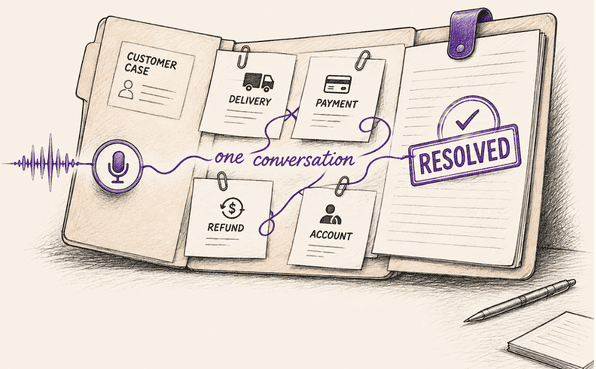
Remember when voice bots could do little more than answer a question and point you in the right direction? You’d call in, ask to check your balance, get an instant response, and the conversation would be over. But the moment your request involved multiple steps, rescheduling a delivery, updating payment details, checking a refund, or resolving an account issue, you were often handed off to a human and asked to start the story all over again.
That's the world of single-turn voice automation, and honestly, it's starting to feel dated. The customers calling in today don't have simple, one-off requests. They have messy, multi-part problems that unfold over the course of a conversation. And that's exactly the gap that agentic AI voice agents are built to close.
So, we’ll explore how multi-step AI voice agents work, what sets them apart from traditional voice automation, and why the ability to handle complex workflows could be the key to building more efficient customer experiences.
What Does "Single-Turn" Actually Mean, and Why Isn't It Enough Anymore?
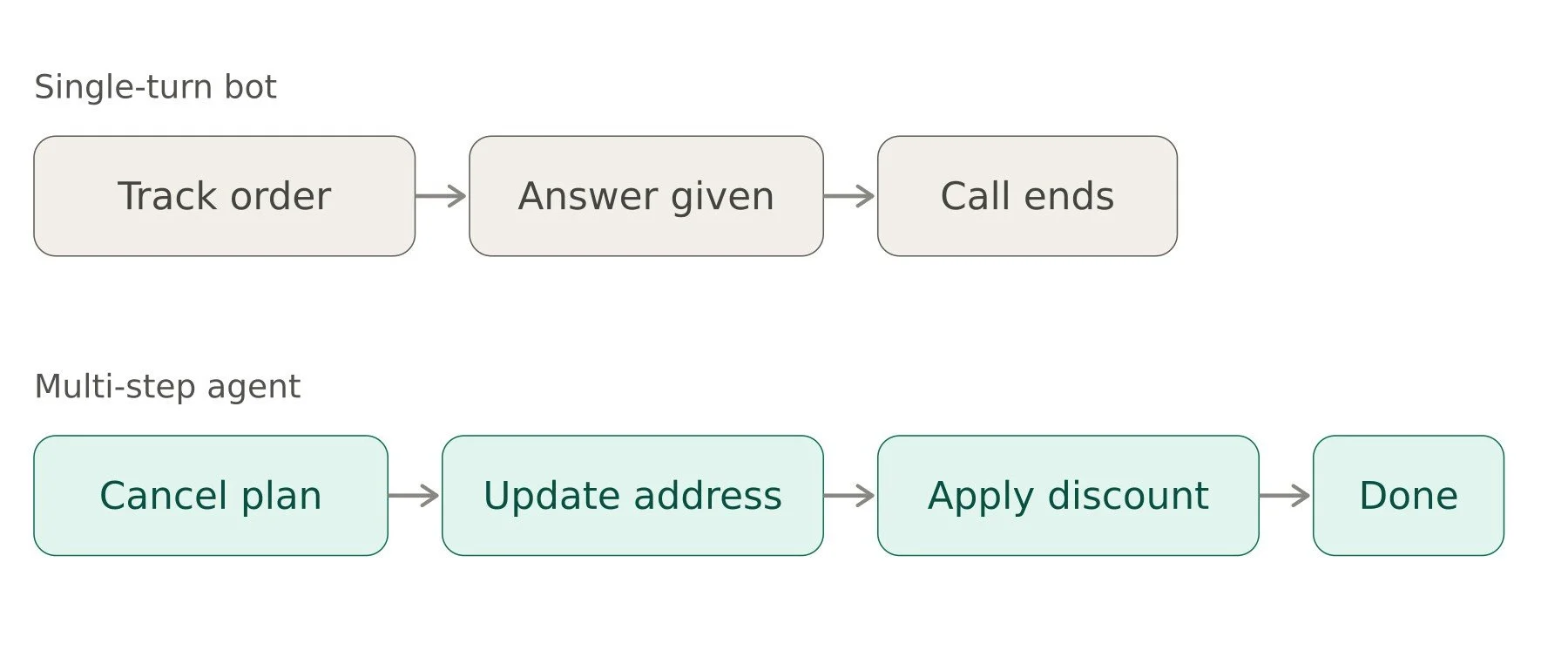
A single-turn system is designed to handle one intent per interaction. You ask a question, it maps that question to a predefined response or action, and the conversation effectively resets. There's no real memory of what came before, no sense of a broader goal, and definitely no ability to adapt when things don't go according to script.
The problem is that real customer conversations rarely stay inside one neat box. Someone calling about a late shipment might also want to update their address, apply a discount code, and ask whether a similar item is in stock. A single-turn bot treats each of these as a separate, disconnected event, which means the customer has to do all the mental work of stitching the conversation together themselves.
AI voice agents built on an agentic foundation flip this around. Instead of reacting to isolated inputs, they treat the whole interaction as a workflow. Something with a beginning, a middle, and a resolution, just like a good conversation with a skilled support rep.
Multi-Step Voice Agents in Action: What a Workflow Looks Like
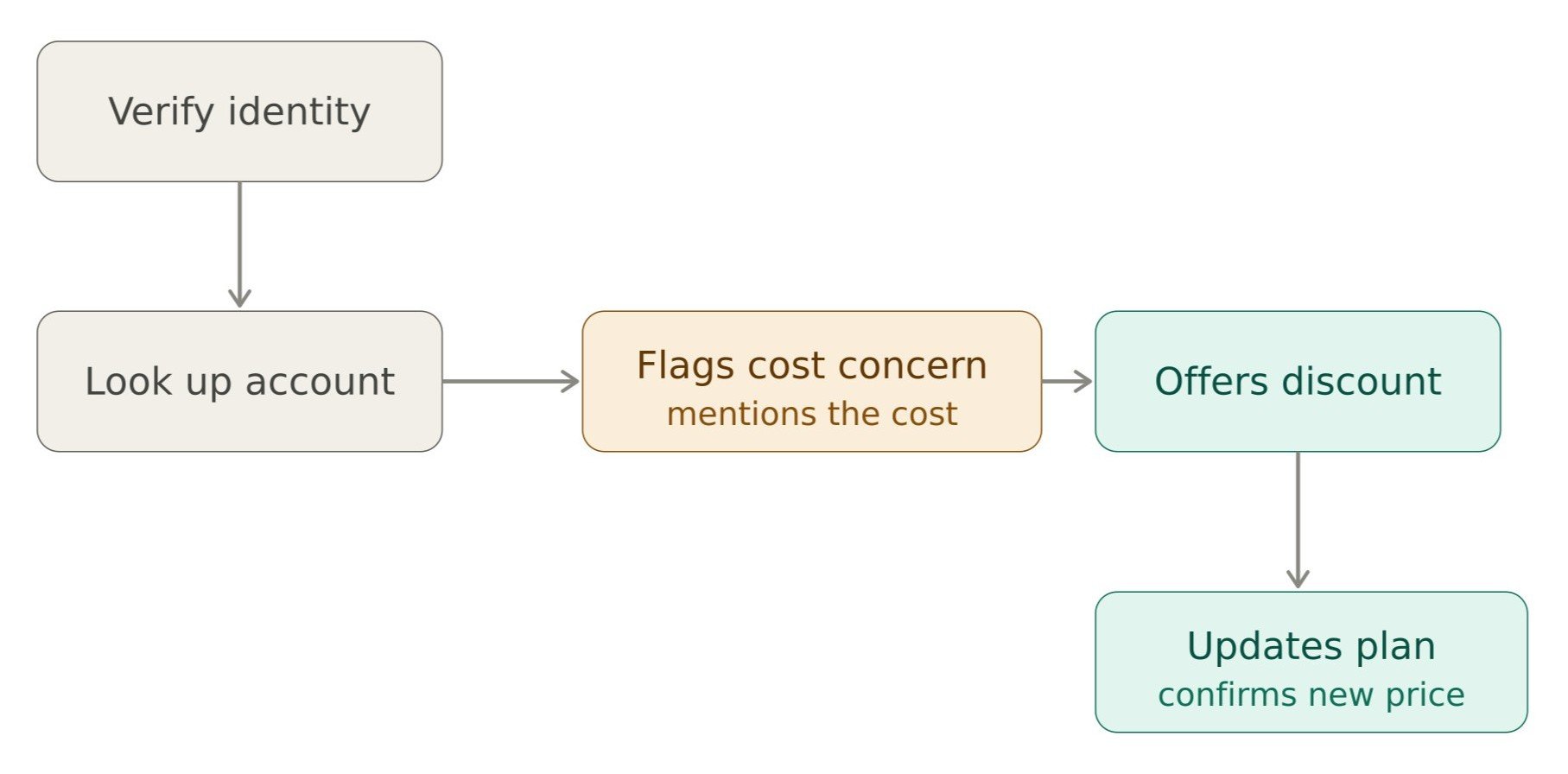
Imagine a customer calls a telecom provider to cancel a subscription. On the surface, that sounds like a single task. But watch what actually happens in a real conversation:
The agent verifies identity through voice or account details.
It looks up the account and identifies active plans, add-ons, and any pending charges.
The customer mentions they're only cancelling because of price. So the agent, recognizing an opportunity, offers a retention discount.
The customer agrees to a modified plan instead of cancelling.
The agent updates the subscription, confirms the new billing amount, and sends a confirmation message.
That's five distinct steps, several decision points, and a branching path that could have gone in completely different directions depending on the customer's responses. This is what multi-step voice agents are actually for, not just answering questions, but carrying a task through to genuine completion, adjusting as new information comes in.
A single-turn system would have just processed the cancellation and hung up. The business loses a customer it might have kept, all because the technology wasn't built to reason beyond the first request. If you're mapping out the infrastructure this needs to sit on, our guide to the modern enterprise AI stack is a useful next step.
Voice Agent Orchestration: What’s Happening Under the Hood
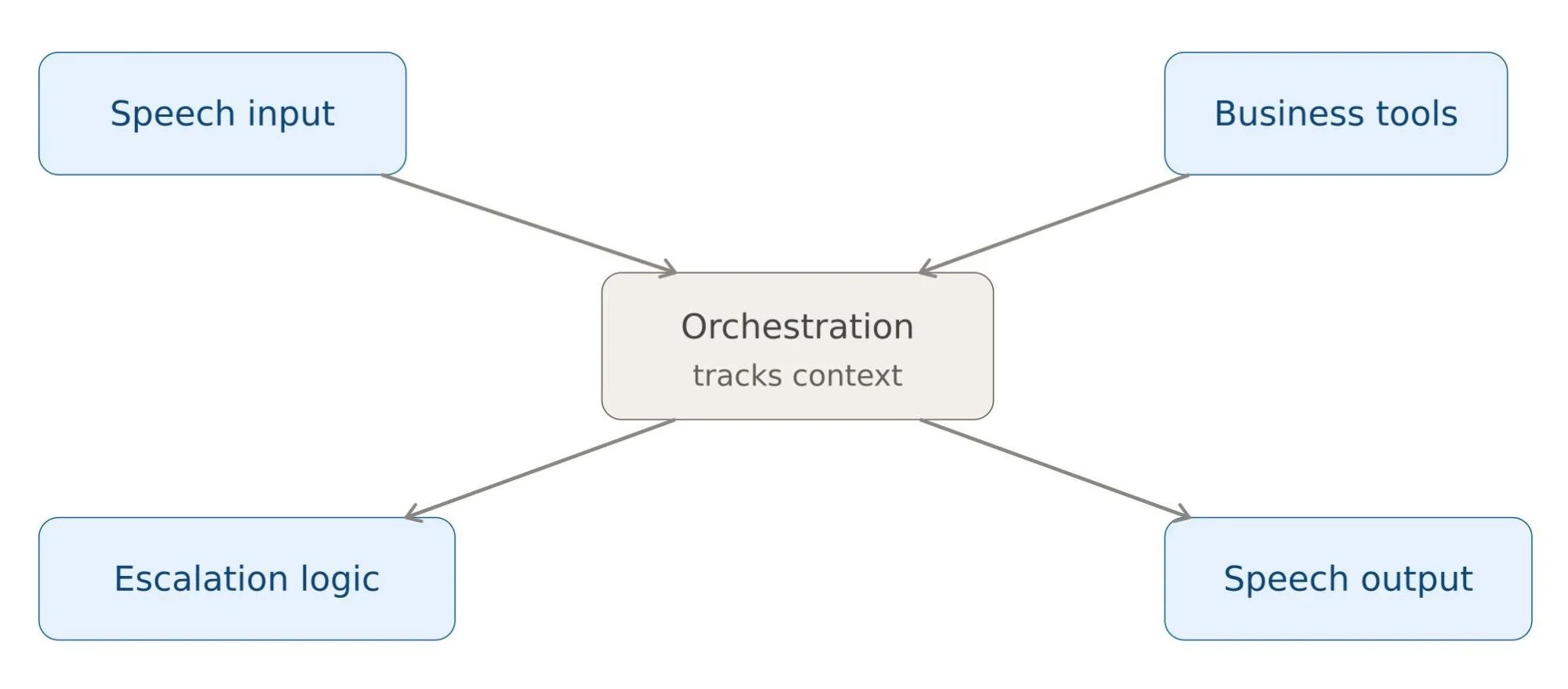
None of this works without solid coordination behind the scenes, which is where voice agent orchestration comes in. Multi-agent orchestration is essentially the traffic control system because it manages how different components (speech recognition, language understanding, business logic, external tools, and speech generation) work together in real time without tripping over each other. Good orchestration handles things like:
Maintaining context across the entire call, not just the last exchange.
Routing specific sub-tasks to the right tool or system (CRM lookups, payment processors, scheduling APIs).
Managing interruptions and clarifications without losing the thread of the original goal.
Deciding when a task genuinely needs human escalation versus when the agent can keep going.
When orchestration is done well, the customer never really notices it. The conversation just feels smooth and competent. When it's done poorly, you get that frustrating loop where the bot keeps asking you to repeat information it should already know.
Where Multi-Step Voice Agent Fits Into Customer Workflow Automation
Zoom out a bit, and multi-step voice agents are really just one expression of a bigger trend, i.e., customer workflow automation. Companies aren't just trying to automate individual questions anymore. They are trying to automate entire processes, from initial contact to final resolution.
That could mean:
End-to-end order modifications (address changes, item swaps, refunds).
Appointment scheduling that checks real-time availability across multiple calendars.
Insurance claims intake that gathers documentation and pre-qualifies a claim before a human ever touches it.
Technical support that walks through diagnostic steps and only escalates when the issue truly needs a specialist.
The common thread is that these workflows involve multiple steps, multiple systems, and often multiple decision points. This is where conversational AI as a broader discipline intersects with practical business outcomes: it's not enough for the AI to sound natural; it needs to actually move the process forward.
Why This Matters for AI-Powered Customer Service
There's a reason so many companies are investing here. AI-powered customer service built on multi-step reasoning doesn't just cut costs, but it changes what customers can actually accomplish without waiting on hold. Gartner projects that agentic AI will autonomously resolve the majority of common customer service issues without human intervention within the next few years. That’s a sharp departure from today's single-turn deflection rates.
A few concrete benefits worth calling out:
Fewer handoffs. When an agent can complete an entire workflow instead of just the first step, customers don't get bounced between departments or forced to repeat their story to a new person.
Faster resolution times. Because the system can execute actions directly, there's no lag between "the AI understands the request" and "the request gets done."
More natural interactions. Customers don't have to phrase things perfectly or break their request into separate calls. They can talk the way they'd talk to a person, and let the agent figure out the sequence of actions needed.
Better handling of edge cases. Real conversations have curveballs like a customer changes their mind, provides information out of order, or asks a tangential question mid-task. Multi-step agents are built to absorb that without falling apart.
What to Look for in a Conversational AI Agent
If you're looking for a conversational AI voice agent, it's worth being specific about what "agentic" actually needs to include. A genuinely capable conversational AI agent should be able to:
Hold and reference context across the entire interaction, not just the last turn.
Break a stated goal into an ordered set of executable steps.
Call external tools or APIs mid-conversation, not just retrieve static answers.
Recover gracefully from failed steps instead of dead-ending.
Know its own limits and escalate to a human at the right moment, with full context handed off.
This last point is easy to overlook, but it matters a lot. The best AI voice agent for customer support isn't necessarily the one that never escalates; it's the one that escalates intelligently, at the right time, with everything the human agent needs already gathered and ready to go.
The Bigger Picture
The shift from single-turn scripts to multi-step, agentic reasoning is really a shift in ambition. Early voice bots were built to answer questions. The current multi-step voice agents are built to get things done. That's a meaningfully different bar, and it's why so much of the recent progress in this space has been focused less on making voices sound more human, and more on making the underlying reasoning capable of handling complexity.
Customers don't call in with tidy, single-intent requests; they call in with real problems that unfold as the conversation goes. The systems that can follow that unfolding, adapt to it, and carry it through to resolution are the ones that will actually feel helpful rather than frustrating.
If you’re ready to move beyond basic automation and explore how AI voice agents can streamline your own customer service workflows, now is the time to act. Discover how a modern conversational AI agent can handle your most complex tasks and provide the seamless support your customers deserve.
Frequently Asked Questions
-
A regular voice agent maps each question to a scripted response and resets after every turn. An agentic AI voice agent reasons about the customer's overall goal, breaks it into steps, and keeps that context alive for the whole call, including taking real actions through connected tools.
-
They can do both. Because agentic systems call real APIs and business tools mid-conversation, they can update records, process refunds, reschedule appointments, or modify subscriptions.
-
Orchestration is the coordination layer that manages context, tool routing, and escalation decisions in real time during a call. Without it, a multi-step agent can't reliably track what's already been done or decide what to do next. It's the backbone that keeps a complex workflow coherent.
-
Smart escalation is one of the defining traits of a capable conversational AI agent. It recognizes when a task exceeds its judgment or authority and hands off with full context, rather than looping the customer or guessing.
-
It depends on scope. Automating one well-defined workflow (like order status or scheduling) is a relatively contained project. Automating end-to-end, multi-system workflows takes more integration work, but that's also where the largest gains in resolution time and reduced handoffs tend to show up.
-
Not if it's designed well. The goal isn't to replace every human interaction, but it's to resolve routine, multi-step requests automatically and route anything requiring judgment or empathy to a person, with the context already gathered.
Related Readings
Let’s Talk

Drop us a note, we’re happy to take the conversation forward 👇🏻