
Two viral “X” posts disagree on whether AI services can scale like software. What the data says, and what it means for your next AI project.
On November 21, Gabriel Petersson, co-founder of AI startup Energy, wrote on X that the company is "saying no to multiple 8 figure contracts right now because we can't find FDEs that meets our bar fast enough."
A day later came a post from Yash Patil, CEO of AI platform Applied Compute. Four days earlier, Palo Alto Networks had agreed to buy the company for $4.5 billion. Yash posted one line:
Gabriel cannot grow without more people. Yash says AI lets a services business grow without adding them.
If you are planning an AI rollout, the question behind this debate is yours too: do you need these engineers, and who should they work for?
The short answer
Do you need one? Only if the AI agent must work across several systems with messy data.
Are you ready? Have a result to measure, an owner who decides fast, and a team to run the agent afterward.
Where from, and at what cost? Hire your own, use your vendor's, or bring in a consulting firm. Public rates run from about $25 to over $500 an hour.
The five steps near the end have the details and the sources.
By the numbers
4.6x: open FDE jobs grew 4.6 times in a year, to about 1,500. All engineering jobs grew just 2.5 percent. (Lenny Rachitsky, TrueUp data)
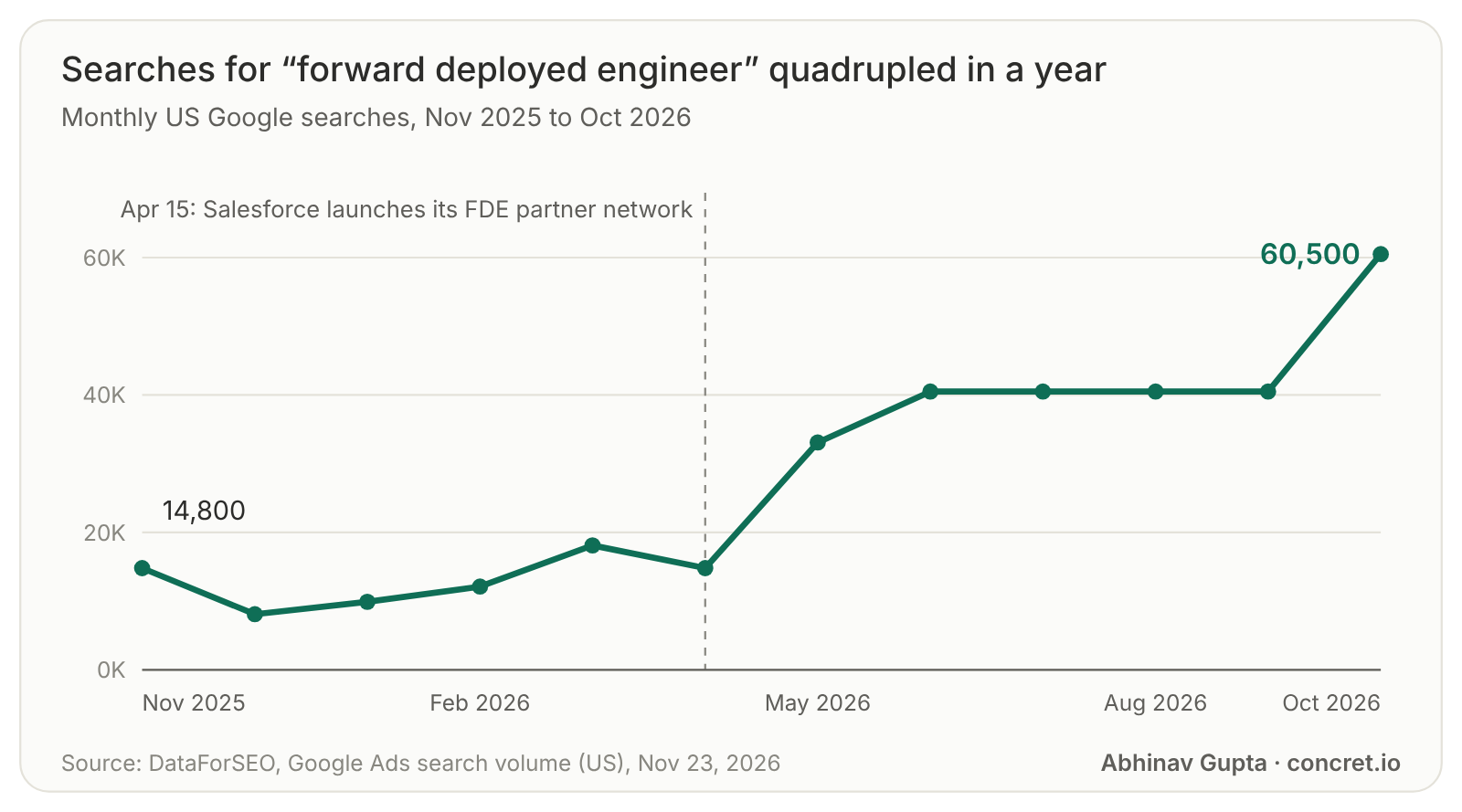
4x: US Google searches for "forward deployed engineer" went from 14,800 to 60,500 a month in under a year. (DataForSEO)
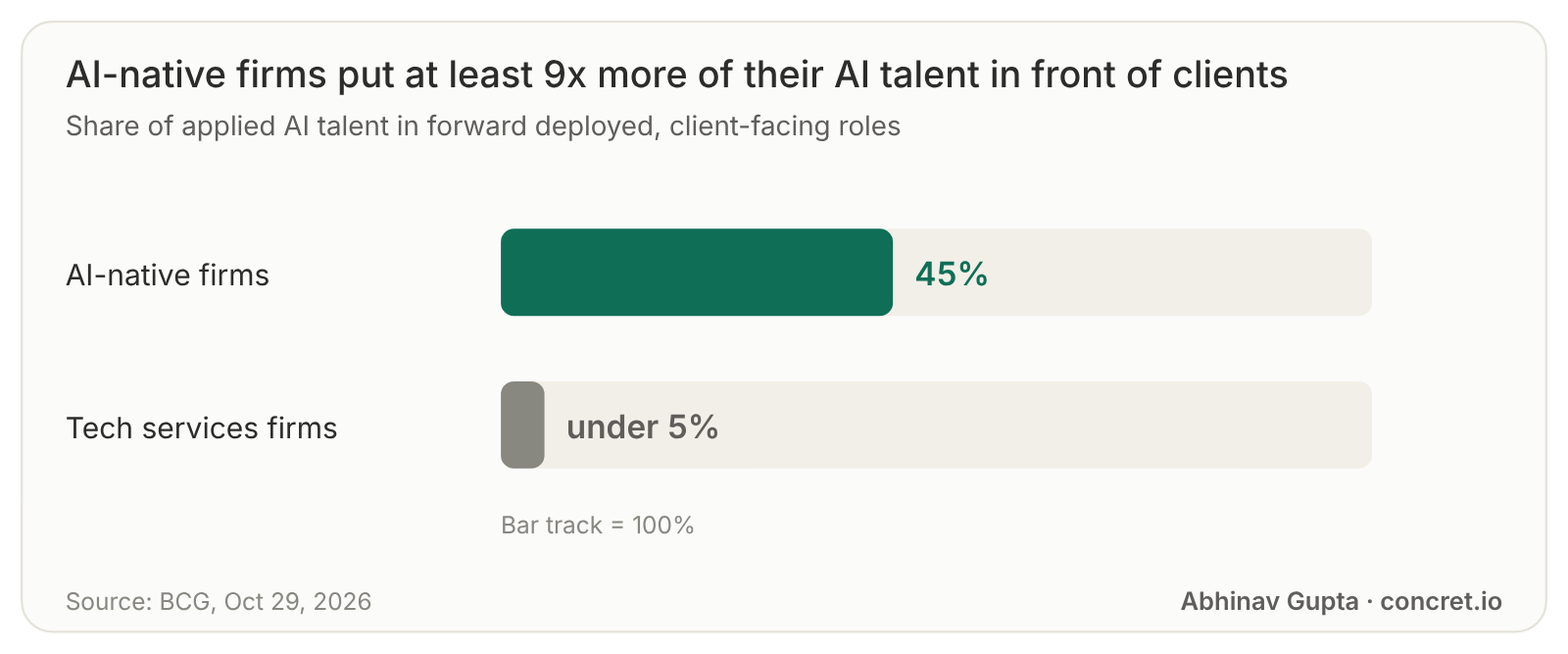
45% vs under 5%: at AI-native firms, 45 percent of the people who build AI systems work directly with clients. At traditional IT services firms, under 5 percent do. (BCG)
$4 billion+: the starting investment behind OpenAI's new deployment company, which is built around FDEs.
32%: only about a third of leaders say AI is making a lasting difference across their whole company. (Accenture research, cited by ServiceNow)
One warning on the job numbers. Lenny Rachitsky notes that some of these "new" FDE jobs are old jobs with a new title. The BCG number is the one to watch: a gap of at least nine times.
What is a forward deployed engineer?
A forward deployed engineer does not advise from the outside. They write real code that makes a product work with one customer's data, systems and rules. Their job is done when the system works in daily use, not when the demo goes well.
Palantir invented the role. OpenAI's head of FDE, Colin Jarvis, says it closes "the deployment gap": the gap between what AI models seem able to do and what people can rely on in their daily work.
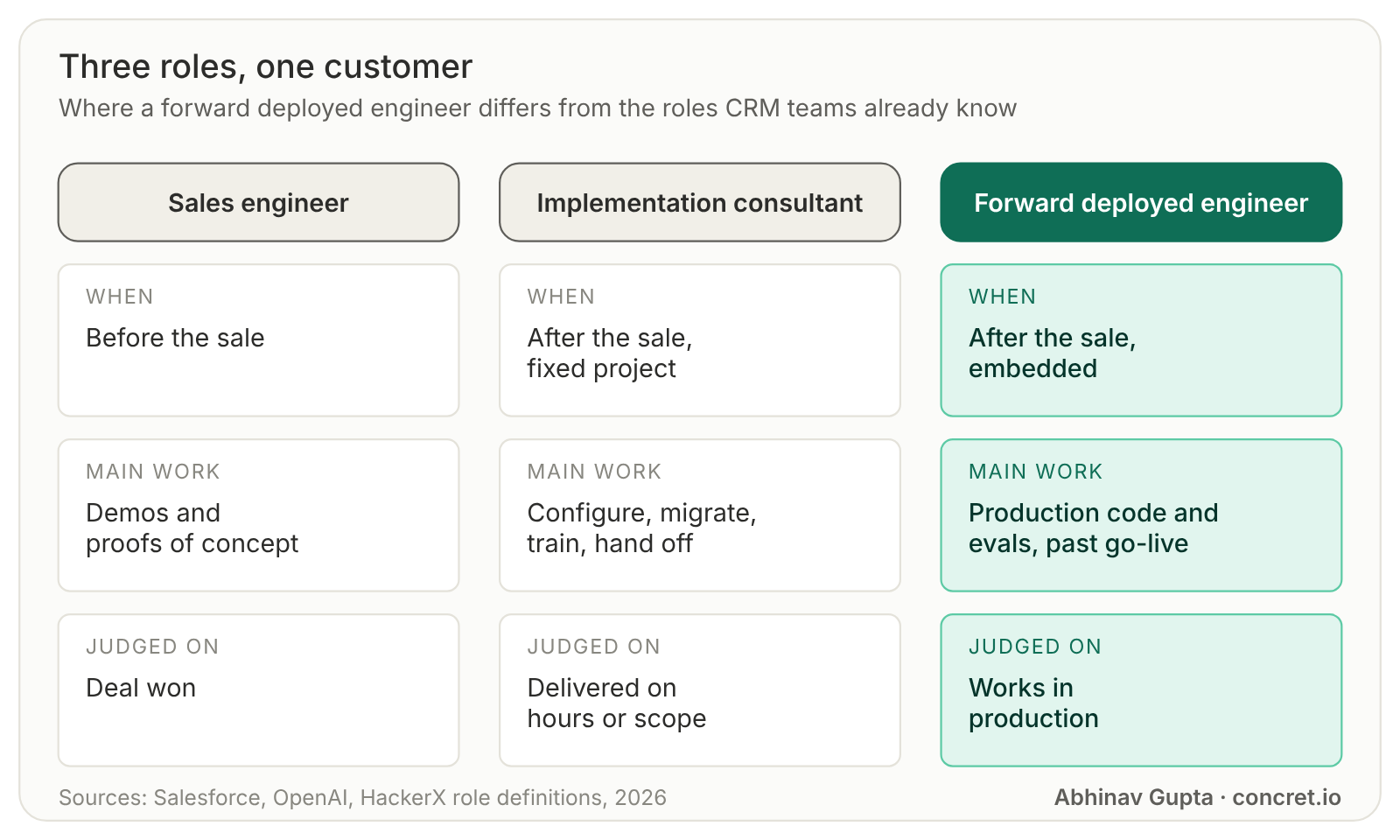
If you have ever spent a quarter inside a client's Salesforce org fixing their identity resolution so an automation could finally be trusted, you know this job. The difference is that the market now prices it very differently.
Who is right? Each is half right
Yash is right that AI lets each person do far more. But Applied Compute itself says its engineers "embed within companies, working shoulder to shoulder with their teams." Even an AI platform company puts people next to customers.
Gabriel is right that people are still the bottleneck. But BCG argues the shortage is partly a choice. Traditional IT services firms already employ engineers who could do this work. They have not put them in front of clients.
In the words of BCG partner Sreyssha George, these firms "do not have an AI talent shortage, they have a talent decision to make."
AI does not remove people from the work. It changes who employs them, and who pays for them.
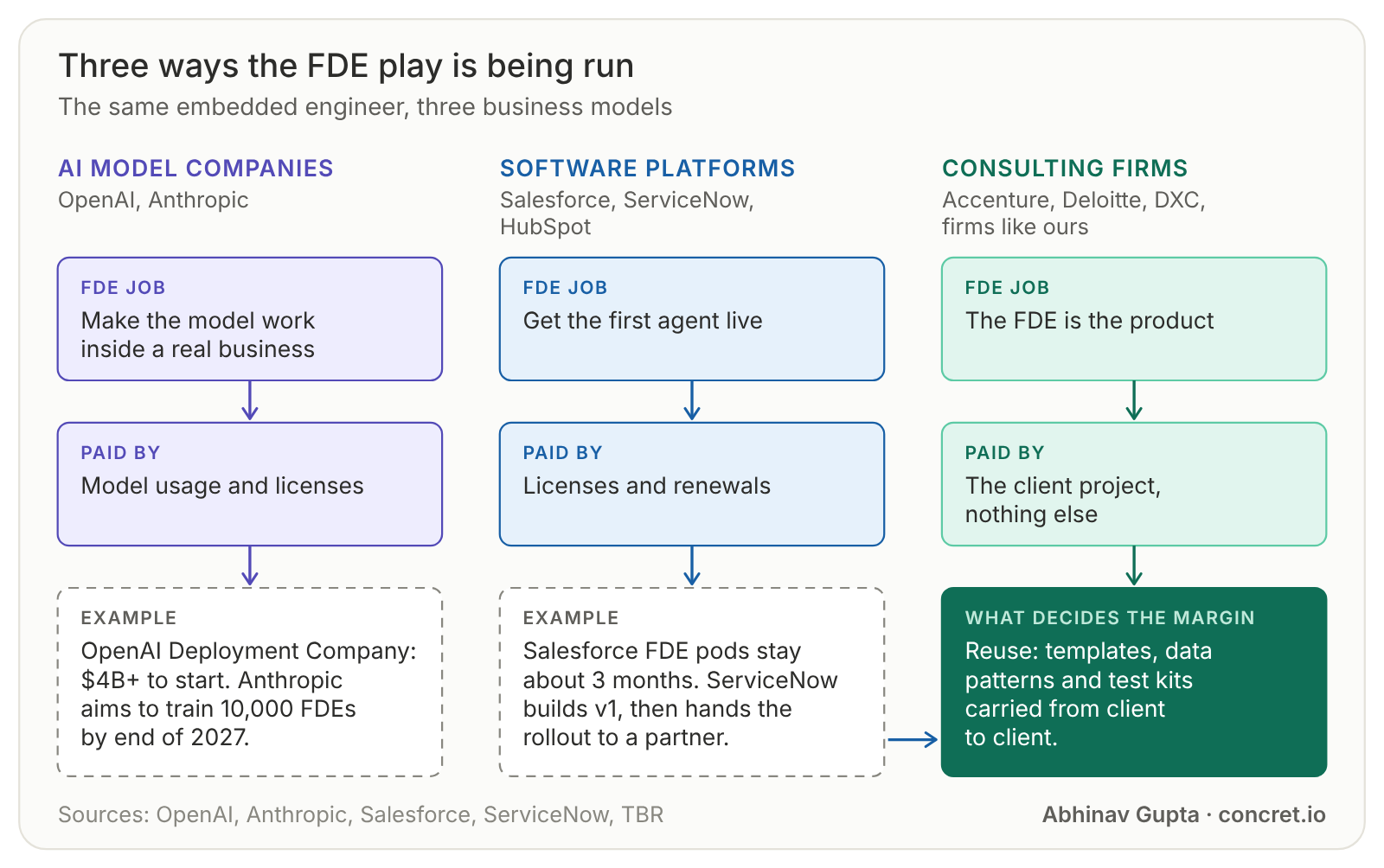
Three ways the FDE play is being run
1. AI model companies. OpenAI and Anthropic sell AI models. Their FDEs make those models work inside real businesses.
OpenAI built its own FDE team, then set up a separate company for it in May. Its first move: a deal to buy consulting firm Tomoro and its team of about 150.
Anthropic has its own FDEs too, but its big bet is on training others. Its Claude Frontier Academy plans to train 10,000 FDEs by the end of 2027, starting with firms like Accenture, Deloitte and McKinsey.
2. Software platforms. Salesforce, ServiceNow and HubSpot sell the software that AI agents run on. Their FDEs get the first agents working. For scale, they lean on partners.
Salesforce: its FDE teams stay with one client for about three months.
ServiceNow: it works with Accenture. ServiceNow's FDEs build the first version, and Accenture rolls it out.
HubSpot: it is still testing the idea. In its September investor deck, it called its partner network its "forward-deployed moat."
3. Consulting firms. Accenture, Deloitte, PwC, DXC and firms like mine. For us, the FDE is not a cost of selling software. The FDE is what we sell.
That one difference changes the money. AI model companies and platforms can pay for FDEs out of what they earn from the product. Analyst firm TBR says they can even run FDEs at a loss.
A consulting firm cannot. The client project has to pay for every engineer. To me, that is the main reason services do not yet scale like software.
Monthly US Google searches, Nov 2025 to Oct 2026. Source: DataForSEO. Chart by the author.
For a buyer, this tells you what each FDE is there to do. A vendor's FDE is there to grow your use of the product. A consulting firm's FDE is there to deliver your project. Both can serve you well. Just know which one you are hiring.
FDE - Hype vs reality?
Hype: "Every AI project needs an embedded team." Reality: no. Save it for hard problems. Marc Andrusko at Andreessen Horowitz warned that copying Palantir can turn firms into "expensive services businesses." HFS Research calls FDE work "high-touch and expensive by design."
Hype: "Thousands of FDEs are on the way." Reality: training takes time. In June, DXC promised tens of thousands of Claude-trained engineers. A month later, 86 were ready, Channel Dive reports. The first graduates of Anthropic's Claude Frontier Academy are due in early 2027.
Hype: "A partner badge proves skill." Reality: Salesforce's select FDE Partner Network rewards partners for "agents reaching production." That is a good filter. But HFS warns buyers that these badges "are gates, not capabilities."
What forward deployed engineers actually deliver?
Real results are still rare. In an HFS survey of 545 enterprise decision makers, just 7 percent of companies building AI agents had them in full production and tied to business targets.
But where FDEs are involved, the wins are specific. Here they are, by the same three plays. All numbers are the companies' own.
1. AI model companies
OpenAI, at a chip maker. More than 10 use cases went live. One cut the time spent writing tests by about 48 percent. Team: about 15 FDEs. Time: three to six months.
2. Software platforms
Salesforce, at Bombardier. A calculation that took engineers at least four hours now takes a sales agent 10 to 20 seconds. Time: 15 weeks.
Salesforce, at Trustpilot. The support backlog fell 99 percent in six months. Time to go live: 8 weeks.
Salesforce with a partner, at Batteries Plus. A partner built a two-agent pilot. Salesforce then scaled it to 10 agents, which have created $14 million in sales pipeline. Team: three people from Salesforce.
3. Consulting firms
Deloitte. A tool that can cut a software migration from 12 months to weeks. Team: one engineer and one designer. Deloitte works in six to eight week sprints.
Concret.io, my own firm, at a healthcare billing company. To prepare an insurance appeal, staff used to search many Salesforce screens and open every attached file. Now they type part of a claim number, and an AI assistant gathers it all in one pass, with every fact linked to its source.
Across all three plays, the wins look alike. One clear use case at a time. A small team per use case. Weeks or a few months, not years. One number that moved. ServiceNow's head of FDE, Miku Jha, says its team gets solutions live in under 10 weeks.
Does your business need an FDE?
Not always. Here is a simple way to decide.
Step 1: Is the work hard enough?
You likely do not need one if the job is one process, one team and clean data. Your current team or partner can finish it in weeks.
You likely do if the AI agent must work across several systems, the data is messy, and it has to prove itself in real daily work.
Step 2: Are you ready for one?
Have three things in place first.
A result to measure. One number, like Bombardier's four hours cut to seconds. Pick yours.
A business owner who can make decisions fast.
A team that will run the agent after the FDE leaves.
IDC finds that the client's readiness, not the provider's skill, is the main limit on what FDEs deliver.
Step 3: Where should the FDE come from?
You have three choices: hire your own, use a vendor's FDE (an AI model company or a software platform), or bring in a consulting firm. Here is how they compare.
| Hire your own | Your software vendor's FDE | A consulting firm's FDE | |
|---|---|---|---|
| Who they are | Engineers on your own payroll | Engineers employed by the company whose software you buy | Engineers from a services firm, such as Accenture, Deloitte or mine |
| Time to start | 2 to 4 months to hire (recruiter estimates), or about 3 months to train your own | Fast, but the vendor picks who gets one | Weeks. They are already hired and trained |
| Staying power | About 2.3 years, the median in an MMC Ventures study | About 3 months for Salesforce's FDE teams | Until the contract ends |
| Cost | About $216,000 a year in pay, the US median on Levels.fyi, as The Register reported. That is about $104 an hour, before benefits | No public price. Some chosen accounts get one free. FDE fees can top $200,000 a quarter per use case, by a Gartner estimate | From about $25 an hour at India-based firms to $500 or more at Big 4 firms. See the rate guide in Step 4 |
| Main risk | They leave, and the search restarts | You cannot run or change the system without them | The know-how leaves with the firm |
| Best when | AI work will keep coming for years | The agent runs fully inside that vendor's software | The agent spans several systems and you need to start now |
Gartner also predicts that by 2028, 70 percent of enterprises will abandon AI agents built by vendor FDEs, because costs soar and their own teams cannot change them.
Step 4: What will it cost?
These are guides, not quotes. Most are rates for Salesforce consulting work, the closest public stand-in for FDE rates. They mix list prices, US government price caps and market estimates.
| Who you pay | Rate per hour | Where the number comes from |
|---|---|---|
| Salesforce | $257 for a developer to $517 for a principal architect. These are list prices for its own consultants, before discounts. No FDE price is public | A 2026 New York State price sheet that lists Salesforce's part numbers and list prices by role |
| Big 4 firms | $250 to $500 or more | A market guide from a consulting firm. Deloitte's US federal price caps have a median of $247 |
| US boutique firms | $125 to $250 | The same market guide. US federal price caps for an AI engineer at small firms have a median of $172 |
| India-based firms | $25 to $50 for general Salesforce work. $40 to $100 for a senior FDE | GoodFirms lists 277 firms with a median of $37. The senior rate is from a provider's rate card |
What the guide shows: at list price, Salesforce's own consultants probably cost about as much as a Big 4 firm. Boutique and India-based firms charge less per hour. But a lower rate is not a lower bill. Hours and seniority decide the total.
I run an India-based consulting firm, so weigh my view of both tables.
Step 5: Five questions before you sign
Ask every partner:
Which agent have you put into daily use, and can I talk to that client?
What is the finish line, and what happens to your fee if we miss it?
Who exactly will be on my team, how senior are they, and what is the blended rate?
What will my team own, and be able to run, on the day you leave?
Who on your team owns our data quality?
If a partner cannot answer all five clearly, keep looking.
From our own work: the healthcare billing project above shows why the last question matters. The assistant finds insurance cards hidden in files with unrelated names, such as a scan saved as "Final Invoice." It flags when a Salesforce field and a scanned document disagree.
It checks every case for missing fields before staff start writing. And it is built to say "I don't know" instead of guessing.
The bottom line
The FDE title is new. The job is not. What changed is the money around it: who employs these engineers, who pays for them, and what buyers expect in return.