Retrieval-Augmented Generation: How RAG Actually Works in Production
Key Takeaways:
Production RAG goes beyond vector databases, relying on strong data, retrieval, context, security, evaluation, and observability.
Get the fundamentals right, or even a powerful LLM cannot deliver reliable results.
A production-ready RAG needs retrieval, evaluation, security, observability, and data pipelines working together.
An employee asks your internal assistant: “What’s our leave policy for people who’ve completed more than five years?”
A capable model gives a fluent, confident answer. It is also wrong, because your HR policy was never in its training data. The model did not lie on purpose. It did what language models do: predicted plausible text from what it already knew.
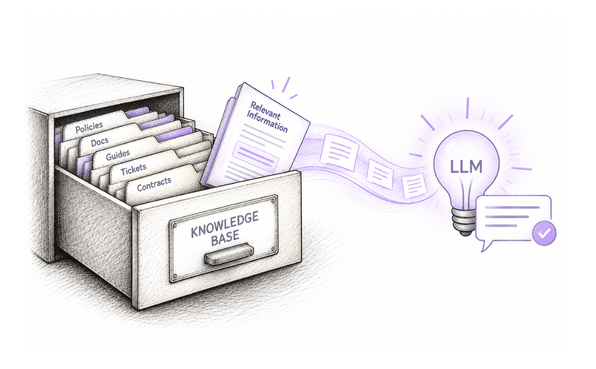
That gap is the reason Retrieval-Augmented Generation (RAG) exists. RAG gives a large language model (LLM) access to private, changing, or citable knowledge at query time instead of requiring that knowledge to be baked into model weights.
In one line: RAG retrieves relevant evidence, adds it to the model's context, and uses that context to generate an answer.
What Is Retrieval-Augmented Generation (RAG)?
Retrieval-Augmented Generation is an architecture that combines information retrieval with language generation. Instead of asking an LLM to answer from its learned parameters alone, a RAG system first searches an external knowledge source, selects relevant material, and provides that material as context for the model.
How RAG works
1. Retrieve: Search an indexed knowledge source for passages relevant to the user's question.
2. Add context: Assemble the best passages, along with useful source metadata, into the model prompt.
3. Generate: Ask the LLM to answer using the supplied context and to abstain when the evidence does not support an answer.
RAG reduces hallucination risk, but it does not eliminate hallucinations. A model can still misread, overgeneralize, or incorrectly combine perfectly good retrieved context.
Why plain LLMs fall short for enterprise knowledge
Knowledge cutoff: The model does not automatically know information created after training.
No private data: Contracts, tickets, policies, and internal documentation may never have been part of training.
No provenance: A standalone model cannot reliably point to the source that supports a particular answer.
Hallucination: When evidence is missing, the model can fill the gap with plausible but incorrect text.
How RAG Works in Production
A production RAG system is best understood as two connected pipelines: an offline ingestion pipeline that prepares the knowledge base, and an online query pipeline that retrieves evidence for each request.
RAG Architecture: Offline and Online Pipelines
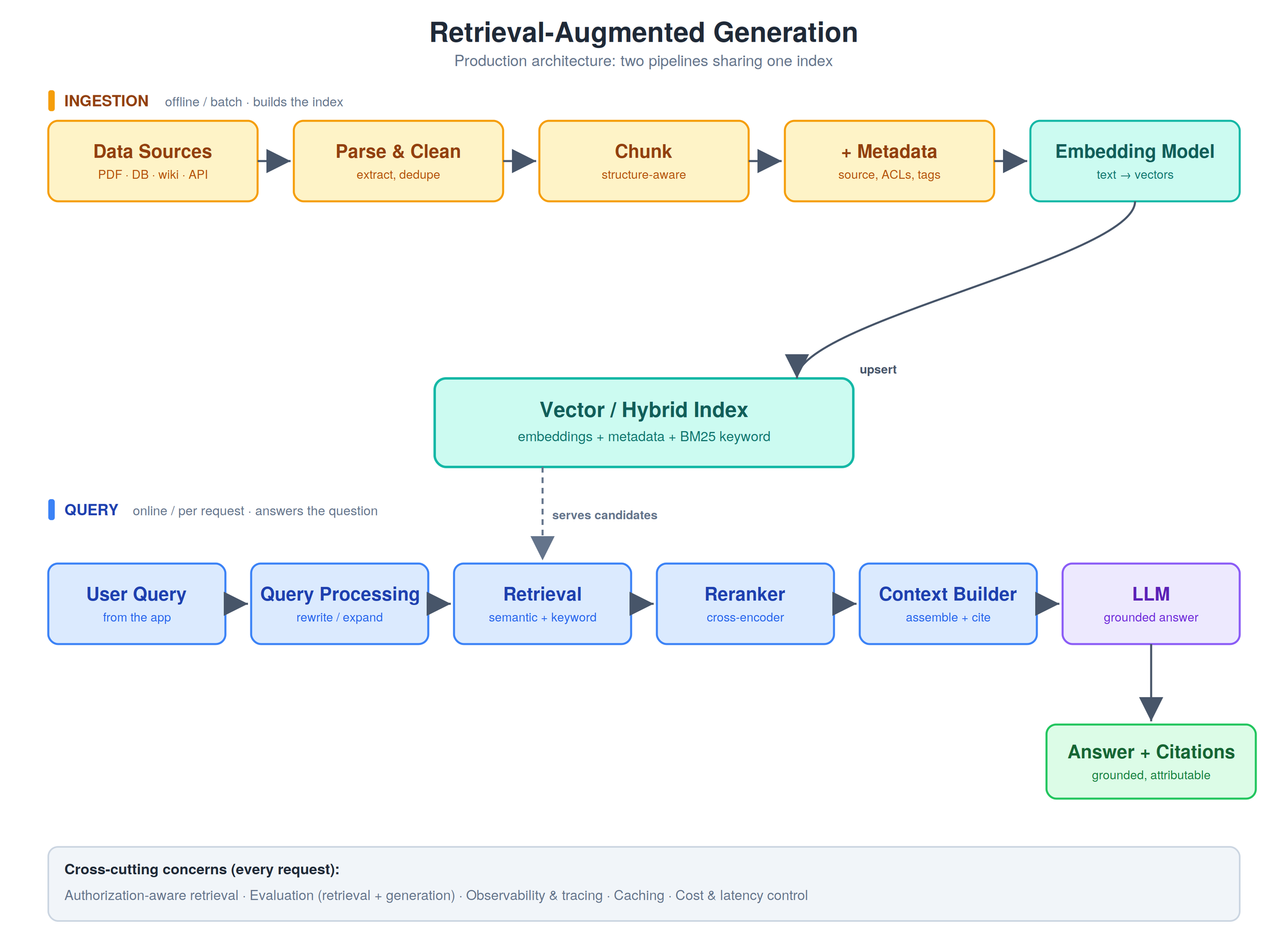
Figure 1. Production RAG architecture: an offline ingestion pipeline builds the index; an online query pipeline reads from it per request.
| Pipeline | What happens | Why it matters |
|---|---|---|
| Offline ingestion | Parse documents, split content, create embeddings, and build/update the index. | Sets the quality ceiling of retrieval. |
| Online query | Process the question, retrieve candidates, rerank them, build context, and generate the answer. | Drives per-request latency, cost, and answer quality. |
The ingestion pipeline runs in the background and largely determines the ceiling of system quality. If a document is parsed badly or chunked badly, no clever prompt at query time can fully recover the missing structure. Re-index on a schedule or when source documents change; do not re-embed the entire corpus for every question.
RAG Retrieval Quality: Chunking, Embeddings, Hybrid Search, and Reranking
People often assume the model is the main determinant of RAG quality. In production, many of the biggest gains come from the retrieval layer.
1. Chunking
Chunking splits documents into pieces small enough to retrieve precisely while retaining enough surrounding meaning to preserve the rule or fact being answered.
Consider a policy that says: “Employees may work remotely up to three days per week, provided their manager approves and their role is not customer-facing.” If a chunk boundary lands after “three days per week,” retrieval can return the permission while dropping the conditions. The model may then confidently state a policy that does not exist.
| Strategy | What it does | When it helps |
|---|---|---|
| Fixed-size | Splits by token or character count. | Uniform text and quick baselines. |
| Recursive | Splits on structure such as paragraphs and sentences. | Most general-purpose corpora. |
| Semantic | Splits where meaning changes. | Dense or topic-mixed documents. |
| Parent-child | Retrieves a small child chunk but feeds larger surrounding context. | When both retrieval precision and context matter. |
There is no universal best chunk size. It depends on the document structure, embedding model, and questions users actually ask. Tune chunking with evaluation rather than copying a tutorial's default.
2. Embeddings
An embedding turns text into a vector: a list of numbers arranged so semantically similar content tends to be close together. For example, “vacation carryover” and “rolling over unused leave” can be close even when they share few exact words.
Two practical points matter. A larger embedding dimension does not automatically mean better retrieval; training quality and fit to the task matter more. Also, query and document embeddings need to be compatible, typically produced by the same embedding model or a deliberately matched model family.
3. Retrieval and hybrid search
Semantic search compares the query with vector representations and is strong at meaning. Keyword search, such as BM25, is strong at exact tokens such as part numbers, error codes, case IDs, and proper nouns. Hybrid search combines both signals.
Reciprocal Rank Fusion (RRF) is a common way to fuse ranked lists. A constant around 60 is a common zero-configuration starting point, but it is not a guarantee of better results. On some corpora, adding a weak lexical signal can introduce noise. Measure retrieval performance before and after.
4. Reranking
First-stage retrieval is optimized for recall: retrieve a reasonably broad candidate set so the relevant passage is likely to appear. A reranker, often a cross-encoder, then scores candidates against the query with richer interaction and promotes the strongest few before they reach the LLM.
This two-stage design exists for a practical reason: cross-encoders are accurate but too expensive to run over millions of documents. Cheap retrieval narrows the field; expensive reranking improves precision.
RAG Prompt Construction, Grounding, and Citations
Retrieved chunks should be assembled into the prompt with explicit instructions about how the model should use them. A simple pattern is:
SYSTEM: Answer only using the provided context. If the answer
        is not in the context, say you don't know.

CONTEXT:
  [chunk 1] ... [chunk 2] ... [chunk 3]

QUESTION: <user question>
Two practices separate many demos from products: instruct the model to refuse unsupported answers, and carry source metadata with each chunk so the final answer can cite where the evidence came from.
Retrieved documents are also untrusted input. If a document contains text such as “ignore previous instructions,” that text is attempting to influence the model's behavior. Treat retrieved content as data, not as instructions, and test the system against prompt injection.
RAG vs Fine-Tuning: When Should You Use Each?
RAG and fine-tuning are not competing answers to the same problem. They solve different constraints, and mature systems can use both.
| Need | RAG | Fine-tuning |
|---|---|---|
| Frequently changing knowledge | Strong | Weak |
| Private documents | Strong | Costly |
| Factual grounding and citations | Strong | Weak |
| Domain style, format, and tone | Weak | Strong |
| Updating knowledge cheaply | Strong | Weak |
| Explainability through source evidence | Strong | Weak |
Clean split: retrieval is primarily for knowledge; fine-tuning is primarily for behavior. Use RAG when the constraint is fresh, private, or citable information. Use fine-tuning when the constraint is how the model should write or behave. Combine them when both knowledge and behavior need to be controlled.
Common RAG Failure Modes and How to Fix Them
Most production failures are easier to understand when you separate what broke, why it broke, and what signal would expose it.
| Failure mode | What breaks | Practical fix |
|---|---|---|
| Silent retrieval failure | The right document exists but never reaches the model. | Measure retrieval recall independently from answer quality. |
| Bad chunking | Rules become separated from their conditions. | Use structure-aware or parent-child chunking and test on real questions. |
| Too much context | Relevant evidence gets diluted by irrelevant passages. | Rerank and keep top-k deliberately small. |
| Stale index | Source documents change but the index remains outdated. | Re-index on source changes and track freshness. |
| Prompt injection | Retrieved content attempts to override model instructions. | Treat retrieved text as data, sanitize where appropriate, constrain instructions, and test adversarially. |
The recurring lesson is that many RAG failures are retrieval, data, or systems problems, not simply model problems.
Enterprise RAG: Security, Evaluation, Governance, and Observability
A demo may need a vector database. A production enterprise system needs controls around identity, quality, monitoring, and operations.
Authorization-aware retrieval
Users must not retrieve documents simply because those documents exist in the index. Permissions should be enforced at retrieval time, usually through metadata filters tied to the user's identity, so search can surface only documents that the user is authorized to see.
Evaluation
“The answer looks good” is not a methodology. Measure retrieval quality separately from generation quality. Useful retrieval measures include recall, MRR, and nDCG; generation evaluation can include faithfulness, answer relevance, and citation correctness.
Observability
Log enough information to reproduce a bad answer: the query, retrieved chunks, similarity and rerank scores, prompt size, token usage, latency, and final answer. When a user reports a failure, you should be able to see exactly what evidence reached the model.
Cost and latency
Accuracy, latency, and cost trade against one another. Practical levers include lowering top-k, reranking selectively, caching repeated queries and embeddings, and using a smaller generation model when quality allows.
Data governance and freshness
Production RAG also needs ownership for source data, retention rules, update propagation, and deletion handling. If a policy is changed or removed at the source, the index needs a reliable way to reflect that change.
Is RAG Still Relevant in 2026?
The “RAG is dead” argument usually points to very large context windows and agentic systems that can fetch their own data. The more useful conclusion is narrower: naive chunk-and-pray RAG is fading, but retrieval remains important.
Long context can reduce the need for retrieval when the complete, relevant source material comfortably fits in context. But enterprise knowledge bases are often far larger than a model's context window, and irrelevant material can still dilute the signal.
Agentic RAG
Agentic RAG lets an agent search, inspect results, refine the query, and search again when a single retrieval pass is insufficient. It is useful for genuinely multi-step questions, but it adds latency and complexity. An agent built on weak retrieval is still built on weak retrieval.
Graph RAG
Graph RAG combines retrieval with a knowledge graph to answer relationship-heavy questions that flat similarity search can struggle with, such as tracing how entities connect.
The practical 2026 framing is a toolkit rather than a set of beliefs: skip retrieval when long context is enough; use retrieval when knowledge is large, fresh, private, citable, or access-controlled; and use fine-tuning when behavior needs to change.
Production RAG Checklist
· ☐ Define knowledge sources, owners, formats, and access rules.
· ☐ Build reliable ingestion; parsing is where quality can fail first.
· ☐ Choose and evaluate a chunking strategy using real user questions.
· ☐ Select an embedding model and use compatible embeddings for queries and documents.
· ☐ Pick a vector or hybrid store that fits your scale and infrastructure.
· ☐ Add hybrid search only if evaluation shows it improves retrieval.
· ☐ Add reranking when top-k precision needs improvement.
· ☐ Enforce authorization at retrieval time.
· ☐ Require citations and an explicit “I don't know” behavior when evidence is insufficient.
· ☐ Test retrieved content for prompt injection and other adversarial inputs.
· ☐ Evaluate retrieval and generation quality separately.
· ☐ Instrument the full pipeline and monitor it in production.
· ☐ Define freshness, deletion, and re-indexing behavior for source changes.
Frequently Asked Questions
-
RAG lets an LLM search external knowledge before answering. It retrieves relevant information, adds it to the model's context, and generates a response grounded in that evidence.
-
Production RAG typically uses an offline ingestion pipeline to parse, chunk, embed, and index content, plus an online pipeline for retrieval, reranking, context assembly, generation, and citations.
-
No. RAG can reduce hallucinations by supplying relevant evidence, but the model can still misread or misuse that evidence. Retrieval quality and generation quality must be evaluated separately.
-
RAG is mainly used to provide fresh, private, or citable knowledge at query time. Fine-tuning is mainly used to change model behavior, style, or task-specific patterns. Many systems use both.
-
Enterprise RAG requires authorization-aware retrieval, evaluation, observability, freshness controls, prompt-injection defenses, and deliberate cost and latency management, not just a vector database.
Related Readings