
AIforce: Salesforce's Big Dreamforce 2026 Announcement, Explained
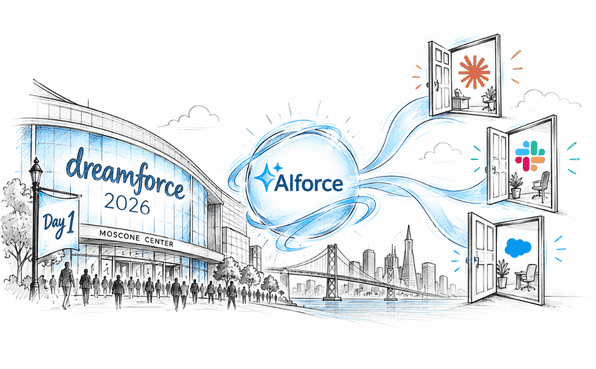
Salesforce used the opening keynote of Dreamforce 2026 Day 1 (September 15 to 17, Moscone Center, San Francisco) to unveil AIforce, a new interface layer for the platform.
The pitch is simple: stop asking people to come to Salesforce. Instead, let Salesforce's data, workflows, permissions, and business logic show up wherever people already work, inside Claude, Slack, or the standard Lightning screens.
CEO Marc Benioff called it "an interface revolution." Patrick Stokes, president of applications and marketing, put it more bluntly: AIforce lets customers "break free of a shared user interface."
What AIforce Actually Is
AIforce is not a new app you log into. It is a live interface layer that sits on top of the Salesforce architecture and exposes it to any AI surface.
Practically, that means:
Employees who have never opened a Salesforce dashboard can ask questions, update records, and trigger workflows through a chat interface.
Agents can read across hundreds of records at once, pull in connected systems, and act on a complete view of the business, faster than any human could.
Instead of navigating fixed layouts and fields, people can describe the interface they want and get a composed, live view built on the fly.
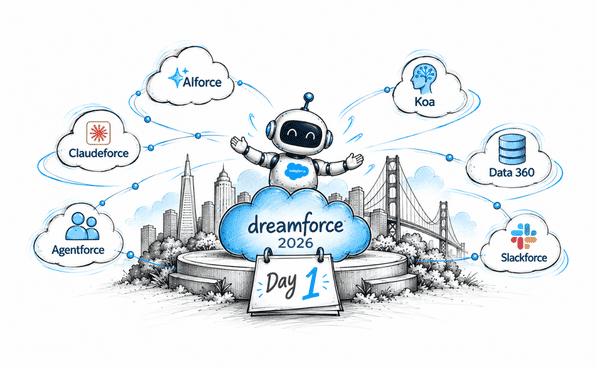
Salesforce is positioning this as the next layer on top of what it calls the Agentic Enterprise stack: Data 360 for unified data and memory, Customer 360 for business logic and permissions, Agentforce for the actual digital workforce, and now AIforce as the delivery layer that puts all of it inside any AI tool.
The Three Launch Surface
AIforce ships with three components at launch. More are expected.
| Surface | What it does | Who it's for |
|---|---|---|
| Claudeforce | Packages Salesforce data, permissions, and 37 prebuilt sales skills into a ready-made MCP server inside Claude. Also ships a Salesforce Development plug-in for Claude Code with 40+ skills. | Sales reps, developers, admins |
| Slackforce | Brings Salesforce context into Slack via Surfaces (live, shareable interfaces), Slackbot (a reasoning assistant across Slack and CRM data), Slack CRM (update Salesforce records from a Slack prompt), and Slack Code (multiplayer coding in Slack). | Teams already living in Slack |
| Agentforce Coworker | An AI teammate inside the existing Lightning interface, reasoning across accounts and history, operating fully within existing permissions. | Current Salesforce users who don't want to leave the app |
A few numbers worth noting: Salesforce says Salesforce in Claude has already been piloted by Deloitte, GitLab, and Legora and is now in beta for all customers. Agentforce Coworker reportedly hit 100,000 activated users within 35 days of its own rollout, and Fulton Bank says it went from zero to 20+ live use cases across roughly 3,000 users within weeks.
Why Salesforce Is Doing This
Salesforce's own framing: most of a company's knowledge already lives inside Salesforce, but until now, the only way to reach it was to open the app and click through the UI. That capped who could use the platform and how much value they could pull out of it at any given moment.
AIforce is Salesforce's answer to the fact that AI agents and MCP ecosystems have made it possible to bolt AI onto any data source. Rather than risk being just another connected system, Salesforce wants to be the trusted, governed layer underneath all of it, no matter which chat window the work happens in.
Salesforce co-founder Parker Harris said it plainly about the Slack piece: "You may never log in to Salesforce again."
The Governance Angle
This is the part that should matter most to enterprise buyers, and it is where Salesforce is spending most of its messaging:
Permission-based by default. Every request runs on the user's existing permissions. Agents only see what that person is already allowed to see.
Zero Data Retention. Business data is used to answer the question at hand and is not retained by the model provider.
No new setup. Salesforce says there is no new permissions model, no migration, and no custom integration work required. Admins connect once.
For teams that have spent the last two years worried about shadow AI tools quietly touching CRM data without oversight, this governance-first framing is clearly aimed at getting security and compliance teams comfortable before they get asked "can we just use Claude for this?"
Open by Design: The Ecosystem Play
AIforce runs on what Salesforce calls the Headless Toolkit, an open architecture exposing MCPs, APIs, plug-ins, and skills to developers. Around that sits the AgentExchange marketplace, where partners including Anthropic, AWS, Google, and Microsoft, plus tools like Docusign, Gamma, Jasper, and Rippling, plug in their own agents and interfaces.
That is a meaningful shift for a company that has historically wanted people inside its own UI. Now it wants to be the trusted backend everywhere else.
What's Missing, For Now
A few things to flag honestly:
No public pricing yet. Salesforce's own release notes say pricing and packaging are subject to change and availability may vary by region.
No fixed general availability date across all surfaces. Salesforce in Claude is in beta; other pieces are rolling out at different paces.
Independent coverage (SiliconANGLE, IT Pro, TechRadar) confirms the announcement and the three launch surfaces, but details beyond Salesforce's own press materials are still thin since this landed within the last 24 hours.
If you're evaluating this for your own stack, treat the current messaging as directional rather than a finalized commercial offer.
What This Means If You're Running Salesforce Today
If your team already has Agentforce or Salesforce Marketing Cloud in place, AIforce is less a brand-new tool to learn and more a new front door to the same governed data you already have. The practical next steps look like:
Get familiar with what Agentforce already does before layering AIforce surfaces on top of it. Our breakdown of Agentforce as Salesforce's AI agent platform is a good starting point if your team hasn't standardized on it yet.
Understand the trust and governance model before you let Claudeforce or Slackforce touch live CRM data. We've covered how the Einstein Trust Layer secures Agentforce interactions in detail, and the same permission-based logic underpins AIforce.
If you're already on Agentforce 360, AIforce is additive, not a replacement. See our explainer on Salesforce Agentforce 360 for how the pieces fit together.
Marketing and RevOps teams specifically should look at how this connects to the broader 2026 Salesforce release cycle, since AIforce builds directly on Multi-Agent Orchestration and Slack First Sales, both introduced earlier this year.
Sources
Salesforce official announcement: Salesforce Unveils AIforce, Bringing the Full Power of Its Platform to Any Interface
Frequently Asked Questions
-
No. It's an interface layer on top of Salesforce's existing architecture (Data 360, Customer 360, Agentforce). You connect it to surfaces you likely already use, Claude, Slack, or Lightning, rather than adopting a standalone app.
-
Salesforce says no. Admins connect once, and access follows whatever permissions already exist. No new permissions model, no custom integration work, according to the official announcement.
-
Salesforce states AIforce runs on Zero Data Retention: business data answers the query at hand and isn't retained by the model provider. Worth confirming this directly with your Salesforce rep before rolling it out, since exact terms can vary by agreement.
-
Agentforce is the digital workforce, the actual AI agents doing tasks. AIforce is the delivery layer that puts Salesforce's data and logic inside whatever tool you're using. Agentforce Coworker is one of AIforce's three launch surfaces, an AI teammate that lives inside the existing Lightning UI rather than in Claude or Slack.
-
Partially. Salesforce in Claude (part of Claudeforce) is in beta for all customers. Agentforce Coworker is active for existing Salesforce customers. Slackforce and the rest are rolling out on their own timelines. No firm general-availability date has been given for the full AIforce layer, and pricing hasn't been published.
-
Not entirely, but that's the direction Salesforce is pushing. Co-founder Parker Harris said as much about the Slack integration specifically. For now, Lightning still exists and Agentforce Coworker runs inside it, so it's additive rather than a full replacement.
Related Readings

Let’s Talk

Drop us a note, we’re happy to take the conversation forward 👇🏻