
Key Takeaways:
Beyond Marketing: Data 360 expands CDP into a unified data platform across sales, service, marketing, and AI.
More Than a Rebrand: New capabilities like Intelligent Context and Tableau Semantics strengthen data integration and AI readiness.
Pricing & Roadmap: Flex Credits and profile-based licensing offer new ways to manage Data 360 costs in 2026.
Salesforce Data 360 is the latest name in the evolution of Salesforce’s customer data platform, following Salesforce CDP and Data Cloud. However, the changes across these versions go beyond branding, particularly in data integration, AI capabilities, and pricing.
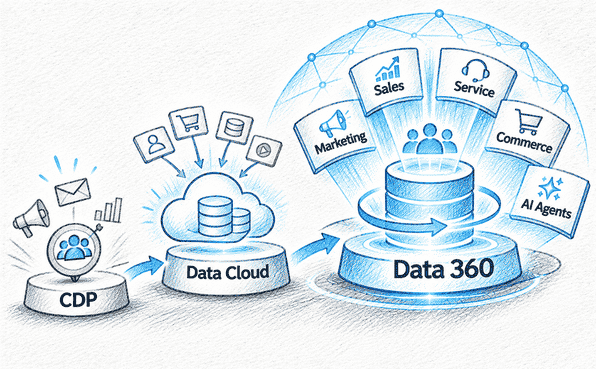
The evolution of Salesforce CDP vs. Data 360 reflects a shift from marketing audience management to broader data integration, identity resolution, and customer insights across sales, service, and marketing. This marked a significant change in how businesses could use customer data across the Salesforce ecosystem.
On October 14, 2025, Salesforce rebranded Data Cloud as Data 360, aligning its positioning with the broader Agentforce ecosystem. The rebrand itself did not change the platform's functionality. Instead, capabilities such as Intelligent Context for unstructured data and Tableau Semantics for consistent business metric definitions reflect the platform's broader data and AI capabilities.
In 2026, Salesforce introduced additional Data 360 pricing options, including Flex Credits and profile-based licensing for eligible customers. These options give businesses different ways to manage data consumption and licensing costs.
In this guide, we’ll cover:
Salesforce Data 360 vs CDP: Key changes and expanded capabilities.
Data 360 pricing: Latest pricing models and their relationship with Agentforce.
Product identity: Is Data 360 the same as Data Cloud, and is Data 360 a CDP?
Is Salesforce Data 360 the Same as Salesforce CDP?
Yes, understanding Salesforce Data 360 vs. CDP starts with knowing that both belong to the same product line, which evolved from Salesforce CDP to Data Cloud and then Data 360
But CDP was mainly a Marketing Cloud tool, while Data 360 is a platform-wide data layer that also supports AI agents through Agentforce 360.
| Question | Short answer |
|---|---|
| Is it the same product line? | Yes. Salesforce CDP became Data Cloud, and Data Cloud became Data 360. |
| Does it do the same job? | Partly. Both unify customer data into profiles, but the old CDP was a Marketing Cloud product for audience segmentation and activation, while Data Cloud spans the whole Salesforce platform. |
| Is the name the same? | No. Data Cloud was renamed Data 360 in October 2025, and it now falls under Agentforce 360 as the data layer that gives agents context. |
What this means for you: if your plans still say “CDP,” the product has grown well beyond marketing, so your roadmap may be missing use cases. If they say “Data Cloud,” you mostly need to update the name and check what’s new.
Salesforce CDP vs Data 360: How CDP, Genie, and Data Cloud Connect
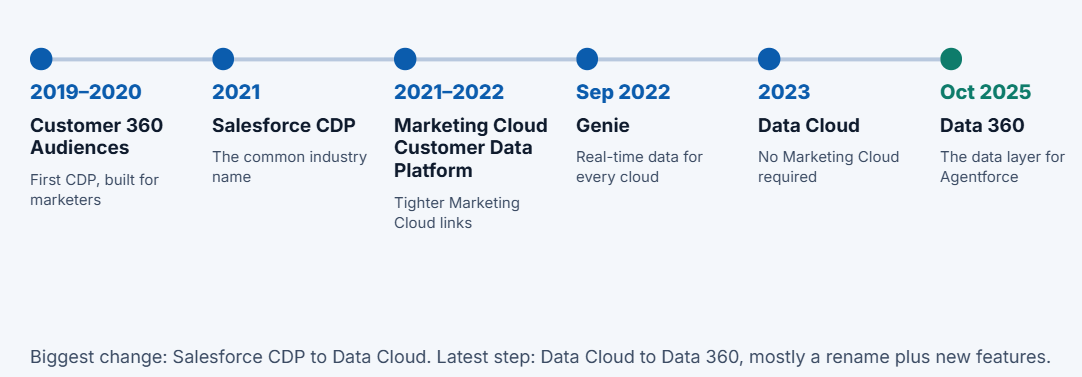
Salesforce has changed this product’s name several times since 2019. Here’s what each name meant and what changed along the way.
| Name | When | What it meant |
|---|---|---|
| Customer 360 Audiences | Announced 2019, launched 2020 | Salesforce’s first CDP. It unified customer data into a single profile and let marketers build audience segments, and it was a Marketing Cloud product |
| Salesforce CDP | 2021 | Salesforce called it “CDP” because that was the common industry term. At that time, it was available only to Marketing Cloud customers. |
| Marketing Cloud Customer Data Platform | Around 2021–2022 | Better Marketing Cloud integration to use customer audiences directly in campaigns. |
| Genie | September 2022 | A larger platform that connected real-time data across Salesforce and could access data directly from Snowflake. |
| Data Cloud | 2023 | Rebranded from Genie to "Data Cloud" to better reflect its broader enterprise scope, moving beyond just a marketing CDP into a universal data foundation that handles structured and unstructured data. |
| Data 360 | October 2025 | The same platform, now placed under Agentforce 360 as the data layer that gives AI agents context |
What Changed From Salesforce CDP to Data 360
Before the changes, here is a quick look at the product.
What Salesforce Data 360 Does
Salesforce Data 360 pulls customer data from many systems into one place, so every team and every AI agent works from the same customer view.
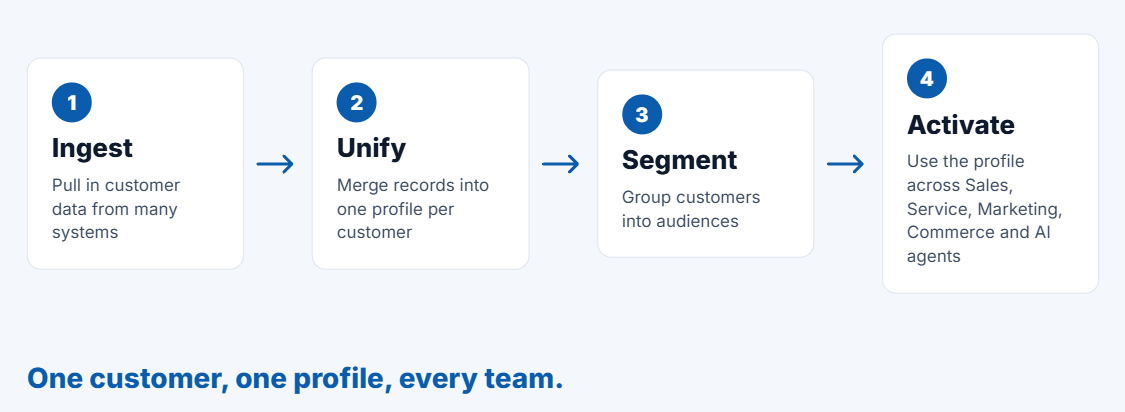
In simple terms: one customer, one profile, and every team can use it.
Want to see how Data 360 works in practice? Read how we implement Salesforce Data 360.
The Salesforce CDP vs Data 360 comparison involves two stages: the expansion from Salesforce CDP to Data Cloud and the later rebrand from Data Cloud to Data 360. The later rebrand from Data Cloud to Data 360 changed the product's name and positioning, while its capabilities continued to evolve through separate feature updates.
1. It works across every Salesforce team, not only marketing
Arrived with: Data Cloud (2023)
Salesforce CDP was primarily built for marketing teams to segment audiences and activate campaigns. Data Cloud, now Data 360, takes this further by connecting customer data across
Salesforce clouds. Sales, service, marketing, and commerce teams can now work from a shared customer profile instead of relying on separate data sources.
One shared customer profile: Every team gets a more complete view of customer interactions and history.
No Marketing Cloud dependency: Organizations can use Data 360 without relying on Marketing Cloud.
Beyond marketing campaigns: Customer data supports sales interactions, service experiences, and commerce activities.
2. Zero Copy: use data where it already lives
Arrived with: Data Cloud, and expanded at Dreamforce 2025
Instead of copying data into Salesforce, Data 360 can connect to live data in Snowflake, Databricks, Google Cloud, and more, without complex ETL or duplicating the data.
During the Dreamforce 2025 keynote, Salesforce shared an estimate of more than $10M in engineering costs saved through Zero Copy at the company itself (Salesforce Ben). It is Salesforce’s own figure, so treat it as a claim and not a guarantee.
No duplicate data: Reduce the need to copy and maintain the same data across systems.
Connect existing data platforms: Work with supported platforms such as Snowflake and Databricks.
A broader integration ecosystem: Dreamforce 2025 brought announcements expanding Zero Copy connectivity and capabilities.
3. Real-Time Actions With Triggered Flows
Arrived with: Data Cloud
The old CDP built audiences for campaigns. Data 360 can also start Salesforce automations when data changes, when a calculated insight updates, or when a streaming event is processed.
Example: if a customer’s lifetime-value score crosses a set level, a follow-up task can be created right away, with no need to wait for the next campaign send.
4. A Data Layer for AI Agents
Arrived with: Data 360 (October 2025)
This is the biggest shift in how Salesforce positions the product. Data 360 now sits under Agentforce 360 as the data layer that gives agents context. Before an agent replies, it can see who the customer is and what has already happened.
At Dreamforce 2025, Salesforce described three use cases for Data 360:
Marketing
Agentforce
Customer 360
5. Intelligent Context: Turning Documents Into Agent-Ready Data
Introduced with: Data 360 (generally available since October 2025)
Important business information often sits in PDFs, tables, images, and flowcharts rather than structured records. Intelligent Context converts this content into searchable, structured information, helping AI agents retrieve relevant details and deliver more accurate answers. Its low-code setup also makes it easier for business users.
In Salesforce’s demo, an agent couldn’t determine a patient’s program eligibility until Intelligent Context processed the relevant information in a lengthy PDF.
6. Tableau Semantics: Keep Business Metrics Consistent Everywhere
Tableau Semantics applies consistent metric definitions across Salesforce clouds and tools such as Snowflake and Databricks. If “revenue” means the same thing everywhere, agents and dashboards stop contradicting each other.
7. Secure Data Sharing With Clean Rooms and Governance
Arrived with: Data 360 (Clean Rooms planned for general availability in December 2025)
Clean Rooms allow two companies to compare selected customer data and find shared audiences without revealing sensitive customer information. For example, an airline and a hotel can identify shared customers without exchanging their full customer lists.
Data 360 also includes built-in security controls to manage data access, customer consent, and sensitive information. AI-powered tagging helps identify sensitive data, while private connections to AWS and Azure help keep data transfers off the public internet. These features help businesses collaborate securely without unnecessarily exposing customer data.

Salesforce CDP vs. Data 360: The Key Differences at a Glance
Now that we’ve covered the key changes, let’s compare Salesforce CDP vs. Data 360 side by side to see how the platform has evolved beyond its original marketing-focused purpose.
| Feature | Salesforce CDP (Earlier) | Data 360 (Now) |
|---|---|---|
| Primary purpose | Segment audiences and activate marketing campaigns. | Unify data and activate it across business operations. |
| Target Teams | Primarily marketing teams. | Marketing, sales, service, commerce, and AI agents. |
| Main focus | Customer data and marketing use cases. | Customer data, enterprise data, and AI-ready context. |
| Data sources | Focused on customer data needed for segmentation and activation. | Connects structured and unstructured data from Salesforce and supported external sources. |
| Data integration | Uses data ingestion and integration processes to bring data together. | Supports batch and streaming ingestion, transformations, and Zero Copy data access. |
| External data warehouses | Often requires integration pipelines to bring external data into the platform. | Supports Zero Copy connections with platforms such as Snowflake, Databricks, and Google BigQuery. |
| Real-time capabilities | Processed customer data for segmentation and campaign activation based on available data updates. | Supports streaming data and low-latency access to connected data, enabling more timely customer insights and actions. |
| AI and Agentforce | Used Einstein AI for predictions and marketing personalization, but had no autonomous Agentforce AI agents. | Supports Agentforce AI agents that can answer customer queries, recommend actions, and automate business tasks using connected data. |
| Business metrics and semantics | Focused on customer and marketing metrics, such as audience size and campaign performance. | Supports Tableau Semantics to give business metrics, such as revenue and customer retention, consistent definitions across reports and platforms. |
| Partner data collaboration | Not part of the CDP-era product. | Clean Rooms, policy rules, AI classification, private connectivity. |
| Data types | Structured customer records. | Structured data plus documents, images, and tables. |
| Timing of actions | Campaign-driven. | Event-driven, real-time automation. |
Salesforce Data 360 Pricing Changes After March 2026: Flex Credits vs. Profile-Based Pricing
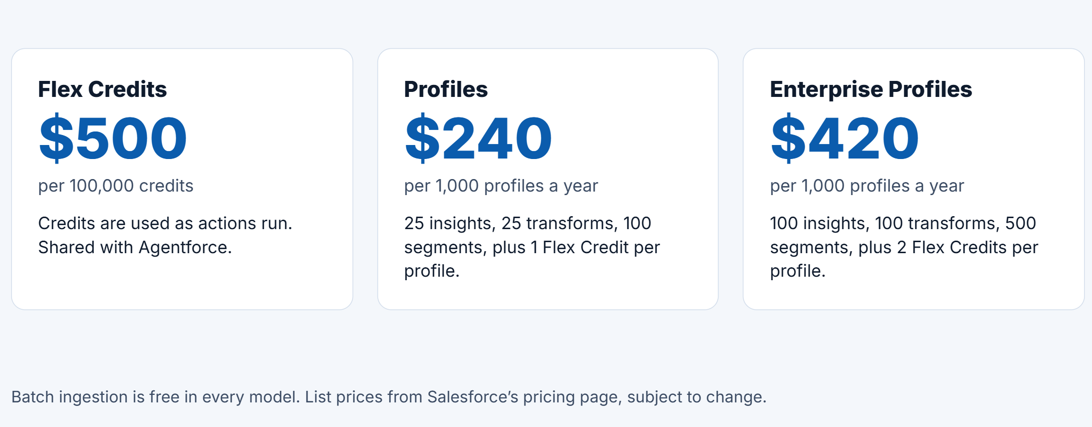
Salesforce overhauled Data 360 (formerly Data Cloud) pricing on March 2, 2026, adding a choice between pay-as-you-go Flex Credits and flat Profile-Based Pricing. Batch data ingestion and zero-copy integrations are free in every model.
Flex Credits (Consumption-Based Model)
Salesforce Flex Credits are a consumption-based, per-action pricing model for Data 360 and Agentforce that costs $500 per 100,000 credits, which values each credit at $0.005. Each time you run an action, credits are deducted, so your bill follows your usage.
Payment options: pre-purchase, pay-as-you-go, and pre-commit.
Shared credits: can move between Data 360 and Agentforce.
What you pay for: actions such as unstructured data processing, unification, segmentation, queries, and streaming.
Best for: varied or growing workloads where you want to pay only for what runs.
Profile-Based Pricing (Flat Rate per Profile)
Salesforce Profile-Based Pricing is a flat-rate model for Data 360 that starts at $240 per 1,000 profiles per year, which works out to $0.24 per profile. The actions that build those profiles are included in the price, so the bill is easier to predict. It comes in two tiers:
Profiles: $240 per 1,000 profiles per year
Up to 25 calculated insights, 25 transforms, and 100 segments
1 Flex Credit per profile per year
Enterprise Profiles: $420 per, 1000 profiles per year (0.42 per profile)
Up to 100 calculated insights, 100 transforms, and 500 segments
2 Flex Credits per profile per year, plus access to data masking and ad audience add-ons
What still uses Flex Credits: queries and unstructured data processing for AI agents.
Best for: steady marketing journeys or proactive service built on unified profiles
Need a full cost picture before you choose a model? See our breakdown of Salesforce Data 360 pricing and implementation costs.
What to Update in Your Roadmap Now That Data Cloud Is Data 360
The shift from Data Cloud to Data 360 doesn't mean you need to rebuild your existing Salesforce setup. It gives you a reason to look at what's already working and where you can do more with your data.
Before your next planning cycle, revisit these four areas:
Your current use cases: Are you using unified customer data only for marketing campaigns, or are sales and service teams benefiting from it too?
Your data architecture: Could supported Zero Copy integrations give you access to external data without creating unnecessary copies?
Your AI plans: Do your planned Agentforce use cases have access to the right customer information, with the necessary permissions and context?
Your budget: Do your current Data 360 pricing assumptions match your expected usage, integrations, and upcoming AI workloads?
The goal isn't to change everything at once. Identify the gaps in your current setup, prioritize the opportunities that matter to your business, and update your roadmap accordingly.
Conclusion: What Matters Most in Salesforce Data 360 vs CDP
Salesforce Data 360 (formerly Data Cloud) is the same product line as the old Salesforce CDP, but the gap between them is bigger than a name change. The move from Salesforce CDP to Data Cloud was the real expansion, taking the product from a marketing tool to a data layer for every Salesforce team.
The move from Data Cloud to Data 360 in October 2025 was mostly a rename, with real additions such as Intelligent Context and Tableau Semantics, plus a new role as the data layer for Agentforce.
What to take away:
Scope: if your plans still treat this as a campaign tool, they are out of date.
Names: update “CDP” and “Data Cloud” in your roadmap, contracts, and vendor quotes.
Pricing: since March 2026, you can choose between Flex Credits and Profile-Based Pricing, and nothing forces you to switch.
Whether you’re weighing Salesforce CDP vs Data Cloud or Data Cloud vs Data 360, the next step is the same: check where your setup stands and plan the update before your next renewal.
Not sure where your Data 360 roadmap stands? Talk to our Salesforce Consultant and get a clear, practical plan.
Frequently Asked Questions
-
Yes, and it does more than a traditional CDP. It handles the core CDP jobs: it ingests, unifies, segments, and activates customer data across Salesforce clouds. Unlike the old marketing-only CDP, the same profiles also serve all Customer 360 products, including sales, service, commerce, and AI agents.
-
Yes, it’s the same product with a new name. Salesforce renamed Data Cloud to Data 360 in October 2025 and placed it under Agentforce 360. The underlying capabilities are the same, and existing Data Cloud agreements and pricing are honored through the end of the current term. You’ll mostly notice the change in documentation and product pages.
-
Because every Salesforce team can work from the same customer profile. Data 360 works with all Customer 360 products and sends data into multiple clouds, so marketing, sales, and service stop working from separate records. It can also start real-time Salesforce automations when data changes, which is harder to do with a standalone tool.
-
A traditional CDP serves marketing, while Data 360 makes the same profiles available to sales, service, commerce, analytics, and AI agents. It now sits under Agentforce 360 as the data layer that gives agents context.
-
Yes. Salesforce says you can connect and centralize data from any source, using free batch ingestion and zero-copy integrations. Which approach fits depends on the source and how your data is set up.
-
Through Intelligent Context, which turns documents into information that agents can use. It converts unstructured content such as PDFs, tables, images, and flowcharts into structured data and builds a secure search index for agents. This work still uses Flex Credits, since unstructured data processing is billed as usage, even on profile pricing.
Related Readings

Let's Talk

Drop us a note, we’re happy to take the conversation forward 👇🏻