
10 Salesforce Winter 27 Updates Everyone Needs to Know
Key Takeaways:
Salesforce Winter ’27 is here, and these are the updates that deserve your attention.
Agentforce, Marketing Cloud, Data 360, and developer tools get major new AI capabilities.
Updates will roll out gradually, so review availability and prepare your teams before features reach your org.
Winter 27 is here, and just like every year, Salesforce has dropped another massive release and this time, AI agents aren't a side feature anymore. They're running campaigns, booking appointments, and building your data models.
If you're someone who can't go through 1,000 pages of release notes or hundreds of scattered news updates and blog posts, you're in the right place. Today, we'll walk through the 10 Salesforce Winter '27 updates that actually matter for you, no fluff, no filler, just the features worth knowing about before your next release call.
#1. Create Salesforce Scheduler Agents in the New Agentforce Builder
Earlier, booking appointments meant either a human picking up the phone or a boring self-service widget put on a website. But this year’s Winter release update changes that entirely. Now, Agentforce Builder lets you create dedicated Scheduler agents, AI agents that can handle the entire appointment-booking conversation on their own, end to end.
But the thing that makes this a useful update in today's world is: the agent now checks a partner's connected external calendar before confirming a slot. So if a sales rep, advisor, or field technician has a meeting set in their personal Outlook or Google Calendar that Salesforce doesn't know about, the agent won't double-book them. That's a small detail, but it's the difference between a scheduling agent people actually trust and one that creates more cleanup work than it saves.
Why it matters: This is a good early signal of where Agentforce Builder is headed, that is less "chatbot that answers FAQs," and more "agent that owns an entire operational workflow" like scheduling, with real guardrails built in.
#2. Agentforce Platform Enabled by Default
Here's a quiet but significant shift: starting Winter '27, Agentforce is on by default for Foundations (Enterprise, Performance, Unlimited, Developer) and Agentforce 1 Edition, new orgs get it automatically at creation, and existing orgs get it rolled out over time. And Salesforce confirms it costs nothing extra.
The change is currently in preview, and the Agentforce toggle will eventually be removed from Setup entirely. But admins aren't losing control, you can still disable the platform via the Einstein Setup page, or activate/deactivate individual agents in Builder.
Why it matters: Salesforce is treating agentic AI as core infrastructure, not an opt-in module. With this update it's obvious to expect more orgs experimenting with agents simply because the door is already open.
#3. Easily Compare and Merge Agent Versions in Agentforce Builder
Building agents used to mean rebuilding from scratch every time you wanted to test a change. But with the version comparison and merging inside Agentforce Builder. Admins can now pull up two versions of an agent side-by-side, in either Canvas or Script view, see exactly what changed, and selectively merge specific updates instead of overwriting the whole agent.
This is the kind of quality-of-life feature that matters once you're managing agents at scale: multiple team members iterating on the same agent, testing prompt tweaks, or rolling back a change that broke something, without losing unrelated work in the process.
Why it matters: As orgs move from "one pilot agent" to "dozens of agents across teams," version control stops being a nice-to-have and becomes essential. This brings Agentforce Builder a step closer to how developers already work with code.
#4. Run Self-Optimizing Campaigns with Agentforce Marketing Goals Agent
Manual campaign orchestration, picking the right channel, content, and send time for each customer, has always been a lot of guesswork dressed up as strategy. The Agentforce Marketing Goals Agent takes that decision off your plate. All you have to do is set a goal, and the agent selects the right campaign, channel, content, and timing for each individual customer automatically.
You're not handing over the keys blindly, though. Marketers get full visibility into what the agent is doing and can define exactly how much it handles autonomously versus what stays under manual control. Pair it with the beta Adaptive Campaign Audiences feature, and the agent can even decide which campaign wins when a customer qualifies for multiple at once.
Why it matters: This moves campaign management from "marketer configures rules" to "marketer sets goals and agent executes" a real step toward autonomous, always-optimizing marketing.
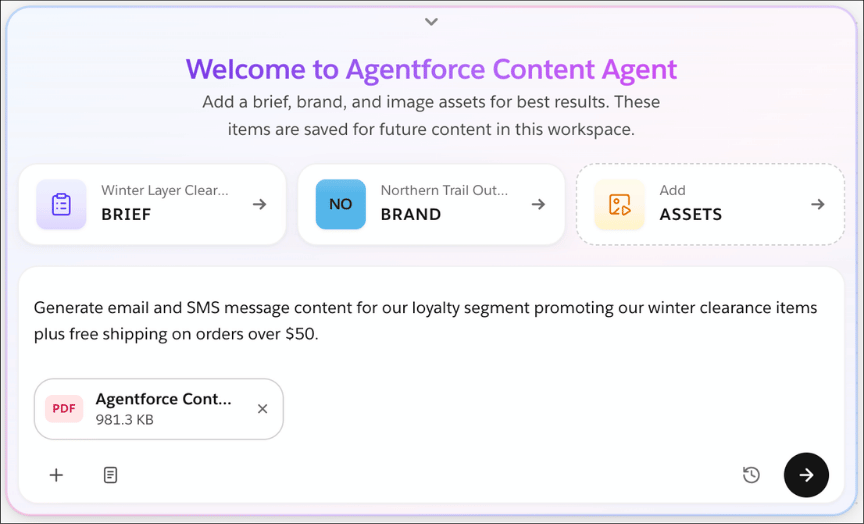
#5. Create Campaign-Ready Content Faster with Agentforce Content Agent
Content creation is usually the bottleneck in any campaign, briefs get passed around, drafts go back and forth, and brand consistency slips somewhere along the way.
Agentforce Content Agent compresses that into a single collaborative workspace. Describe your campaign in a prompt, and it generates on-brand copy and images for email, SMS, and RCS, grounded in your actual marketing briefs, customer data, and brand guidelines.
You have complete control over refinement, as nothing goes live without a human reviewing and approving it first, and finished content publishes straight to Salesforce CMS, ready to plug into campaigns run by the Marketing Goals Agent.
#6. Turn Marketing Leads into Qualified Sales Pipeline with the Buyer Engagement Agent
Lead handoffs between marketing and sales tend to lose some value due to situations where leads sit in a queue, follow-up is inconsistent, and by the time someone reaches out, interest has cooled. The Buyer Engagement Agent closes that gap by handling inbound lead generation and high-volume outbound nurturing automatically, across your marketing channels.
It doesn't just send templated emails. The agent runs two-way conversations, replying to web chat, qualifying leads, and booking meetings, all tied to your existing campaigns and brand kit, so sales and marketing work off one shared view of every buyer instead of two disconnected systems.
#7. Equip Your AI Coding Agent with Salesforce Skills (AI Skills)
Salesforce is now shipping its own best-practice knowledge as an installable skills package for AI coding tools. The sf-skills repository gives your AI coding agent: Claude Code, Codex, or any compatible CLI, real expertise in Lightning Web Components, Flow, and Apex, so it follows actual Salesforce patterns instead of generic coding advice.
Setup is a one-line install: npx skills add forcedotcom/sf-skills in Claude Code or Codex. Inside Agentforce Vibes (Salesforce's own coding tool), skills are installed and kept updated automatically with no setup required.
Why it matters: This is Salesforce packaging its own platform expertise for AI coding agents to consume directly, instead of leaving them to guess Salesforce-specific patterns from general training data.
# 8. Create a Messaging Channel with a Headless Claude Skill
Setting up a new messaging channel; Facebook, WhatsApp, LINE, or Apple Messages for Business, used to mean juggling multiple apps, APIs, and routing configs, easily eating 15+ minutes of context-switching. Winter '27 replaces that with a Claude skill. Run service_de_headless_channel_configure in a supported AI coding environment, answer a few prompts about which channel you need, and it configures the entire setup; APIs, routing, and all for you.
It's a small but telling detail: Salesforce is now shipping admin workflows as AI coding skills instead of just UI wizards, meant to run inside tools developers already use.
# 9. Build a Segment by Describing It with the Data 360 Marketing Agent
Building audience segments has always meant knowing exactly which filters, fields, and nested logic to click together, a skill most marketers never fully master, so it usually falls on ops or data teams. Winter '27 removes that translation step.
All you need to do is describe an audience in plain language, and the Data 360 Marketing Agent builds the matching filter criteria for you including standard and nested segments, and filters based on calculated insights.
It works inline, too: open an existing segment on the canvas, describe what you want to add, and the agent adjusts filters directly rather than making you start over.
# 10. Measure Retrieval-Augmented Generation (RAG) Effectiveness with Advanced Retriever Metrics
If you've built an agent that pulls answers from your own documents and data, you've probably had this moment: the retrieved context looks fine, but you have no real way to know if it's actually good.
Data 360's Retriever Playground now includes a context precision score to fix that. Test a retriever with a question and a reference answer in Advanced Mode, and it scores how well the retriever ranks relevant chunks above irrelevant ones plus other metrics like response time and the actual retrieved chunks.
Wrapping Up
That's the list, 10 updates out of hundreds, but the ones actually worth your attention before your next release call. If there's one thread running through all of them, it's this: Agentforce isn't a bolt-on feature anymore. It's showing up inside scheduling, campaigns, lead nurturing, data setup, and even the tools developers use to build on Salesforce itself.
You don't need to roll all of this out on day one. Start with whatever's already breaking in your workflow.
Winter 27 is rolling out on a staggered schedule, so if a feature mentioned here isn't in your org yet, it's likely just a matter of time. Keep an eye on your release notes, or better yet, bookmark this post and come back when it's your turn.
More Salesforce Updates You Should Know
Dreamforce 2026 Announcement: AIforce, Claudeforce, Koa & AI Updates Dreamforce 2026 Day 2: Main Highlights
What's New in Salesforce 2026: Summer, Spring & Winter Releases
AIforce: Salesforce's Big Dreamforce 2026 Announcement
Top 10 Reasons Agentforce Packages Fail Security Review
Agentforce Headless Agents: The Enterprise Architect's Guide
Salesforce Agentforce: A complete guide
Frequently Asked Questions
-
Most Winter '27 features are generally listed under an October 2026 rollout, though Salesforce ships many Agentforce, Marketing Cloud, and Data 360 features on a rolling basis in the weeks.
-
It depends on the feature. Some, like Agentforce being enabled by default, require no setup at all. Others, like Scheduler Agents or the Data 360 MCP Server, do require an admin to configure them. Each Salesforce release note includes a "How" section explaining exactly what setup is needed.
-
Most of these updates require specific editions or add-ons, commonly Enterprise or Unlimited edition, often paired with the Salesforce Foundations add-on or Agentforce 1 Edition. Availability varies feature by feature, so it's worth confirming against your org's current edition before assuming a feature is accessible to you.
-
The complete official Salesforce Winter 27 release notes are published by Salesforce to cover every product area including Agentforce, Marketing Cloud, Data 360, Sales, and Service, in complete detail.
Related Readings
Let’s Talk

Drop us a note, we’re happy to take the conversation forward 👇🏻