
Key takeaways:
Compare cost per resolved call. Call centers and AI both carry hidden costs, so the fairest ROI view includes setup, integration, QA, tuning, and escalations.
AI voice agents tend to win on cost, speed, and consistency for high-volume calls, while human teams win on complexity, empathy, and judgment.
A hybrid approach gives the best ROI. Let AI resolve routine calls, hand complex ones to humans, and test on your most repetitive call type.
Delivering exceptional customer service while keeping operational costs under control is a growing challenge for businesses. Traditionally, offshore call centers have been the go-to solution for managing high call volumes and providing round-the-clock support. However, the rise of AI voice agents is transforming how companies handle customer interactions, offering a new approach to balancing cost, efficiency, and service quality.
The real question is not which option is better in general. It is which one delivers better ROI and quality for your specific mix of calls. This guide compares AI voice agents vs. offshore call centers across cost, ROI, quality, speed, scalability, and risk, then shows where each wins and how to combine them.
What Are Offshore Call Centers and AI Voice Agents?
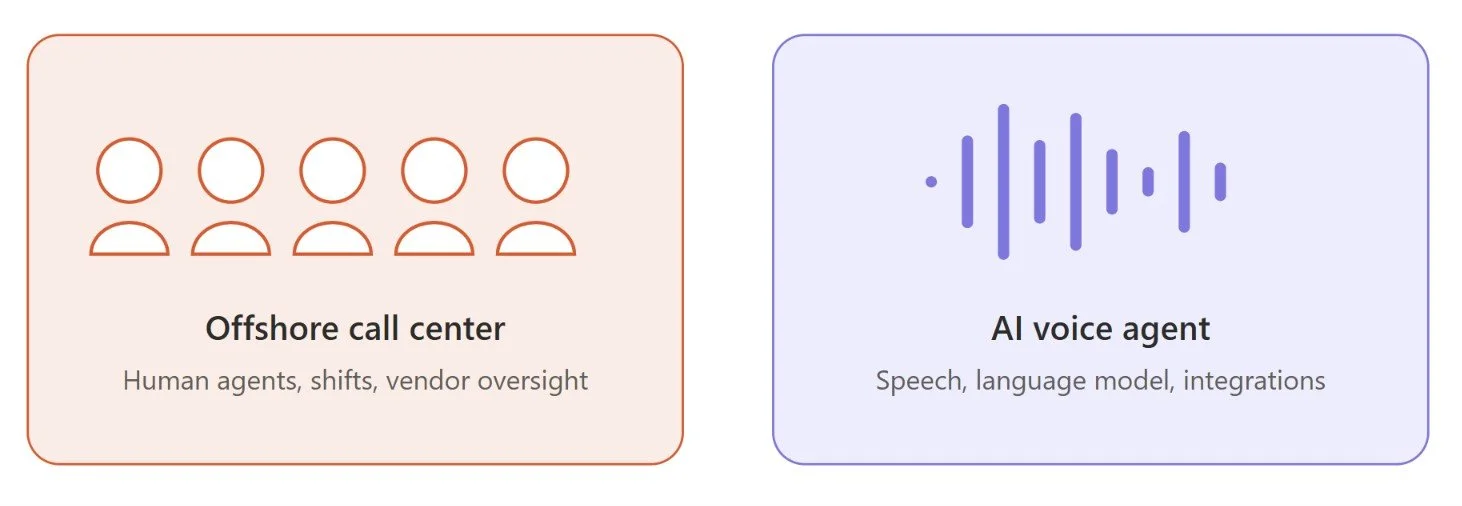
Offshore call centers outsource your phone support to a vendor in a lower-cost country. You get trained human agents, shift coverage, and a management layer, but you also take on vendor oversight, quality assurance, and time-zone coordination.
AI voice agents are software that holds spoken, two-way conversations. They combine speech recognition, a language model, voice synthesis, and integrations with your CRM, help desk, and calendar, so they can understand a request and act on it during the call.
Offshore centers are typically used for broad, ongoing support volume. AI voice agents are typically used for repetitive, well-defined calls such as scheduling, order status, FAQs, and lead qualification, though their scope keeps growing.
Cost Comparison: What You Actually Pay
Offshore call centers usually bill per agent hour, per agent per month, or per call. Pricing in 2026 runs roughly $6 to $16 per hour offshore before setup, QA, and oversight. Per-call pricing is common too, and offshore cost per call can fall to about $1.50 to $2.50, though escalation rates tend to run higher.
AI voice agents usually bill per minute, by subscription or as a custom build. The all-in cost of a production agent could be roughly $0.07 to $0.49 per minute, depending on provider, volume, voice quality, and integrations. Custom builds cost more upfront, and integration work is often a large share of it.
Both sides carry costs that rarely appear in a quote:
| Offshore call center | AI voice agent | |
|---|---|---|
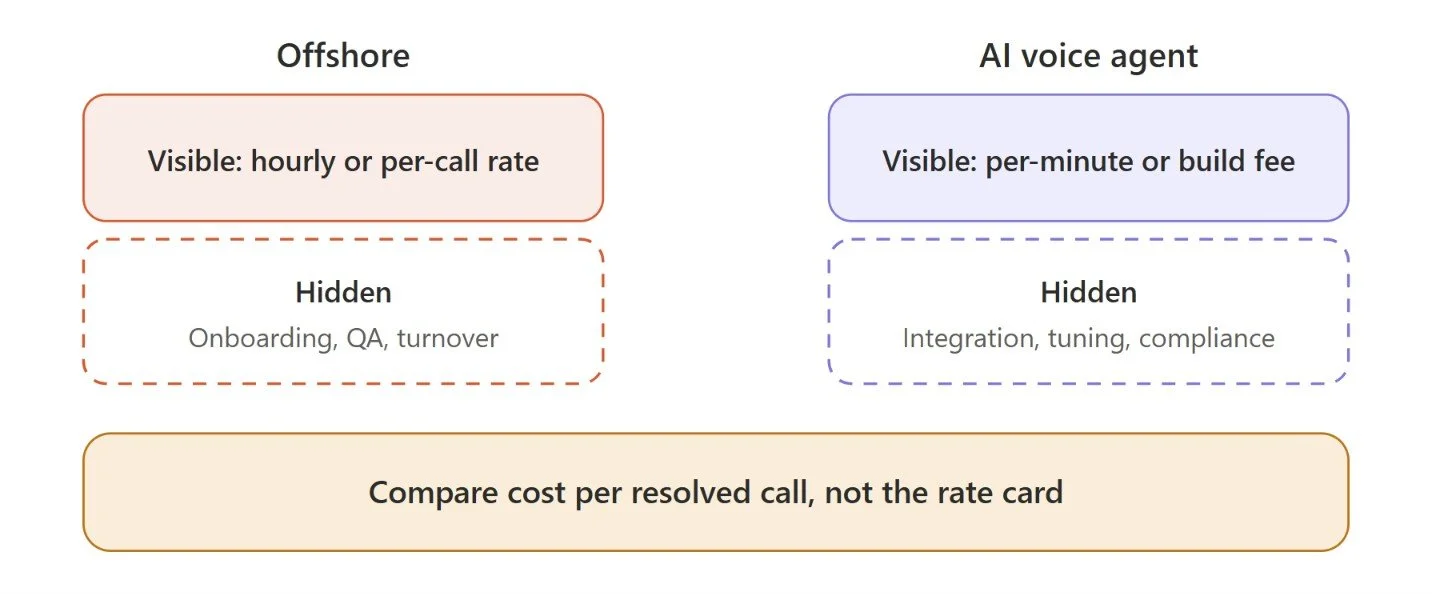
| Visible cost | Hourly, per-agent or per-call rate | Per-minute, subscription or build fee |
| Hidden costs | Onboarding, training, QA, vendor management, turnover | Integration, tuning, monitoring, compliance work |
| Cost behavior as volume grows | Rises roughly with headcount | Rises with usage but at a lower marginal rate |
The fairest comparison is cost per resolved call, not the hourly or per-minute rate. A low rate is expensive if calls are escalated or need a second contact. Accent differences and time-zone gaps can raise escalation rates and lower first-call resolution, which pushes up your effective cost per resolved interaction. Treat all published figures as rough guides and get quotes based on your own volume.
ROI Comparison: Total Cost of Ownership vs. Business Value
When comparing the ROI of AI voice agents vs. a call center, it is about more than just comparing the rate card. Here are a few things to look at:
Setup and ramp-up: An offshore call center means recruiting, training, and a ramp period. AI agent means integration, conversation design, and testing.
Operating cost as volume grows: An offshore call center scales roughly linearly with agents. AI voice agent scales with usage, so extra calls cost less at the margin.
Break-even timeline: AI agent usually has a higher upfront effort and a lower running cost, so payback depends on call volume.
Revenue impact: Fewer missed calls, faster lead response, and better follow-up add value that a pure cost comparison misses.
A simple formula works for either option:
Monthly net benefit = (current monthly cost + value of recovered revenue) - (new monthly cost). Payback period = one-time setup cost ÷ monthly net benefit.
A worked example (illustrative assumptions, not benchmarks): a business handles 10,000 calls a month at an average of five minutes, with an all-in offshore cost of $2.50 per call, or $25,000 a month. Suppose an AI voice agent handles 60% of calls at $0.25 per minute, or about $1.25 per call, and the remaining 40% stay offshore.
AI-handled calls: 6,000 × $1.25 = $7,500
Offshore calls: 4,000 × $2.50 = $10,000
New monthly cost: $17,500, a saving of $7,500 per month
With a one-time setup of $15,000, payback is about two months
Change the assumptions to match your own volume, containment rate, and pricing. The point is the method, and that the result depends heavily on how many of your calls are routine enough for AI to resolve.
Quality Comparison: Customer Experience Head-to-Head
| Offshore call center | AI voice agent | |
|---|---|---|
| Consistency | Varies by agent and shift | Same persona and answers on every call |
| Accents and noise | Human agents adapt well, though accent gaps can affect clarity | Improving, but can struggle with strong accents, noise, and specialist terms |
| Empathy and judgment | Strong on sensitive or unusual calls | Limited, so best for routine requests |
| Resolution | Depends on training and scripts | Strong on well-defined tasks with system access |
| Training and turnover | High attrition, with offshore turnover often running 30 to 40 percent | No turnover, but needs ongoing tuning |
| Brand control | Depends on coaching and QA | Controlled through persona, approved content, and guardrails |
Neither option wins on every dimension. Human call center agents handle nuance and emotion better. AI delivers a level of consistency that is hard to maintain across a large, changing workforce. Quality depends on the call type as much as the channel.
Learn more: How to Measure AI Voice Agent Quality Beyond CSAT and Call Duration
Speed and Availability
24/7 coverage. Offshore centers can staff around the clock, but night shifts add cost. An AI agent answers at any hour at the same rate and reduces the high call abandonment rate.
Peak-hour spikes. Human call center agents need forecasting and overflow plans. AI agents can handle many calls at once.
Time to launch. Call centers require recruiting, training, and ramp-up. A focused AI pilot can go live in weeks, though custom integrations take longer.
Scaling up and down. Adding or removing offshore agents takes time and often contract changes. AI capacity follows demand.
Scalability and Flexibility
Offshore contracts often include minimum volumes or notice periods, which makes seasonal swings costly. AI usage-based pricing flexes more naturally with demand.
Changing scripts, policies, or products is also different. With a human team, every update has to be trained into each agent. With an AI agent, you update the approved content and flows once, then test. Adding a new language or call type is similarly easier with AI, though accuracy still needs testing on real callers.
Risk, Security and Compliance
Both AI voice agents and offshore call centers carry real risks that belong in the comparison.
Data privacy and cross-border handling. Offshore centers move customer data across borders, so contracts, access controls, and monitoring matter. AI platforms raise their own questions about where call data is stored and who can access it.
Consent, recording, and AI disclosure. Callers should be told when they are speaking with an AI, and AI disclosure rules are now in force in many regions. Recording and consent rules also vary by location.
Quality control and fraud. Outsourced staff need ongoing monitoring and access limits. AI needs guardrails to prevent off-script answers and unauthorized actions.
Vendor dependency. Both options create reliance on a provider, so plan for continuity, exit terms, and data portability.
Regulated industries such as healthcare and finance carry extra obligations on either path, so involve legal and compliance teams early.
Where Offshore Call Centers Still Win
Human teams remain the better choice when calls involve:
Emotionally sensitive or high-stakes conversations, such as complaints or collections disputes
Complex, multi-step problem-solving that needs judgment and flexibility
Relationship-driven sales and negotiation
Unusual situations that don't fit a defined flow
Where AI Voice Agents Win
AI voice agents are strongest when you have:
High-volume, repetitive requests with clear answers
After-hours and overflow coverage without paying for night shifts
Scheduling, lead qualification, and order status calls that connect to your systems
Consistent brand voice at scale, regardless of volume
Data capture from every call, including transcripts, intent, and outcomes
The Hybrid Approach: Combining Both
For most businesses, the best answer is not either/or. A hybrid model lets AI handle the routine work and keeps human agents for the calls that need them.
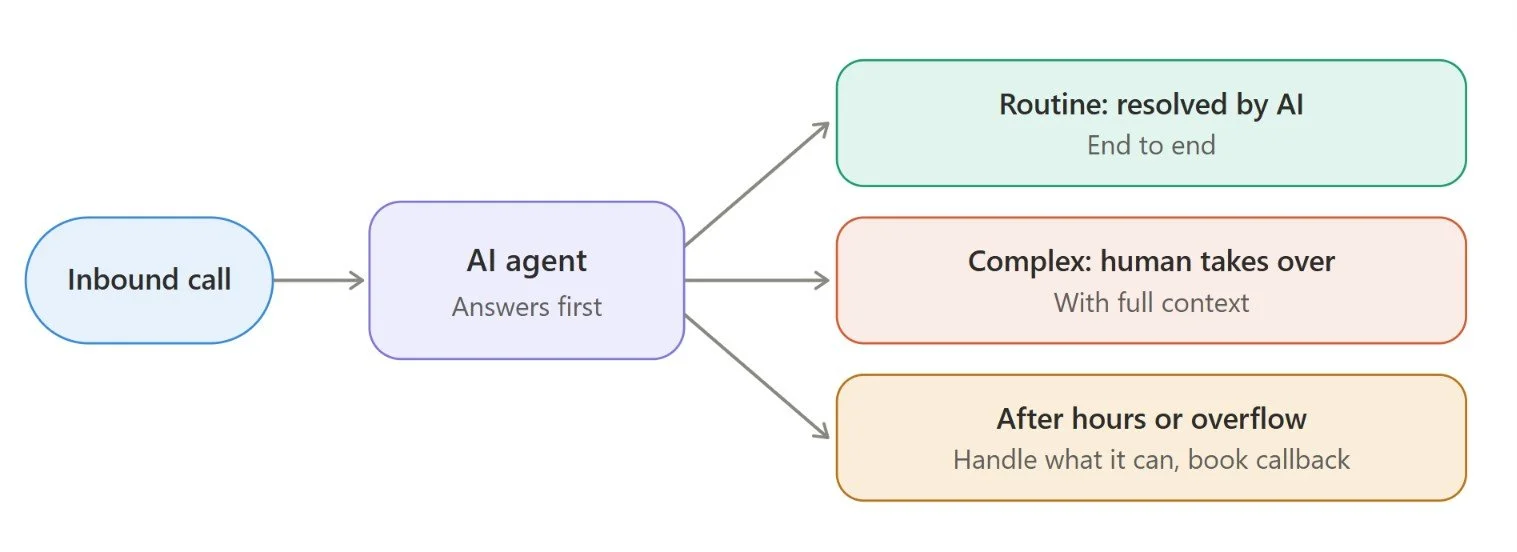
Example routing logic:
If the request is routine and the agent has the data to resolve it, it handles the call end to end.
If the request is complex, emotional, or out of scope, the agent transfers to a human agent with the full conversation context.
If it is outside business hours or during an overflow spike, the agent handles what it can and schedules a callback for the rest.
This reduces offshore volume without cutting service quality, and it makes the human team more effective, since they focus on the work where they add the most value. Smooth handoff is critical: callers should never have to repeat themselves.
How to Decide What to Choose: A Practical Framework
Analyze your call mix. Break down your calls by type, volume, and complexity. The share of routine calls is the biggest driver of potential AI savings.
Score each option. Rate the offshore call center, AI voice agent, and hybrid on cost, quality, speed, risk, and scalability, weighting the factors that matter most to your business.
Run a pilot. Test AI on your most repetitive call type before committing to a platform or changing a contract. AI voice agent development services can help with the integration, conversation design, and testing.
Ask the right questions. Ask offshore vendors about attrition, QA, data handling, and contract flexibility. Ask AI providers about latency, accuracy on your callers, integrations, compliance support, and human handoff.
Final Thoughts
AI voice agents and offshore call centers are not direct substitutes. AI tends to win on cost, speed, consistency, and availability for routine, high-volume calls. Human teams win on complexity, empathy, and judgment. The best ROI usually comes from matching each call type to the right channel, often with a hybrid model.
Start by auditing your call mix, then pilot AI on your most repetitive call type. Measure cost per resolved call and customer satisfaction against your baseline, and expand only where the results hold up.
Want to bring AI voice agents into your customer support operations? Hire our AI voice agent developers and consultants to help you build intelligent, scalable voice solutions tailored to your workflows. Contact our team today to explore how.
Frequently Asked Questions
-
AI voice agents can be more cost-effective for high-volume, repetitive calls because they reduce dependence on human staffing and can operate around the clock. Offshore call centers may have lower hourly labor costs than domestic teams, but expenses such as training, supervision, turnover, and quality assurance add to the total cost.
-
Not in every situation. AI voice agents can automate many routine interactions, including appointment scheduling, lead qualification, reminders, and basic customer support. However, complex complaints, sensitive discussions, and exceptions may still require human agents. Many businesses achieve better results by automating routine calls and routing complex cases to trained human representatives.
-
Neither option guarantees higher customer satisfaction. AI voice agents may improve satisfaction by reducing wait times and resolving simple issues quickly. Offshore human agents may perform better when customers need reassurance, nuanced explanations, or personalized problem-solving. Businesses should measure customer satisfaction scores, first-contact resolution, repeat-call rates, and escalation rates before deciding.
-
It depends on scope. A focused AI voice agent can go live in a few weeks, while custom integrations take longer. Most teams phase the move, starting with one call type and shifting volume gradually as results prove out.
-
Usually yes. AI resolves routine calls and handles after-hours coverage, while humans take complex or sensitive ones. This reduces offshore volume without cutting service quality, as long as handoffs pass full context so callers never repeat themselves.
Related Readings
Let's Talk

Drop us a note, we’re happy to take the conversation forward 👇🏻