
Key Takeaways:
Certification isn’t proof of experience. Before you hire a Salesforce Data 360 consultant, look for hands-on work in identity resolution, data ingestion, and Agentforce data readiness.
The consultant’s fee is only part of the cost. Data 360 pricing also depends on credit consumption, and the right expert helps you keep it under control. See what really drives the budget.
Match the expert to your project stage. An independent consultant, an in-house team, or a consulting partner each fits a different need. Learn which one suits yours, and which red flags to avoid.
Buying Salesforce Data 360 is the easy part. Making it work is where most projects succeed or stall.
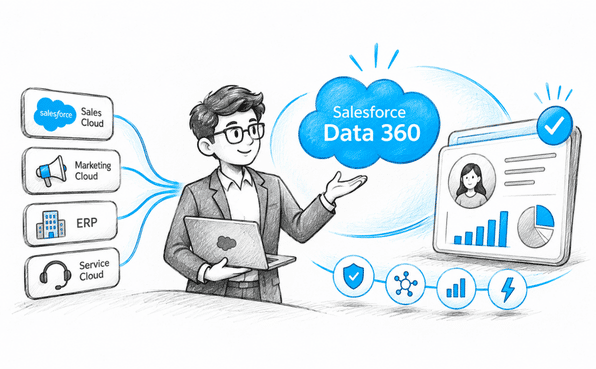
Salesforce Data 360 (formerly Salesforce Data Cloud) promises one connected view of every customer. But your data still lives in Sales Cloud, Marketing Cloud, your ERP, and your support desk. Without the right expert, a Salesforce Data Cloud implementation can quickly turn into duplicate profiles, messy data, and a platform no one trusts.
That is why businesses hire a Salesforce Data 360 consultant, an expert who can lead customer data unification across every system.
A skilled Salesforce Data Cloud consultant handles data ingestion, data harmonization, and identity resolution to build unified customer profiles your teams can rely on. They also set up data governance, calculated insights, data segmentation, and data activation, ensuring Agentforce data readiness so your AI agents work from accurate, connected information instead of guesswork.
The right consultant also helps you control Data 360 pricing, use Zero Copy integration with your existing data warehouse, and get value faster.
So how do you find the right Salesforce Data 360 implementation partner? This guide covers the key skills to look for, the questions to ask, the red flags to avoid, and how to choose the right Salesforce Data 360 consultant for your business.
What a Salesforce Data 360 Consultant Actually Solves
A Salesforce Data 360 consultant helps businesses tackle data fragmentation, identity resolution gaps, data integration complexity, and the lack of reliable data context needed to power AI and connected customer experiences.
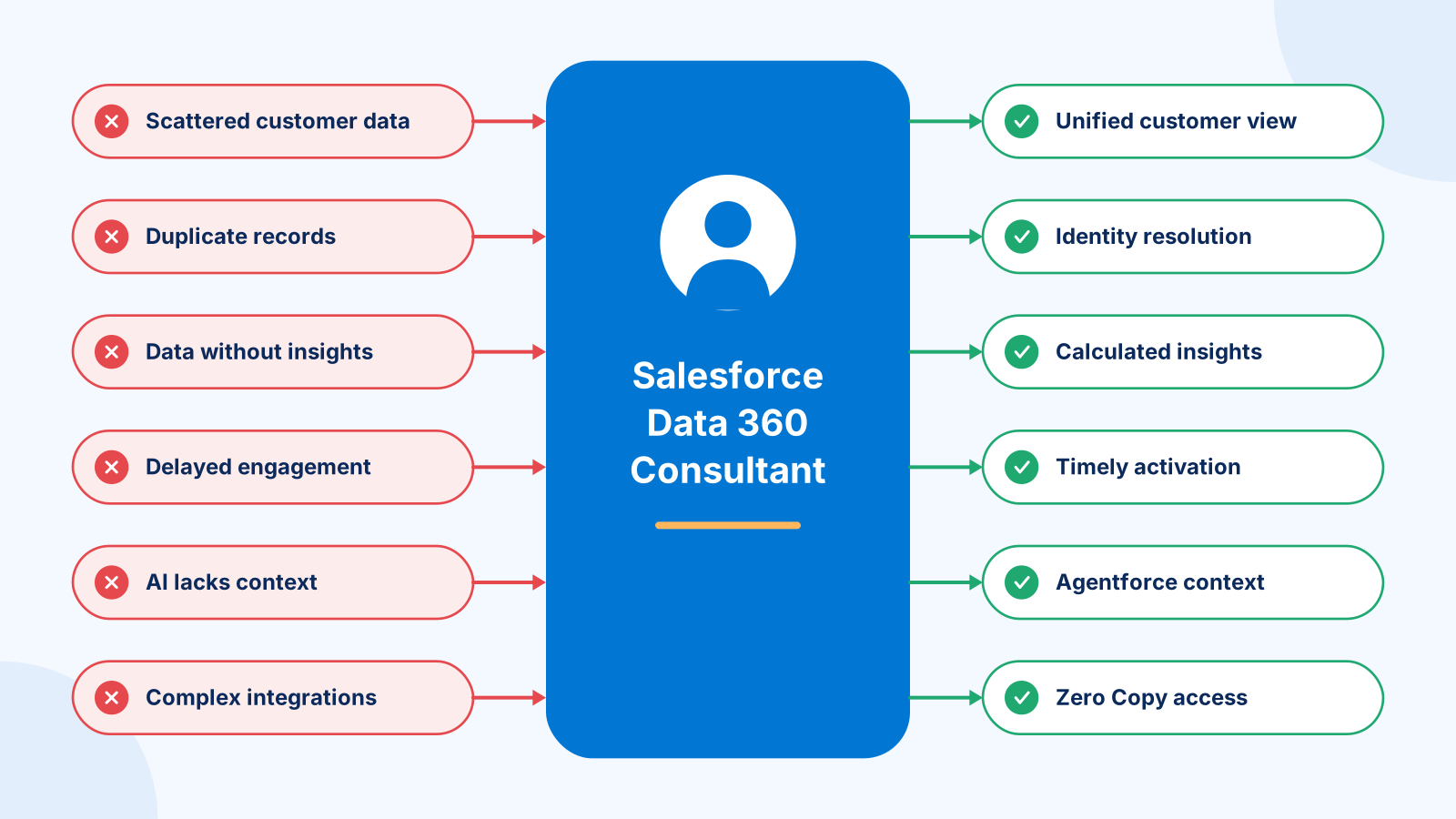
Let's look at the major challenges they solve and how they help businesses overcome them.
| Business Challenge | The Problem | How a Consultant Solves It |
|---|---|---|
| Scattered Customer Data | Customer data is spread across multiple platforms. | Connects data sources to build a unified customer view |
| Duplicate Customer Records | The same customer appears in multiple inconsistent profiles. | Uses identity resolution to match and unify customer records. |
| Data Without Insights | Raw data offers little value without meaningful insights. | Creates calculated insights and segments to turn data into actionable intelligence. |
| Delayed Customer Engagement | Teams struggle to respond to customer behavior in time. | Enables timely data processing and activation across supported channels. |
| AI Agents Lacking Context | AI agents lack the customer data needed for relevant actions. | Connects trusted customer data with Agentforce for contextual interactions. |
| Complex Integrations | Integrations create extra pipelines and data duplication. | A Salesforce Data 360 integration consultant simplifies data access using connectors and Zero Copy where supported |
Data 360 only delivers value when your data is unified, trusted, and ready for action. A consultant makes your Salesforce Data Cloud implementation faster, without the rework, duplicate records, or stalled projects.
Key Skills to Look for in a Salesforce Data 360 Consultant
A strong Salesforce Data 360 consultant (formerly Salesforce Data Cloud) brings together data architecture, business strategy, and AI expertise.
Beyond knowing the platform, they should understand how your business data connects, how it supports decision-making, and how it creates the foundation for Agentforce.
Here are the five core Salesforce Data 360 consultant skills to evaluate when hiring or assessing a consultant.
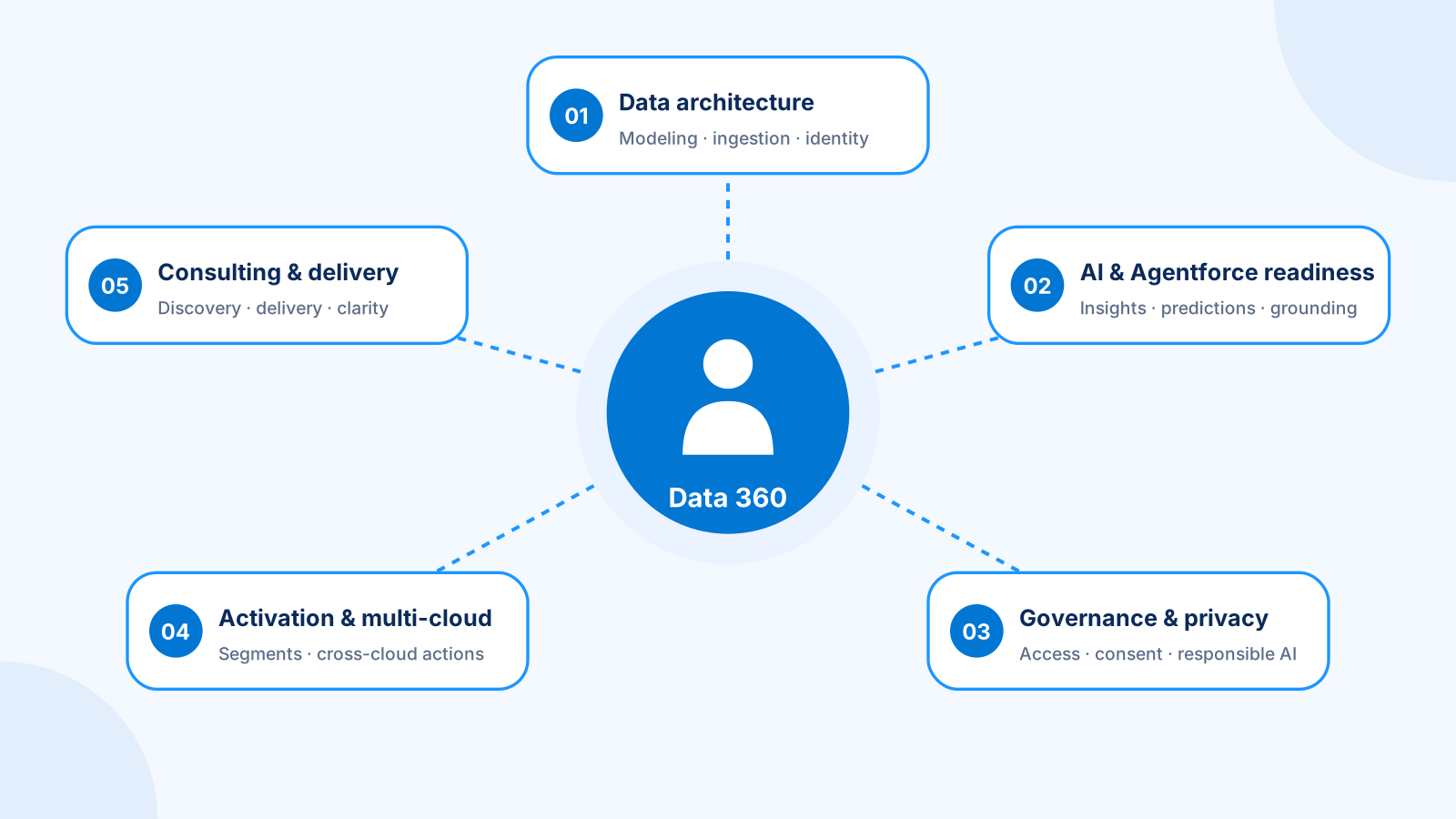
01. Data Architecture, Modeling, and Harmonization
A reliable data foundation starts with the right architecture. Your consultant should know how to connect, structure, clean, and unify data across systems to create accurate, usable customer profiles.
Data 360 data model: Understand data objects, data spaces, and data kits, and how to structure them around business requirements.
Data ingestion and integration: Connect batch and streaming sources through connectors, APIs, SDKs, and Zero Copy, selecting the right approach for each data source.
Identity resolution: Configure and troubleshoot match and reconciliation rules to unify customer records without incorrect matches or unresolved duplicates.
Data transformation: Build batch and streaming transformations that turn raw data into structured, consistent, and usable information.
02. AI, Analytics, and Agentforce Readiness
Data becomes more valuable when it can support intelligent decisions and actions. A Data 360 consultant for Agentforce should understand how to provide trusted customer context to Agentforce and other AI capabilities.
They should also be comfortable building calculated insights, predictive insights, and data enrichments, while understanding analytics capabilities such as Tableau Next to turn unified data into actionable business insights.
03. Governance, Privacy, and Responsible Data Use
Customer data requires careful management, especially when it's used across teams, channels, and AI-powered workflows. A consultant should incorporate governance and privacy requirements from the start.
Access controls: Configure permission sets, access restrictions, and appropriate data access.
Consent management: Ensure customer preferences and consent requirements are respected across data use and activation.
Data governance: Establish policies for data quality, privacy, compliance, and responsible usage.
Responsible AI: Understand ethical data usage, communication capping, and safeguards for AI-driven interactions.
04. Activation and Multi-Cloud Strategy
Unified customer data should reach the teams and platforms that need it. A Data 360 consultant should know how to turn unified profiles and insights into targeted actions across the Salesforce ecosystem.
Segmentation: Build dynamic segments based on customer attributes, behaviors, and insights.
Data activation: Publish and deliver segments and insights to Marketing Cloud, Sales Cloud, Service Cloud, and supported external channels.
Cross-cloud integration: Understand how Data 360 connects with Salesforce clouds, including Commerce, to support connected customer experiences.
05. Consulting and Communication Skills
Technical expertise alone doesn't make a successful consultant. They must translate business objectives into practical solutions, guide stakeholders, and manage implementation from planning through deployment.
Business discovery: Identify business challenges, gather requirements, and translate them into clear user stories.
Project delivery: Manage the Data 360 implementation lifecycle, from discovery and configuration to testing, deployment, and monitoring.
Stakeholder communication: Explain technical decisions, implementation trade-offs, and platform limitations in business-friendly language.
Cost awareness: Understand Data 360 consumption, pricing considerations, and how implementation decisions affect ongoing costs.
Credentials Worth Checking
The Salesforce Certified Data 360 Consultant certification (formerly Data Cloud Consultant) is a useful starting point when evaluating a candidate's platform knowledge.
For broader or more complex implementations, certifications such as Platform Data Architect and Agentforce Specialist can further demonstrate relevant expertise.
However, certifications alone don’t prove Salesforce Data 360 implementation expertise. Hands-on project experience, problem-solving skills, and the ability to work with real business requirements matter just as much.
7 Questions to Ask Before Hiring a Salesforce Data 360 Consultant
Before you hire a Salesforce consultant for Data 360, look beyond certifications and service prices. You need to understand who will handle your implementation, how they will manage your data, and what happens after deployment.
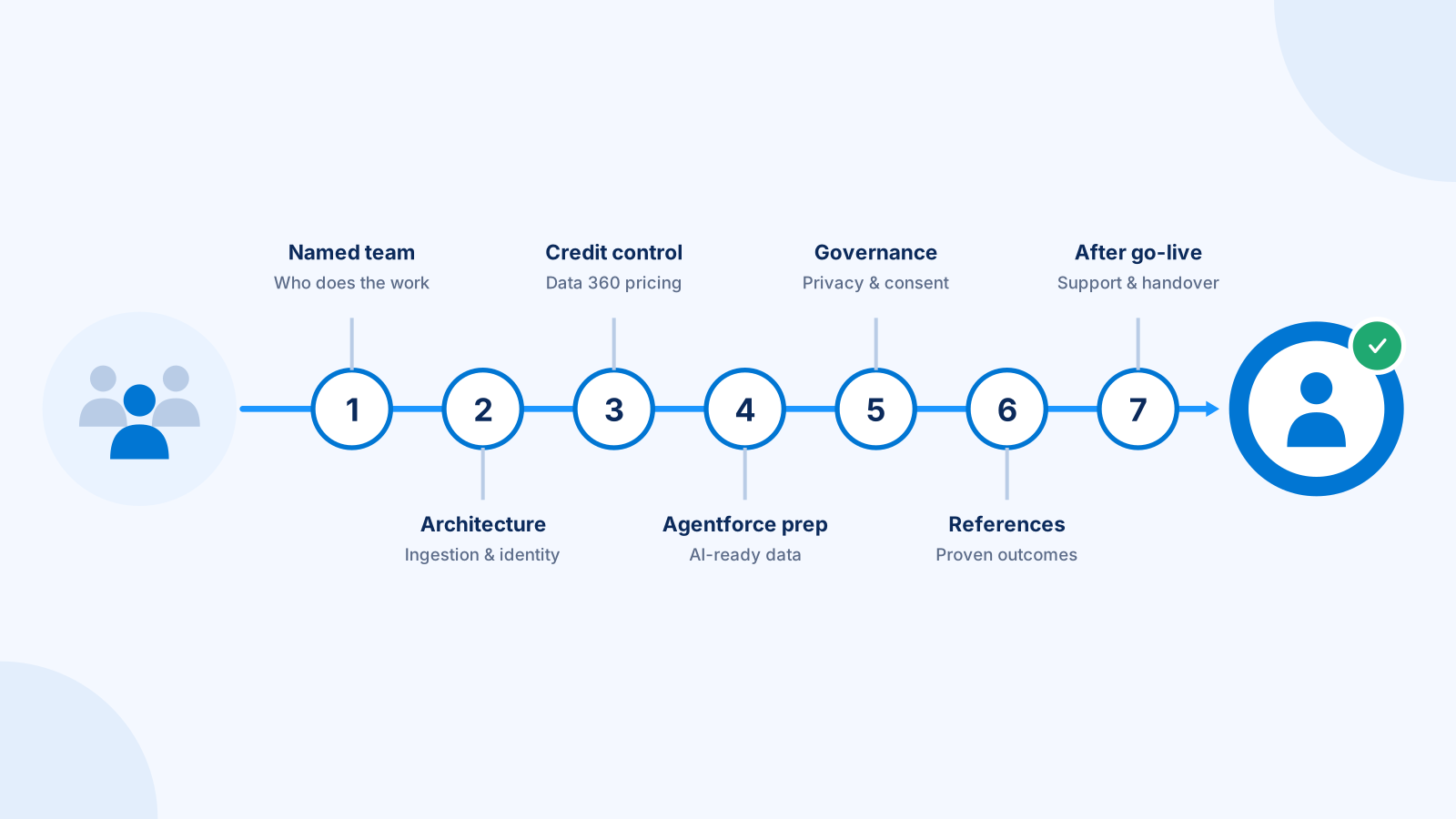
These seven questions can help you evaluate a consultant's technical expertise, cost management, and delivery reliability before signing a contract.
1. Who Will Work on Our Project, and What Data 360 Experience Do They Have?
Ask for the names and roles of the people who will actually handle your implementation. Don't rely only on the consulting firm's overall experience.
Verify their Salesforce certifications and hands-on experience with data ingestion, identity resolution, data modeling, and activation.
Ask whether the assigned team has delivered projects with similar data complexity and business requirements.
2. What's Your Approach to Data Ingestion, Identity Resolution, and Harmonization?
Your implementation depends on how effectively data is collected, matched, and organized across different systems.
Ask how they select between batch ingestion, streaming, APIs, and Zero Copy integration.
Understand how they handle inconsistent records, duplicate profiles, and identity matching across source systems.
3. How Do You Keep Data 360 Credit Consumption and Costs Under Control?
Data 360 pricing (also searched as Salesforce Data Cloud pricing) goes beyond implementation costs. Without proper credit planning, consumption can quickly push your budget off track.
Ask how they forecast Data 360 credit consumption and calculate projected costs.
Check their approach to budget allocation, usage monitoring, and cost optimization.
4. How Can You Make Our Data Ready for Agentforce and Cross-Cloud Activation?
If you plan to use Agentforce or connect Data 360 with other Salesforce products, your consultant should understand how unified data supports these use cases.
Ask how they prepare trusted customer context for Agentforce and relevant AI workflows.
Check how they plan to activate unified data across Marketing Cloud, Sales Cloud, Service Cloud, and other destinations.
5. How Will You Protect Customer Data and Maintain Governance?
Data integration must align with security, privacy, and governance requirements.
Check their approach to data spaces, RBAC, consent management, and compliance.
Ask how they enforce data access policies and protect sensitive information across clouds.
6. Can You Share Relevant Data 360 Projects and Client References?
Request examples of previous implementations and speak with clients to verify project outcomes and delivery experience.
7. What Happens When the Project Scope Changes or Implementation Goes Live?
Clarify how they handle change requests, testing, documentation, knowledge transfer, and post-launch support, including Salesforce managed services.
The best Salesforce Data 360 consultant isn’t the one with the longest list of badges. It’s the one who can turn your business goals into a scalable setup, with the right architecture and integrations, that still delivers value years from now.
Salesforce Data 360 Consultant vs. In-House Team vs. Consulting Partner
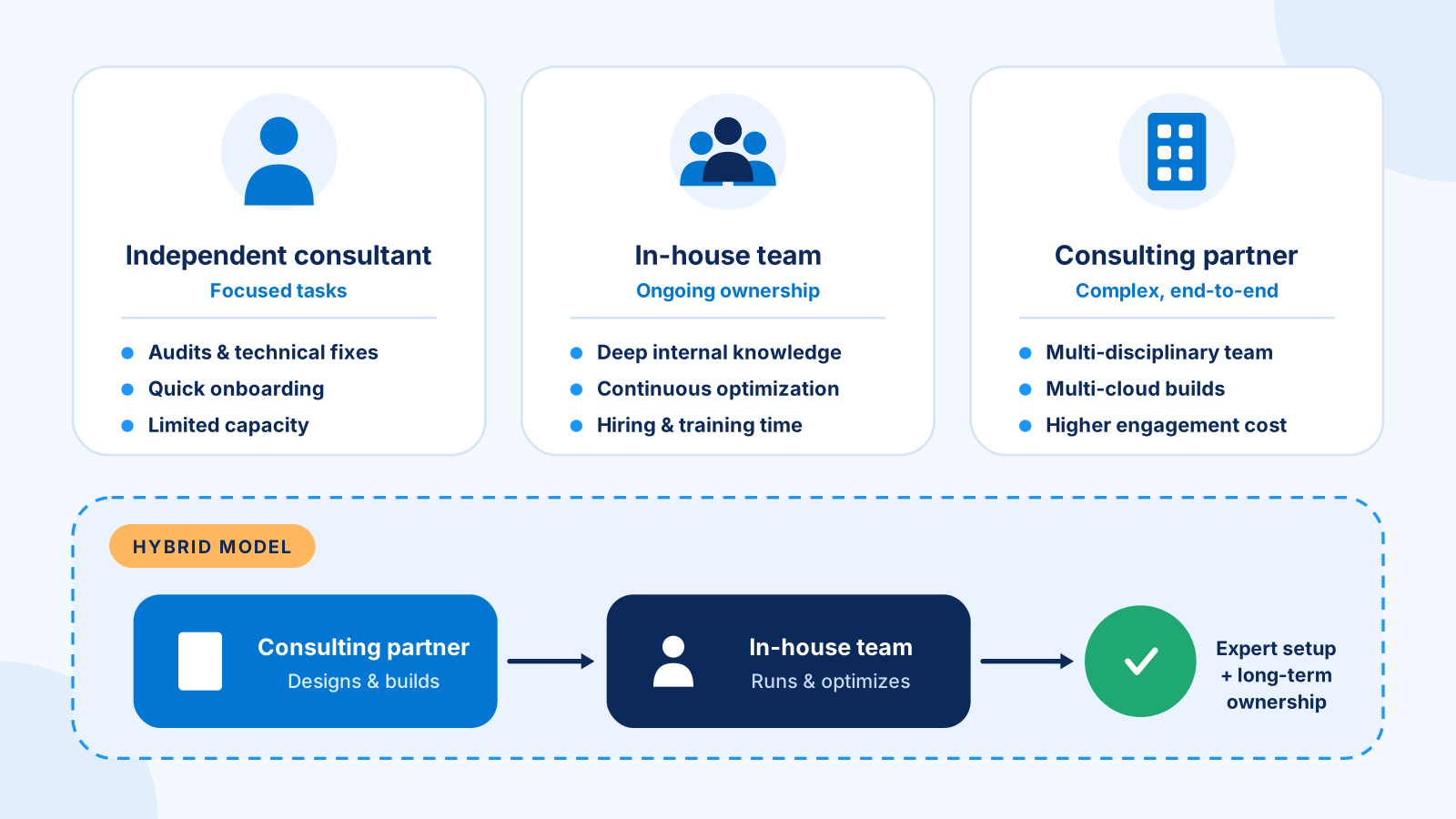
Here’s how an independent consultant, an in-house team, and a Salesforce Data 360 consulting partner compare.
Comparison at a Glance
| Comparison | Independent Consultant | In-House Team | Consulting Partner |
|---|---|---|---|
| Best Fit | Specific Data 360 tasks and technical guidance | Ongoing platform management | Complex, end-to-end implementations |
| Expertise | Specialized individual skills | Internal business and system knowledge | Multi-disciplinary technical team |
| Availability | Quick onboarding for focused projects | Requires hiring or training | Access to ready-to-deploy specialists |
| Cost Structure | Hourly or project-based fees | Salaries, training, and overhead | Project fees or managed-service contracts |
| Key Limitation | Limited capacity for large projects | Potential skill gaps | Higher engagement costs |
Which Hiring Model Fits Your Data 360 Goals?
Independent Consultant: Need specialized expertise for a specific implementation, audit, or technical challenge? An independent expert may be the right fit.
In-House Team: Prioritize long-term platform ownership, internal expertise, and continuous optimization? Build an in-house team.
Consulting Partner: Need Salesforce Data 360 consulting for businesses with a complex, multi-cloud setup? A consulting partner brings the specialists and resources needed.
What About a Hybrid Model?
Why pick just one? Many businesses don’t.
A consulting partner can design and build your Data 360 architecture, while your in-house team takes over daily operations, monitoring, and optimization. You get expert-level setup from day one and long-term ownership without starting from scratch.

What Influences the Cost of Hiring a Salesforce Data 360 Consultant?
There’s no standard fee for hiring a Salesforce consultant who specializes in Data 360. The cost depends on what you’re building, how complex your data environment is, and the level of support you need.
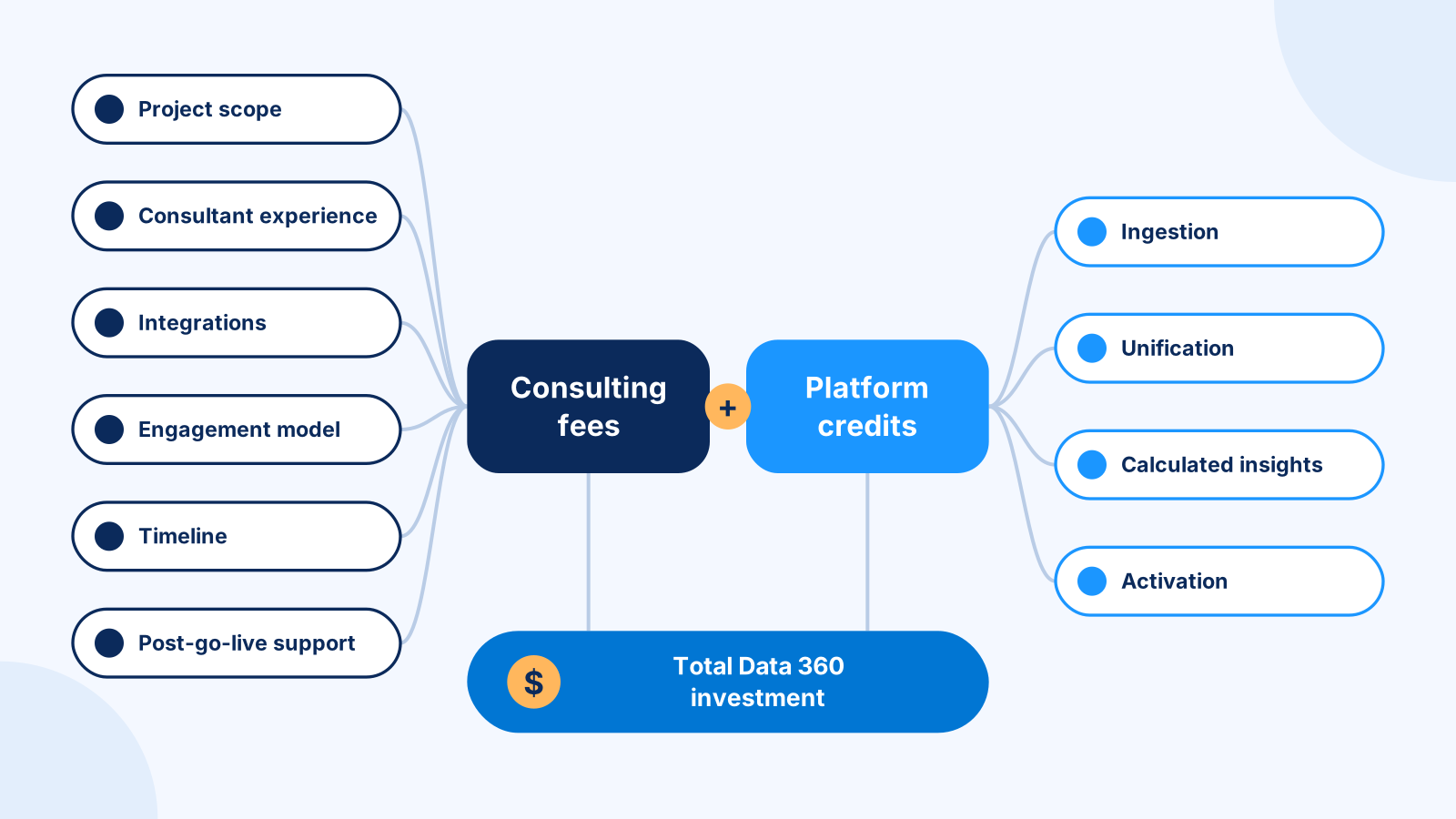
Here are six factors that shape the consulting budget:
01. Project Scope and Complexity
A basic setup with a few data sources requires less effort than an enterprise implementation involving multiple systems, custom data models, and complex identity resolution.
02. Consultant's Experience
A specialist with hands-on Data 360 implementation experience may charge more than a general Salesforce consultant. The difference often comes down to how well they can handle complex technical requirements.
03. Integration Requirements
Connecting Salesforce with ERP systems, marketing platforms, and external data warehouses adds to the integration effort and overall project cost.
04. Engagement Model
Independent consultants typically charge hourly or project-based fees. Consulting partners may offer fixed-scope projects or managed service contracts.
05. Project Timeline
Tight deadlines, additional development work, or the need for multiple specialists can increase consulting fees.
06. Post-Implementation Support
The work doesn’t always end at go-live. Salesforce managed services can cover monitoring, troubleshooting, performance optimization, and ongoing governance, which adds to the long-term budget.
Don't Overlook Data 360 Platform Costs
Consulting fees are only one part of the investment. Salesforce Data 360 also has consumption-based costs, so Salesforce Data Cloud pricing depends on platform usage and credit consumption.
Factor in credit consumption for ingestion, unification, insights, and activation when estimating the total budget.
Not sure what Data 360 will really cost? See our complete Salesforce Data Cloud pricing guide before you plan your budget.
Red Flags to Watch for When Hiring a Salesforce Data 360 Consultant
A weak implementation approach can create problems that are difficult and expensive to fix later. Before you hire a Salesforce Data 360 consultant, look beyond their promises and watch for these technical and delivery-related red flags:
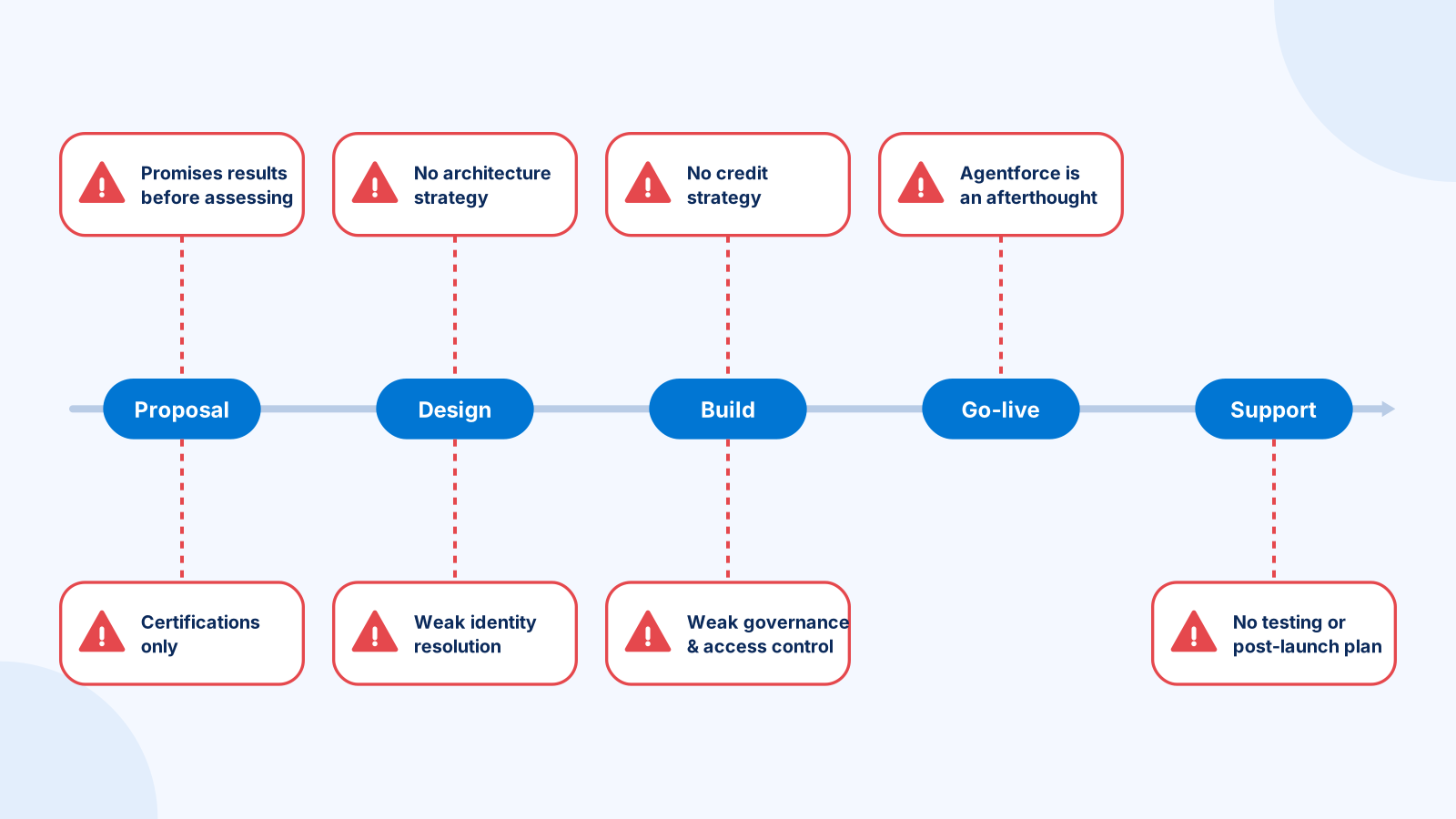
Promises Results Without Understanding Your Requirements: Be cautious of consultants who suggest timelines, costs, or outcomes before assessing your data sources, business goals, and existing architecture.
Relies Only on Certifications: Certifications demonstrate platform knowledge, but they don't prove hands-on implementation experience. Ask for examples of projects they've actually delivered.
No Clear Data Architecture Strategy: If a consultant jumps straight into configuration without assessing your source systems, data model, data mapping, and integration architecture, the implementation may face scalability issues later.
Limited Understanding of Identity Resolution: Identity resolution requires more than matching customer names or email addresses. Be cautious if they cannot explain match rules, reconciliation rules, duplicate handling, and unified profile creation.
No Strategy for Data 360 Credit Consumption: Vague estimates around data ingestion, unification, calculated insights, and activation can leave you exposed to unexpected consumption costs. Look for a consultant who can forecast usage and recommend optimization strategies.
Overlooks Data Governance and Access Controls: Weak data access policies, consent management, data spaces, and role-based access controls (RBAC) can expose sensitive customer information and create compliance risks.
Treats Agentforce Data Readiness as an Afterthought: Simply connecting Data 360 to Agentforce does not guarantee useful AI experiences. The consultant should understand how to provide trusted, relevant customer context through unified profiles and properly configured data access.
No Plan for Testing, Monitoring, or Optimization: If the proposal ends at deployment, ask what happens next. Data validation, identity resolution testing, ingestion monitoring, performance tuning, and post-launch support are essential for long-term reliability.
Cannot Demonstrate Real Implementation Experience: Be cautious of consultants who rely entirely on certifications or generic demos but cannot explain actual project challenges, architectural decisions, or measurable outcomes.
How Concretio Helps Businesses Implement Salesforce Data 360
Ready to hire a Salesforce Data 360 consultant who has done this before? Scattered customer data shouldn’t hold your business back.
At Concretio, we help businesses turn disconnected data into unified customer profiles, actionable insights, and smarter customer experiences through Salesforce Data 360.
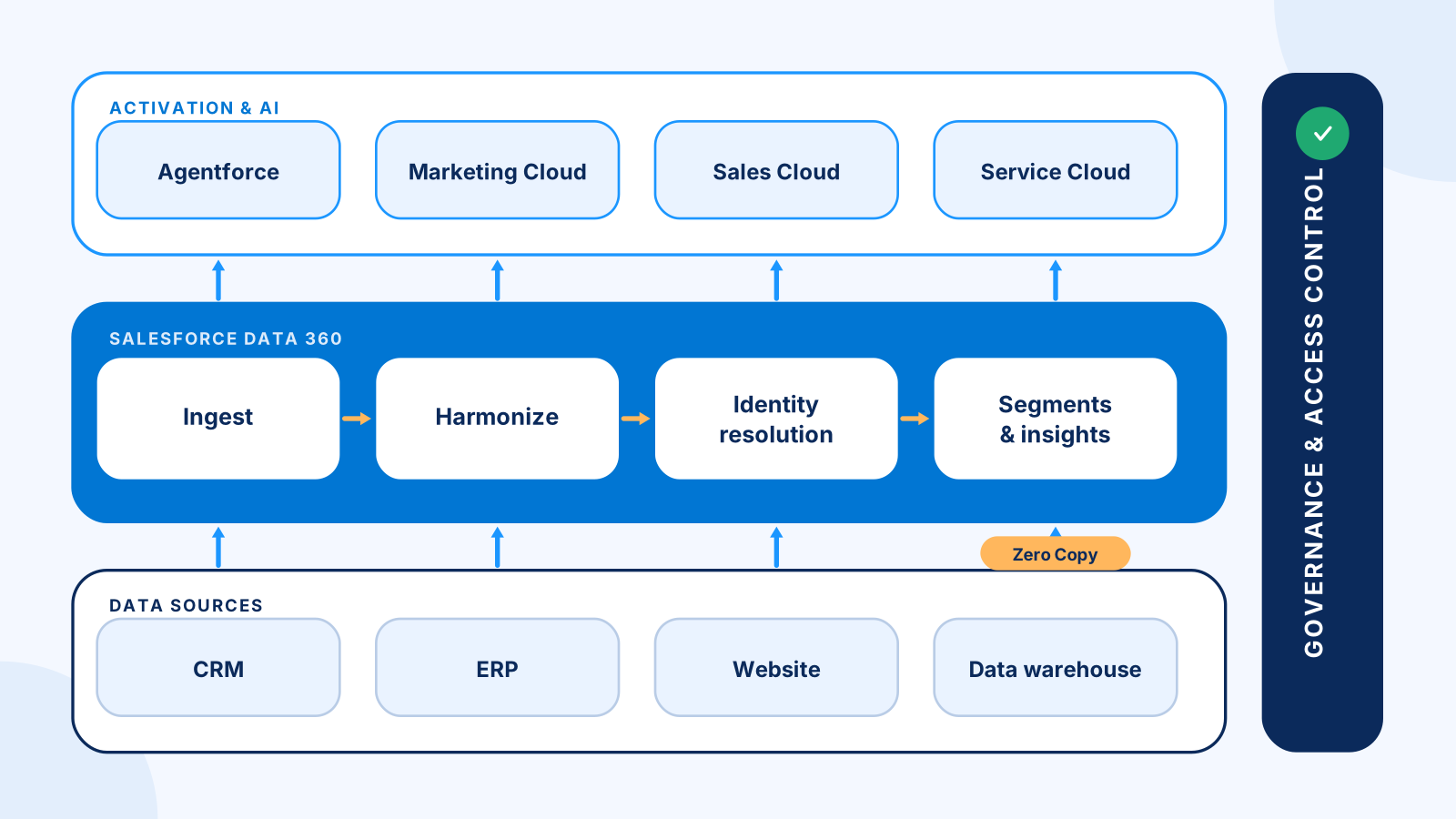
As a Salesforce Data 360 implementation partner, Concretio offers end-to-end implementation services, from data architecture cvb integration fa identity resolution, segmentation, and data activation.
We also ensure Agentforce data readiness, strengthen governance, and optimise your data ecosystem for long-term scalability.
Explore our Salesforce Data 360 consulting services for businesses, or dive into our Salesforce Data 360 implementation guide for a closer look at the process.
Conclusion
Choosing the right Salesforce Data 360 consultant can make the difference between a smooth implementation and a complicated one. Whether you hire a Salesforce consultant or a full implementation team, focus on hands-on Salesforce Data 360 implementation expertise, technical depth, and a clear understanding of your business goals to get lasting value.
Ready to get started? Explore Salesforce Data 360 consulting services and connect with our experts to plan your implementation.
Frequently Asked Question
-
Hire one when your customer data sits in several systems, you see duplicate or inconsistent profiles, or your team lacks Data 360 experience. It also makes sense before you roll out Agentforce, since AI agents need clean, connected data. The earlier you bring one in, the fewer problems you’ll fix later.
-
Not on its own. The Salesforce Certified Data 360 Consultant credential shows platform knowledge, but it doesn’t prove hands-on delivery. Ask for real project examples, client references, and details on how they handled identity resolution, integrations, and cost control. Experience at the project stage matters as much as the badge.
-
Match rules decide which records belong to the same person or account, using exact or fuzzy comparisons on fields like email or name. Reconciliation rules then choose which value wins when sources conflict.
-
A data stream brings in source data, which lands in a data lake object (DLO) as raw data. You then map it to a data model object (DMO), the harmonized structure that segments and insights use.
-
Credits are used by ingestion, unification, insights, segmentation, and activation. A consultant reduces usage by ingesting only needed data, using Zero Copy where it fits, setting sensible refresh schedules, and monitoring after go-live.
-
Start with clean unified profiles and a well-mapped data model. Then expose the right data to agents through data graphs, search indexes, and retrievers for unstructured content, with access controls limiting what agents can use.
-
Use permission sets and data space access to control who sees what, and map consent data to profiles so activations respect customer preferences. Set these controls up before activating data or exposing it to AI.