
Why Managed Package Upgrades are the "Secret Sauce" of Salesforce Headless 360.
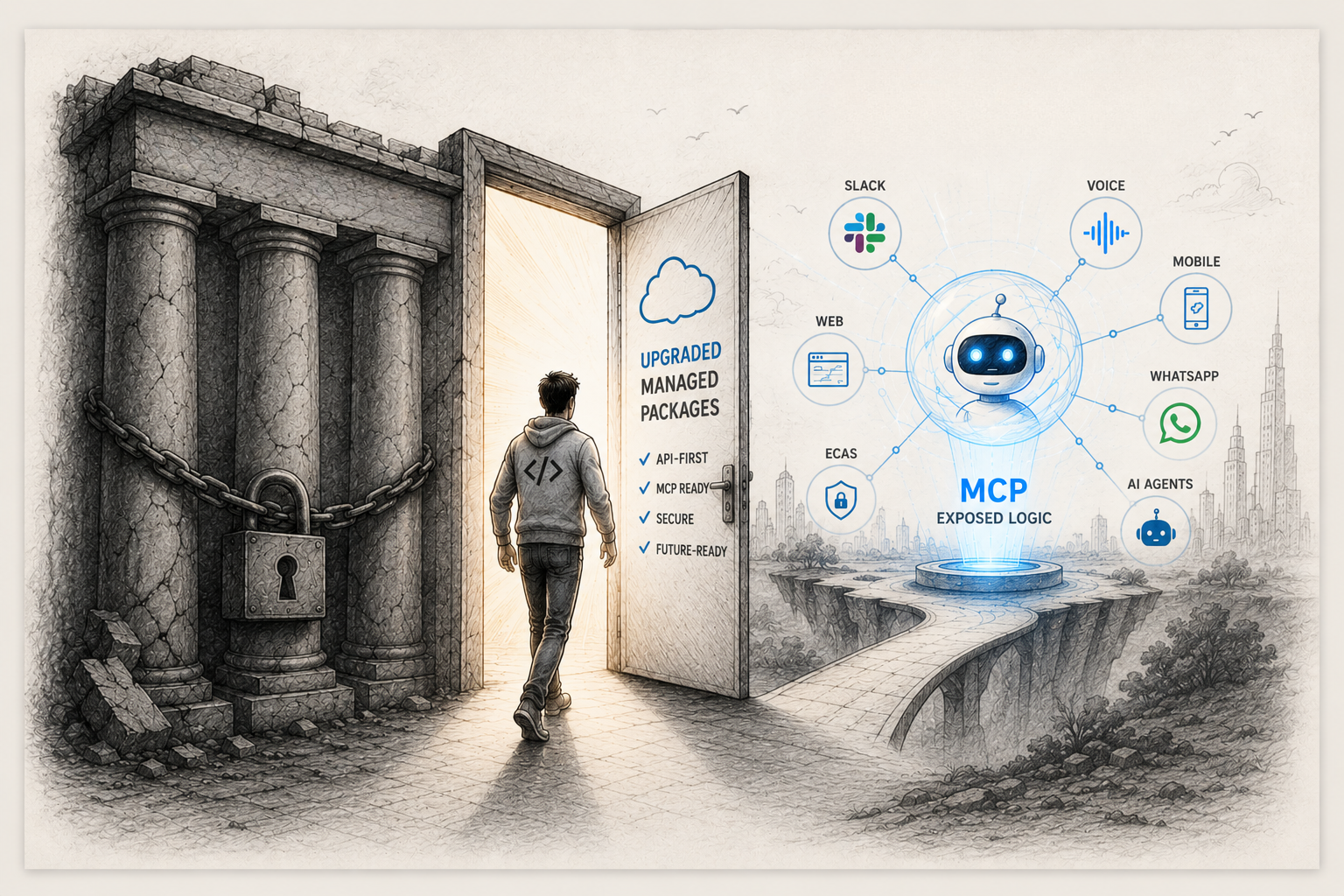
Key Summary:
Salesforce Headless 360 enables AI-ready, API-first automation.
AI agents and MCP-first workflows automate and modernize managed packages.
Salesforce Data Cloud AI improves insights, forecasting, and digital experiences.
Is your Salesforce AI actually leveraging your custom architecture, or is it flying blind?
With the rise of Salesforce Headless 360 and autonomous AI agents, a critical gap is emerging: legacy Salesforce packages are becoming functionally invisible. The logic still exists, but modern tools like Salesforce Agentforce AI can’t access it.
This is no longer a conversation about missing features; it’s a crisis of relevance. Below, we break down what’s changed and why upgrading your managed package strategy is now essential.
The Headless 360 Shift: Why Managed Packages Can No Longer Stay Static
The “Headless 360 Shift” represents a fundamental turning point in how Salesforce packages are designed and consumed. The traditional model delivering a rigid, UI-driven solution no longer aligns with how modern Salesforce ecosystems operate.
Enterprises today are moving toward flexible, API-first architectures, where systems are expected to integrate seamlessly, scale rapidly, and adapt to evolving user experiences. In this environment, static managed packages are no longer sufficient.
The Core Challenge: Inflexible and Non-Transparent Package Design
In many traditional implementations, managed packages have been delivered as complete, tightly coupled solutions with predefined UI, logic, and structure. While this approach simplifies initial deployment, it can introduce certain limitations as systems evolve:
Constrained User Experience Flexibility
Interface customization can be limited by the package design, often requiring extensions or workarounds to meet specific business requirements.Variable Interoperability
Data and business logic may not always be fully exposed, which can make integration with external systems or custom applications more complex.Dependency on Vendor Release Cycles
Organizations relying on packaged functionality may need to align with vendor update schedules, which can influence how quickly new capabilities or technologies are adopted.
These limitations are not new, but in a traditional UI-driven model, they were manageable. However, with the shift to Headless 360 and AI-driven execution, these constraints become significantly more visible and impactful.
What is the Headless 360 Shift?
Headless 360 fundamentally redefines how Salesforce systems operate by separating backend logic from the user interface and making that logic directly accessible to APIs, AI agents, and external applications.
Three key changes drive this shift:
MCP-driven capabilities that expose your platform logic to AI agents, enabling coding assistants to access and execute business functions seamlessly.
A unified experience layer that delivers native interactions across every channel, from Slack and voice interfaces to mobile apps and messaging platforms like WhatsApp.
Advanced control mechanisms that govern agent behavior across environments, allowing teams to define, monitor, and optimize AI execution before and after deployment.
Together, these changes transform managed packages from isolated, UI-driven solutions into accessible, composable engines capable of powering AI-driven and multi-channel experiences.
From UI-First to MCP-First: Redefining How Packages Are Consumed
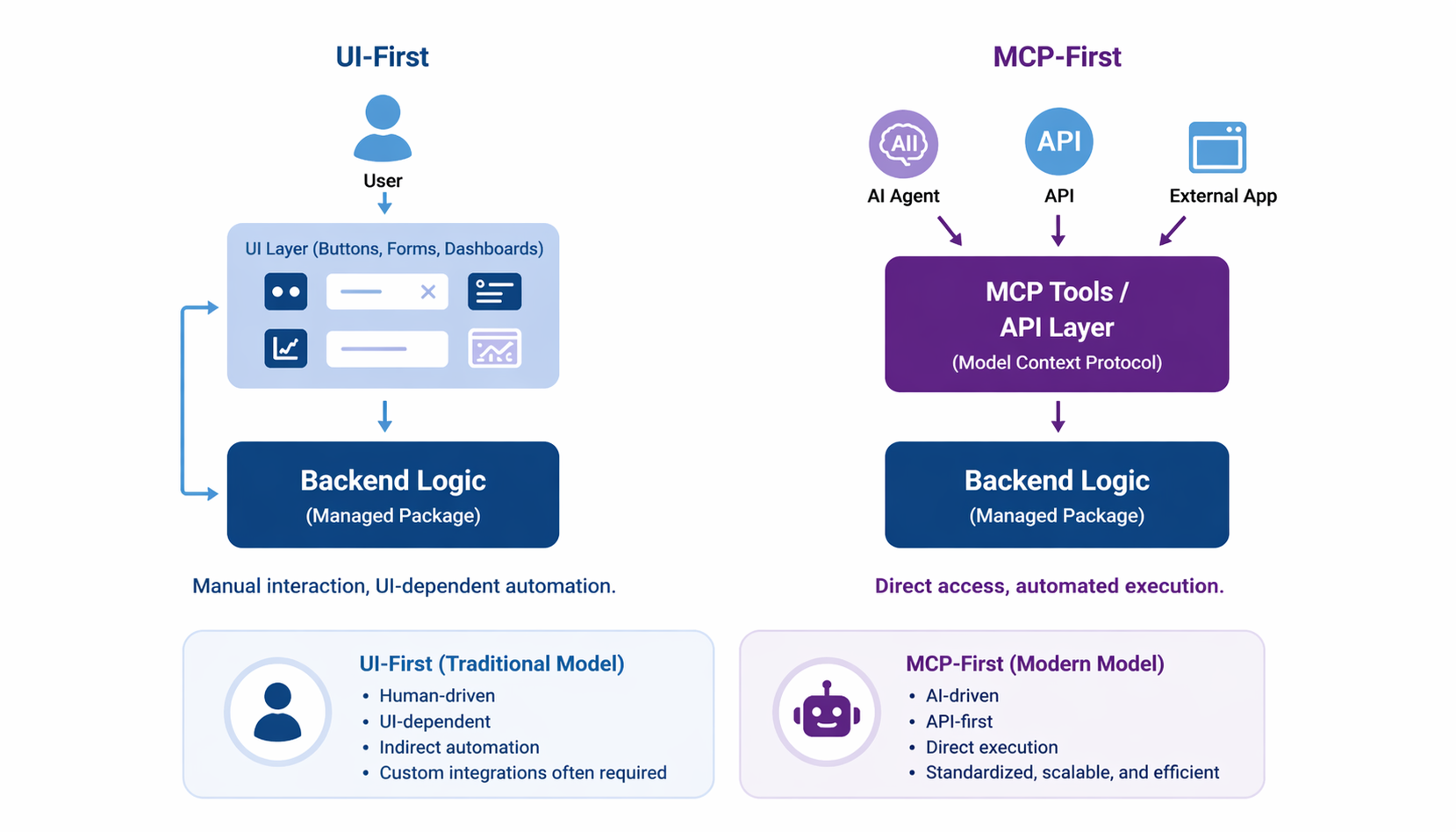
The shift from UI-first to MCP-first changes how Salesforce systems operate. Instead of relying on user interfaces to trigger logic, systems now expose functionality as machine-readable tools.
This allows AI agents and APIs to directly access and execute business logic without UI dependency, making automation faster and more scalable.
This shift becomes especially important in the context of Salesforce Agentforce AI, where agents are expected to:
Interact with systems autonomously
Execute workflows programmatically
Leverage existing business logic without manual intervention
Key Differences: UI-First vs MCP-First
UI-First (Traditional Model)Applications are designed for human users, with logic accessed through interfaces. Any automation or agent interaction often depends on indirect methods such as UI simulation or custom integrations.
MCP-First (Modern Model)Applications expose their logic as structured tools (APIs/functions), enabling AI agents to understand and execute tasks directly without relying on user interfaces.
This shift fundamentally changes the role of managed packages. If their logic is not exposed in a structured, machine-readable way, they cannot be effectively utilized in an AI-driven, Headless Salesforce environment.
From Connected Apps to External Client Apps (ECA): Rethinking Integration Architecture
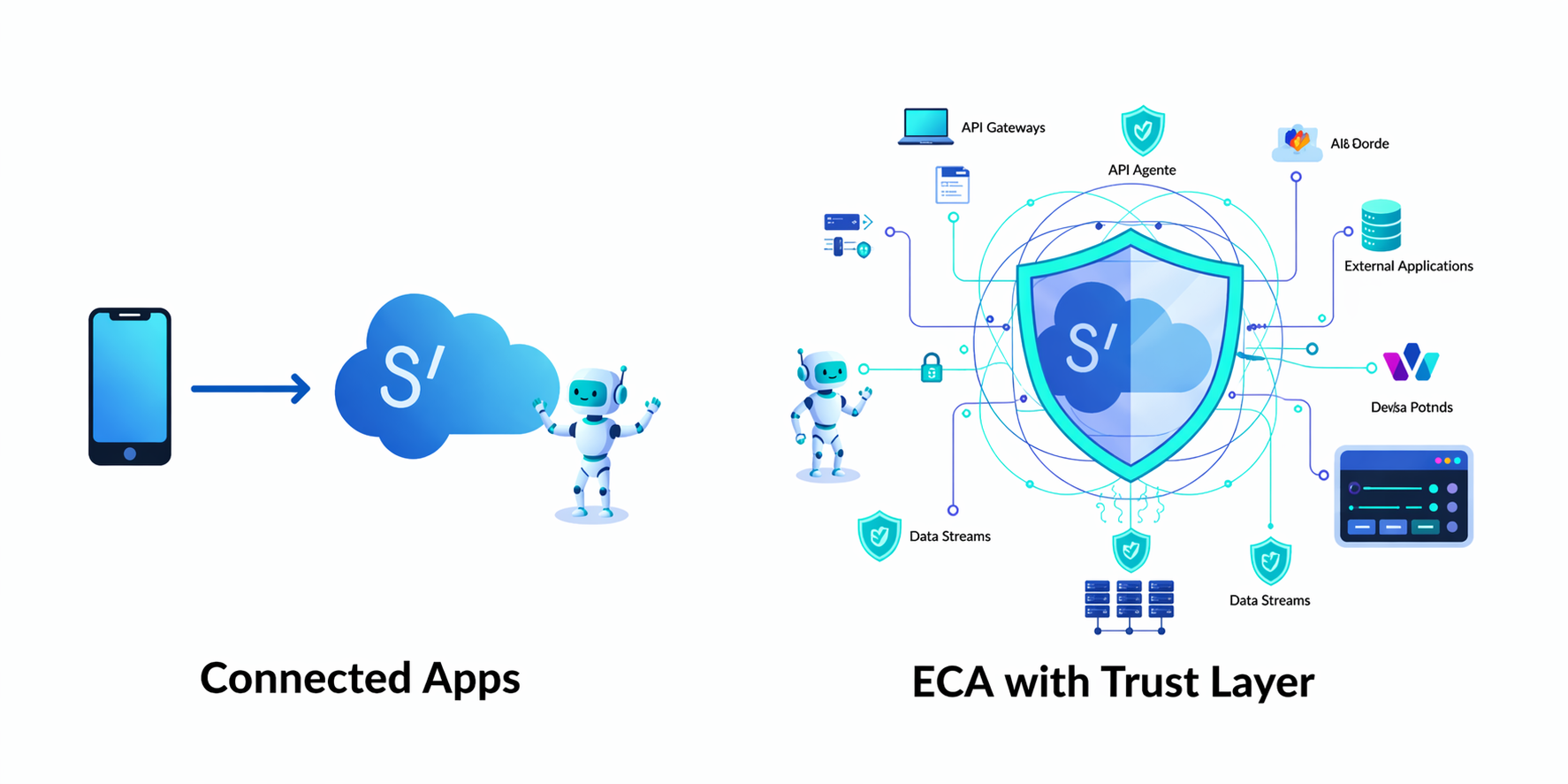
Salesforce is moving from Connected Apps to External Client Apps (ECAs), introducing a more secure, API-first integration model.
Unlike user-based access in Connected Apps, ECAs use application identity and governed permissions, enabling better control and alignment with AI-driven, Headless architectures.
For managed packages, staying compatible with this shift requires continuous updates.
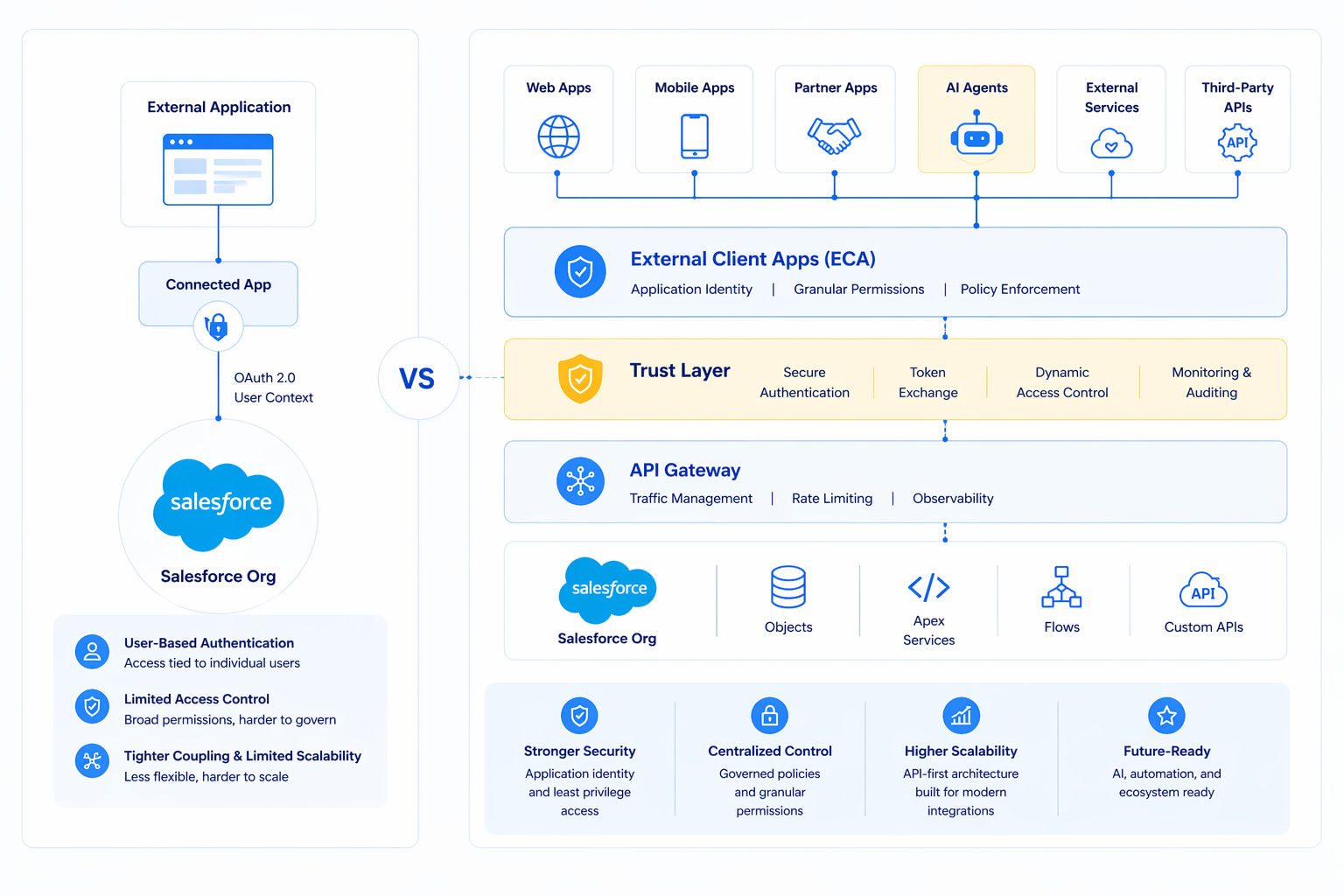
This shift also reflects a broader platform direction:
New integrations are increasingly expected to use ECAs as the standard
Connected Apps are being phased out for future development
Security follows a “default closed” model, requiring explicit configuration for access
This shift makes it clear that modern Salesforce integrations are built on secure, API-first principles, and only updated managed packages can fully align with and leverage this new architecture.
The Business Reality: Staying Visible in an AI-Driven Salesforce
These architectural shifts lead to a clear business outcome: maintaining relevance now depends on how accessible and adaptable your systems are.
Upgrading managed packages is no longer just about adding new features; it’s about ensuring that your business logic remains visible and usable within an AI-driven ecosystem.
Organizations today must ensure that:
Business logic is accessible to AI and automation layers
Systems remain aligned with ongoing platform evolution
Integrations are resilient, scalable, and future-ready
Without regular updates, a disconnect begins to emerge. While the Salesforce platform continues to evolve and AI capabilities expand, the underlying package logic can remain tied to outdated patterns.
This gap can lead to:
Reduced automation efficiency
Limited AI-driven outcomes
Increased operational complexity
To stay aligned, many organizations are:
Adopting Salesforce managed services to maintain consistent upgrade cycles
Choosing to hire a Salesforce developer with expertise in modern packaging and architecture
The priority has shifted from simply building systems to ensuring they remain continuously accessible, adaptable, and effective in an AI-driven environment.
Conclusion: Ensuring Managed Packages Stay Future-Ready
As Salesforce evolves, it’s no longer enough for systems to simply work, they need to stay aligned with modern architectures. Salesforce packages that aren’t regularly updated risk becoming harder to integrate, extend, and scale.
Long-term success depends on how well your systems adapt to change, not just how they perform today.
Ready to Strengthen Your Salesforce Foundation?
Don’t let outdated managed packages limit your AI potential. Partner with a Salesforce consultant to modernize your architecture, improve integration flexibility, and keep your Salesforce ecosystem future-ready.
Frequently Asked Questions
-
Salesforce managed packages are pre-built collections of components—such as objects, Apex code, and integrations designed to be distributed and installed across multiple Salesforce orgs with controlled updates and versioning
-
Managed packages need updates to stay compatible with evolving Salesforce architecture, ensure smooth integrations, and maintain performance and security as the platform changes.
-
Headless 360 refers to an API-first approach where business logic is decoupled from the user interface, allowing systems to operate across multiple channels and integrations without relying on a traditional UI.
-
MCP-first architecture enables systems to expose business logic as machine-readable tools, allowing direct interaction through APIs and automation instead of relying on user interfaces.
Related Reading

Let’s talk

Drop us a note, we’re happy to take the conversation forward 👇🏻