
Heroku Alternatives: The 11 Features That Never Shipped
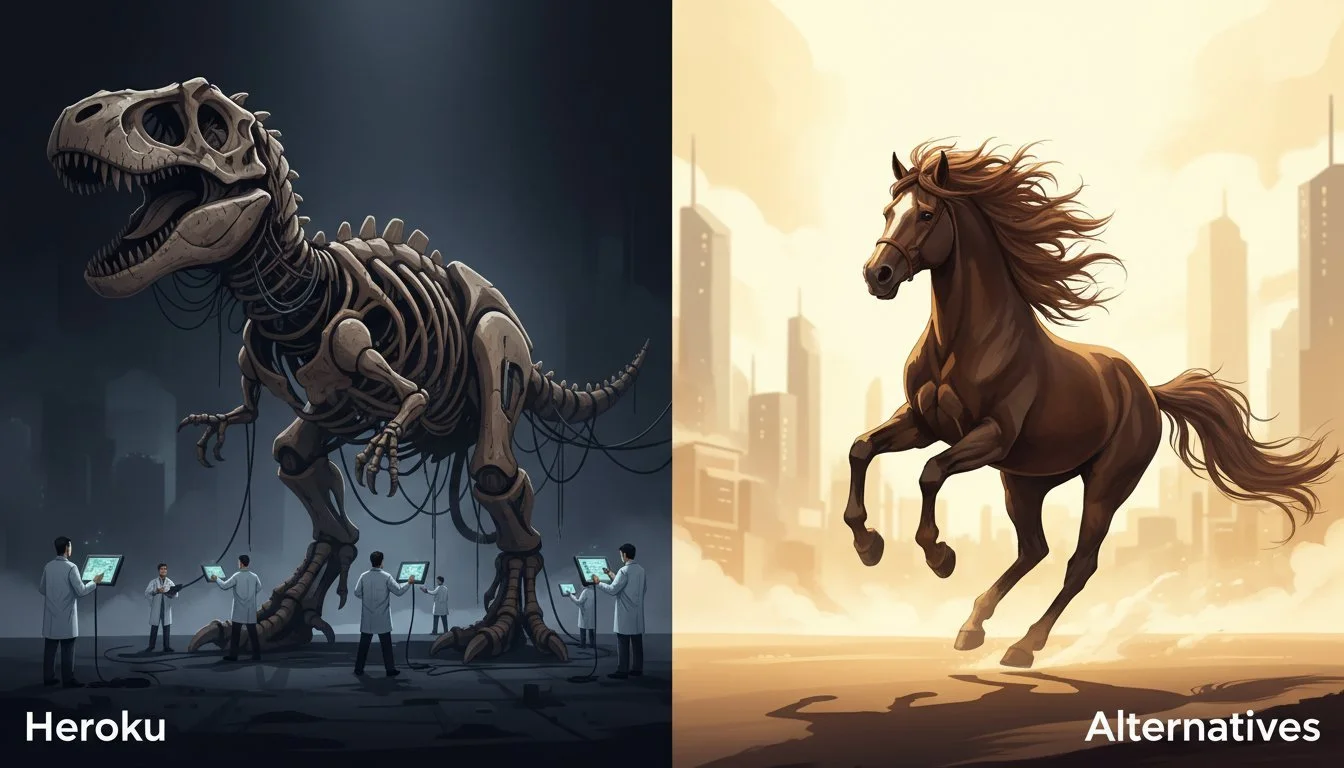
Heroku shipped 1 new product category after 2017 (Managed Inference, 2024).
In that same period, six competitors (all founded after Salesforce bought Heroku), each shipped 20+ major features. That's roughly 1 vs 120 in new capabilities. Here's the short version. I mapped the 11 critical features Heroku never built. The timeline explains why developers are choosing Heroku alternatives and which platforms ship what you need.
Why This Matters Now?
Heroku's February 2026 feature freeze didn't come out of nowhere. From 2011 (Cedar stack) through 2026, the platform stayed largely the same while the rest of the market moved on.
Post-acquisition, Heroku had two regions, a 30-second HTTP ceiling, no autoscaling, and an ephemeral filesystem.
Six competitors (Render, Fly.io, Railway, Vercel, DigitalOcean, Netlify) were founded after the acquisition and built what Heroku wouldn't.
The 11 gaps below aren't niche; they were table stakes for modern PaaS by 2020. Understanding what Heroku didn't build makes it clear why teams are leaving and where they're going.
Technical Deep Dive: The 11 Gaps
The 30-Second Trap
Heroku enforced a 30-second HTTP timeout from the Cedar stack launch in 2011 until the feature freeze in 2026. If your request took 31 seconds, it was killed. No config option. No override.
Every developer hit this wall. File uploads had to be backgrounded. Report generation needed a worker dyno. AI inference had to finish in 29 seconds. The 30-second limit was a daily reminder that Heroku was built for their architecture, not your use case.
What competitors shipped:
Render (2019) offered a 100-minute HTTP timeout (6,000 seconds vs Heroku's 30), configurable per service.
Fly.io (2020) has no hard timeout; long-running connections work natively.
Railway (2021) lets you set timeouts by workload type.
For 15 years, Render's timeout was 200x longer than Heroku's. The fix would have been a config parameter. Heroku chose not to ship it.
The Autoscaling Gap Developers Begged For
Autoscaling was the #1 most-requested Heroku feature for over a decade. Third-party add-ons (HireFire, Adept Scale, Rails Autoscale) existed only to work around the gap.
Heroku's response was manual scaling via heroku ps:scale web=4: fixed dyno sizes, no vertical scaling, no automatic adjustment. A traffic spike at 3 AM meant over-provisioning 24/7 or watching the app crash. The Heroku Fir generation (October 2025) promised autoscaling and launched without it. The feature freeze killed the roadmap four months later.
What competitors shipped:
Render (February 2022): horizontal autoscaling on CPU and memory, on all paid plans.
Fly.io (May 2022): machines auto-start in ~300ms when requests arrive, stop when idle; scale-to-zero with sub-second cold starts.
Railway (2023): vertical autoscaling by default, horizontal via replica dial with load balancing.
DigitalOcean App Platform (2023): CPU/memory-based autoscaling with configurable min/max containers.
Every modern PaaS offers autoscaling as a core capability. Heroku never did.
The Storage Problem Heroku Never Solved
Heroku used an ephemeral filesystem. Write a file to disk, restart the dyno (at least once per 24 hours), and it was gone. That was the Cedar stack’s design, not a bug.
From 2011 to 2026, applications were forced into a stateless-only model: no user file uploads without S3, no SQLite, no local caching. Heroku pioneered the twelve-factor idea of treating the filesystem as ephemeral but never built past it.
What competitors shipped:
Render (2019, at launch): Persistent Disks: SSD-backed storage that survives deploys, restarts, and scaling, from 1GB to 256GB+.
Fly.io (October 2020): Fly Volumes: NVMe-backed storage enabling SQLite, LiteFS, and stateful workloads.
Railway (September 2023): volumes with copy-on-write and cross-region copying.
Competitors offered persistent storage as a core feature from day one; Heroku never did.
The Edge Revolution Heroku Missed
While Vercel, Netlify, and Fly.io built edge compute into their platforms, Heroku ran all code in one or two AWS regions. No CDN for dynamic content, no edge functions; application logic always ran server-side in the origin region.
What competitors shipped:
Fly.io (2020): apps on Firecracker microVMs across global regions, requests routed to the nearest region via BGP Anycast.
Vercel (December 15, 2022): Edge Functions GA: JavaScript/TypeScript/WebAssembly on V8 isolates with sub-millisecond cold starts.
Netlify (April 19, 2022): Edge Functions on Deno with 50–200ms cold start.
Edge compute defined 2022–2024. Heroku didn't take part.
The AI Boom With No GPU Support
Heroku offered zero GPU support for the entire Cedar era (2011–2025). Every dyno was CPU-only. When the AI boom hit in 2022–2023, teams building ML products looked elsewhere from day one.
Heroku Fir (October 2025) listed GPU support on the roadmap but never shipped it. The February 2026 freeze means GPU dynos will likely never materialize. Heroku did launch Managed Inference (GA November 2025): a managed API for Claude, GPT, and open-weight models. That was model-as-a-service, though, not GPU compute for custom workloads.
What competitors shipped:
Fly.io (2022–2024): GPU Machines with NVIDIA GPUs for inference, fine-tuning, and custom ML.
DigitalOcean (2024): GPU Droplets (NVIDIA H100) plus Gradient AI Platform.
The AI and ML wave arrived in 2022. Heroku had no answer.
Six More Gaps That Tell the Same Story
Six more gaps follow the same pattern: Heroku had the capability or saw the demand but chose not to ship.
VPC / private networking: Private Spaces (2016) offered network isolation and VPN peering but at ~$1,000/month (enterprise-only). Self-serve users had no private networking. DigitalOcean (2019), Fly.io (2020), Render (2021), and Railway (2023) made it available to everyone.
Multi-region deployment: Heroku offered two regions for 14 years: US (Virginia) and EU (Dublin). Private Spaces added more, still enterprise-only. Fly.io launched with global multi-region deployment from day one (2020); Vercel's edge network spans 30+ PoPs. Heroku stayed at 2 regions.
Usage-based pricing: Heroku charged fixed per-dyno fees; dynos ran and billed 24/7. Pricing rose 300–400% under Salesforce. Fly.io (pay-per-VM-second) and Railway (vCPU-minute billing) aligned cost with actual demand. Heroku never did.
Built-in observability: Heroku had Logplex (last 1,500 lines, no persistence) and basic Application Metrics (2014). Beyond that, tracing, search, and alerting required paid add-ons. Railway (2024) shipped Log Explorer, Metrics Dashboard, and configurable alerts; Vercel (2023) added Web Analytics and Speed Insights.
Scale to zero: Heroku's free dynos slept after 30 minutes (removed 2022); paid dynos ran 24/7. Fly.io machines auto-stop when idle and restart in ~300ms; Railway scales to zero replicas; Vercel and Netlify scale to zero by design.
WAF / DDoS protection: Heroku had no native WAF or DDoS protection. Heroku Shield (2017) added compliance (HIPAA/PCI), not general-purpose filtering. Render (February 2022) made DDoS protection free for all users. Vercel (May 2023) shipped Vercel Firewall. Netlify (2024) added a managed WAF. Heroku shipped nothing.
Comparative Analysis
| Year | What Heroku Shipped | What Competitors Shipped (Examples) |
|---|---|---|
| 2011 | Cedar stack, Postgres, Twelve-Factor | Platform foundation |
| 2012–2017 | Connect, Flow, CI, Private Spaces, Shield | Heroku’s productive era |
| 2018 | Stack refresh only (Heroku-18) | Render founded |
| 2019 | Nothing significant | Render: persistent disks, preview environments |
| 2020 | Stack refresh only (Heroku-20) | Fly.io: edge platform, global regions, private networking |
| 2021 | Nothing significant | Railway: multi-DB support |
| 2022 | Free tier removed; security breach | Fly.io: Machines API, scale-to-zero. Render: autoscaling, free DDoS. Vercel: Edge Functions GA |
| 2023 | Nothing significant | Railway: horizontal scaling, private networking, volumes. Vercel: storage suite, WAF, VPC |
| 2024 | Postgres on Aurora, Managed Inference (pilot) | Railway: full observability. DigitalOcean: GPU Droplets, Gradient AI |
| 2025 | Fir generation (enterprise-only), Managed Inference GA | Render: $80M Series C. Fly.io: GPU Kubernetes support. Railway: full observability. Vercel: Ship AI. DigitalOcean: Gradient AI expansion |
| 2026 | Feature freeze | — |
From 2018 to 2024 (six years), Heroku shipped nothing significant.
Every competitor was founded after the acquisition and shipped what Heroku users had been asking for.
Heroku didn't lose to Kubernetes or serverless; it lost to stagnation. PaaS platforms that don't build escape hatches push their best users out. Heroku refused to build them.
What People Are Saying
The freeze made headlines and showed up in developer discussions.
DevOps.com on X led with “Salesforce Freezes Heroku Feature Development, Signals Long-Term Shift.” On Reddit, discussions about Heroku alternatives and PaaS choices keep surfacing.
Railway, Render, and Vercel come up as go-to options. One r/vercel thread put it bluntly: “Heroku lost developers and never fully [recovered].”
The r/SaaS take on trust echoes the same theme: “Heroku, Killed their free tier in 2022 with relatively short notice. Tons of hobby projects and small [teams] affected.”
My Take / Expert Commentary
Heroku's feature freeze didn't start in February 2026; the pattern of stagnation took hold years earlier. From 2018 to 2024 (six years), the platform stood still while Render, Fly.io, Railway, Vercel, DigitalOcean, and Netlify built the features Heroku's users had been asking for. The 11 gaps I mapped aren't exotic: autoscaling, persistent storage, private networking, multi-region deployment were table stakes for modern PaaS by 2020. Heroku had the resources, brand, and users; what it lacked was the will to ship.
Which of these 11 gaps hit you hardest, and are you still on Heroku, on a competitor, or running your own infrastructure?
For platform strategy or migration support, get in touch.
FAQs
What are the best Heroku alternatives in 2026?
The top Heroku alternatives are Render, Fly.io, Railway, DigitalOcean App Platform, and Vercel. Each ships the features Heroku never built: autoscaling, persistent storage, edge deployment, GPU support, and usage-based pricing. For the full analysis of why Heroku declined, see my deep-dive on Medium (update slug when published).
What features did Heroku never build?
Autoscaling, persistent storage, edge deployment, and GPU support. Also missing: private networking for self-serve users, usage-based pricing, and built-in observability. Plus scale-to-zero, WAF/DDoS protection, configurable HTTP timeouts, and multi-region deployment.
How many features did Heroku ship after 2017?
One new product category: Managed Inference (2024). Competitors shipped roughly 120+ major features in the same period.
Why didn’t Heroku ship autoscaling?
Unknown. It was the #1 most-requested feature for over a decade, promised for the Fir generation, and never delivered.
What’s the 30-second HTTP timeout?
Heroku terminated any HTTP request longer than 30 seconds. Unchanged from 2011 to 2026. Render offers 100 minutes (6,000 seconds).
Did Heroku have private networking?
Yes, but only via Private Spaces at ~$1,000/month (enterprise-only). Self-serve users had none. Competitors like Fly.io, Render, and Railway made it available to everyone.
What is the platform paradox?
PaaS makes early-stage development easy, then pushes you to leave as you scale. Heroku’s feature freeze meant it never built the escape hatches for growing teams, which accelerated the exodus.
Further Reading
My Deeper analysis:
Why Heroku died: full analysis
Feature comparisons:
Render vs Heroku · Railway: Top 5 Heroku Alternatives · PaaS Showdown 2025
Heroku history:
The Story of Heroku · Heroku Changelog · Twelve-Factor App
Official announcements:
An Update on Heroku · Heroku Fir GA