
I Analysed 12 Heroku Post-Mortems, Here's what they got wrong
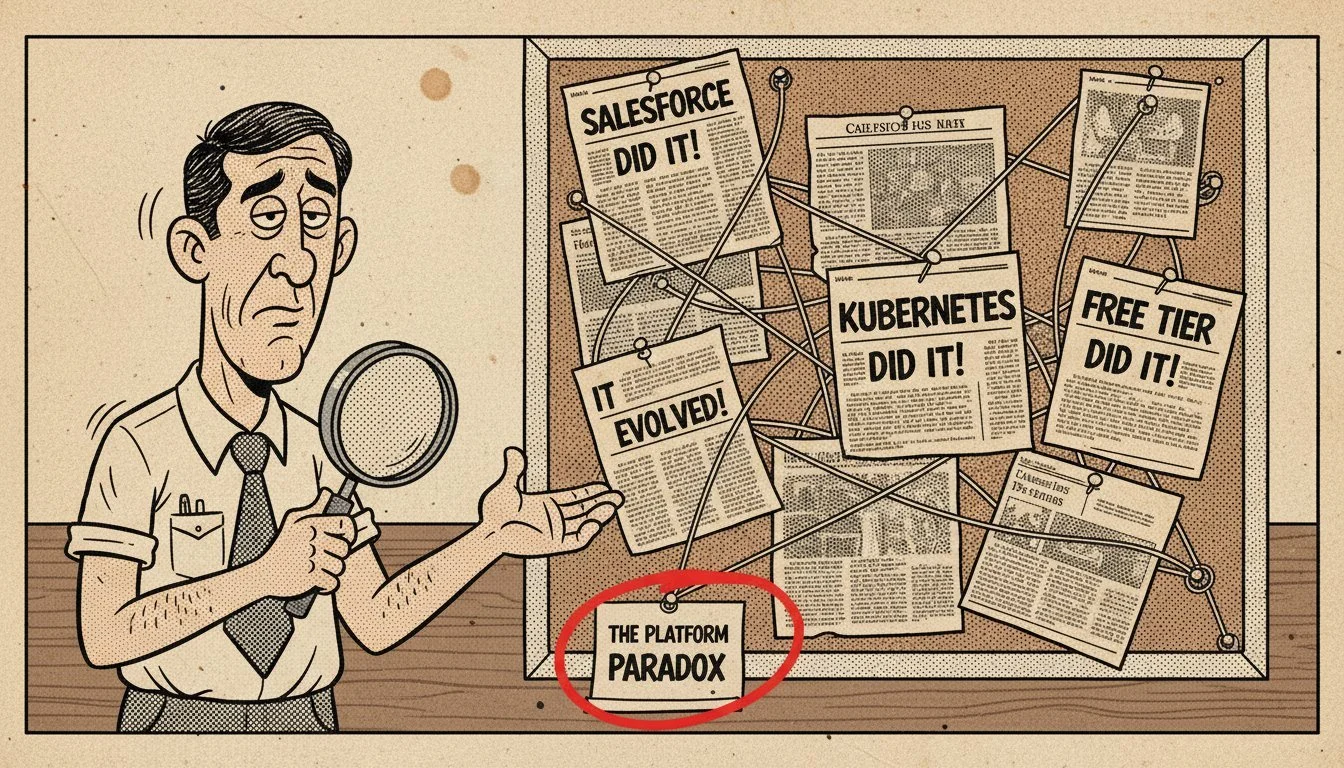
I dug into 12 Heroku post-mortems. They agree on the facts. They clash on the cause. Almost none spot the pattern that ties the whole story together.
So why did Heroku die? No single villain. No single event. Just a decade of standing still while the product kept looking fine on the surface, and a structural trap nobody named.
Here are the 12 sources: Will Vincent, Infoworld, Tech Stackups, Matt Rickard, Redmonk, SiliconANGLE, The Register, DevClass, Encore Cloud, and Heroku's own blog. Four myths keep showing up. Here's what lines up when you stack the evidence.
The Heroku Decline: Timeline and Context
The Timeline
The story starts earlier than most people think. Salesforce picked up Heroku in 2010 for $212M. Cedar shipped in 2011. After that? Mostly quiet.
The next decade brought small updates but no big leaps. Rivals shipped containers, edge functions, and serverless runtimes. Heroku shipped price hikes. Costs rose roughly 300–400% under Salesforce.
Then things sped up:
2022: Security breaches and the free tier cut pushed the platform into public decline
June 2025: A 24-hour outage caused by a vendor OS update that exposed a legacy script flaw
February 6, 2026: Salesforce moved Heroku to "sustaining engineering" mode. No new features. No new enterprise deals
Where the 12 Pieces Agree, and where they Split?
Jason Warner, Heroku's former engineering lead, called it a "gorgeous, snowglobe-like experience" frozen in time.
The 12 sources agree on that much. They diverge on why. Some point to Salesforce.
Others say Kubernetes ate PaaS as a category. Tech Stackups zeros in on UX rot, nine signup screens, forced MFA, onboarding that repels devs.
Four myths keep cropping up. Each one's only part of the picture.
Myth 1: Salesforce Killed Heroku
The claim: Salesforce bought Heroku and underinvested until it withered. A classic acquisition-and-shelve story.
What the 12 sources show:
Jason Warner, former Heroku engineering lead, called the platform a "resourcing black hole" that was "never finished"
Infoworld found that headcount stayed flat while app count on the platform ballooned
Heroku sat at an odd angle to Salesforce's CRM business, not competing with it, but not clearly reinforcing it either
As Salesforce concentrated investment on AI and Agentforce, Heroku moved down the priority list
The reframe: Salesforce is a CRM company. It concentrated investment where it saw the strongest growth signal, enterprise AI, automation, Agentforce. Heroku never found a clear path to CRM-level revenue, and without that strategic link, funding was always going to be a hard sell internally. The root cause is a structural misalignment between a dev-first platform and a sales-first parent, not intent.
Myth 2: Kubernetes Killed Heroku
The claim: Kubernetes made PaaS obsolete. Containers ate managed platforms.
What the 12 sources show:
Heroku had already stalled by 2012, years before Kubernetes went mainstream
Warner flagged missing "escape hatches": no multicloud, no VPC support, no way to grow past Heroku without leaving
Rivals moved fast: Render added 100-minute HTTP timeouts and persistent disks. Railway hit 12.9 million monthly deploys in 2025
Heroku? Same 30-second timeout the whole time
The reframe: Kubernetes didn't kill Heroku. Heroku chose to freeze. After 2017, the platform shipped one new product line (Managed Inference in 2024). The rest? Ubuntu LTS stack refreshes.
Rivals: All founded after the buyout, shipped what devs had been asking for:
2019: Render launched with persistent disks and preview environments, two features Heroku never built
2020: Fly.io launched its edge platform with WireGuard networking across 35+ regions. Heroku? Two regions
2022: Fly.io shipped Machines API, ~300ms VM boot, scale-to-zero. Render added DDoS protection and autoscaling. Vercel shipped Edge Functions. Heroku? Dropped the free tier
2023: Railway shipped horizontal scaling, private networking, and persistent volumes, all in one launch week. Vercel added storage, VPC peering, and WAF
2024: DigitalOcean launched GPU Droplets for AI. Railway baked in full observability
From 2011 to 2026: same 30-second timeout, same short-lived filesystem, same manual scaling, same two regions. Nothing budged.
See the complete feature breakdown and platform comparison in my other post. The timeline shows exactly when Heroku could have moved and chose not to.
Myth 3: Free Tier Removal Killed Heroku
The claim: The free tier was Heroku's pipeline for new devs. Killing it in 2022 broke sign-ups.
The evidence:
Fraud had already made the free tier too costly to keep running
Porter's analysis shows cost was just one reason teams left
Teams wanted VPCs, observability, and modern runtimes, years before the free tier vanished
The decline started long before the removal
The reframe: Symptom, not cause. Ditching the free tier didn't start the exodus. It sped up one already in motion.
Myth 4: Heroku Didn't Die, it evolved.
The claim: Heroku moved to a support-only model. It still runs. It's still backed.
The evidence:
The February 2026 blog post says "actively supported and production-ready"
The fine print: no new features, no new enterprise deals
Enterprise clients shift to credit-card billing when contracts lapse
Engineering? Patch-and-maintain mode
The reframe: That framing understates the shift. Heroku keeps current users running. But Salesforce has redirected investment toward AI and Agentforce, a bet that makes sense given where enterprise spend is heading. As The Register put it, Heroku is being put "out to PaaSture." It still runs. It just doesn't grow.
The Platform Paradox: What It Means for Your Stack
What most post-mortems skip is the core trap Heroku's failure exposes.
PaaS platforms nail early-stage dev. Fast deploys. Zero config. Instant databases. But scale up and you hit walls. You need VPC peering. Custom networking. Multicloud. Real observability. The platform that got you shipping fast becomes the thing holding you back. Cloud66 calls this the "PaaS graveyard" pattern. Heroku's not alone, just the most visible case. The real failure? It never built the escape hatches.
Picking a new platform? Look for ones that get the paradox:
Render — persistent disks, private networking, VPC support. Solves the "growing out" problem
Fly.io — edge deployment, pay-per-second. Steeper curve but more room to grow
Railway — usage-based pricing, one-click DBs. Fast start. Watch for the same trap at scale
PaaS Showdown 2025 offers a rough guide. Under 5 engineers? Try Railway or Render. 5–15? Look at Fly.io. Above 15? You're likely heading self-managed.
The Bottom Line
The 12 post-mortems mostly nail the facts. What they miss is the pattern underneath: every PaaS that doesn't build escape hatches for its best users will end up the same way.
Does your platform strategy account for that? Or are you building the next trap?
Ready to talk platform strategy? Contact our team to discuss choices that scale with your business.
Further Reading
Primary Analysis:
The Decline of Heroku - Infoworld
Why Did Heroku Fail? - Matt Rickard
Heroku in 2025 - Redmonk
Migration & Alternatives:
The End of Heroku - Encore Cloud
PaaS Graveyard: Why Platforms Keep Dying - Cloud66
Official Sources:
An Update on Heroku - Heroku Blog
June 10 Outage Corrective Actions - Heroku Blog