
Key takeaways:
Salesforce Data 360 ROI depends on accurate customer data, strong governance, and effective activation across business workflows.
A focused Salesforce Data 360 activation strategy helps improve customer engagement, campaign performance, and operational efficiency.
A 30-day Data 360 optimization plan helps identify implementation gaps, prioritize valuable use cases, and measure business results through clear KPIs.
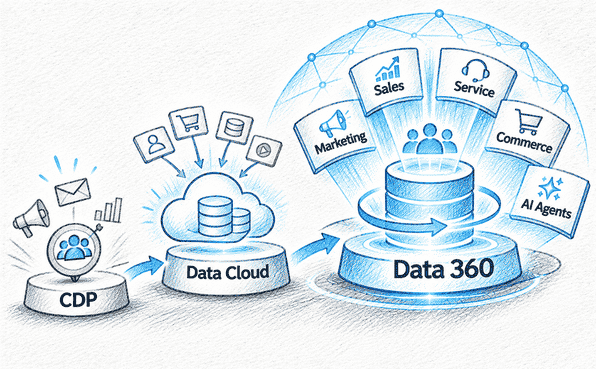
Salesforce Data 360 helps businesses unify customer data, build complete customer profiles, and create smarter audience segments for personalized experiences. It gives teams the insights they need to make better decisions and understand customers across different touchpoints. But a Salesforce Data 360 implementation is only part of the journey. The real challenge is turning these capabilities into measurable Salesforce Data 360 ROI through activation.
So, where is the gap?
In many implementations, data is unified, and customer profiles are ready, but teams struggle to put that information into action. Marketing campaigns lack relevant audience activation, sales teams miss valuable customer insights, and service teams don’t always have the context to personalize interactions. As a result, achieving the expected ROI remains difficult.
The solution isn’t necessarily another implementation. It’s a focused strategy that identifies underused capabilities, closes existing gaps, and prioritizes the use cases that matter most.
In this guide, we’ll walk through a 30-day Activation Rescue Plan to help you improve your Data 360 ROI, activate customer data, and measure the business value it delivers.
Quick Overview: Activation, Rescue & ROI in Salesforce Data 360
| Term | Meaning | Role in Data 360 |
|---|---|---|
| Activation | Putting unified customer data to work across your apps to engage the right people at the right time. | Using customer profiles and segments across marketing, sales, service, and Agentforce. |
| Rescue | Finding and fixing gaps in an existing implementation. | Helps address unused features, disconnected data, poor data quality, and gaps between unified profiles and actual business use. |
| ROI (Return on Investment) | Measuring whether the business benefits justify the time, money, and resources invested. | Tracking improvements in revenue, customer engagement, and operational efficiency. |
The 30-Day Salesforce Data 360 Activation Plan
This 30-day plan focuses on improving an existing Salesforce Data 360 implementation, not starting a new one from scratch.
Not sure whether your original setup covered everything? Compare it against our Salesforce Data 360 implementation checklist before you begin the audit.
Each phase targets specific gaps, from data quality and identity resolution to audience activation and ROI measurement.
The goal is to launch at least one high-value activation use case and establish a clear path for further optimization.
Here's a practical four-phase approach to getting your existing Data 360 investment back on track.
Phase 1: Audit & Identify Gaps (Days 1–7)
Identify what's broken, unused, or underperforming.
Review Data Sources: Audit connected CRM systems, external data warehouses, and existing data streams for incomplete or delayed ingestion.
Check Data Quality: Identify duplicate records, missing attributes, and inconsistent customer information.
Audit Identity Resolution: Review match rules, reconciliation rules, and unified customer profiles.
Review Activation Setup: Identify unused segments, disconnected activation targets, and manual workflows.
Check Consumption: Review credit usage, storage, and unnecessary processing costs.
Expected outcome: A clear audit of technical issues, unused capabilities, and ROI gaps.
Phase 2: Fix Data & Prioritize Use Cases (Days 8–14)
Address critical gaps and select high-value use cases.
Improve Data Quality: Correct mapping issues, incomplete records, and duplicate customer data.
Optimize Identity Resolution: Refine matching and reconciliation rules to improve unified profiles.
Review Data Governance: Check access policies, permissions, and data usage controls.
Prioritize Business Use Cases: Select high-value marketing, sales, or service opportunities.
Define KPIs: Set measurable targets for conversions, engagement, customer retention, or operational efficiency.
Expected outcome: A cleaner data foundation and a prioritized activation strategy.
Phase 3: Activate High-Value Use Cases (Days 15–21)
Launch targeted segments, workflows, and priority integrations.
Build Audience Segments: Create targeted segments using customer attributes, behavioral data, and calculated insights.
Configure Activation Targets: Connect relevant segments to Marketing Cloud Engagement or supported advertising platforms.
Enable Data Actions: Configure event-driven workflows for relevant customer activities.
Connect Agentforce: Explore unified customer context for AI-powered service and employee workflows.
Test Activation: Validate audience publishing, data accuracy, and downstream workflows.
Expected outcome: At least one tested, business-focused activation use case.
Phase 4: Measure ROI & Optimize Performance (Days 22–30)
Evaluate KPIs, activation performance, and consumption costs.
Track Business KPIs: Monitor campaign conversions, engagement, lead quality, and operational efficiency.
Review Activation Performance: Check segment accuracy, publishing status, and workflow execution.
Measure Consumption Costs: Compare Data 360 usage against the business value generated.
Identify Performance Gaps: Find workflows or use cases that need further optimization.
Plan Next Steps: Document results and prioritize the next set of activation opportunities.
Expected outcome: An initial ROI assessment, performance report, and optimization roadmap.
30-Day Activation Rescue Plan at a Glance
| Phase | Timeline | Main objective |
|---|---|---|
| Phase 1 | Days 1–7 | Audit existing implementation |
| Phase 2 | Days 8–14 | Fix data gaps and prioritize use cases |
| Phase 3 | Days 15–21 | Activate high-value use cases |
| Phase 4 | Days 22–30 | Measure ROI and optimize |
How to Measure Salesforce Data 360 ROI
Measuring Salesforce Data 360 ROI starts with defining clear Key Performance Indicators (KPIs). Rather than tracking how many customer profiles are unified or segments are created. Businesses should measure how Data 360 activation improves sales performance, marketing results, customer service, and operational efficiency.
Before activating a use case, establish baseline metrics. Then compare them with the results after activation to identify measurable improvements.
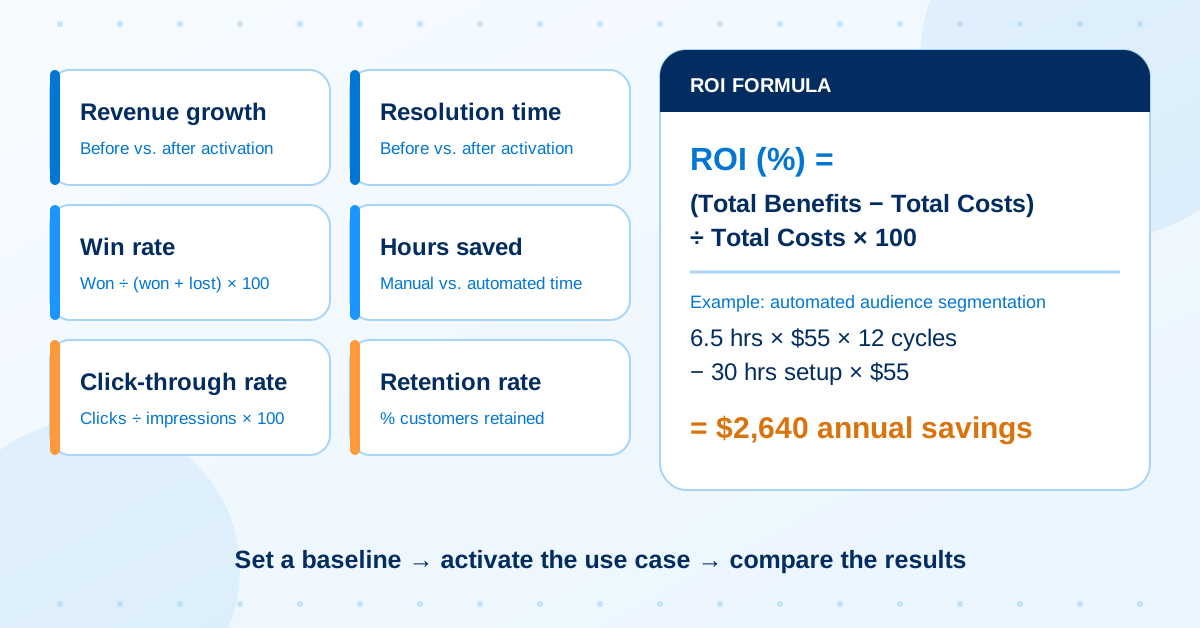
The right KPIs depend on which Data 360 use cases you want to improve. Here are some practical examples:
| Business Objective | KPI | How to Measure It |
|---|---|---|
| Increase sales revenue | Revenue growth | Compare revenue before and after activating cross-sell and upsell opportunities. |
| Improve sales performance | Win rate | (Won Deals ÷ Total Won and Lost Deals) × 100 |
| Improve campaign engagement | Click-through rate (CTR) | (Total Clicks ÷ Total Impressions) × 100 |
| Reduce service costs | Case resolution time | Compare average case resolution time before and after activation. |
| Improve operational efficiency | Hours saved | Compare manual processing time with automated workflow time. |
| Improve customer retention | Retention rate | Measure the percentage of customers retained over a defined period. |
Calculate the Business Value of Data 360 Activation
Once you identify the relevant KPIs, calculate the financial impact of each activation use case. Include both additional revenue and operational savings, while accounting for the costs involved.
ROI Formula:
ROI (%) = ((Total Benefits − Total Costs) ÷ Total Costs) × 100
For example, consider a marketing team that uses Data 360 to automate audience segmentation.
Time saved per campaign cycle: 6.5 hours
Average hourly cost: $55
Campaign cycles per year: 12
Initial setup effort: 30 hours
Annual operational savings:
(6.5 × $55 × 12) − (30 × $55) = $2,640
This represents estimated annual savings from reduced manual effort, before considering other platform, integration, and operating costs.
How Salesforce Data 360 Activation Drives Measurable ROI
The impact of Data 360 activation becomes clearer when you look at the business outcomes it can influence. From reducing advertising waste to improving sales performance and automating customer service, the right activation strategy can create measurable value across different business functions.
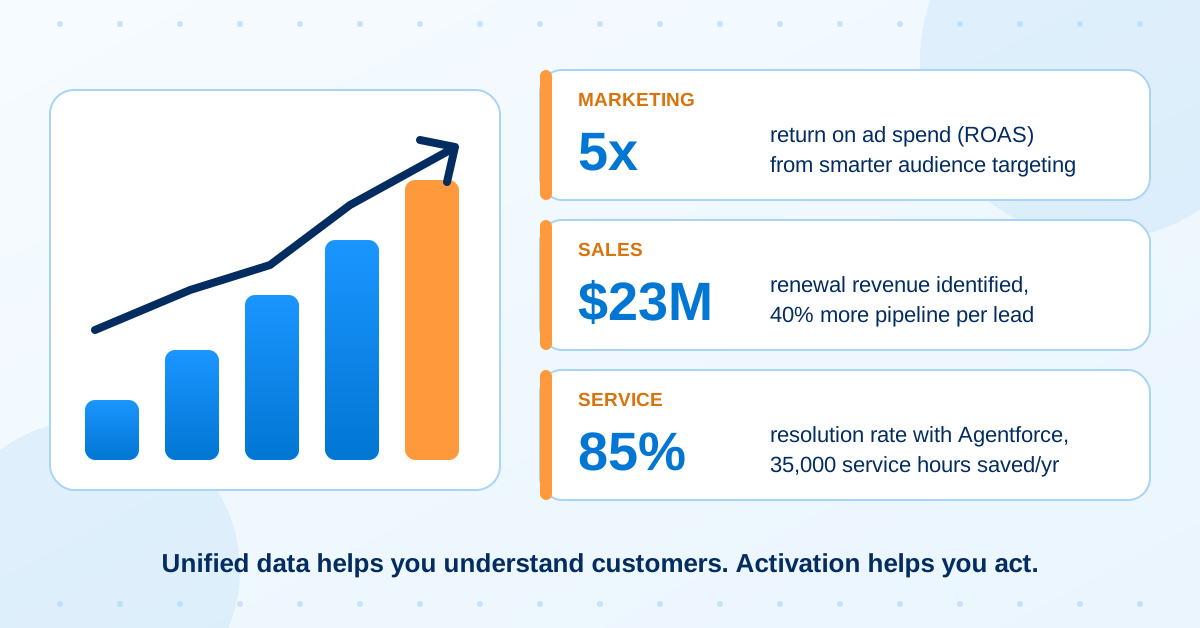
The difference is simple: unified data helps businesses understand their customers, while data activation helps them act on that understanding.
Here are some ways Salesforce Data 360 activation can contribute to measurable business ROI.
Lower Customer Acquisition Costs With Better Audience Targeting
Salesforce Data 360 helps marketers build targeted audiences using first-party data, purchase behavior, and customer preferences, then activate those segments across advertising platforms.
ROI impact: Improved budget efficiency, better audience targeting, and higher conversion rates.
Improve Advertising Returns With First-Party Customer Data
Data 360 Segmentation and Activation helps marketers target high-value audiences using purchase history, customer preferences, and engagement data. These segments can be pushed to platforms like Google Ads and Meta to reach customers who are more likely to convert.
The result? Less wasted ad spend, stronger conversions, and better advertising ROI.
Salesforce Customer Zero example: Salesforce reported a 5x return on advertising spend (ROAS) through smarter audience segmentation and optimized campaign delivery using its unified data foundation.
Increase Sales Opportunities With Unified Customer Intelligence
Sales teams need more than a list of leads; they need to know which opportunities are worth pursuing. Salesforce Data 360 activation, combined with Agentforce, helps surface buying signals, identify renewal opportunities, and uncover cross-selling potential before valuable deals slip away.
The result? Better lead prioritization, faster sales cycles, and stronger pipeline growth.
Salesforce Customer Zero example: Salesforce identified $23 million in potential renewal revenue and achieved a 40% improvement in sales pipeline per lead through AI-powered sales intelligence and targeted lead nurturing. These are internal results, not guaranteed outcomes.
Reduce Customer Service Costs With Data-Powered Agentforce
Slow resolutions and repetitive support requests increase service costs. By connecting Salesforce Data 360 with Agentforce, businesses can give AI agents access to relevant customer context, helping them resolve routine queries faster while human representatives focus on complex cases.
The result? Faster resolutions, reduced support workload, and lower service costs.
Salesforce Customer Zero example: Salesforce reported an 85% resolution rate with Agentforce across millions of conversations and approximately 35,000 customer service hours saved annually through automation.

Why Salesforce Data 360 Isn't Delivering the ROI You Expected
Several factors can limit the ROI of Salesforce Data 360, including poor data quality, incomplete integrations, unused activation capabilities, and a lack of clear business KPIs.
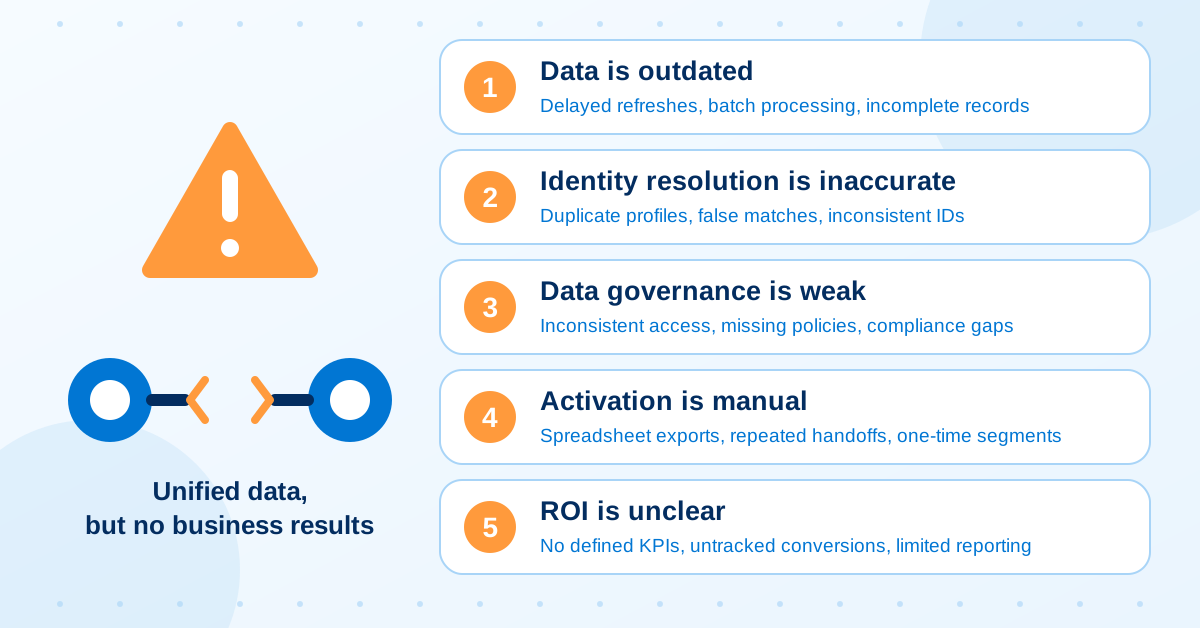
Identifying these gaps helps businesses improve their existing Salesforce Data 360 implementation and get more value from their investment.
5 Signs Your Data 360 Implementation Is Underperforming
If your Data 360 investment isn't delivering the expected results, these five issues may be holding it back.
Data is outdated (delayed refreshes, batch processing, incomplete records).
Identity resolution is inaccurate (duplicate profiles, false matches, inconsistent customer IDs).
Data governance is weak (inconsistent access controls, missing policies, compliance gaps).
Activation is manual (spreadsheet exports, repeated handoffs, one-time audience segments).
ROI is unclear (no defined KPIs, untracked conversions, limited performance reporting).
Each of these gaps quietly reduces your Salesforce Data 360 ROI, even when the platform itself is working as designed. These gaps don't necessarily require a complete re-implementation. The right fixes, prioritized use cases, and a focused activation strategy could be what stands between your current Data 360 setup and the results you're expecting.
What Should You Measure During the First 30 Days?
A 30-day activation sprint may not be long enough to demonstrate the full revenue impact of Data 360. However, it can establish whether the right capabilities are working and whether early business improvements are visible.
Focus on these indicators:
Data quality: Improvements in record completeness, freshness, and identity resolution accuracy.
Activation performance: Successful segment publishing and workflow execution.
Campaign performance: Early changes in engagement and click-through rates.
Sales performance: Changes in lead quality and opportunity conversion.
Operational efficiency: Reduction in manual work and processing time.
The important thing is to compare these results against your original baseline. Track longer-term outcomes, such as customer retention, revenue growth, and customer lifetime value, over a suitable measurement period.
The real measure of Salesforce Data 360 ROI isn't how much data your platform processes. It's how much measurable business value your teams generate from activating it.
Final Thoughts: Turn Your Data 360 Investment Into Business Value
Your next Data 360 improvement may not require another tool, integration, or a new Salesforce Data 360 implementation. It may simply require fixing what isn't working, activating underused capabilities, and focusing on the use cases that deliver the strongest returns.
A focused Salesforce Data 360 activation strategy can help improve campaign performance, uncover sales opportunities, and reduce operational costs. Track the right KPIs, address activation gaps, and keep optimizing to improve your Salesforce Data 360 ROI.
Need help identifying what's holding back your results? Talk to our Salesforce consultants and find the right opportunities to get more value from your existing Data 360 investment.
FAQs
-
Salesforce Data 360 ROI measures the business value generated from using Data 360 compared with its implementation, licensing, integration, and operating costs.
-
It is a structured approach to reviewing an existing Data 360 setup, fixing data and activation gaps, launching priority use cases, and measuring early business results within 30 days.
-
Important KPIs include conversion rates, campaign revenue, customer acquisition cost, customer retention, case resolution time, activation success rates, and operational savings.
-
Poor data quality, inaccurate identity resolution, weak governance, unused activation capabilities, disconnected workflows, and unclear business objectives can limit ROI.
-
Identity resolution matches customer records from different sources to identify records belonging to the same individual or entity. It helps create unified customer profiles and supports more accurate segmentation.
-
Implementation focuses on connecting data sources, configuring data streams, mapping data, and setting up identity resolution. Activation focuses on using that prepared data in marketing, sales, service, and AI-driven workflows.
-
Salesforce Data 360 helps businesses unify customer data, improve audience segmentation, personalize customer experiences, support data-driven decisions, and make customer insights available across business functions.
Related Readings

Let's Talk

Drop us a note, we’re happy to take the conversation forward 👇🏻