
Account Engagement (Pardot) vs Marketing Cloud Growth: Which one to Buy in 2027
Key Takeaway:
Account Engagement (Pardot) vs Marketing Cloud Growth are automation tools that help B2B marketing but differ in architecture, data management, and platform focus.
Buying the right solution depends on the company's goals & requirements.
Growth vs MCAE: Together, they combine traditional B2B lead nurturing with next-generation SF Core & Data Cloud capabilities with no additional base license cost
The wrong assumption to choose between Account Engagement (Pardot) vs Marketing Cloud Growth could lead to direct financial or operational loss due to a fundamental mismatch in target audience, architecture, and core capabilities.
However, this is not just about Account Engagement vs. Marketing Cloud Growth but also about Marketing Cloud Engagement (like Marketing Cloud Account Engagement Vs Marketing Cloud Growth Vs Marketing Cloud Engagement).
This could be confusing for anyone, and changing the name/rebranding is not just a choice but has great reasons that could change the way you prepared your strategies previously in order to bring more out of Salesforce, as these three distinct Salesforce marketing automation tools are designed for different audiences and use cases.
In this blog post, we will discuss each step by step, in detail. So you can make an informed decision before you embark on one of the products.
Still foggy? Let us get into it.
Differences Between Marketing Cloud Account Engagement, Marketing Cloud Growth, and Marketing Cloud Engagement?
Account Engagement (Pardot) vs Marketing Cloud Growth are both Salesforce’s automation solutions. They are designed to support Business-to-Business (B2B) marketing but differ in architecture, data management, and platform focus.
Actually, you should know about SF’s three different tools in detail, step by step. All three tools from SF (Marketing Cloud Engagement vs Marketing Cloud Account Engagement vs Marketing Cloud Growth) are confusing and make it difficult for businesses like yours to choose the right solution that aligns with a company’s exact goals and objectives.
Check this table for a quick scan of Account Engagement vs Marketing Cloud Growth, with just key technical differences.
Comprehensive Technical Difference
| Feature / Dimension | Account Engagement (MCAE / Pardot) | Marketing Cloud Growth (MCG) | Marketing Cloud Engagement (MCE) |
|---|---|---|---|
| Primary Use Case | B2B lead nurturing, drip campaigns, and sales enablement | B2B growth, rapid AI-driven automation, and CRM-native marketing | High-volume enterprise B2C cross-channel consumer engagement |
| Data Management & Architecture | CRM data connector; synced prospect & custom objects | Built natively on Salesforce Core & Data Cloud | Data Extensions (relational database) via Marketing Cloud Connect |
| Lead Qualification & Scoring | Traditional Scoring & Grading rules | Engagement / Fit scores powered by Data Cloud | Einstein Engagement Scoring (predictive engagement) |
| Consent Management | Email Preference Center & CRM opt-out fields | Unified Consent Record & Salesforce Flow | Publication Lists, Suppression Lists & Preference Management |
| Automation Engine | Engagement Studio, Automation Rules & Completion Actions | Salesforce Flow & Data Cloud event triggers | Journey Builder & Automation Studio (SQL/SSJS) |
| Supported Channels | Email, web forms, landing pages | Email, SMS, WhatsApp, landing pages | Email, Mobile Push, SMS, WhatsApp, Advertising Studio |
https://trailhead.salesforce.com/trailblazer-community/feed/0D5KX00000mlFtb0AE
In this section, you will know whether it’s for your business or not and how it will help your organization.
1. What is Salesforce Account Engagement
The answer to “What is Pardot Salesforce?” is now Marketing Cloud Account Engagement. This is a rebranded name and is also abbreviated as MCAE. This B2B marketing automation platform focuses on lead generation, nurturing, scoring, and strong alignment between marketing and sales.
Who it is for
MCAE is a deal for companies with longer sales cycles and a sales team. It is SF’s enterprise, multi-channel marketing platform. Its large-scale customer engagement design across email, SMS, push notifications, and other communication channels is commonly used for B2C lifecycle marketing.
What’s New in SF Account Engagement
Create email with Einstein: To explore the enhanced campaign experience on Marketing Cloud.
Copy to Salesforce Content Management System (CMS): The system assists you in reusing content by copying content and marketing assets into a CMS workspace.
Build Segments in Data Cloud: Allows you to build powerful segments with a 360-degree view of each customer.
Let Your Marketing Flow: Start leveraging Salesforce Flow to automate tasks like content distribution and lead creation.
2. Marketing Cloud Growth (MCG)
MCG, a game changer for businesses, is a simplified marketing automation solution designed for growing businesses. It provides core email marketing and journey capabilities without the complexity of full Marketing Cloud Engagement.
Benefits of Salesforce MCG
Available within CRM as a small package.
Works in line with Data Cloud.
All marketing features at a limited price.
Easy to utilize with other systems.
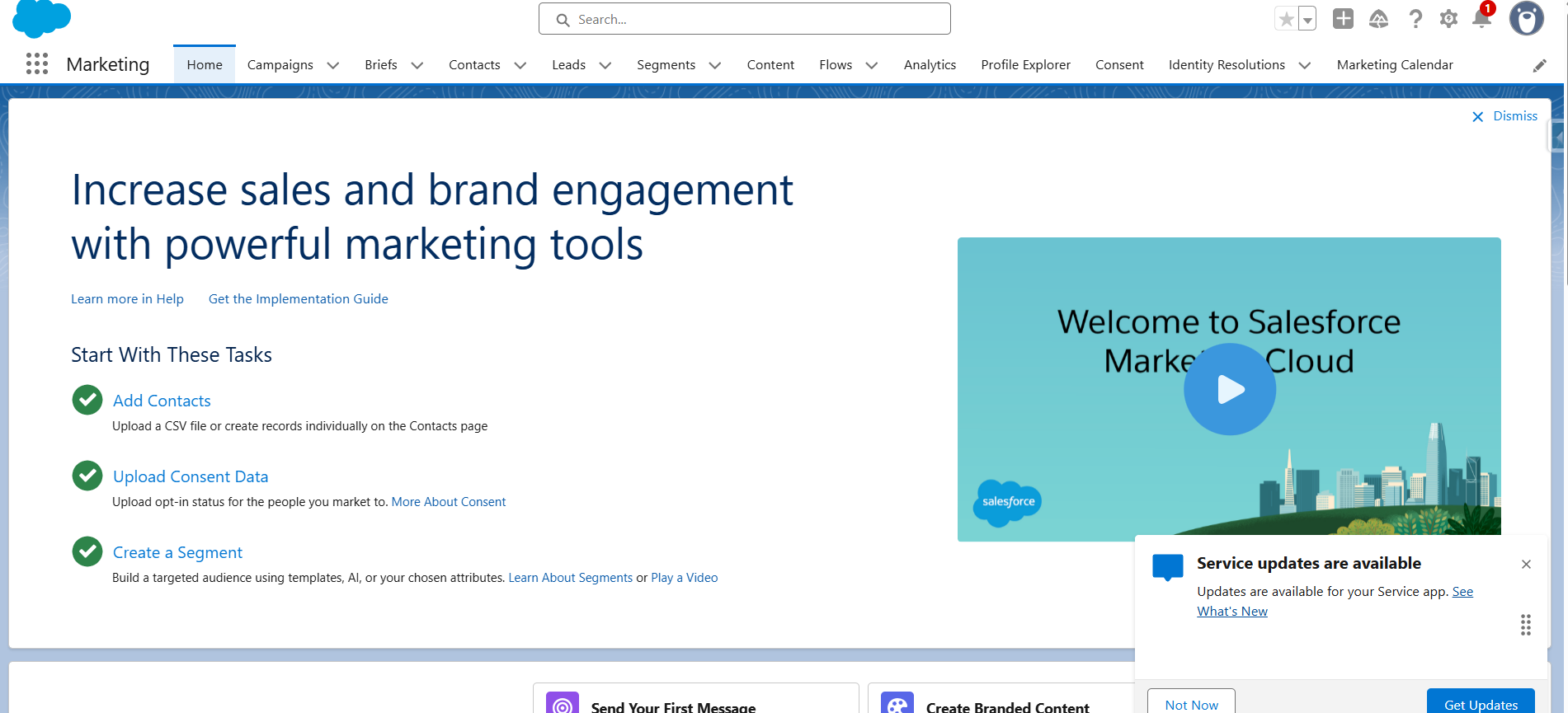
3. Marketing Cloud Engagement
Marketing Cloud Engagement (formerly ExactTarget) is Salesforce’s enterprise, multi-channel marketing platform. It is designed for large-scale customer engagement across email, SMS, push notifications, and other channels and is commonly used for B2C lifecycle marketing.
Benefits of SF MCE
Best for B2B high-volume marketing.
Full enterprise-grade
Multi-channel platform from
Email, SMS (MobileConnect)
Push notifications
Advertising (Advertising Studio)
Complex customer journey (Journey Builder)
> What Expert Says: “Salesforce Marketing Cloud Engagement is one of the most powerful and feature-rich of all three, but it is the most complex and expensive solution. If you are seeking to use this solution for a large-scale B2C campaign, you may consider this multi-channel platform”
Account Engagement (Pardot) Vs Marketing Cloud Growth: Which One to Buy in 2027
Selecting one of the products depends on a company’s goals and requirements. You can make an informed decision between Account Engagement and Marketing Cloud Growth with the following discussion.
If you are seeking to prioritize B2B lead generation, lead scoring, and nurturing through established marketing programs, then choose Marketing Cloud Account Engagement.
Do you want CRM native campaign execution, SF Flow-based automation, and marketing workflows built around connected SF data? Then you can go for Marketing Cloud Growth.
If you are already using Account Engagement, assess the relevant Account Engagement+ packaging before planning a migration. The newest capabilities may be available alongside your existing tools, depending on your edition and entitlements.
You need to think hard based on the facts if you want to make an informed decision, for the best choice is the platform that can align with your marketing requirements, existing architecture, and total cost of ownership, but not the one with the longest feature list.
Which SFMC Product is Best for Your Industry?
This table will help you make the right decision, and you can know how to choose the right solution for your organization. Check the table, as it is created for you to scan based on your industry.
| Industry | Recommended Product | Key Considerations |
|---|---|---|
| B2B SaaS & Technology | Account Engagement or Marketing Cloud Growth | Choose Account Engagement for lead scoring, qualification, and long B2B sales cycles; consider Growth for CRM-connected campaigns and Salesforce-native automation. |
| Manufacturing & Professional Services | Account Engagement | Supports long sales cycles, industry-specific campaigns, and sales follow-ups. Growth is an alternative for organizations prioritizing native Salesforce workflows. |
| Financial Services & Insurance | Depends on complexity | Account Engagement suits B2B relationship marketing, while Growth supports CRM-connected campaigns. Evaluate consent management, data access, and regulatory requirements. |
| Retail & Ecommerce | Marketing Cloud Engagement or Marketing Cloud Growth | Engagement suits established, large-scale multichannel campaigns. Growth may fit businesses seeking CRM-connected marketing and unified customer data. |
| Healthcare & Education | Depends on audience and data requirements | Account Engagement supports B2B outreach and institutional lead nurturing; Growth supports CRM-connected campaigns. Assess privacy and sensitive-data handling. |
| Enterprises (Multiple Brands/Regions) | Marketing Cloud Engagement or Marketing Cloud Growth | Engagement may suit complex, high-volume multichannel operations. Growth may fit organizations standardizing on Salesforce's core platform. |
Feature Comparison: Marketing Account Engagement vs Marketing Cloud Growth
Both SF MCAE and SF MCG support different marketing needs. Engagement focuses on B2B lead generation and nurturing, while MCG brings marketing automation into SF’s core platform, supporting CRM connected campaigns and customer engagement.
| Feature | Marketing Cloud Account Engagement | Marketing Cloud Growth |
|---|---|---|
| B2B lead generation | Built for B2B lead nurturing, scoring, and qualification | Supports lead generation through CRM-connected marketing campaigns |
| Lead scoring | Lead scoring and grading; advanced scoring depends on edition | People scoring and AI-powered capabilities vary by edition |
| Email, forms, and landing pages | B2B email marketing, forms, and landing pages | Email campaigns, forms, and landing pages within Salesforce |
| Marketing automation | Engagement Studio, automation rules, and completion actions | Salesforce Flow-based automation and marketing journeys |
| Audience segmentation | Lists and prospect criteria | Data 360 segments and Salesforce data |
| CRM integration | Connects prospect activity with Salesforce CRM records | Built on the Salesforce platform with native CRM integration |
| Personalization | Dynamic content and prospect-based personalization | CRM-connected personalization and more advanced capabilities in eligible editions |
| AI capabilities | Available features depend on edition and add-ons | Agentforce campaign creation and other AI capabilities depend on edition and entitlements |
| Analytics | Campaign reporting, with advanced analytics available in eligible editions | Campaign analytics and opportunity-related measurement capabilities vary by edition |
| Best fit | B2B organizations with established lead-nurturing processes | Organizations seeking CRM-native marketing and connected customer data |
Note: the features availability depends on the purchased edition, licenses, configuration, and any required Data 360 entitlements.
What Happens When Using Account Engagement and Growth Edition Together
Account Engagement (Pardot) vs Marketing Cloud Growth Edition together lets you combine traditional B2B lead nurturing with next-generation SF core and Data Cloud capabilities at no additional base license cost.
Key Things that Take Place When Pardot vs Marketing Cloud Growth Edition are Together:
Unified Customer Data (Data Cloud): SFDC Marketing Cloud Growth Edition integrates with SF Data Cloud, which gives you a real-time, 360-degree view of customers and prospect interactions across Sales Cloud, Service, e-commerce, and external databases.
Side-by-side operations: The combination allows you to run both applications simultaneously in the same SF environment to align with your current Account Engagement setup.
Agentforce and AI campaign creation: With the help of Einstein, it assists you to unlock prompt based end to end multi channel campaign and content generation.
Native SMS and WhatsApp: No more need for third-party integrations, as the system allows you to gain two-way 24/7 conversational messaging such as automated event reminders, service scheduling, and surveys.
Cross-object personalization: Beyond standard Sales Cloud object limits, you can use cross-object merge fields and Data Cloud-powered dynamic content to personalize email, SMS, and web pages.
Important Operational Differences that You Must Keep in Mind
Consent Model: MCAE uses permission-based consent, whereas the Growth Edition enforces rigid, integrated Consent Records.
Campaigns Do Not Share: The campaigns in both Account Engagement and Growth don’t automatically mirror each other, and they also require distinct naming structures.
Consumption-Based Credit: The features you will use in Growth Edition, including Artificial Intelligence (AI) messaging actions such as SMS and Data Cloud queries, are driven by consumption-based credits.
Should You Compare Account Engagement vs Marketing Cloud Growth vs Marketing Cloud Engagement
First of all, keep in mind that Pardot is the old name, and it was rebranded as Marketing Cloud Account Engagement officially in 2022.
Salesforce Marketing Cloud Account Engagement (Pardot), Marketing Cloud Engagement, and Marketing Cloud Growth depend primarily on your business model, buying cycle, and technical resources.
Quick Comparison
| Feature | Account Engagement (Pardot) | Marketing Cloud Engagement | Marketing Cloud Growth |
|---|---|---|---|
| Primary Audience | B2B (Business-to-Busine) | B2C (Business-to-Consume) | Smaller B2B customers |
| Sales Cycle | Long cycles with multiple decision-makers | Short, transactional purchase cycles | Mid-market or smaller B2B sales |
| Lead Scoring | Out-of-the-box scoring and grading | Einstein Engagement Scoring (predictive opens/clicks) | Engagement and Fit scores |
| Channels | Email, web forms, landing pages | Email, SMS, WhatsApp, mobile push, ads | Core email and journey flows |
| Data Architecture | Native integration with Sales Cloud CRM | External architecture with bidirectional sync connectors | Built natively on Data Cloud |
| Technical Skill Needed | WYSIWYG builders; manageable by specialists | Complex data management; requires developers / SQL | Setup involves IP warming, DKIM/DMARC, Data Extensions |
| Entry List Price (US) | From $1,250 /org/ month (Growth+) | From $2,000/org/ month (Pro+) | Included for some existing Account Engagement customers |
Explore Marketing Cloud Advanced Edition
Marketing Cloud Advanced Edition is a higher tier of Marketing Cloud Next (MCN), and it is built on SF’s core platform. It provides you with Growth features plus advanced AI, Journey experimentation, and conversational messaging capabilities.
What Key Features Does MC Advance Provide:
Artificial Intelligence Power Scoring: You can use predictive insights to understand your customers' engagement better and prioritize audiences.
Path Experimentation: Test different customer journey paths that allow you to optimize campaign performance.
Unified Conversations: It supports two-way SMS and WhatsApp conversations across customer-facing teams, subject to required add-ons.
Advanced automation: Manage more active flows and larger marketing object storage limits than Growth.
Marketing Cloud Growth Vs Advance
MCG suits companies that need core CRM connected marketing automation. If you experience Advanced, it’s better for teams requiring predictive scoring, journey experimentation, and expanded capacity.
| Edition | Starting price (USD) |
|---|---|
| Growth | $1,500/org/month |
| Advanced | $3,250/org/month |
The prices for Growth vs. Advanced are billed annually. The messaging and other usage-based services may cost you extra.
Should You Switch from Account Engagement (Pardot) to Marketing Cloud Growth?
You may decide to switch when Marketing Cloud Growth offers you capabilities that justify the migration cost and effort.
Signs You Can Benefit from MCG
Need for SF Flow based on marketing automation.
Need of CRM connected data and segmentation.
Need for supported multi-channel campaigns and Agentforce capabilities.
When It Makes Sense to Stay on Account Engagement
The existing B2B lead nurturing workflows perform well.
The Engagement Studio, lead scoring, and grading meet needs.
Current integration and reporting work reliably.
Feature Gaps to Validate Before Switching
Automation rules, prospect data structures, content assets, reporting capabilities, consent management frameworks, third-party integrations, and overall licensing costs. Existing MCAE workflows typically require rebuilding in SF Flow rather than migrating directly.
Can Account Engagement and Marketing Cloud Next Coexist?
Yes. Subject to proper licensing and org configuration, a hybrid architecture allows you to maintain existing Account Engagement campaigns while gradually adopting Marketing Cloud Next (Growth or Advanced) capabilities built natively on Data Cloud.
What Happens to Existing Assets and Integrations?
Conduct a comprehensive audit of all existing automations, email templates, landing pages, forms, data field mappings, consent records, and API connections. While content assets in Salesforce CMS can be reused, campaign logic and data flows will not transfer automatically.
Migration-Readiness Checklist
Audit Core Automations: Map existing Engagement Studio programs and completion actions to Salesforce Flow.
Review Data Schema & Consent: Align custom prospect fields and email preference centers with Data Cloud and Unified Consent Records.
Inventory Content Assets: Transfer reusable email layouts, image libraries, and web assets to Salesforce CMS.
Evaluate TCO & Credits: Calculate consumption-based credit usage (SMS, WhatsApp, Data Cloud queries) alongside base edition costs.
What Are the Pros, & Cons, and Limitations of MCAE Vs MCG
MCAE: Strengths & Trade-offs
Pros
Strong B2B lead nurturing, scoring, and grading.
Established Engagement Studio automation.
Suitable for existing Salesforce-connected marketing teams.
Cons
Some advanced features require higher editions or add-ons.
Connector configuration and synchronization require administration.
Program and API limits vary by edition.
MCG: Strengths & Trade-offs
Pros
Built on Salesforce's core platform.
Uses Flow-based automation and CRM-connected data.
Offers eligible AI-powered campaign creation capabilities.
Cons
Some features depend on Data 360 licenses, credits, or add-ons.
Usage allocations and content-generation limits apply.
Complex data requirements may increase implementation effort.
What is Current Salesforce Marketing Cloud Pricing for Both Platforms
Salesforce Marketing Cloud pricing in 2027 is structured around two main platform families. It includes Marketing Cloud Next (on Core), Marketing Cloud Engagement (traditional SFMC), and Marketing Cloud Account Engagement (Pardot).
1. Marketing Cloud Next (New Core Platform)
| Edition | Monthly List Price | Annual List Price | Best For | What’s Included |
|---|---|---|---|---|
| Growth | $1,500/org | $18,00 | Growing teams needing modern agentic marketing | Agentforce campaign creation, multi-channel journeys, form and landing pages, 180,00 email credit/year, 1 scoring model |
| Advanced | $3,250/org | $39,000 | Teams needing advanced testing & conversations | Everything in Growth+ Path experimentation, predictive scoring, unified SMS/WhatsApp conversion, 360,000 email credit/year, 2 scoring models. |
Marketing Cloud Next Pricing(https://www.salesforce.com/marketing/marketing-cloud-editions/pricing/)
Note: SMS and WhatsApp are not included; they are paid and are add-ons (starting at $2 to $10 per 1,000 credits).
2. Marketing Cloud Engagement (Traditional Platform+ Net Capabilities)
| Edition | Monthly List Price | Annual List Price | Best For | What’s Included |
|---|---|---|---|---|
| Pro+ | $2,000 / org | $24,000 | Mid-size programs | Marketing Cloud Growth + 2.5M email messages, 15,000 contacts, 250K Data Cloud credits |
| Corporate+ | $5,500 / org | $66,000 | Larger multi-channel needs | Marketing Cloud Advanced + 10M emails, 1M mobile app messages, 45,000 contacts |
| Enterprise+ | $30,000 / org | $360,000 | High-volume enterprise | Marketing Cloud Advanced + 150M emails, 10M mobile app messages, 500,000 contacts. |
Marketing Cloud Engagement Pricing (https://www.salesforce.com/marketing/engagement/pricing/)
3. Account Engagement (Pardot), B2B Marketing Automation
| Edition | Monthly List Price | Annual List Price | Contacts Included | Best For |
|---|---|---|---|---|
| Growth+ | $1,250 / org | $15,000 | 10,000 | Entry-level B2B automation + Marketing Cloud Next Growth |
| Plus+ | $2,750 / org | $33,000 | 10,000 | Stronger analytics & AI scoring + Next Advanced |
| Advanced+ | $4,400 / org | $52,800 | 10,000 | Business units, dedicated IP, higher limits |
| Premium+ | $15,000 / org | $180,000 | 75,000 | Full enterprise features + Premier Success |
Account Engagement Pricing (https://www.salesforce.com/marketing/b2b-automation/pricing/)
Extra contacts: Starting at $100 per additional 10,000 contacts per month.
Important Notes for Buyers
These are list prices. Most customers negotiate discounts.
Real cost is driven more by message volume, contacts, and add-ons than the base edition fee.
Common add-ons: SMS/WhatsApp credits, extra email sends, Business Units ($2,500/month each), Data Cloud profiles, Personalization, Marketing Intelligence, and Success Plans (Premier is often ~30% of net license fees).
Pricing can change. Always get a formal quote from Salesforce.
What Will Be the Future of Salesforce Marketing Cloud: Marketing Cloud Next
Marketing Cloud Next is Salesforce Marketing Cloud Future. It is rebuilt on SF’s Core and integrates Data 360 (formerly Data Cloud) and Agentforce AI. If we see Growth and Advanced, they are its editions.
Core Shifts
Agentic Marketing: The modern solution of autonomous AI agents replaces one-way broadcast with two-way, cross-channel conversations.
Native Architecture: Marketing, Sales, and Service share one database and workflow, and this is replacing the legacy ExactTarget stack.
Real-time personalization: Data 360 handles segmentation and activation, and this replaces manual data extensions and sync scripts.
Low-code orchestration: Flow Builder and workflows reduce reliance on AMPScript, SQL, and SSJS.
What Marketers Should Learn
Prioritize Strategy over Setup: Teams can spend less effort on technical configuration or complex connectors, pivoting toward prompt engineering, strategic planning, and unified technical architecture.
Platform Coexistence: Legacy Marketing Cloud Engagement will continue to operate parallel to Next capabilities throughout a multi-year enterprise transition period.
Unified Licensing Models: Salesforce cost structures are shifting toward all-inclusive platform packages instead of fragmented modular add-ons.
Ask the Following Questions to Choose the Right SFMC Product
Do you primarily generate B2B leads or engage a large customer audience?
Are you seeking advanced lead scoring or multichannel customer journeys?
Is your SF data architecture ready for MCN?
Do you think your existing automation and integration need to remain intact?
Does the expected business value justify licensing and implementation costs?
Clear all these questions first, as it will help you make an informed decision to choose one of the right editions for your business.
Conclusion
The Salesforce marketing portfolio could be confusing for anyone, but you need to learn how each differs and what the role of each of them is. It is not just about Account Engagement (Pardot) vs Marketing Cloud Growth but also about Marketing Cloud Engagement. Choosing one of the right solutions could drive your business growth because they feature distinct system architectures, data models, and platform capabilities.
Your time is more valuable than money; why waste it? Connect with one of the experts at Concret.io right now, as you learned how each differs and could help your company achieve the set goals.
Resources
https://trailhead.salesforce.com/trailblazer-community/feed/0D5KX00000mlFtb0AE
Salesforce Marketing Cloud Official Pricing
Salesforce Help: Marketing Cloud Growth Edition Documentation
Frequently Asked Questions
-
Marketing Cloud Engagement is built for high-volume, multi-channel B2C marketing. On the other hand, Marketing Cloud Account Engagement (Pardot) is designed for B2B lead nurturing and sales alignment.
-
No, Pardot is now Marketing Cloud Account Engagement (MCAE); SF Marketing Cloud is now Marketing Cloud Engagement. They are designed for different business models and use cases. If you are looking for high-volume, multi-channel B2C marketing, choose MCE, or if you want to nurture leads and sales alignment, then select Marketing Cloud Account Engagement (MCAE).
-
The future of SFMC centers on the transition towards Marketing Cloud Next (known as Marketing Cloud Growth or Advanced), which builds the platform natively on SF Core and integrates Data Cloud with Agentforce AI.
Core Shifts
Agentic Marketing
Native Architecture ( Marketing Cloud Core)
Data 360 and Real-Time Personalization
Low code/No Code Focus
Is Pardot now called Account Engagement?
Yes, SF officially changed the name; its shorter name is Account Engagement or MCAE.
Related Readings
Let’s Talk

Drop us a note, we’re happy to take the conversation forward 👇🏻