How Salesforce Is Rebuilding Marketing Cloud with Agentforce Marketing
Key Takeaways:
Platform Transformation: Marketing Cloud is moving to Salesforce’s core platform with Data 360 for real-time, AI-driven conversations.
Autonomous AI Agents: Agentforce uses Atlas reasoning and Einstein Trust Layer to automate campaigns, audiences, and customer journeys.
Pricing & Strategy: Consumption-based Flex Credits make data readiness and use-case evaluation essential before migration.
Did you know that Salesforce has rebuilt Marketing Cloud? It is now transitioning towards Agentforce Marketing to run natively on the core Salesforce platform, with Data Cloud built right in. This will solve long-standing architectural, data, and usability problems that plagued classic SFMC (Marketing Cloud Engagement).
Salesforce's recent marketing report says 75% of marketers are already dabbling in some form of AI, whether it is predictive, generative, or agentic AI. But only 13% of marketers are currently using agentic AI, autonomous AI agents that take actions on your behalf.
This is a great opportunity for SMB marketers who want to grow quickly by adopting Artificial Intelligence (AI). As a large number (87%) of the industry is sitting on the sidelines, it can help improve performance and deliver durable benefits.
AI agents let marketers reduce manual execution work and free up about 6 to 7 hours a week that you can put into more creative and strategic tasks.
In this comprehensive blog post, we will learn what Agentforce is, its architecture, how SF is rebuilding the years-old SFMC, and what’s new in it, including Agentforce pricing currently.
What Is Agentforce Marketing?
Agentforce Marketing is now a next-generation, AI-driven evolution of SFMC. It uses autonomous AI agents that manage your campaign, build audiences, and optimize your customer journeys in real time.
SF’s broader platform Agentforce’s capabilities allows you to deploy autonomous AI agents. It connects safely to enterprise data and CRM workflows.
Naming Map: Legacy vs. Current Capabilities in 2027
| Old / Traditional Term | Current Agentforce Marketing Equivalent / Description |
|---|---|
| Marketing Cloud Engagement (MCE) | Formerly "ExactTarget"; traditional multi-channel enterprise journey management (email, mobile, advertising), now integrated with Agentforce actions. |
| Account Engagement (MCAE) | Formerly "Pardot"; B2B marketing automation and lead management toolset. |
| Marketing Cloud Next / Growth / Advanced | The modern native Salesforce marketing automation editions are built directly on the core CRM and Data 360/Agentforce layer. |
| Salesforce Intelligence | Advanced marketing analytics and performance reporting tools integrated into the suite. |
| Salesforce Personalization | Real-time web and channel personalization engine (formerly Interaction Studio) powered by live data signals. |
Why Salesforce Is Rebuilding Marketing Cloud
SF rebranded its marketing cloud into Agentforce Marketing to:
Shift digital marketing from static.
One-way “do not reply” broadcasts into the dynamic.
AI-driven.
Two-way conversations.
This update shifts from a siloed, standalone messaging tool into a native, AI-driven platform built directly on core CRM and Data 360 (Data Cloud).
Statistics: SF’s Reason to Rebuild Marketing Cloud
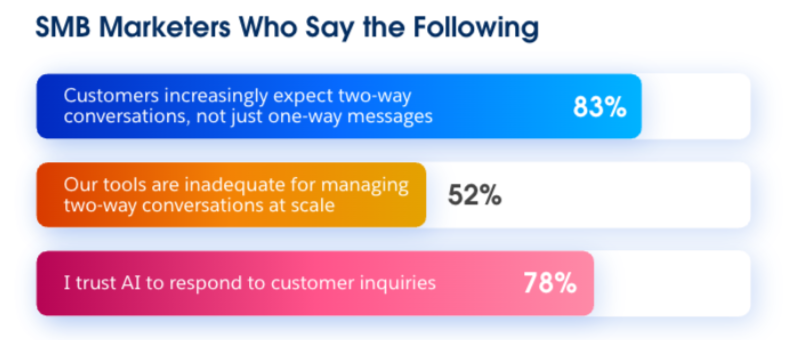
The overwhelming 83% of SMB marketers report that their business customers expect two-way conversations, and they do not need just broadcast messages.
52% of marketers admit that their current tools are completely inadequate when it comes to managing two-way conversations at scale.
The modern solution, Agentforce AI in SFMC, has earned 87% of marketers’ trust as the modern solution. It allows AI agents to respond to customer inquiries, nurture and qualify leads, and let lean teams finally deliver the hyper-personalized conversations that buyers demand; furthermore, it eliminates the need to add massive headcount to pull it off.
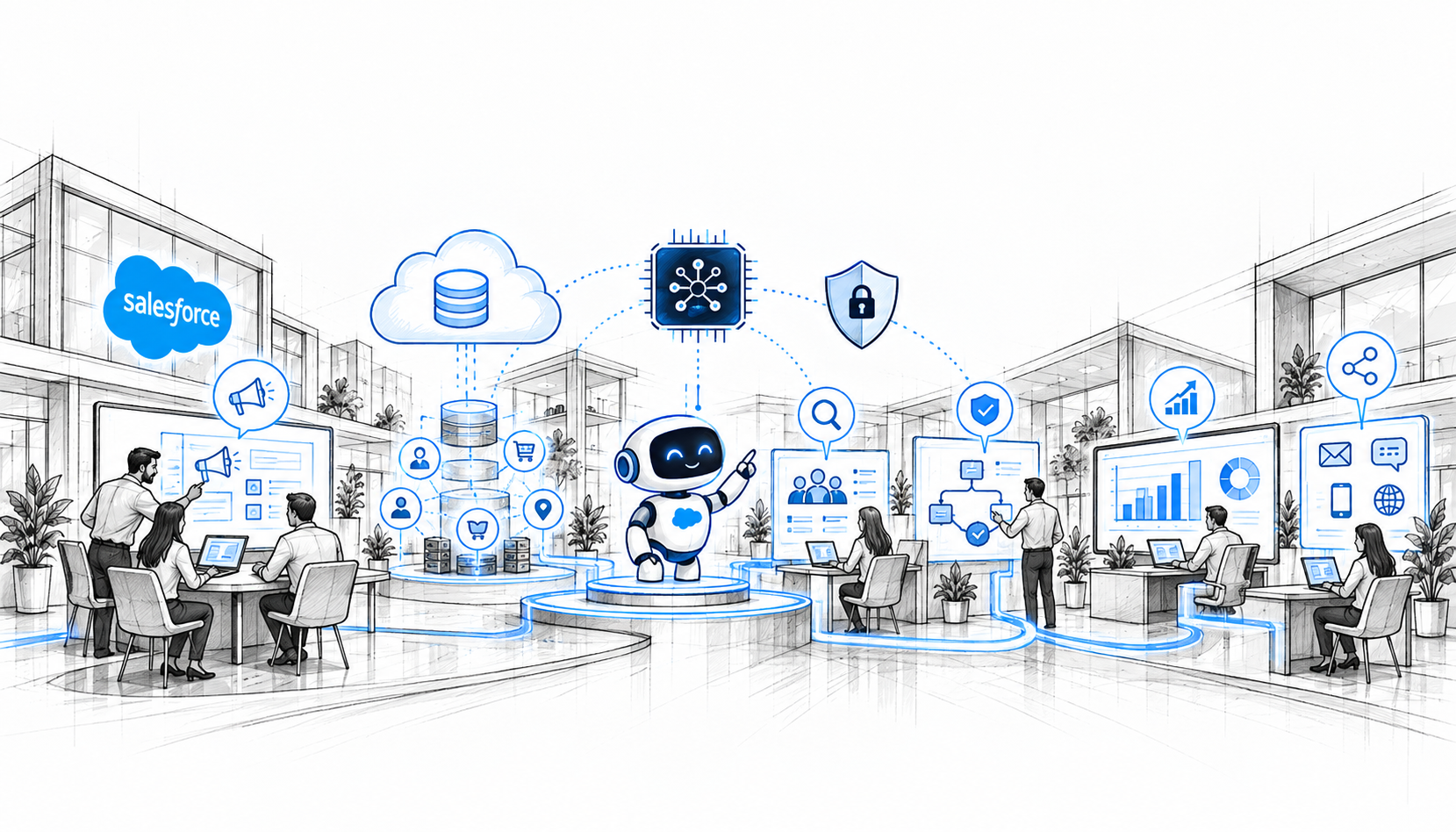
Agentforce Architecture for Marketing: Data 360, Atlas and the Trust Layer
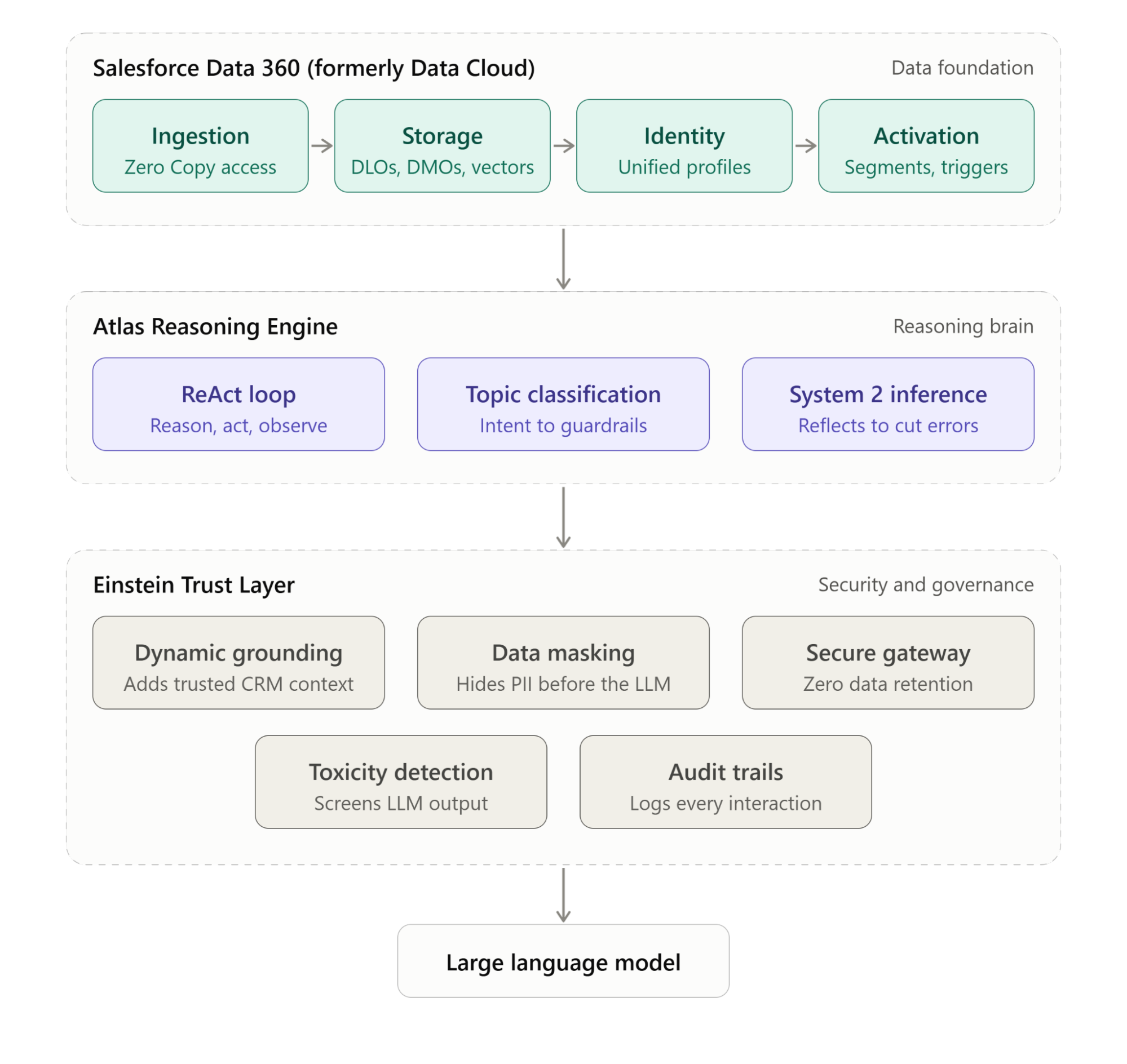
Salesforce Data 360 (formerly Data Cloud) serves as the native, real-time data engine and foundational Customer Data Platform (CDP) for Agentforce architecture.
1. Architectural Layers of Data 360 in Agentforce Marketing
Ingestion and Zero Copy Connectivity: It connects to more than 270+ sources, and this includes MuleSoft and APIs. This process uses Zero Copy Integration to federation link external data lakes such as Snowflake, Databricks, Google BigQuery, and AWS without data duplication or heavy ETL pipelines.
Storage and Harmonization: For accurate and better results, your AI requires clean data. So, in the second step, it stores original raw data in Data Lake Objects (DLOs) and maps them to Customer 360 Data Model Objects (DMOs); further, it processes unstructured assets such as your PDFs or logs into a vector database for AI readiness.
Identity Resolution and Unification: In the third step it applies fuzzy, exact and normalized match/reconciliation rules across households, touchpoints, and devices to create a living, and the 360 degree within this unifies customer profiles.
Analysis and Activation: It powers segmentation (generative, waterfall, nested), calculated insights, and real-time triggers. It will help in feeding context directly to Agentforce Marketing Agents in order to drive cross-channel execution like email, web, mobile, and paid media with a second response time.
2. Salesforce Agentforce is powered by the Atlas reasoning Engine. This acts as an autonomous brain for enterprise-grade AI automation.
The core architecture and Workflow it follows is
ReAct prompting Loops, where it uses a Reason, ACT, and Observe cycle instead of standard linear Chain of Thought prompting, which further allows agents to dynamically adapt to new information.
Topic Classification: This maps the user intent to specific business instructions, guardrails, and scoped policies.
System 2 interference: It retrieves deep CRM data and metadata context, then reflects on its own outputs to minimize hallucinations before finalizing a response as well.
3. Einstein Trust Layer is SF’s native security and governance architecture. It sits between Agentforce and large language models (LLMs), and this ensures enterprise data remains private and secure at the same time.
Core Architecture and Data Journey
Dynamic grounding
Data masking
Secure gateway & zero data retention
Toxicity detection
Audit trails
Agentforce Studio, Agentforce Documentation and Agentforce Marketing Trailhead
Agentforce Studio is Salesforce’s central workplace. It allows you to configure, build, and test autonomous AI agents. This is unlike traditional chatbots that rely on strict decision trees; Agentforce agents use large language models (LLMs), and they understand user intent, reason through complex tasks, and dynamically execute actions.
When it comes to building and testing an agent, it involves four core steps, which are as follows:
You have to define the agent’s role and guidelines.
Assign topics.
Add actions.
Test in the agent tester
Best Agentforce Implementation and Governance Resources
Agentforce Evaluation and Testing: Assess agent accuracy, validate actions, test business scenarios, and monitor performance before deployment.
Agentforce Implementation and Configuration: Understand how to configure agents, connect business data, define actions, and integrate agents into existing Salesforce workflows.
Salesforce AI Security and Governance: Address data privacy, access controls, security risks, and responsible AI practices to ensure reliable enterprise deployment.
Agentforce Prompt Design: Define clear instructions, business rules, and response guidelines to improve agent accuracy and consistency.
Agentforce Service Automation: Identify customer service processes suitable for agent automation, such as handling routine inquiries, supporting case resolution, and escalating complex issues to human teams.
These resources help business and technical decision makers evaluate Agentforce use cases, plan implementation, manage risks, and measure business value.
What Are the Core Capabilities and Use Cases of Agentforce
Segment creation, briefs, content, journeys, campaign summaries
Segment Creation: Build target audiences instantly via natural language prompts instead of complex SQL.
Campaign Brief: You will need to synthesize high-level goals into structured briefs outlining messaging and audiences, including the KPIs.
Content Generation: Produce multi-channel copy and dynamic personalizations aligned with brand guidelines.
Journey Builder: Design the multi-step customer flows and triggers automatically using one of the best-practice templates.
Campaign Summaries: Aggregate cross-channel performance metrics into executive-level overview reports.
Conversational Journeys Across Email, SMS, and Web
Email: Turn static promotional broadcasts into interactive dialogues enabling real-time preference updates.
SMS: Execute two-way conversational text messaging to manage schedules, answer queries, and process opt-ins.
Web: Deliver personalized messaging and live interactions tailored to real-time browsing behavior.
Context Retention: Maintain session history seamlessly as customers move across channels.
B2B vs B2C Use Cases
B2B Use Cases: Focus on account-based nurturing based on buyer stage, automated lead scoring and routing, and multi-stakeholder personalization across buying committees.
B2C Use Cases: Focus on high-volume personalization like cart abandonment recovery, predictive reorder reminders, and automated loyalty program engagement.
Example with a Sample Case Study
This is a sample case study for your comprehensive understanding. Go through the same and understand whether the same solution could help your brand.
Scenario: A global retail brand deployed Agentforce Marketing to recover abandoned shopping carts and re-engage dormant high-value customers.
Execution: Automated identification of abandoned carts in Data Cloud coupled with real-time, interactive SMS conversational recovery prompts.
KPI Results: The brand achieved more than an 18% increase in cart recovery within 30 days. Further, the brand also saw a 2.4x higher conversion rate compared with static SMS broadcasts.
The Current Agentforce Marketing Pricing in 2027
Here is the complete breakdown for Agentforce pricing; it helps you understand the pricing structure.
| Category / Edition | Pricing Structure | Key Features & Details |
|---|---|---|
| Marketing Cloud Next Growth Edition | $1,500/org/month (billed annually) | Designed for foundational, cross-channel journeys and AI-assisted automation. |
| Marketing Cloud Next Advanced Edition | $3,250/org/month (billed annually) | Includes Agentforce Campaigns with built-in AI scoring, complex path experimentation, and multi-channel conversations for SMS and WhatsApp. |
| Account Engagement+ (B2B) | Starts at $1,250/org/month (up to $15,000/org/month for Premium+) | Base Growth+ includes 10,000 contacts for lead nurturing, scoring, and Agentforce campaign elements. Tiers scale to Plus+, Advanced+, and Premium+. |
| Engagement+ (B2C) | Starts at $2,000/org/month (up to $30,000/org/month for Enterprise+) | Entry Pro+ plan bundles 15,000 contacts and up to 2.5 million email sends. Higher tiers include Corporate+ and Enterprise+. |
| Intelligence+ | $11,000/org/month (billed annually) | Updates legacy marketing intelligence stack for automated data harmonization and unified marketing dashboards. |
| Personalization+ | $15,000/org/month (billed annually) | Enables sub-second web/app behavioral triggers and localized agent orchestration based on active real-time data. |
| Agentforce User License & Flex Credits | $5/user/month plus Flex Credits ($500 per 100k credits) | User license provides baseline access. Standard agent actions consume 20 credits ($0.10) and voice actions consume 30 credits ($0.15). |
| Agentforce 1 / Max Editions | From $550/user/month | Bundles unmetered employee usage with an organizational allowance of 2.5 million Flex Credits per org/year. |
| Hidden Costs / Additional Overages | Varies by consumption and service tier | Includes contact overages ($100/10k contacts/mo), Data Cloud consumption (up to $108k/yr), SMS/WhatsApp routing, faulty agent loop consumption, and Premier Success Plans (30% net license fee). |
Price Difference in Marketing Cloud or Agentforce Marketing Cloud
Price difference in Marketing Cloud or Agentforce Marketing Cloud. The Salesforce Marketing Cloud relies primarily on a flat per-organization monthly subscription. If we look at the Agentforce features, autonomous agent actions are managed through consumption-based Flex Credits.
Here is a clear side-by-side comparison of the price difference between choosing Marketing Cloud and choosing the modern solution of Agentforce Marketing Cloud.
| Feature / Dimension | Traditional Salesforce Marketing Cloud (Growth / Advanced / Engagement) | Agentforce Marketing Cloud (AI-Driven / Flex Credits) |
|---|---|---|
| Pricing Basis | Per-org (e.g., $1,500/mo for Growth; $3,250/mo for Advanced) or volume-based (Engagement). | Per-user license baseline (500 per 100k credits). |
| Billing Model | Annual contracts billed annually in advance. | Pre-purchase, pre-commit, or Pay-Go via Digital Wallet tracking. |
| AI Usage Metering | Built-in basic Einstein AI scoring/path experimentation included in flat base platform fees. | Metered execution tokens/actions via Flex Credits (e.g., 20 Flex Credits per autonomous agent action). |
| Primary Value Driver | Access to channel volume (emails, SMS/WhatsApp credits) and database size. | Autonomous execution volume (campaign creation, brief generation, automated segmentation). |
Pricing sources: Salesforce Marketing Cloud Pricing | Salesforce Agentforce Pricing | Salesforce Marketing Cloud Engagement Pricing
Checkout Three-Year Cost Scenarios
All the below examples are just estimated factors, and they are based on subscription licenses plus projected message/action consumption for month 36.
1. Small Team
Profile: a single brand, low to moderate monthly volume, basic multi-channel journeys.
Traditional Marketing Cloud (Growth): It charges you $1,500/org/month ($18,000 year) + minor overages ($2,000/year for extra sends)
Year 1 to 3 total: $20,000 years x 3 = $60,000.
Agentforce Marketing Cloud: The minimal user license tier ($5/ month for per user for 5 seats + $300 year) + lower-tier Flex Credit pool for autonomous campaigns ($1,000 month consumption).
Year 1 to 3 total: ($12,300 year) x 3 = 36,900
2. Mid-Size Team
Profile: Growing multi-channel execution (SMS, WhatsApp, path experimentation), moderate AI-assisted segmentation.
Traditional Marketing Cloud (Advanced): 3,250/org/month(39,000/year) + add-on messaging credits ($10,000/year).
Year 1 to 3 Total: $49,000/yr 3 = $147,000.
Agentforce Marketing Cloud: Moderate autonomous agent usage scaling up to mid-tier Flex Credit consumption ($2,500/month in actions/tokens).
Year 1to 3 Total: ($30,300/yr) 3 = $90,900 (subject to burst pricing if agent task complexity increases).
3. Enterprise Team (High-Volume/Custom Engagement)
Profile: Multi-brand, high-frequency B2C database messaging or heavy automated campaign operations.
Traditional Marketing Cloud (Engagement+ / Enterprise): Custom quote-based volume starting around 2,000–11,000+/org/month bundled, averaging $120,000+/year.
Year 1 to 3 Total: $120,000/yr 3 = $360,000+.
Agentforce Marketing Cloud: High-volume automated workflows driven entirely by continuous autonomous agents, scaling into large Flex Credit consumption blocks (6,000 to10,000/month usage).
Year 1to 3 Total: ($96,000/yr) 3 = $288,000 (with open risk profiles if runaway agent jobs spike token counts).
Feature Difference: Marketing Cloud Engagement vs. Marketing Cloud Next
Marketing Cloud Engagement automates journeys based on rules marketers define, while Marketing Cloud Next uses unified data, AI, and Agentforce to make marketing more adaptive, intelligent, and autonomous.
| Feature | Marketing Cloud Engagement | Marketing Cloud Next |
|---|---|---|
| Core approach | Rules-based marketing automation | AI-powered, agentic marketing |
| Journey orchestration | Journey Builder | Flow + AI-powered orchestration |
| Automation | Predefined workflows and rules | Adaptive automation with AI agents |
| Customer data | Data extensions and marketing data | Data 360 unified customer data |
| Segmentation | Marketers create/manage segments | AI can generate audiences using natural language and real-time data |
| Content creation | Marketer-created content using Content Builder | AI-assisted content and campaign creation |
| Personalization | Rules and predefined customer attributes | Real-time, AI-driven personalization |
| Decisioning | Marketer-defined decision splits | AI-powered journey decisioning |
| Customer interaction | Primarily campaign/message driven | Two-way, conversational interactions |
| Optimization | Marketers analyze performance and adjust campaigns | AI can monitor and optimize campaigns |
| AI | AI capabilities can be added/used alongside existing workflows | Agentforce and Einstein are built into the experience |
| CRM integration | Integrates with Salesforce CRM | Built natively on the Salesforce Platform |
| Existing Journey Builder journeys | Designed and executed here | Can be connected/used with the next-generation environment |
| Best suited for | High-volume, established marketing programs | Adaptive, real-time and AI-driven customer engagement |
Marketing Cloud Implementation and Migration Roadmap
A successful Salesforce Marketing Cloud implementation requires you to understand the existing marketing stack, customer data, integrations, and exact business requirements.
Note: If you are one who is moving from Marketing Cloud Engagement to newer Marketing Cloud capabilities. You should treat migration as a phased process rather than a simple platform switch.
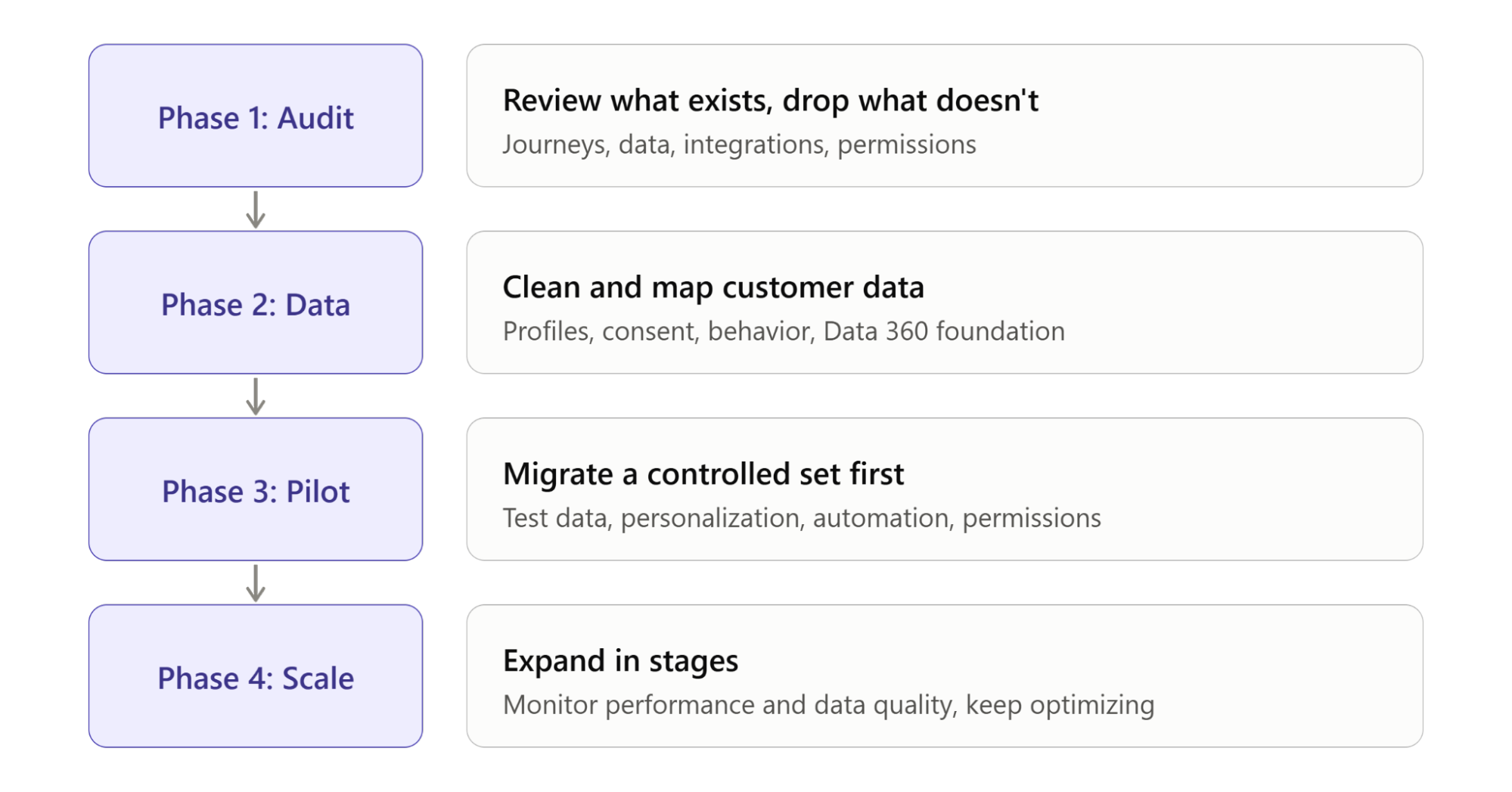
Phase 1: Audit
Review the existing SFMC environment, including:
Data extensions
Journeys
Automations
Integrations
Content
User permissions
Dependencies
Identify redundant assets such as:
Outdates workflows
Data quality issues
Processes that shouldn’t be carried into the new environment
Phase 2: Data
Clean and map your customer data before migration. Now define how customer profiles, consent information, behavioral data, and other relevant records will be structured and connected. If you are adopting Marketing Cloud Next, there organizations should also evaluate how Data 360 will support a more unified customer data foundation.
Phase 3: Pilot
Begin with a controlled migration of selected journeys, campaigns, data, and integrations. Test data accuracy, personalization, automation, integrations, permissions, and customer experiences before expanding the implementation.
Phase 4: Scale
In the fourth phase, migrate the remaining workloads in stages after the pilot is validated.
Monitor campaign performance
Data quality
Integrations
Integrations
Journey behaviour
Optimize the new environment
Timeline, Team Roles, and Implementation Costs
The implementation timeline varies according to:
Data complexity
Number of journeys
Integrations
Customization requirements
Migration scope
A typical project may involve marketing stakeholders, SF administrators, developers, data and integration specialists, and implementation partners.
Costs: the cost of Marketing Cloud Implementation is very significant; its key cost drivers include are as follows:
Salesforce licenses
Implementation services
Data migration
Integration
Custom development
Testing
Training
Ongoing support
What Are Common Marketing Cloud Migration Mistakes
Here are the common mistakes you must consider for SFMC migration.
Migrating unnecessary legacy assets
Failing to clean and map data
Overlooking integrations and dependencies
Insufficiently testing journeys
Neglecting consent and governance requirements
You must pay attention to other common issues: treating migration as a one-time technical exercise instead of planning for ongoing optimization and adoption.
Which Industries Should Use Marketing Cloud vs. Upgrade?
If you have mature, rule-based campaigns, stable customer journeys, and limited needs for real-time personalization. You may not need to upgrade to the newer version immediately. This can include businesses whose existing Journey Builder, Automation Studio email, SMS, and other established workflows already meet their requirements.
Salesforce allows existing Engagement customers to continue using the capabilities while adding newer functionality when needed.
Industries that can benefit from Marketing Cloud Next
The industries that have large customer volumes, complex journeys, frequent personalization needs, or significant amounts of real-time customer data are stronger candidates for Marketing Cloud Next.
| Industry | Why Marketing Cloud Next Can Help |
|---|---|
| Retail and e-commerce | Real-time personalization, product recommendations, loyalty, and conversational engagement |
| Financial services | Personalized customer journeys and timely, context-aware communications |
| Travel and hospitality | Adaptive offers and real-time customer engagement across the journey |
| Healthcare | Personalized communications where appropriate, with strong privacy and governance controls |
| B2B and technology | AI-assisted demand generation, lead nurturing, account-based marketing, and sales alignment |
| Media and entertainment | Personalized content and cross-channel engagement at scale |
Risks, Limitations and Governance
Consent, privacy, and brand safety.
Maintain customer consent, data privacy, access control, and governance. You can use clear brand guidelines and AI guardrails in order to prevent inaccurate, inappropriate, or non-compliant communications.
When Not to Migrate Yet
Delay migration if your current Marketing Cloud setup meets business needs, critical integrations are not ready, data needs significant cleanup, or your team lacks the resources to manage and test the new environment.
How to Choose: Marketing Cloud Vs. Marketing Cloud Next Decision Checklist
Here are the top five questions every marketer must consider before they jump on to have Agentforce Marketing Cloud.
1. Are you seeking real-time personalization?
If yes, you can look for Marketing Cloud Next, which could be a better fit for you.
2. Is your current Marketing Cloud setup enough?
If Marketing Cloud Engagement, Journey Builder, and Automation Studio meet your needs, upgrading may not be necessary.
3. Do you need Agentforce for marketing?
Consider whether AI agents can improve campaign creation, personalization, and engagement.
4. Is your data ready for Marketing Cloud Next?
Assess data quality, consent, integrations, and Data 360 readiness.
5. Does the upgrade justify the cost?
Compare implementation, migration, licensing, and training costs with expected business value.
Conclusion
The entire world moves on with the evolving solution of Artificial Intelligence (AI), as digital marketers are already dabbling in various forms of AI, from predictive and generative to agentic AI. They need more productive, intelligent, quick, and effortless solutions in order to get rid of legacy data silos and manual technical plumbing.
However, making an informed decision about choosing between the modern Agentforce Marketing solution and the previous one is easy. Therefore, you just need to determine whether you have mature, rule-based campaigns, stable customer journeys, and limited needs for real-time personalization; you may not need to switch to the newer version. It requires you to consider all the aspects before you jump on.
Are you ready for the evolving solution of Agentforce Marketing Cloud? Plan your Agentforce Marketing move with Concret right now.
Resources
Frequently Asked Questions
-
No, Marketing Cloud Engagement automates journeys based on rules marketers define, while Agentforce Marketing/Marketing Cloud Next uses unified data, AI, and Agentforce to make marketing more adaptive, intelligent, and autonomous. With AI agents, marketers plan, create campaigns and content, optimize, and orchestrate adaptive customer experiences across every channel and interaction. It is built on the world’s #1 CDP, as Agentforce Marketing connects data, AI, automation, and engagement into one deeply unified platform for both B2B and B2C marketing purposes.
-
The cost of Agentforce Marketing varies based on the underlying deployment tier. If you are looking for entry-level plans, it typically starts around $1,250 per month. This is because SF uses a combination of base platform editions, user licensing, and consumption-based models; therefore, the total cost depends on how you are deploying AI agents.
-
Agentforce allows you to build autonomous AI agents, being SF’s overarching, cross-functional platform. On the other hand, Agentforce Marketing/Salesforce Marketing Cloud is tailored to marketing automation, campaigns, and customer engagement.
-
MC Next is a next-generation, AI-driven enterprise marketing platform. It is built natively on Data Cloud to unify customer data, real-time engagement, and cross-channel workflows. Its upgrade eliminates legacy, siloed marketing modules to offer a single, cohesive environment for B2B and B2C marketing.
-
Yes, but you should have Enterprise Edition or higher to access a free tier of Agentforce through Agentforce Foundations.
-
Agentforce acts as an autonomous, AI-driven partner. It uses natural language and unified customer data to plan, build, and optimize marketing campaigns. Agentforce work is completed in the following ways:
Natural language control
Data Cloud data 360 integration
Autonomous execution
Continuous optimization
Trusted guardrails
-
No, it doesn’t have any dedicated standalone free trial for Agentforce in Marketing Cloud/Marketing Cloud Next. If you are an existing eligible CRM customer, you can have access to baseline Agentforce capabilities via free components in Salesforce Foundations.
Related Readings

Let’s Talk

Drop us a note, we’re happy to take the conversation forward 👇🏻