
8 SFMC Pains Marketing Cloud Next Fixes
Key Takeaways:
Unified Data Architecture: Marketing Cloud Next connects trapped customer silos by leveraging Data 360 & native SF records for real-time personalization.
Flow & Agentforce Automation: Replaces technical overhead & rigid processes with Flow Builder & AI-assisted workflows across complete lifecycle.
Coexistence over Replacement: Legacy tools like Journey Builder, Automation Studio, & AMPscript remain supported during transitions & integrate alongside MCN.
The world is evolving at a rapid speed, and it is about more intelligent decisions, quick, and hyper-personalization for businesses. Can you win this war for your business with the legacy SFMC? The answer is no! As the Marketing Cloud evolves, the older Salesforce Marketing Cloud acts as a severe operational bottleneck.
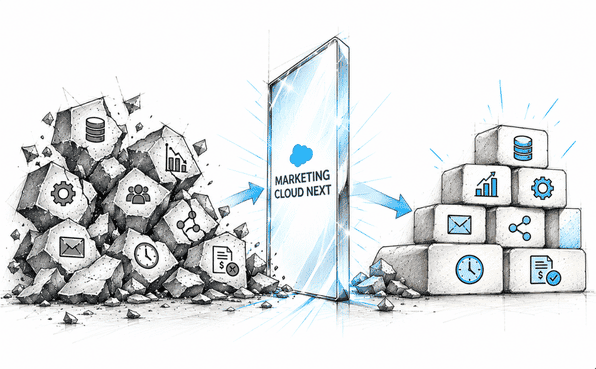
Marketing Cloud Next directly addresses the infrastructure challenges by shifting to a unified, Salesforce native architecture. It leverages harmonized data, Salesforce Flow automation, and embedded AI.
In this article, we will discuss the 8 common SFMC pain points and learn how Marketing Cloud Next resolves them.
Explore: 8 SFMC Pains Marketing Cloud Next Fixes
Here is how Salesforce Marketing Cloud Next will help you solve the top 8 problems organizations usually face today.
1. Customer Data Is Trapped in Silos
The time your business customer data sits across CRM, marketing, service, and external systems. It makes it more difficult for organizations like yours to maintain a unified customer profile.
Marketing Cloud Next Solution
However, the improved solution of Marketing Cloud Next, along with Data 360, allows you to connect and unify data from multiple sources to support segmentation and personalization.
Business Value: It drives business value by having more consistent customer data and relevant campaigns.
2. Marketing Automation Depends Too Much on Technical Teams
Traditional marketing automation can include SQL queries, scripting, data preparation, and dependencies on your technical team. All of these tools remain valuable for complex requirements, but routine campaign changes can become slow when marketers depend on developers or administrators for every adjustment.
How Marketing Cloud Next helps
Marketing Cloud Next (MCN) uses Flow Builder as its visual automation tool. Teams can build workflows that connect marketing actions with Salesforce records and business processes. The Agentforce can also assist with campaign creation and other supported marketing tasks.
Example
A B2B company could create a follow-up workflow based on lead information and campaign engagement, then connect with resulting actions to its SF sales process.
Existing Automation Studio and AMPscript assets should still be evaluated individually. Marketing Cloud Next does not mean every legacy automation or script can be replaced automatically.
Business Value
Faster campaign workflows, reduced repetitive work, and better collaboration between marketing and technical teams.
3. Journey Builder Can't Easily Orchestrate the Entire Customer Experience
A marketing journey may need to respond to sales activity, service interactions, or changes in customer status. When those systems are disconnected, teams can struggle with status. If all those systems are disconnected, teams can struggle to coordinate communications across the entire customer lifecycle.
How Marketing Cloud Next helps
MCN uses Flow Builder and Salesforce native data and workflows to connect marketing activities more closely with CRM processes. The Agentforce adds capabilities for AI-assisted and agent-driven marketing interactions.
You can consider a customer who submits a product inquiry. A connected workflow could initiate relevant follow-up, incorporate available CRM context, and coordinate the next action with the sales team.
Journey Builder vs Flow: Explore What Changes
| Marketing Cloud Engagement | Marketing Cloud Next |
|---|---|
| Journey Builder orchestrates customer journeys. | Flow Builder provides visual automation. |
| Automation Studio handles scheduled and data-related automation. | Salesforce Flow and platform capabilities support workflows. |
| Subscriber and Data Extension models are central to the product. | Salesforce records and Data 360 segments underpin marketing use cases. |
Salesforce identifies Journey Builder as the visual automation tool in Marketing Cloud Engagement.
Flow Builder is the visual automation tool in Marketing Cloud Next.
Value It Delivers to Businesses
Provides you with better coordination between marketing and other Salesforce business processes.
4. Personalization Requires Too Much Manual Data Work
Incomplete customer data and manual segmentation make personalization campaigns more difficult when it comes to scale.
Salesforce Marketing Cloud Next as Data 360 supports unified customer data and segmentation, while the AI assists with supported campaign tasks.
Business Value
The tool helps you with more relevant messaging with less manual audience preparation.
The results depend on data quality, consent, and configuration.
5. Marketing Campaigns Are Still Mostly One-Way
The traditional campaign allows you to design around scheduled messages and predefined customer journeys. However, business customers increasingly expect brands to respond to questions, preferences, and changing needs, rather than simply send another email.
How Marketing Cloud Next helps
Salesforce MCN introduces capabilities designed to support two-way customer conversations as well as AI-assisted marketing interactions. It depends upon the edition and the configuration; a business can use Agentforce to support conversational experiences and automate specific marketing tasks.
Example
Suppose you are a financial services company, and you want to help your business customer explore a suitable product, get answers to common questions, or route a complete request to a human representative; therefore, you can use a conversational experience for the same.
Value it Delivers to Businesses
The tool provides more interactive customer experiences, faster responses, and opportunities to move beyond one-way campaign delivery.
What should you consider?
You need to define which interactions AI can handle
What information to let it access
When the human iteration will be required
How the consent and brand guidelines will be enforced
Note: Don’t assume every channel or conversation type is included in every edition.
6. Reporting and Marketing Visibility Are Fragmented
The disconnected marketing, sales, and customer data make all your campaign attribution, including the Return on Investment (ROI) measurement, difficult.
With the help of MCN in Salesforce, data and workflows can assist you in improving your visibility across customer and campaign activity.
Business value
Better performance analysis and more informed budget decisions.
Accurate attrition will still require appropriate tracking and reporting configuration.
7. Your SFMC Stack Is Becoming Difficult to Maintain
As marketing operations expand, teams may accumulate complex journeys, Salesforce Marketing Cloud, custom scripts, scheduled automations, as well as data extensions and integrations, including duplicated processes.
If you are maintaining all the components, it may consume a lot of your time, and this would otherwise go toward campaign performance and customer experience improvements
How Marketing Cloud Next helps
SF MCN provides you with a Salesforce native approach to marketing automation. This is done through Flow Builder, Data 360, and Agentforce. All these capabilities further assist companies in connecting marketing activities with broader CRM workflows and reduce some disconnected processes.
Note: Marketing Cloud Next is not a universal replacement for every existing Salesforce MC component. SF will also support you with next-generation flows and campaigns with the existing Marketing Cloud Engagement journeys.
Briefly explain where existing Salesforce Marketing Cloud, Journey Builder, Automation Studio, and AMPscript fit during a transition rather than implying everything must be replaced immediately.
8. Your Marketing Team Isn't Ready for AI-Driven Marketing
Traditional automation is useful for executing predefined rules. But when it comes to customer behavior, campaign performance, and business priorities change, teams may need to adjust audiences, messaging, and next steps more frequently.
Managing every adjustment manually can limit how quickly marketing operations respond.
How Marketing Cloud Next helps
Marketing Cloud Next brings together Agentforce, Salesforce data, and automation capabilities to support AI-assisted campaign creation. Personalized marketing workflows. SF also describes capabilities for agents to help plan, create, and optimize campaigns. If you see the exact functions, it depends on the edition, configuration, and available data.
Example:
Suppose you, as a retail marketing team, can use the same solution for AI-assisted campaign creation in order to develop a campaign brief and draft content. At the same time, the marketers review the recommendation, approve messaging, and set performance and brand guardrails.
What Business Value it Delivers
The system will help you with greater campaign capacity, less repetitive work, and more opportunities to adapt the marketing activities to consumer context.
What should businesses need to know?
Artificial Intelligence (AI) doesn’t remove the need for human oversight; teams should establish approval workflows, permissions, data access controls, testing procedures, and clear success metrics before deploying AI-driven marketing processes.
Marketing Cloud Next vs. Marketing Cloud Engagement: What Actually Changes?
Marketing Cloud Next is not just a renamed version. Here, we will discuss how it differs. Check the table below and learn how each will add value to your business.
| Dimension | Marketing Cloud Engagement | Marketing Cloud Next |
|---|---|---|
| Visual automation | Journey Builder | Flow Builder |
| Data model | Subscribers and Data Extensions | Salesforce records and Data 360 |
| Automation | Automation Studio | Salesforce platform workflows |
| Architecture | Marketing-focused environment | Salesforce-native marketing platform |
Source: Salesforce Product Comparison
This table helps you understand Marketing Cloud Engagement vs. Marketing Cloud Next with the comprehensive table.
What Happens to Automation Studio, Journey Builder and AMPscript?
In this section, we will discuss significant points you must know for a better understanding. Here is just a brief overview so you can just scan and know all of them.
Journey Builder: It remains relevant to Marketing Cloud Engagement; the supported integration can connect existing journeys with the next-generation workflows.
Automation Studio: The existing automation will require you to assess what should remain or what should be redesigned.
AMPscript: The existing scripts and the personalization logic should be reevaluated individually rather than assumed obsolete.
Marketing Cloud Connect: You can review the current CRM integrations and determine how they will fit into the target architecture.
How Much Does Marketing Cloud Next Cost?
The Salesforce Marketing Cloud Next pricing depends on the edition, messaging requirements, data consumption, as well as additional capabilities a business needs.
Here is the Marketing Cloud Next pricing that SF publicly lists, as these starting prices are for its core editions.
| Edition | Published price |
|---|---|
| Marketing Cloud Next Growth | $1,500 per org/month |
| Marketing Cloud Next Advanced | $3,250 per org/month |
Data source for Salesforce Marketing Cloud Next pricing: https://www.salesforce.com/marketing/pricing/
Salesforce Marketing Cloud pricing is billed annually. The Messaging, Data 360 consumption, implementation, and other requirements may add to the cost.
Should You Upgrade to Marketing Cloud Next?
If you are confused about whether you should upgrade to Salesforce MCN or not. In this section, you can find out how some of the useful points are listed in a scannable format. This will help you a lot and make an informed decision.
You Can Consider If You Need the Following Things:
If you are seeking better customer data.
The need for a closer integration between marketing and CRM workflows.
AI-assisted campaign operations.
If you need to have more scalable personalization.
Assess Carefully If You Have the Following:
You can establish Journey Builder journeys and complex scripts.
Significant existing SFMC investment.
Data quality issues as well as consent issues.
Unclear migration costs or business requirements.
You need to evaluate the business case before you decide on whether to adopt, integrate, or migrate.
Marketing Cloud Next Implementation: What Should You Plan For?
Audit existing SFMC assets and integrations.
Assess data quality, identity, and consent.
Confirm edition, licensing, and required capabilities.
Identify suitable Agentforce use cases.
Plan workflow migration and integration.
Test data, journeys, permissions, and campaigns.
Define governance and success metrics.
Frequently Asked Questions
-
SF MCN is Salesforce’s next-generation, AI-first marketing platform. It unifies business data, customer workflows, and autonomous AI agents into a single system.
-
The Marketing Cloud is officially called Marketing Cloud Engagement or the classic SFMC. It is a standalone, legacy platform built on acquired ExactTarget infrastructure. On the other hand, Marketing Cloud Next is one of a modern, AI-first platform that is built natively on the core SF CRM and Data Cloud.
-
No, Marketing Cloud Next is not going to replace Marketing Cloud Engagement as of now. Salesforce continues to sell, support, and invest in Marketing Cloud Engagement.
-
Yes, Journey Builder can be connected and used alongside Marketing Cloud Next. The orchestration with Marketing Cloud Next is primarily built natively on the core Salesforce platform, and it is done using SF Flow and Agentforce rather than standard Journey Builder.
-
No, Salesforce Flow is not replacing Journey Builder; instead, the SF is evolving Salesforce Marketing Cloud Next so that both tools can work together on the core SF platform.
-
Within MCN, Automation Studio is replaced by native SF Flow (Flow Builder) as the platform’s primary automation engine. Its key shifts include platform shift, flow-based orchestration, real-time data & AI, and coexistence.
-
AMPscript is not going away; instead, SF is extending its support into the Marketing Cloud Next (Growth and Advanced Editions) and alongside its core role in Marketing Cloud Engagement.
-
The Salesforce Marketing Cloud Next features two main enterprise tiers billed annually on a flat per-organization basis, alongside introductory entry-level user packages.
-
Salesforce Marketing Cloud Next or MCN is worth it if you are net new to Salesforce, already utilizing Data Cloud, or want native CRM alignment, but it may not be with when an immediate, full rebuild is required if you are a large enterprise heavily invested in legacy infrastructure.
Related Readings
Let’s Talk

Drop us a note, we’re happy to take the conversation forward 👇🏻