Inside Marketing Cloud Next: Platform, Editions, and Evolution
Salesforce has evolved its marketing portfolio over time through acquisitions and rebranded them to fit its broader vision. But what happened at Connections 2025 (CNX) wasn’t just another name change.
Many believe that Marketing Cloud simply got “rebranded”. In reality, it was more than that.
Behind the new terminology lies a fundamental transformation in how Salesforce approaches marketing, moving from acquired, standalone tools to a unified, native platform built on the core platform.
Let’s break down what actually changed, how these components fit together, and what it means for businesses using or planning to adopt Salesforce Marketing Cloud.
Why Marketing Cloud Needed a Change
For years, Salesforce’s marketing ecosystem relied on powerful products such as Marketing Cloud Engagement (ExactTarget) and Account Engagement (Pardot). These solutions were originally acquired by Salesforce and, over time, enhanced with new features and capabilities.
However, what remained unchanged was the underlying architecture. These products were not built natively on the Salesforce platform, which meant they continued to operate as separate systems.
With the introduction of Data Cloud and Agentforce, the need for a unified, native marketing platform became clear. The existing setup started to show limitations in meeting modern demands.
To fully leverage unified data and AI capabilities, marketing needed to be built directly on the core platform.
To address this, Salesforce shifted toward a unified approach by building Marketing Cloud Next on the Einstein One Platform (the Salesforce core platform). This enables a single source of truth for data, deeper cross-cloud integration, and the ability to embed AI directly into marketing workflows.
What is Marketing Cloud Next
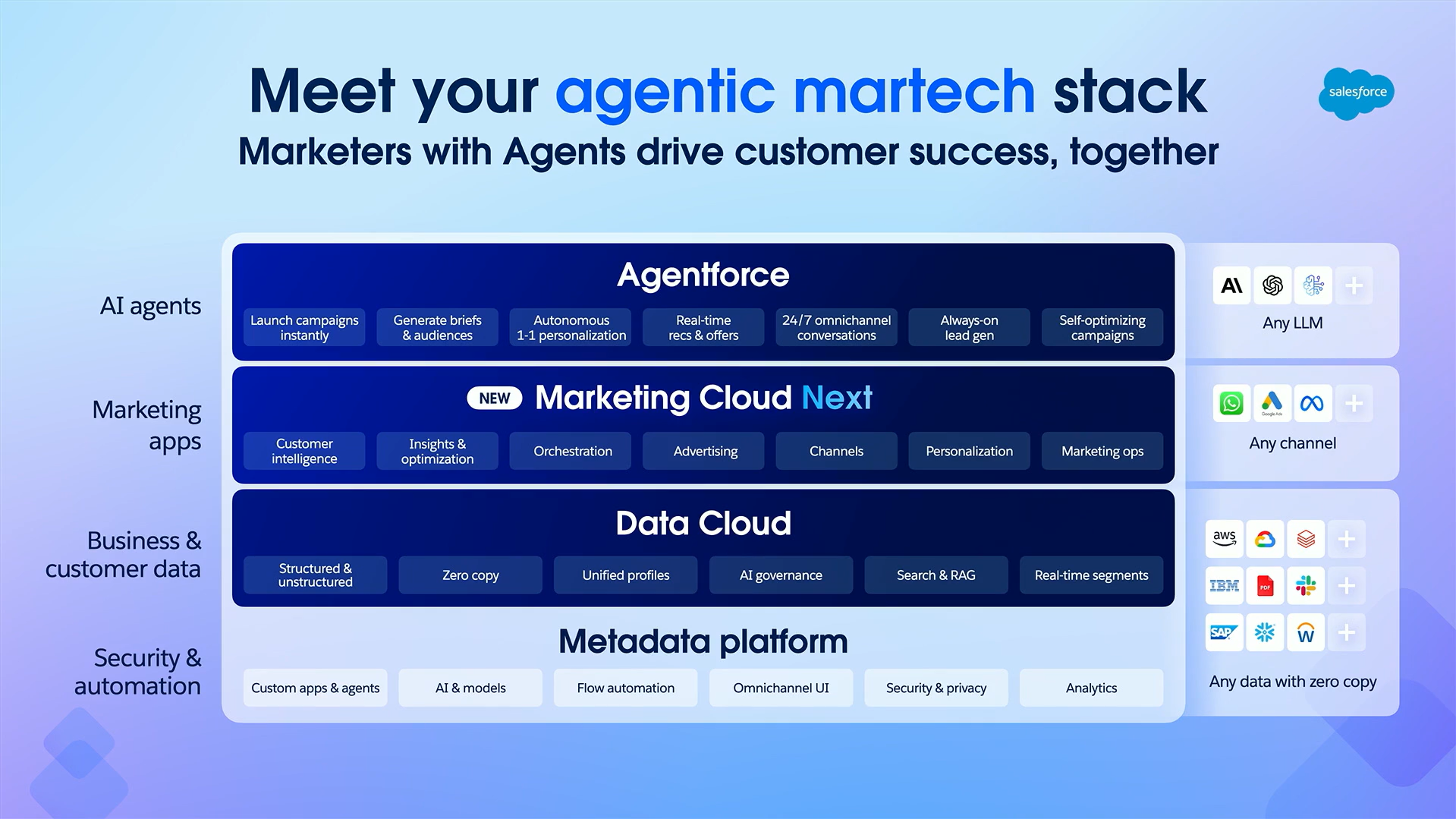
Marketing Cloud Next is Salesforce’s next-generation Marketing solution built natively on the Salesforce Platform. It is not a separate product or a simple upgrade, but a unified system that brings data, AI, and marketing execution together in one place.
Unlike legacy marketing systems, Next is built to work directly with Data Cloud and Agentforce, enabling real-time customer understanding and AI-driven decision-making across campaigns, journeys, and personalization. It uses AI to turn one-way marketing messages into real, two-way customer conversations.
It serves as the core layer on which newer offerings like Marketing Cloud Growth and Advanced editions are built, making it the central shift in Salesforce’s marketing strategy rather than just a rebranded version of existing tools.
To explore how Marketing Cloud Next can be implemented in your organization, connect with Concretio, a Marketing Cloud implementation partner, and unlock the full potential.
What’s now possible with Marketing Cloud Next
Traditionally, marketers worked with separate tools, manual campaign setups, and one-way communication. With Marketing Cloud Next, this shifts to a more connected and intelligent approach powered by AI and unified data.
Agentic Campaign ExecutionWith Agentforce, marketers can move from manual setup to AI-assisted execution. Campaigns, audience segments, content, and journeys can be generated using simple prompts, reducing effort and accelerating time to launch.
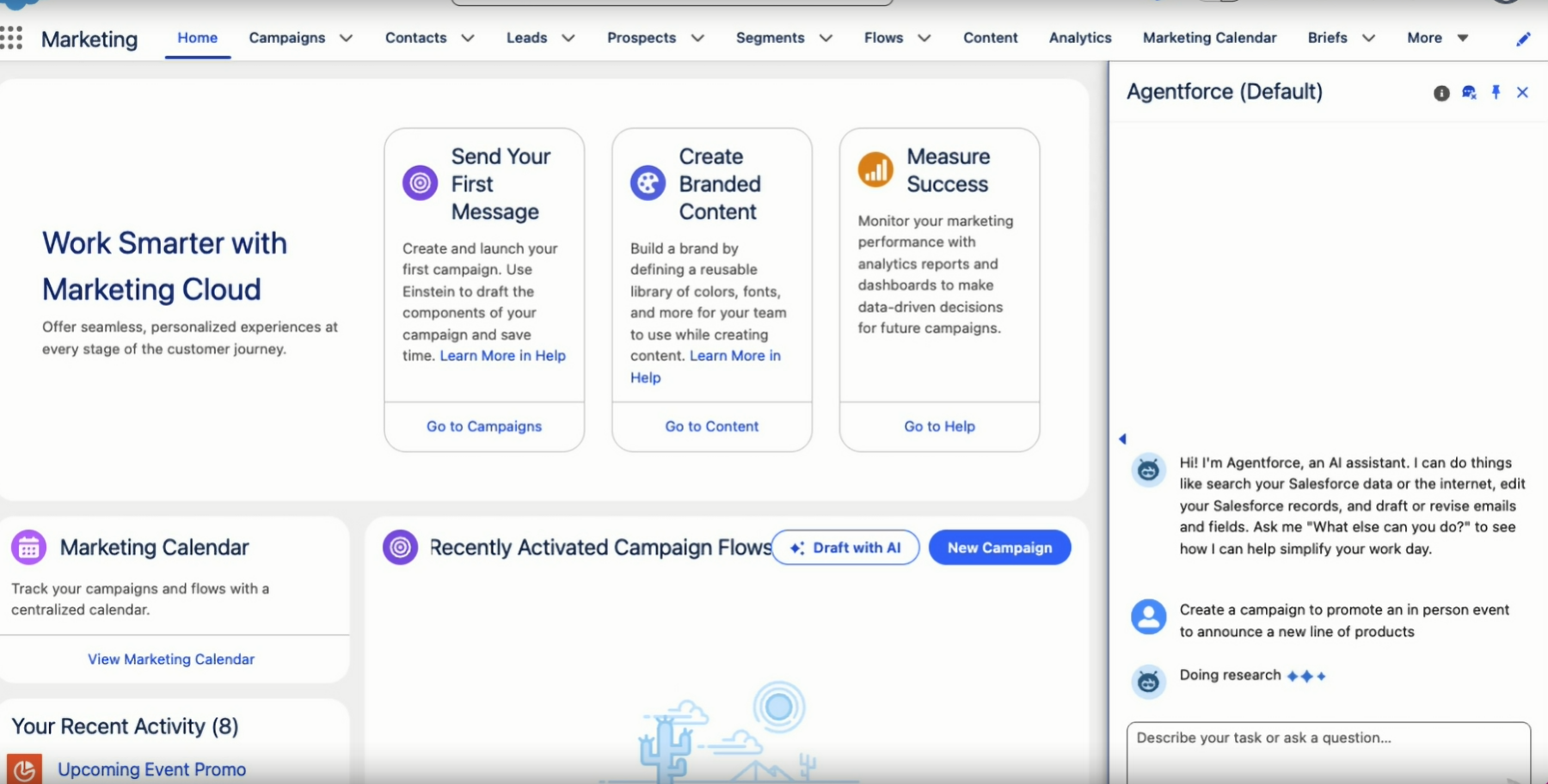
From One-Way Messaging to Two-Way Conversations
Marketing is no longer limited to sending messages. With native support for channels like SMS and WhatsApp, businesses can engage in real-time, two-way conversations where customers can respond and interact directly. These interactions are automatically captured for continuous engagement and follow-ups.
Real-Time Personalization with Unified Data
By leveraging Data Cloud, customer data is unified into a single profile. This enables consistent and personalized experiences across channels based on real-time behavior and preferences.
Cross-Channel Orchestration
Marketing Cloud Next enables seamless coordination across email, mobile, web, and messaging platforms. Instead of running isolated campaigns, businesses can create connected journeys that adapt dynamically to customer actions.
Understanding Growth and Advanced Editions
Both Marketing Cloud Growth and Advanced Editions are built on the same foundation, designed to support different levels of marketing maturity.
Growth Edition
Designed for growing businesses adopting native marketing on Salesforce
Built on the Einstein One Platform with Data Cloud integration
Supports campaign creation, email/SMS, forms, and multi-channel journeys
Includes AI-powered content generation and send-time optimization
Enables faster setup and unified data-driven marketing execution
Starts at $1,500/month (org-based pricing, as of April 2026)
Advanced Edition
Built for organizations with more complex and scaled marketing needs
Includes all Growth capabilities with additional advanced features
Offers predictive AI, scoring, and deeper personalization
Supports journey experimentation and optimization (A/B testing, path experiments)
Enables conversational engagement (SMS/WhatsApp) and advanced analytics
Starts at $3,250/month (org-based pricing, as of April 2026)
Note: Existing products like Marketing Cloud Engagement and Account Engagement also offer “Plus” editions, which act as an upgrade path to access newer capabilities.
By upgrading to a “+” edition (such as Pro+, Corporate+, or Enterprise+), you can unlock Marketing Cloud Next alongside your existing setup. Growth+ and Pro+ editions provide access to Growth Edition capabilities, while Corporate+ and Enterprise+ editions unlock Advanced Edition features, allowing you to extend your current system without replacing it.
Where Do “Plus” Editions Fit In?
While Marketing Cloud Growth and Advanced editions are for new users, “Plus” editions are how existing customers access these capabilities without rebuilding anything.
Plus editions let you extend what you already have. For example, existing editions of Marketing Cloud Engagement and Account Engagement can be upgraded to “+” versions (like Pro+, Corporate+, or Enterprise+) to unlock Marketing Cloud Next capabilities alongside your current setup.
Here’s what they are about:
Built for users of existing marketing products
Not a separate product, but a licensing upgrade (SKU)
Unlocks access to Marketing Cloud Next (Growth or Advanced) alongside the existing setup
No migration required; existing journeys, content, and campaigns remain unchanged
Access provided through Permission Set Licenses (PSLs)
What you gain:
Agentforce-powered campaign creation
Native SMS and WhatsApp engagement
Data unification via Data Cloud
Cross-channel orchestration using flows
Consumption-based model (credits for messaging, AI, and data usage)
Do You Need to Migrate to Marketing Cloud Next?
No, migrating to Marketing Cloud Next is not mandatory.
If you’re already using Marketing Cloud Engagement or Account Engagement, you can continue with your existing setup and adopt new capabilities through “+” editions.
For new implementations, businesses can start directly with Growth or Advanced Editions of Marketing Cloud Next.
This approach gives you the flexibility to evolve at your own pace, without disrupting your current marketing operations. Moreover, if users are thinking about it, they must also be aware of the practices for integrating APIs in marketing platforms seamlessly.
Conclusion
Marketing Cloud Next represents a clear shift in how Salesforce approaches marketing, moving from disconnected tools to a unified, AI-driven platform built on real-time data.
With Growth and Advanced editions, businesses can choose the level of capability that matches their marketing requirement.
At the same time, “Plus” editions ensure existing Marketing Cloud Engagement and Account Engagement customers are not left behind.
Overall, this evolution gives businesses flexibility: start where you are, extend when needed, and scale into a more intelligent, connected, and agentic marketing model at your own pace
Let’s Talk

Drop us a note, we’re happy to take the conversation forward 👇🏻