
The Future of Marketing Cloud Journey Builder: Impact and The Flow
Key Takeaways:
What’s Changing: Journey Builder is becoming a real-time, AI-powered orchestration engine with Data 360 and Agentforce.
Intelligent Flows: Dynamic journeys adapt to real-time customer behavior, intent, and context.
Business Benefits: Enables hyper-personalization, cross-channel automation, and stronger customer retention.
Customer data fragmentation, where the marketing, sales, service, and CRM systems operate in isolation, deprives businesses of a unified customer view. It further leads to operational friction, wasted revenue, and a broken customer experience.
Fragmented customer data acts as a massive bottleneck for modern organizations. It directly impacts your customer experience and drives revenue loss. In one of the surveys by Gartner of 1,203 data management leaders in July 2024, it was found that organizations that fail to realize the vast differences between AI-ready data requirements and traditional data management will endanger the success of their AI efforts.
The Salesforce Marketing Cloud Journey Builder (SFMC JB) orchestrates 1:1 customer lifecycles by executing automated, multi-step communication flows triggered by specific behaviors or events, historically bound by static data extensions and scheduled batch updates; its evolution is fundamentally shifting towards a platform integrated with Data 360, real-time mechanics, and Agentforce AI.
This blog post will walk you through the future of Marketing Cloud Journey Builder; stay tuned and learn what it means for your business.
What Is Marketing Cloud Journey Builder
Marketing Cloud Journey Builder is a visual campaign planning and orchestration tool. It allows marketers to design, automate, and manage personalized, multi-step customer journeys across various channels.
SFMC JB acts as a control center for mapping and managing the entire customer lifecycle, which includes initiating brand awareness and onboarding to retention and loyalty programs. Its core purpose is to replace static, one-off email blasts with dynamic, behaviour-driven paths that respond in real time to individual customers' actions and data changes.
Additionally, the tool serves as the overarching orchestration engine within the Salesforce Marketing Cloud Engagement ecosystem. The entry sources are triggers or data events, such as making a purchase or filling out a form, and this pulls a contact into a journey.
The canvas custom journey activities are visual building blocks such as waiting times, decision splits, and actions; all of them indicate what is going to happen next. Further, the ecosystem integration pulls functional capabilities from other Marketing Cloud studios, and this includes Email Studio and Mobile Studio in order to deliver the actual messages.
Here is the comprehensive and complete list of key capabilities of SFMC JB:
Customer segmentation
Journey orchestration
Email and SMS
Personalization
Automation
Customer data integration
Journey Builder vs. Traditional Campaign Automation
Here is Journey Builder vs. traditional campaign automation; this section will help you understand the clear difference between the older version and the latest one.
| Feature | Traditional Campaign Automation | Marketing Cloud Journey Builder |
|---|---|---|
| Approach | Campaign-centric (one-size-fits-all batch emails) | Customer-centric (individualized lifecycle paths) |
| Trigger Type | Scheduled time/date blasts | Real-time customer actions, behaviors, or API events |
| Interface | Often linear lists or rigid workflows | Visual, multi-path drag-and-drop canvas |
| Cross-Channel | Mostly siloed (primarily email focused) | Integrated across email, SMS, mobile push, and ads |
| CRM Alignment | Limited or manual data syncing | Deep, real-time integration with Sales and Service Cloud |
How Journey Builder Has Evolved
Journey Builder has evolved from a tool for scheduling generic email blasts and now into an AI-powered orchestration engine. This coordinates personalized, cross-channel experiences in real time.
Now the system provides you with a sophisticated and AI-driven customer engagement engine by eliminating the basic email automation tool. This update marks a fundamental shift from rigid, linear campaigns in order to fluid, dynamic customer journeys.
The Key Growth Drivers of SFMC JB Include:
Real-time data.
Behavioral triggers.
Its cross-channel engagement.
Personalization.
AI-driven decision-making.
The best part of this entire process is the importance of first-party data. The tool unifies the first-party data, which is gathered via direct customer interactions, including platforms like Salesforce Data Cloud (rebranded Data 360 in 2025). This practice provides an accurate, governed foundation that is needed to power these real-time, AI-informed decisions.
Real-World Example: Moving on from Broadcasting to Actually Understanding a Customer's Journey
Concretio's 2026 case study: a US life insurance company doing things differently. Rather than just throwing out the odd email blast for good luck, they went out and built a proper behavioural engagement engine with the help of Automation Studio Salesforce Marketing Cloud.
The insurance company used Journey Builder to listen to what their customers were actually doing. Clicks and all that, and then used engagement splits to nudge them in a slightly different direction.
The brand also set up automated data pipelines and dynamic AMPscript content to allow for some pretty sophisticated segmentation and personalisation.
At the end of the day, the result is pretty telling when it comes to customer journey orchestration rather than just plonking customers into a pre-defined sequence you've plucked out of thin air; each and every customer interaction becomes a signal that can actually influence what comes next.
A real-time behavioural tracking system and a shift from mass emails to one-to-one conversations about what actually matters to each customer is the real takeaway from this case study.
The Flow of a Modern Customer Journey
The flow of the modern customer journey is a dynamic, multi-channel orchestration process. Instead of a static, linear campaign. It functions as a highly responsive loop that continuously adapts to real-time customer behavior and unified data triggers, including AI-driven insights.
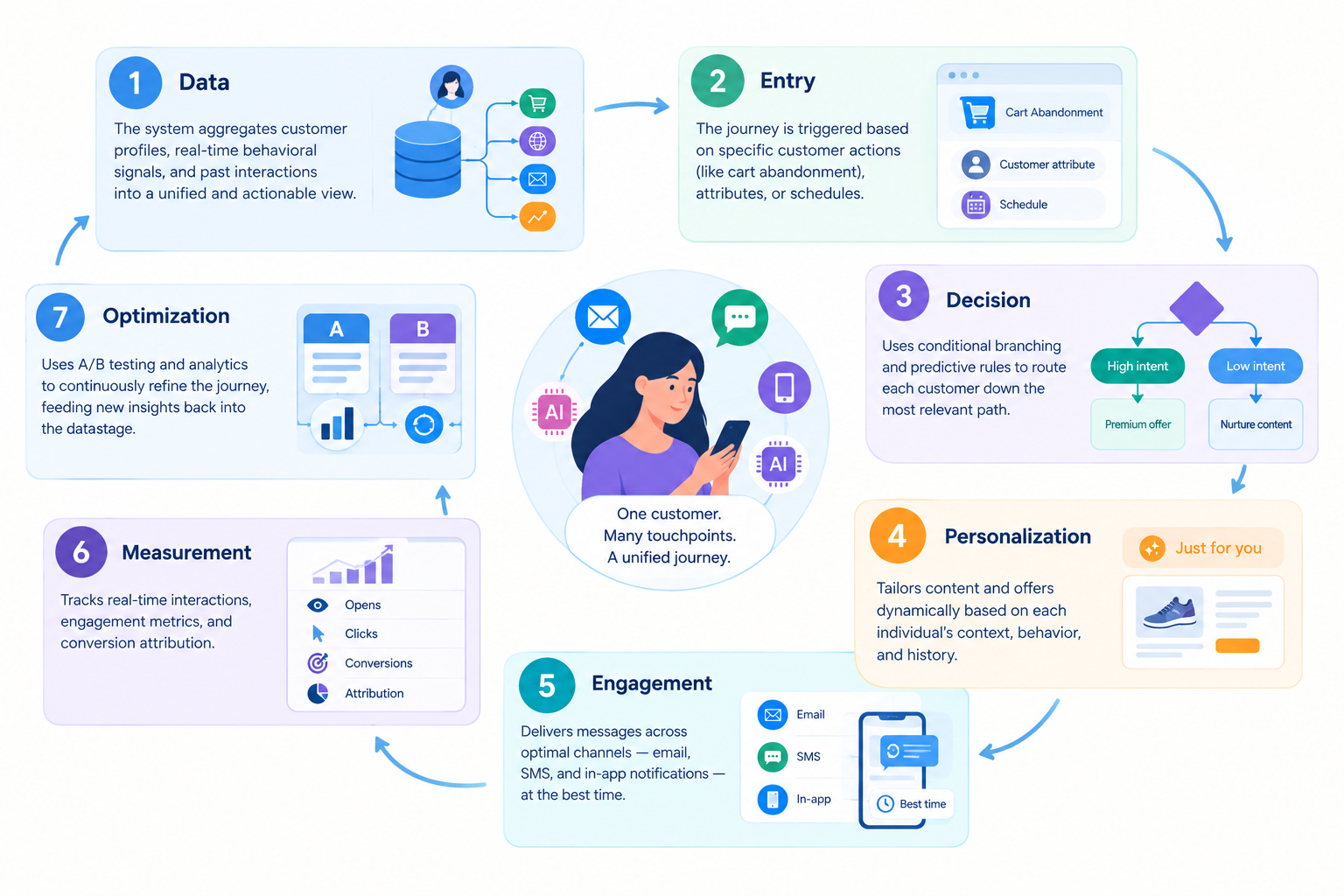
Explore the architectural breakdown of the modern customer journey flow, which includes initial signal capture to continuous refinement.
1. Data
The system aggregates the profiles, including their real-time behavioral signals, into a unified and actionable view.
2. Entry
This will trigger the journey based on specific customer actions, such as cart abandonment, as well as attributes or schedules.
3. Decision
In the third step, it uses conditional branching and predictive rules, which will further route the customer down the most relevant path.
4. Personalization
Tailors the content dynamically while offering and recommending based on each individual’s unique context and history.
5. Engagement
In the fifth step, it delivers messages across optimal channels seamlessly, including email, SMS, and in-app notifications, considering the best possible time.
6. Measurement
The tracking continuously works to provide access to real-time interactions, engagement metrics, and conversion attribution.
7. Optimization
The system leverages A/B testing and analytics so it can continuously refine the journey, feeding new insights back into the initial data stage.
The Impact of Journey Builder on Modern Marketing
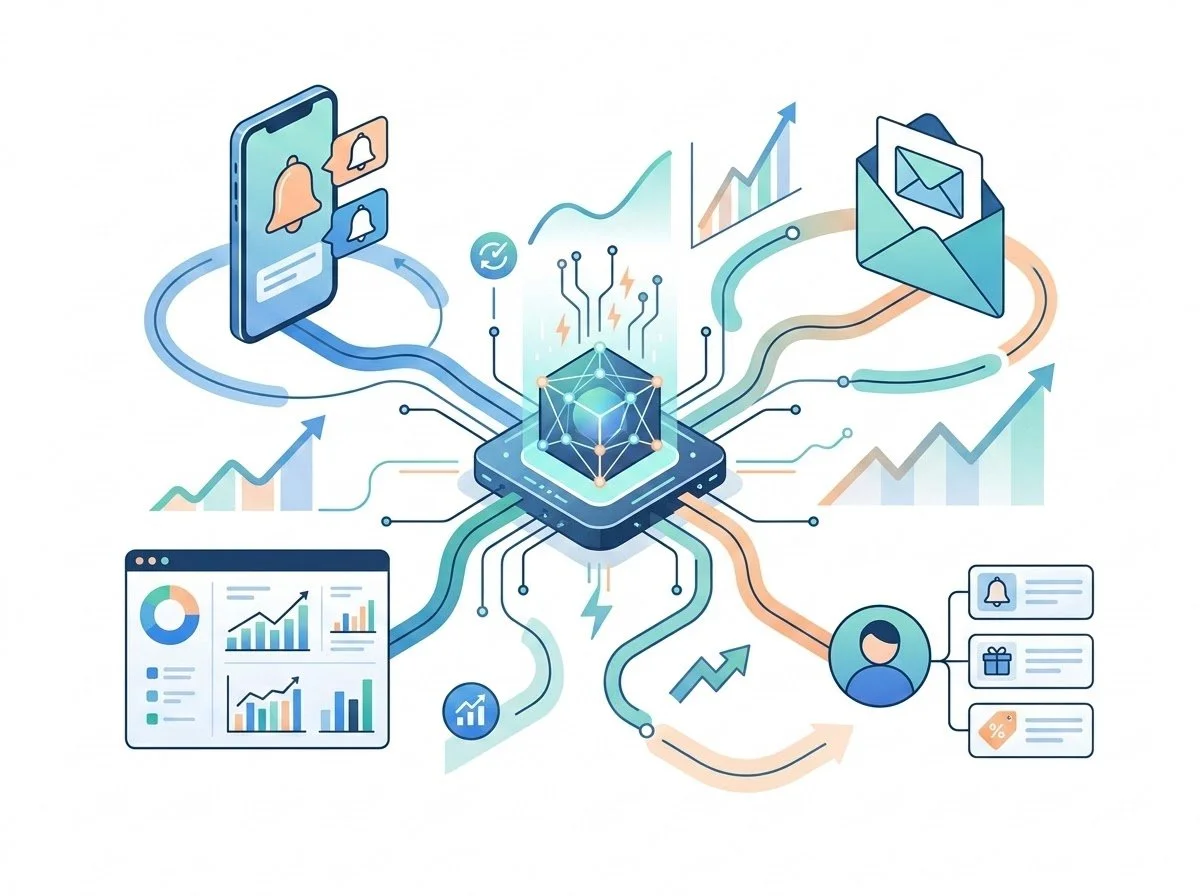
JB changes modern marketing as it shifts the focus from broad, one-size-fits-all campaigns to real-time, behavior-based, as well as individual customer journeys.
Here is the key impact of JB on today’s evolving modern marketing:
Deliver Better Customer Experience
The relevant communication delivers the right message at the exact moment a business customer needs it. Consistent experiences ensure a seamless transition and a unified brand voice.
Greater Marketing Efficiency
Process automation will eliminate repetitive tasks as it automates complex multi-step campaigns. This reduces manual management and frees up your marketing team to focus on strategy rather than daily operational tasks.
Improve Personalization
Its behaviour targeting uses live action and profile data to tailor messages, and this will be for the specific user intents. On the other hand, the advanced segmentation moves beyond basic demographic markers such as age or location to target actual behavior.
Data-Driven Decision Making
The refined journeys optimize ongoing campaigns as they use real-time engagement and interaction data. Behavioral tracking connects specific marketing touchpoints directly with customers' reactions, including conversions.
Improve Customer Lifecycle Management
In the last section, to manage the customer lifecycle, it works on the following practices:
Attracts and captures new prospects.
It will welcome and educate the new sign-ups.
Work on keeping users active and involved with the brand.
To retain its existing customer loyalty.
It will win back the inactive or lapsed users with re-engagement.
The Future of Marketing Cloud Journey Builder
The landscape of customer engagement continues to shift rapidly. Organizations are experiencing increased consumer expectations. Marketing automation must evolve from the rigid, pre-planned tracks into fluid, intelligent experiences.
Here is how the future of Salesforce Marketing Cloud Journey Builder lies in turning static campaigns into dynamic, value-driven conversations.
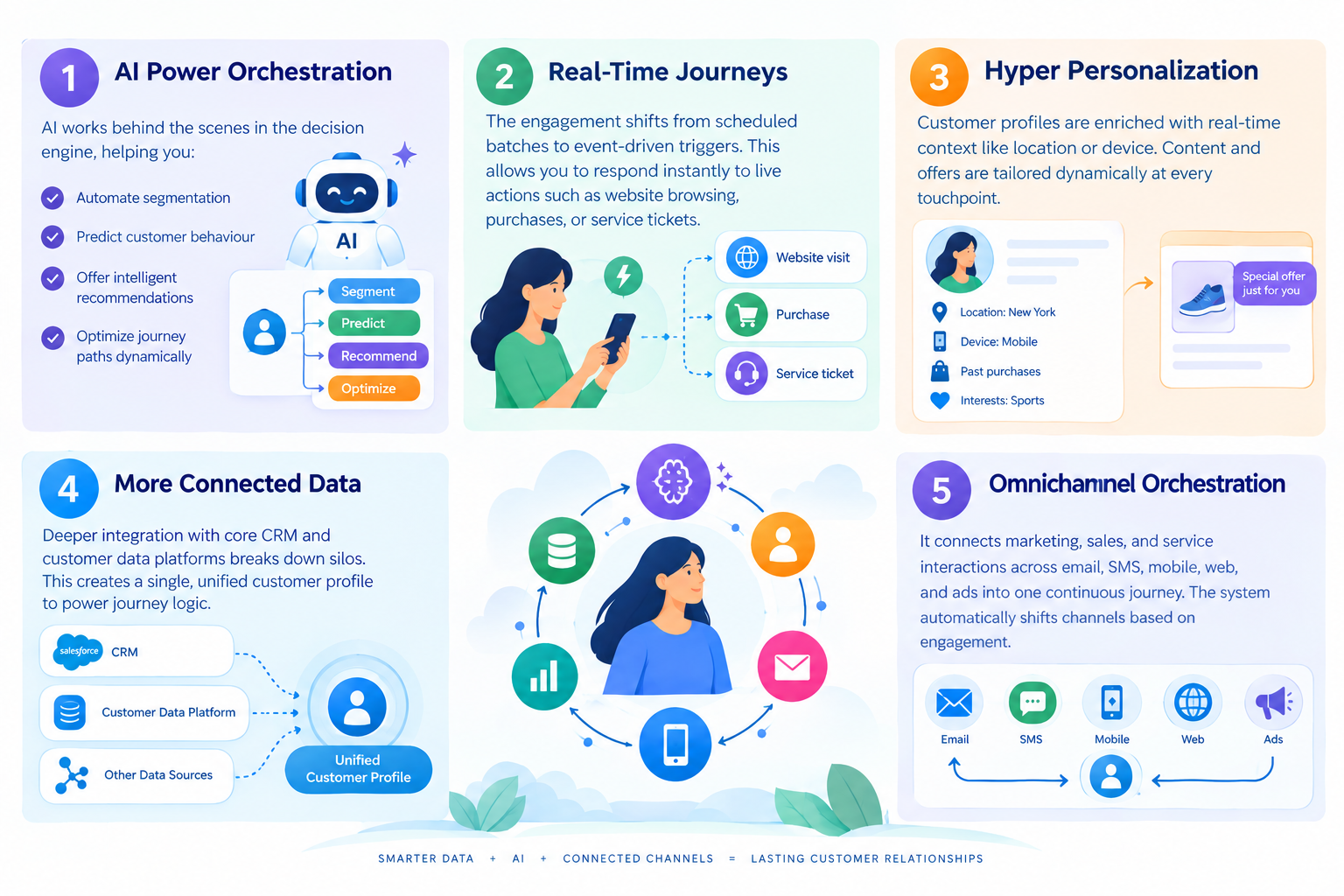
AI-Powered Orchestration
Artificial intelligence plays a significant role in the decision engine, and it handles the following:
1. Automated segmentation
2. Predicts customer behaviour
3. Provides you with intelligent recommendations
4. Optimizes journey paths dynamically
Real-Time Journeys
The engagement moves from the scheduled batch, including blast emails, to entirely event-driven triggers. This action further allows companies to respond instantly to live actions such as website browsing, purchases, or service tickets.
Hyper Personalization
The hyper-personalization process is completed by combining historical customer profiles with real-time context such as location or current device. On the other hand, the content and offers are individualized dynamically at every touchpoint.
More Connected Data
The deep interaction with core CRM and customer data platforms breaks down organizational silos. This creates a single, unified customer profile to power journey logic.
Omnichannel Orchestration
It weaves all the marketing, sales, and service interactions across email, SMS, mobile, web, and ads into one continuous narrative. SFMC JB will automatically shift channels based on user engagement.
From Journey Builder to a More Intelligent “Flow”
Companies are experiencing how automation marketing is evolving beyond rigid, predetermined structures. And this is being done through adaptive, living ecosystems.
In the traditional approach, you would have experienced how a marketer defines a fixed, linear path, and this forces the audience through a pre-built series of static checkpoints.
However, you will find that the future approach flips this model entirely, including continuous customer behavior, and it also autonomously dictates the next step. It further creates a fluid, highly individualized flow.
Instead of it to rely solely on just the basic yes or no logic, such as whether a previous email was opened. The modern framework uses dynamic branching, which is powered by multiple live variables.
Intent: It predicts a customer’s immediate goal or mindset based on their current actions.
In order to engage, it evaluates the depth, frequency, and recency of brand interactions while considering all its touchpoints.
Identifies purchase behavior and, based on that, it adapts instantly to recent transactions, abandoned carts, or live product browsing.
The value of the customer: according to that, it adjusts messaging cadence, offers, and channels, and all of them are done based on lifetime value or loyalty tier.
For customers’ preferences, it aligns with both explicit and passively inferred choices for channels, frequency, and ad content also.
It triggers immediate journey pivots based on the live context for events happening in real time, which could include support for an open ticket or a person’s in-store visit.
What This Means for Marketers
We learned that the evolution of SFMC JB shifts the market’s role from manual execution to strategic oversight. Check how this modern solution is going to assist you and drive your business growth.
1. The automation allows you to avoid repetitive campaign building, freeing up marketers like you to prioritize high-level strategy, creative, and overall customer experience.
2. You will have artificial intelligence proficiency, as it is more about having a better understanding of how to guide as well as leverage the automation tools in the best way possible.
3. Data governance and privacy become non-negotiable; therefore, strict governance and customer consent frameworks are essential in order to fuel personalized engagement safely.
4. The customer-centric design will fulfill immediate customer needs and intent instead of you optimizing the isolated marketing channels.
What Are the Challenges & Considerations to Marketing Cloud Data 360 Integration
Marketing Cloud implementation in real time, including AI-driven orchestration, may lead to several challenges. In this section, we will discuss them all so you can identify and get rid of them before they occur.
Check the data quality and fragmentation.
Consider privacy and consent for real-time tracking.
The journey complexity.
Human oversight.
The challenges with integration.
Measuring Return on Investment (ROI)
Avoiding over-automation as well as excessive messaging.
What Are the Best Practices for Future-Ready Journey Strategies
1. You can start with clear customer objectives first.
2. Build it around your business customer lifecycle stages.
3. Better to use real-time behavioral signals.
4. Keep the data clean and accessible.
5. Create and design for omnichannel experiences.
6. Continue to test and optimize by using A/B testing and real-time analytics.
7. Implement strict rules that will prevent message fatigue.
8. Combine automation with creativity.
Real-World Example: A Future-Ready Customer Journey
Here is a Salesforce journey builder examples of a fluid, with one of a real time customer journey in e-commerce.
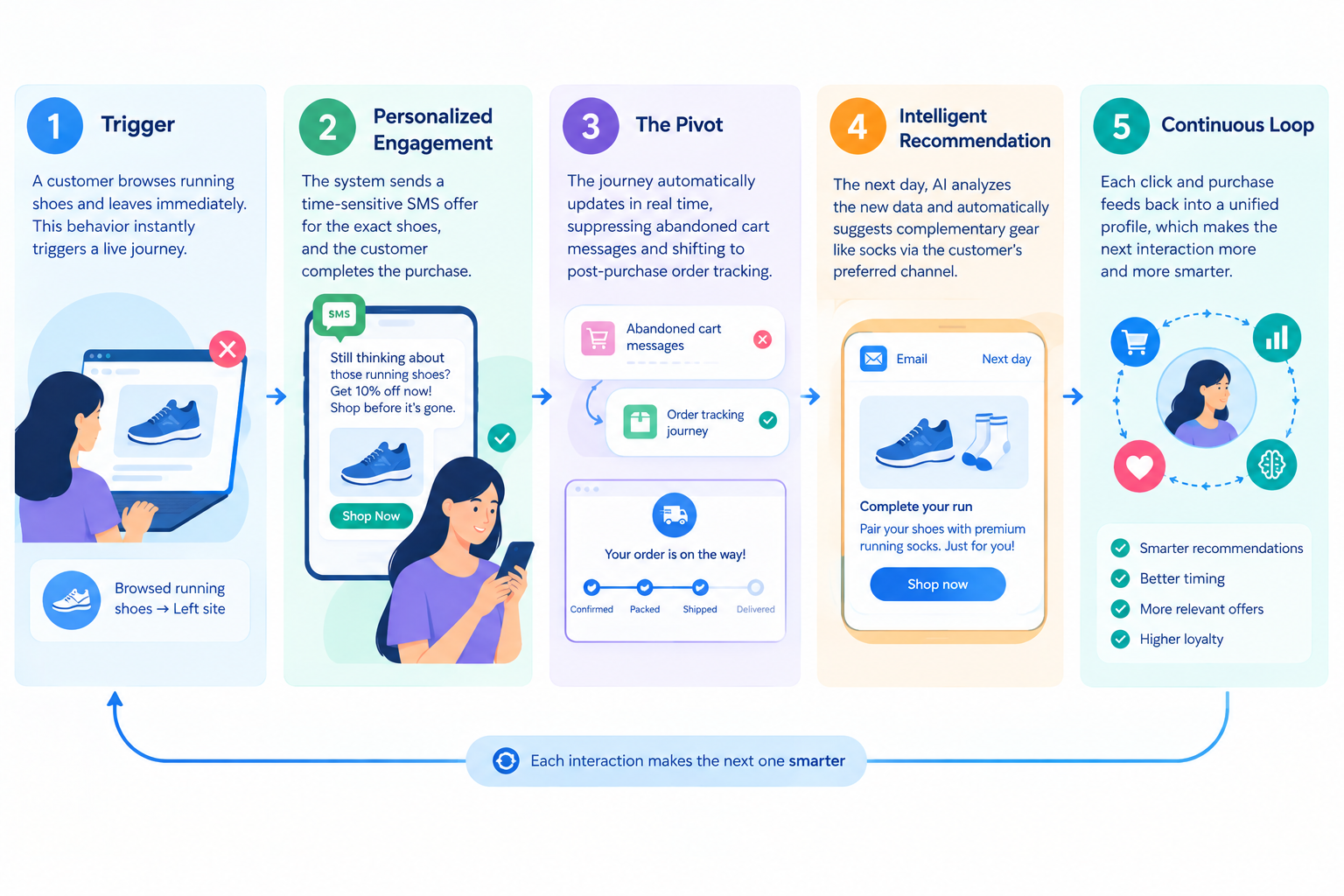
Trigger: Suppose a customer browses running shoes and leaves immediately. This behavior will instantly trigger a live journey.
Personalized Engagement: The system itself sends a time-sensitive SMS offer for the exact shoes, and the customers complete the purchase.
The Pivot: In this third step, the journey will automatically update in real time, suppressing abandoned cart messages and shifting to post-purchase order tracking.
Intelligent Recommendation: The next day, the AI analyzes the new data and automatically suggests complementary gear like socks via the customer’s preferred channel.
Continuous Loop: Each click and purchase feeds back into a unified profile, which makes the next interaction more and more smarter.
How to Measure the Success of Customer Journeys
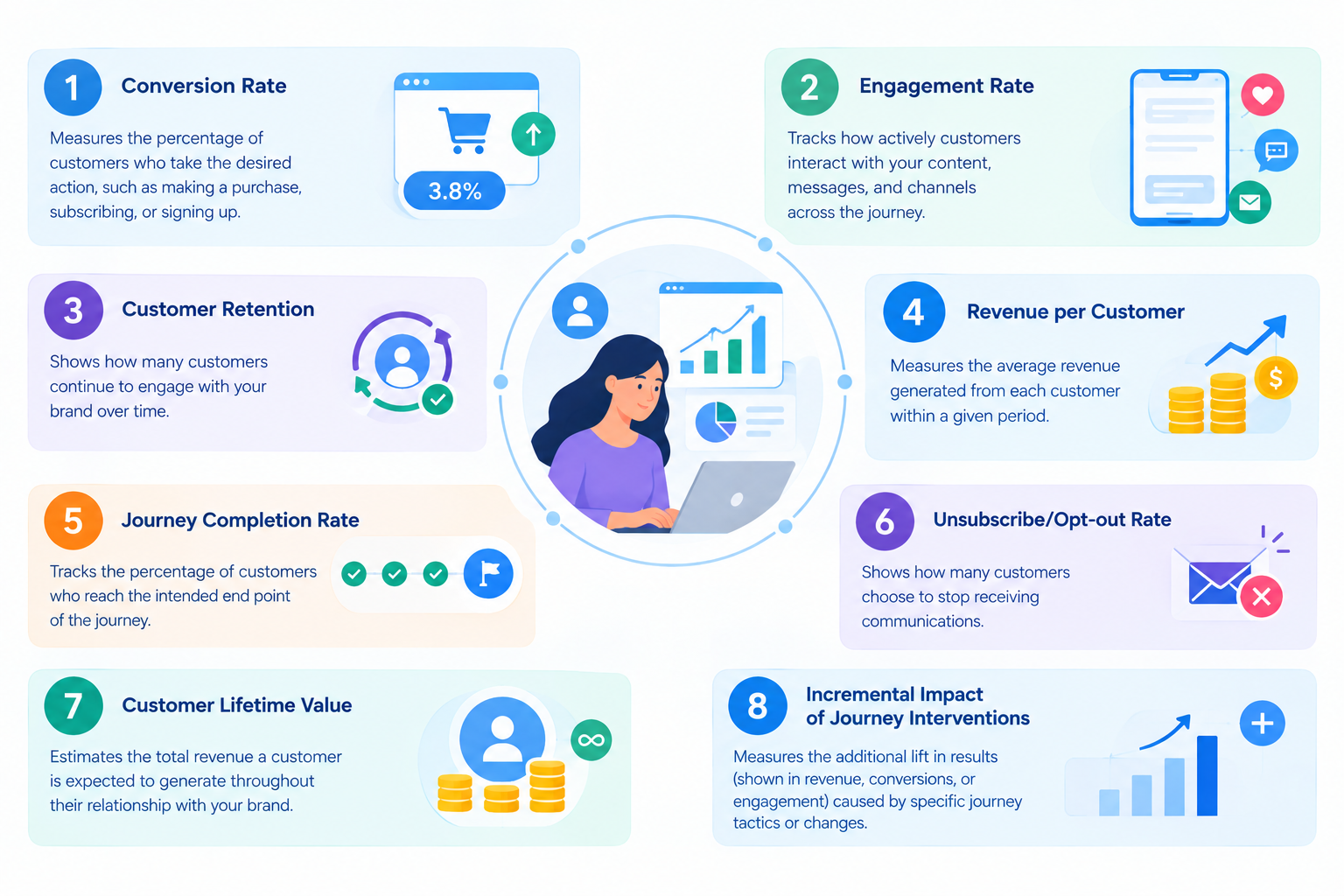
The best way to measure the success of dynamic customer journeys is to tackle a blend of management, financial, and lifecycle metrics.
In this section, we will discuss all the significant factors that you must consider for better results, and they are as follows.
Conversion rate
Engagement rate
Customer retention
Revenue per customer
Journey completion rate
Unsubscribe/opt-out rate
Customer lifetime value
Incremental impact of journey interventions
Conclusion
Now it is clear to you what the future of Marketing Cloud Journey Builder is and how the modern solution aligns with your business needs. It is no longer one-size-fits-all batch emails, but now it is more customer-centric, as it individualizes lifecycle paths. No more scheduled time/data blasts; instead assists with real-time customer actions, behaviors, or API events, integrated across emails, SMS, mobile push, ads, and deep, real-time integration with Sales and Service Cloud.
Are you ready to leverage the modern solution of SFMC JB for your organization? Connect with a Marketing Cloud expert and get rid of traditional manual work.
Source:
Frequently Asked Questions
-
Journey Builder is a campaign planning and customer journey orchestration tool within Salesforce Marketing Cloud Engagement. It lets marketers visualize, design, automate, and manage multi-step as well as multi-channel campaigns simultaneously.
-
There are three types of journeys that include:
Automated Journey: It is always-on nudges that nurture, remind, and re-engage, such as post purchase, win back.
Trigger Journey: It reacts instantly to the customer's behavior, like an increasing abandonment rate or product interest.
Scheduled Journeys: All these are structural campaigns that are tied to dates or events such as seasonal promotions.
Each journey helps balance efficiency and personalization when used strategically.
-
Automation Studio handles backend processing and batch tasks; on the other hand, Journey Builder orchestrates personalized, real-time customer experiences. Both tools in Salesforce Marketing Cloud are powerful, but they solve different problems and can work best when used together.
-
You can think of Journey Builder as a tower that controls and guides every customer interaction across their lifecycle. This can include interest, purchase, loyalty, and advocacy, and with Journey Builder, marketers can:
Automate engagement.
Engage across channels.
Personalize at scale.
Measure what matters.
-
SFMC offers various benefits to use its solution for business growth that offers business targeted audience:
Personalized offerings based on customers’ habits.
Automation saves you resources and time with its marketing automation.
Data integration provides you with an enterprise-wide view with the combination of many databases into one.
Multichannel engagement ensures that customer contacts are made through different channels in order to ensure the message is consistent.
The analytics and reporting provide an in-depth understanding of your campaigns’ effectiveness, including customer behavior.
Related Readings
Let’s Talk

Drop us a note, we’re happy to take the conversation forward 👇🏻