
HubSpot Marketing Hub vs Salesforce Marketing Cloud vs Pardot: A Comparison Guide
Key Takeaways:
HubSpot bundles CRM and marketing in one platform, while Marketing Cloud Next and Pardot both still need Salesforce Sales Cloud underneath them.
Marketing Cloud Next leads on AI with Agentforce built into every edition, but the total cost of ownership is often the highest of the three once Sales Cloud is added.
HubSpot wins on ease of use and speed to launch, while Pardot remains the go-to for teams already deep in the Salesforce ecosystem.
If you've spent any time researching marketing platforms, you've probably noticed the naming gets confusing fast. Pardot isn't really called Pardot anymore; it's Marketing Cloud Account Engagement now. And Salesforce has also rolled out a newer product line, Marketing Cloud Next, built natively on the core Salesforce Platform. So before we even get into the Salesforce Marketing Cloud vs. HubSpot debate, it's worth untangling what you're actually comparing.
Let's break down Salesforce Marketing Cloud vs Marketing Hub vs Pardot, covering the features, pricing, ecosystem, and support, so you can walk into a procurement conversation knowing what you're buying.
Marketing Cloud vs Marketing Hub vs Pardot: Clearing Up the Naming Confusion
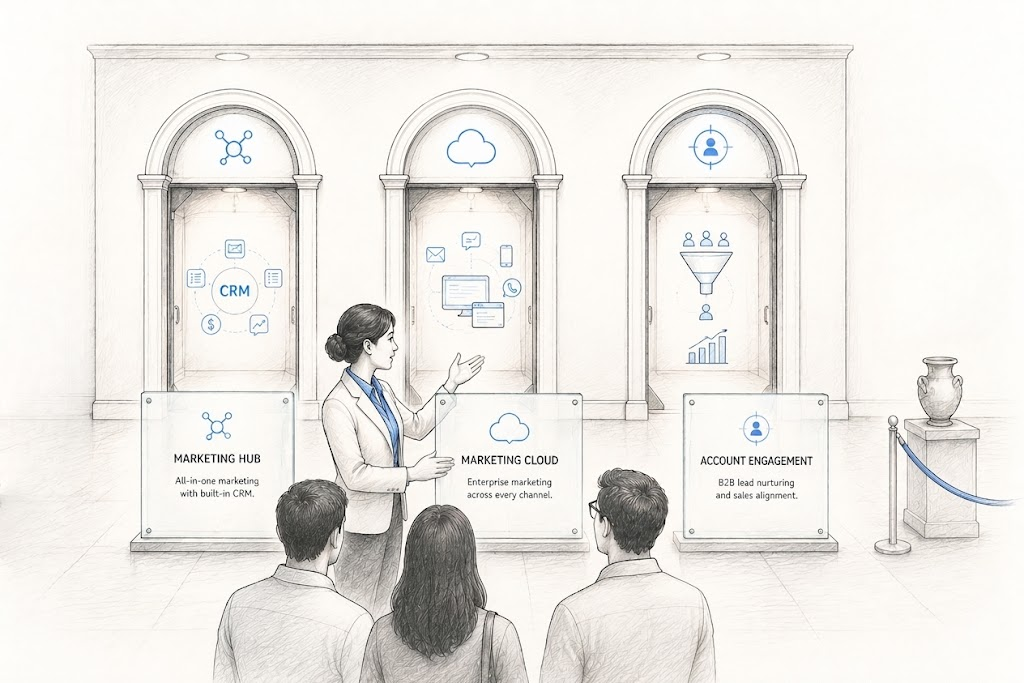
Salesforce's marketing portfolio has a few distinct pieces:
Marketing Cloud Next is Salesforce's newer, agentic marketing platform, built natively on the core Salesforce Platform rather than as a bolted-on acquisition. It's designed for high-volume, multi-channel B2C engagement (email, SMS, WhatsApp, web) with Agentforce AI built into every edition.
Marketing Cloud Account Engagement (formerly Pardot) is built for B2B lead nurturing, scoring, and sales alignment, and is increasingly designed to work alongside Marketing Cloud Next rather than as a competing product.
Marketing Cloud Engagement is the older, legacy platform (originally ExactTarget) that many existing customers still run, now being phased toward Marketing Cloud Next as Salesforce's strategic direction.
Pardot/Account Engagement customers now get access to Marketing Cloud Next's Growth and Advanced Edition capabilities as part of their instance. Even so, both still depend on Salesforce Sales Cloud to function as a full CRM system. Neither comes bundled with a CRM the way HubSpot does.
HubSpot Marketing Hub, on the other hand, is one product that sits on top of HubSpot's own CRM. Contacts, deals, emails, forms, and reporting all live in the same database from day one. That single difference is the thread that runs through almost every other point of comparison.
Comparison Table: HubSpot Marketing Hub vs Salesforce Marketing Cloud Next vs Pardot
| Factor | HubSpot Marketing Hub | Salesforce Marketing Cloud Next | Pardot / Marketing Cloud Account Engagement |
|---|---|---|---|
| Built for | All-in-one marketing + CRM, SMB to enterprise | Agentic, high-volume B2C engagement across email, SMS, WhatsApp, and web | B2B lead nurturing and sales alignment |
| CRM included | Yes, native, single database | No, requires Sales Cloud (built on the same core platform) | No, requires Sales Cloud |
| Starting price | Professional at $890/month, and Enterprise at $3,600/month | Growth Edition ~$1,500/org/mo; Advanced Edition ~$3,250/org/mo | Growth tier $1,250/month |
| Automation depth | Strong, visual, marketer-friendly | Very deep, agent-driven journey creation via Agentforce Campaign Creation | Moderate (Engagement Studio), simpler workflows |
| AI capabilities | Breeze AI, bundled in most tiers, fast to deploy | Agentforce baked into every edition from the start; autonomous campaign creation and optimization | Einstein features layered on top, plus growing access to Agentforce via Marketing Cloud Next |
| Ease of use / UX | Rated easiest to learn, consumer-grade UX | Moderate-to-steep curve; simpler than legacy Engagement but still enterprise-grade | Moderate curve, some workflows need developer help |
| Integrations | 500+ app marketplace, native Salesforce connector | Native to the core Salesforce Platform, full AppExchange access (2,000+ apps) | Tied to the same Salesforce AppExchange ecosystem |
| Admin overhead | Low, most teams self-manage | Moderate to high; lighter than legacy Engagement but still typically needs a Salesforce admin | High, needs ongoing CRM sync management |
| Best fit | SMB to mid-market teams wanting speed and simplicity | Enterprises running complex, agentic, multi-channel B2C campaigns on Salesforce | Companies fully committed to the Salesforce ecosystem |
Clearing Up the Naming Confusion
Features Comparison
| Feature | HubSpot | Salesforce Marketing Cloud Next | Salesforce Account Engagement (Pardot) |
|---|---|---|---|
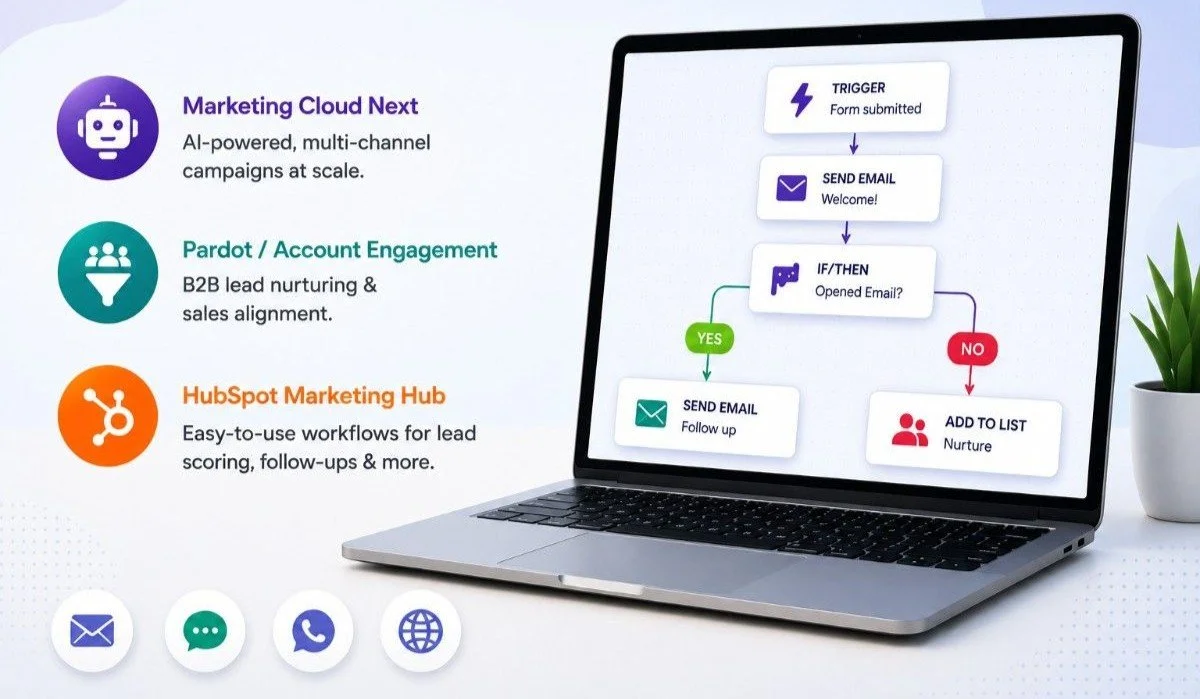
| Automation | Easy-to-build visual workflows for lead nurturing and follow-ups. | AI-powered Agentforce Campaign Creation builds campaigns, audiences, content, and journeys automatically. | Engagement Studio for B2B nurture campaigns and lead scoring. |
| AI Capabilities | AI-assisted content and workflow recommendations. | Advanced AI-driven campaign planning, segmentation, content creation, and journey orchestration. | Basic AI features with growing access to Marketing Cloud Next capabilities. |
| Multi-channel Marketing | Email with limited omnichannel capabilities. | Native orchestration across email, SMS, WhatsApp, and web. | Primarily email, with expanding multichannel options. |
| Ease of Use | Very beginner-friendly with a low learning curve. | Powerful but designed for enterprise users and experienced teams. | Easier than Marketing Cloud Next, but still benefits from Salesforce knowledge. |
| Best For | SMBs and growing marketing teams. | Large enterprises running complex, personalized customer journeys. | B2B organizations using Salesforce CRM for lead nurturing. |
Know how Concretio has improved engagement using SFMC. A case study on SFMC.
AI Capabilities Comparison
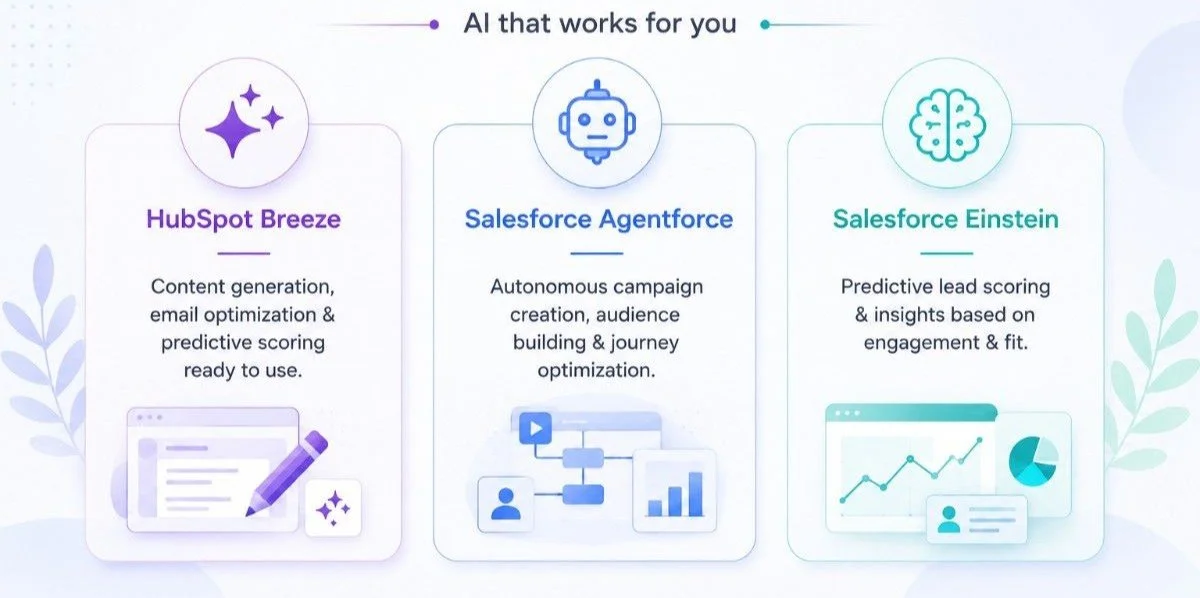
HubSpot's AI suite, Breeze, is bundled across every hub, including the free CRM tier. It handles content generation, prospecting research, email optimization, and basic predictive scoring, and it's designed to work with little to no setup. If you want AI that's useful on day one without hiring a consultant, Breeze delivers that.
Salesforce Marketing Cloud Next puts Agentforce at the center of the product rather than treating it as an add-on. Every edition includes Agentforce Campaign Creation, which can independently draft campaign briefs, build audience segments, write email copy, and launch journeys from a natural-language prompt. It's the most autonomous of the three AI systems compared here, genuinely closer to "AI teammate" than "AI assistant”. But that power comes with enterprise pricing and a platform still built for teams with real marketing operations support.
Marketing Cloud Account Engagement historically relied on lighter Einstein features like Einstein Behavior Score and Einstein Lead Scoring, which rank prospects based on engagement signals and fit. These tools typically need a meaningful volume of historical data (often 1,000+ leads and 100+ conversions) before they perform reliably. The more interesting shift is that Pardot customers are now also gaining access to Agentforce Campaign Creation through their connection to Marketing Cloud Next, narrowing the AI gap between the two Salesforce products over time.
Comparing User Experience
User experience is one of the biggest differentiators between these platforms.
Salesforce Marketing Cloud Next has the steepest learning curve because of its enterprise capabilities. However, Agentforce and natural-language prompts make campaign creation much easier than the legacy Marketing Cloud Engagement platform.
Salesforce Marketing Cloud Account Engagement (Pardot) is simpler than Marketing Cloud Next and better suited for B2B marketing. However, users without Salesforce experience may still find parts of the interface unintuitive.
HubSpot is the easiest platform to learn and use. The intuitive interface of HubSpot Marketing Hub consistently earns higher user satisfaction ratings than Pardot. However, larger HubSpot portals still require good CRM and data management practices to avoid becoming difficult to manage.
Scalability and Enterprise Readiness: Comparing All Three Platforms
This is where company size and future growth plans should drive the decision, and each platform sits at a different point on the scale.
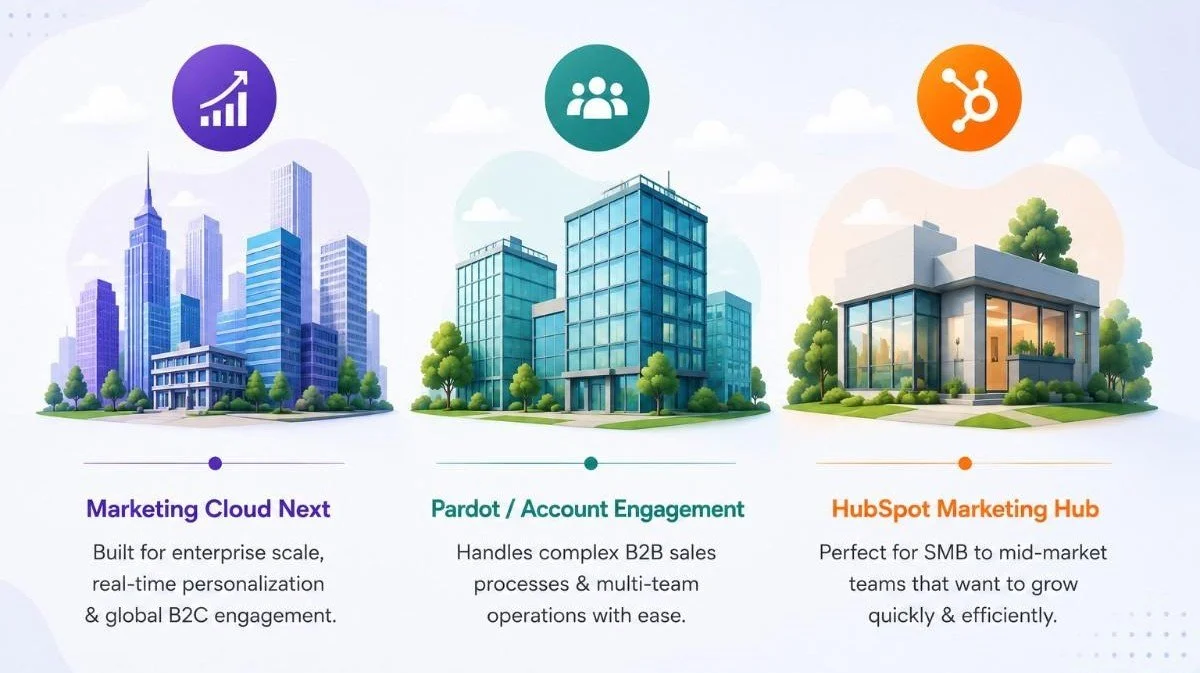
Salesforce Marketing Cloud Next is built for scale in the most literal sense. It's designed to handle large B2C send volumes, real-time personalization, and two-way conversations for global consumer brands. Being built natively on the Salesforce Platform also means it scales more cleanly alongside Sales Cloud and Service Cloud.
Marketing Cloud Account Engagement scales differently. It is built to handle complexity in B2B sales processes rather than raw send volume. Multi-team sales operations, custom objects, territory management, and approval workflows that span departments are all native strengths, especially for large, global organizations already running Sales Cloud.
With growing access to Marketing Cloud Next capabilities, Marketing Cloud Account Engagement customers can now extend into multichannel B2C-style engagement. They don’t even need a full platform migration. Therefore, it is a meaningful scalability upgrade over how the product worked just a couple of years ago.
HubSpot has closed a lot of ground on enterprise capability in recent years. But it's still generally the stronger fit for companies under roughly 500 employees, or any team that wants to grow without immediately hiring a dedicated administrator.
The honest framing most consultants use: HubSpot optimizes for time-to-value, while both Salesforce products optimize for the ceiling of capability. Which one matters more depends on how complex your operations already are, not how complex you expect them to be someday.
Pricing Comparison: HubSpot Marketing Hub vs Salesforce Marketing Cloud vs Marketing Cloud Account Engagement
Pricing is what CMOs and procurement teams usually care about most. It's also where all three platforms diverge sharply from each other.
HubSpot Marketing Hub offers the most transparent pricing. Professional starts at $800/month (billed annually), while Enterprise starts at $3,600/month and includes 10,000 marketing contacts, advanced reporting, AI features, and the built-in HubSpot CRM. Keep in mind that additional marketing contacts, seats, and one-time onboarding fees can increase the total cost.
Salesforce Marketing Cloud Next follows edition-based pricing. Growth Edition starts at approximately $1,500 per org/month, while Advanced Edition starts at around $3,250 per org/month, both billed annually. Higher editions add more AI, personalization, and cross-channel orchestration capabilities.
Salesforce Marketing Cloud Account Engagement (Pardot) is priced separately from Salesforce CRM. Growth Edition starts at approximately $1,250/month, but most organizations also need Sales Cloud licenses, making the total monthly investment significantly higher than the marketing automation subscription alone.
Final Verdict: Which Platform Should You Choose?
There's no universal winner here, only a better fit for your situation:
Choose HubSpot Marketing Hub if you want one platform, a fast implementation, a shallow learning curve, and predictable all-in pricing, especially if you're a small-to-mid-market team without a dedicated marketing ops or Salesforce admin function.
Choose Salesforce Marketing Cloud Next if you're running large-scale, agentic, multi-channel B2C campaigns across email, SMS, WhatsApp, and web, and you have a Salesforce ecosystem to support it.
Choose Marketing Cloud Account Engagement if you're already deeply invested in Salesforce as your CRM, and your sales and marketing teams are aligned around it.
Whatever platform you're choosing, it's worth running a proper Salesforce Marketing Cloud comparison against your actual contact volume, team size, and technical bandwidth before signing anything. If Salesforce is on your shortlist, it’s better to get in touch with Salesforce Marketing Cloud experts early to save you from discovering implementation surprises.
Frequently Asked Questions
-
Implementation timelines follow a similar pattern across the three. HubSpot rollouts for most B2B teams typically take 4-12 weeks. Salesforce Marketing Cloud Next implementations, especially for complex multi-channel journeys, often run 8-20 weeks. Pardot implementations, particularly with a full CRM sync configuration, commonly take 16-24 weeks and frequently require Salesforce Marketing Cloud experts to configure properly.
-
Marketing automation platforms let you create workflows that trigger emails, SMS, lead assignments, and follow-ups based on customer behavior, helping you nurture prospects consistently while reducing manual work and improving conversion rates.
-
Marketing automation platforms streamline campaigns, improve lead nurturing, personalize customer interactions, provide actionable analytics, and increase team productivity, helping businesses generate higher-quality leads and achieve better marketing ROI.
-
AI analyzes customer behavior, predicts intent, personalizes content, recommends next-best actions, and automates engagement across channels. This enables businesses to deliver faster, more relevant, and consistent customer experiences at scale.
-
Yes. You can integrate Salesforce with HubSpot through native connectors, or you can get help from integration experts, enabling seamless synchronization of contacts, leads, deals, and marketing data for better alignment between sales and marketing teams.
Related Readings
Let’s Talk

Drop us a note, we’re happy to take the conversation forward 👇🏻