
Why Every Business Needs an Enterprise Customer Support Solution for Salesforce
Key takeaways:
Rising expectations, global customers, and growing ticket volumes expose the limits of a support setup that isn't built to scale.
A true enterprise solution needs native Salesforce integration, real-time communication, multilingual support, automation, and strong security.
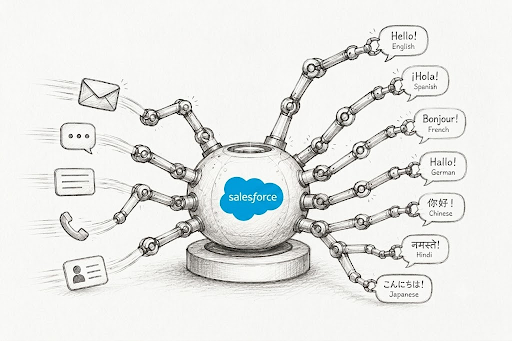
ChatBridge solves the language barrier specifically, letting existing teams support customers in 130+ languages without added headcount.
Growth is supposed to feel like a win, right up until your support team starts drowning in it. As ticket volume scales beyond human capacity, basic ticket setups stall response times and decrease customer satisfaction.
Transitioning to an enterprise customer support solution for Salesforce enables automated query routing, real-time sync, and omnichannel efficiency. It allows teams to scale support without proportional head-count costs. So, let's walk through the real challenges businesses face today, what a proper enterprise-grade solution should include, and where an enterprise solution like ChatBridge solves the challenges.
The Biggest Customer Support Challenges Businesses Face Today
Before talking about solutions, it's worth being honest about what's actually going wrong for a lot of support teams right now.
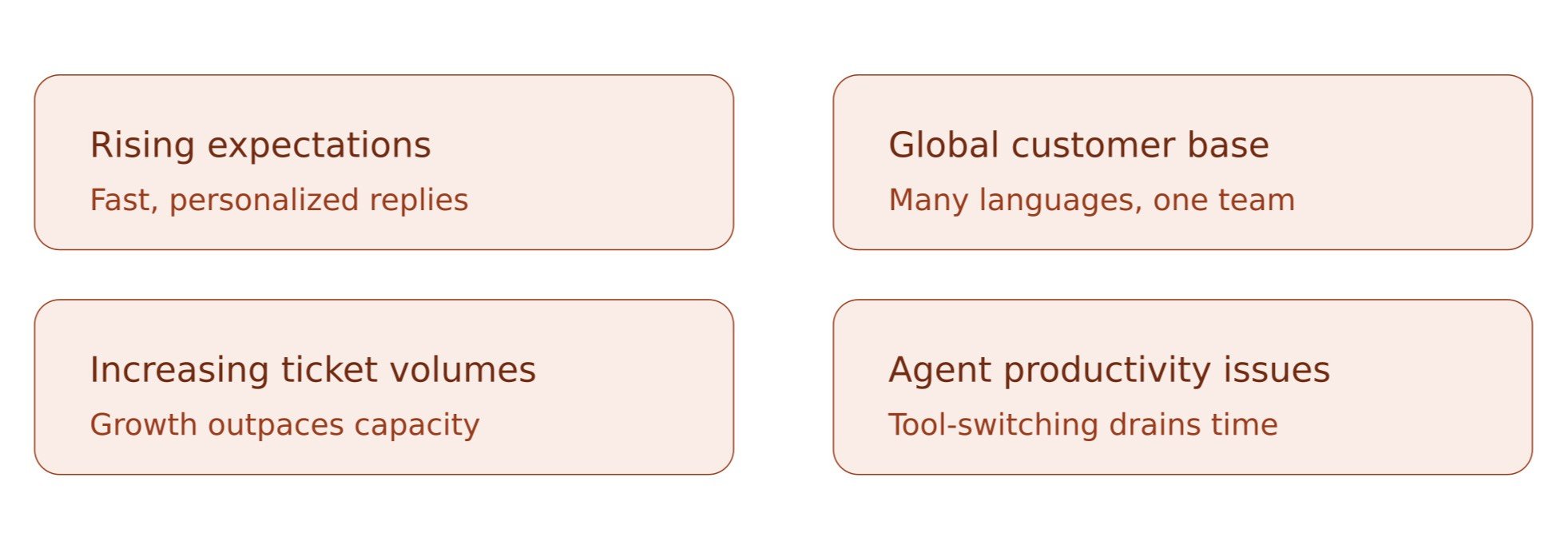
Rising Customer Expectations
Customers today expect fast, personalized, always-available support. A slow reply doesn't just feel inconvenient anymore; it feels like a sign that a business doesn't value their time. And it's not just speed that matters. Customers expect the interaction to feel relevant to them specifically, not like a generic scripted response.
Global Customer Base
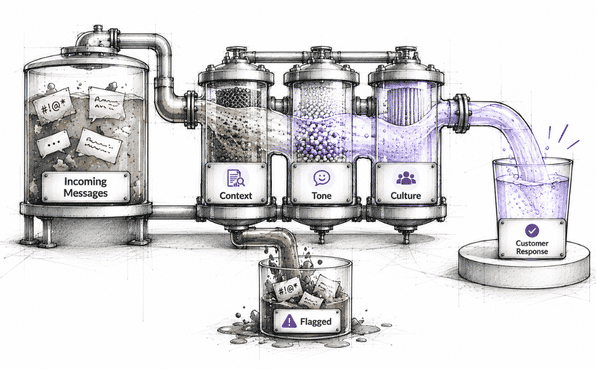
As businesses expand into new markets, localized service becomes critical. When ticket volume spikes across languages like French, Arabic, Portuguese, and Hindi, legacy tools fail. Implementing a multilingual enterprise customer support solution for Salesforce solves this challenge by automatically translating, routing, and tracking cross-border inquiries directly within your CRM, ensuring global SLA compliance without multiplying headcount.
Increasing Ticket Volumes
More customers means more tickets. That part is obvious. What's less obvious is how quickly ticket volume can outpace a support team's actual capacity to keep up, especially when growth happens faster than hiring can.
Agent Productivity Issues
When agents are stuck switching between disconnected tools, manually translating messages, or hunting for information scattered across systems, their actual productive time drops. It's not that agents are working less. It's that so much of their energy goes into managing the tools around the conversation instead of the conversation itself.
Put together, these four challenges explain why so many businesses eventually hit a wall with their existing Salesforce support setup, even when nothing about it was technically broken.
Essential Features Every Enterprise Customer Support Solution Should Have
Once a business recognizes these challenges, the next question becomes: what should an actual enterprise-grade solution include? Here's what matters most.
1. Native Salesforce Integration
A solution that sits awkwardly outside Salesforce, requiring agents to switch tabs or juggle separate logins, adds friction instead of removing it. The best tools live natively inside the console your team already uses every day, keeping case records, chat history, and reporting all in one place.
2. Real-Time Customer Communication
Support today happens in real time, especially in live chat. Any solution that introduces delay, whether through manual steps or clunky workflows, works against the entire point of offering chat support in the first place.
3. Multilingual Customer Support
This has become one of the clearest differentiators between a support setup built for a single market and one built to actually scale. Multilingual customer support means every customer, regardless of language, gets the same fast, clear experience. Without it, businesses end up offering a noticeably worse experience to a large portion of their customer base without even realizing it.
4. Automation
Automation shouldn't replace human agents, but it should absolutely handle the repetitive parts of support so agents can focus on conversations that actually need a human touch. Ticket routing, canned responses for common questions, and workflow triggers all fall into this category.
5. Scalability
A solution that works well for 50 agents but falls apart at 500 isn't really an enterprise solution. It's a temporary fix. True scalability means the tool grows with the business without requiring a complete overhaul every time volume increases.
6. Enterprise Security
Customer data protection isn't optional at enterprise scale. Any support solution handling customer conversations needs to meet serious security and compliance standards, not just claim to.
7. Reporting and Analytics
Support leaders need visibility into what's actually happening: response times, resolution rates, customer satisfaction trends, and where bottlenecks are forming. Without solid reporting, problems stay invisible until they've already caused damage.
Benefits of an Enterprise Customer Support Solution for Salesforce
When these pieces come together properly, the impact shows up in ways that go well beyond just "support feels better."
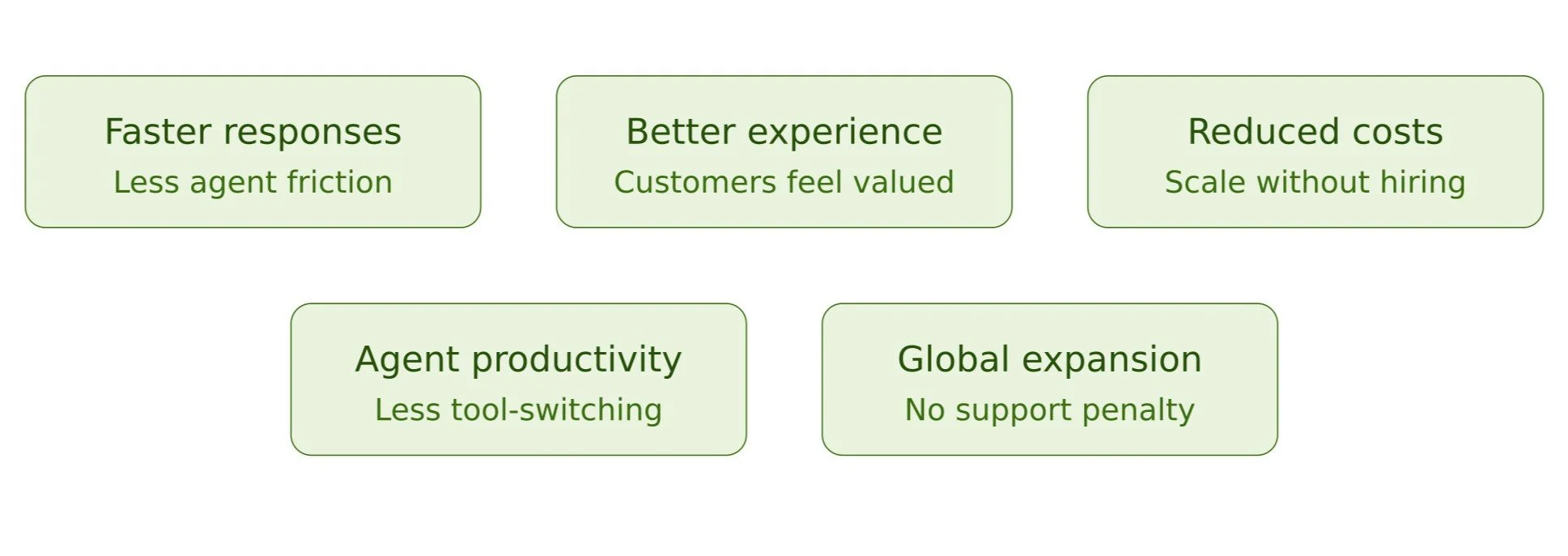
1. Faster response times. With the right tools in place, agents aren't stuck managing workarounds, which means customers get answers faster, across every language and every channel.
2. Better customer experience. Customers feel heard and prioritized, not routed through a clunky process that makes them feel like an afterthought.
3. Reduced operational costs. Instead of hiring your way through every scaling challenge, whether that's ticket volume or language coverage, a proper solution lets your existing team handle more without a proportional cost increase.
4. Increased agent productivity. When agents aren't wasting time on manual translation, tool-switching, or repetitive tasks, they can actually focus on solving problems, which is what they're there to do in the first place.
5. Global business expansion. A support setup that scales cleanly across regions and languages removes one of the biggest hidden barriers to expanding into new markets. You're not starting from scratch in every new country you enter.
How ChatBridge Enhances Enterprise Customer Support in Salesforce
This is exactly where ChatBridge fits in, particularly around one specific piece of the enterprise support puzzle, i.e., language.
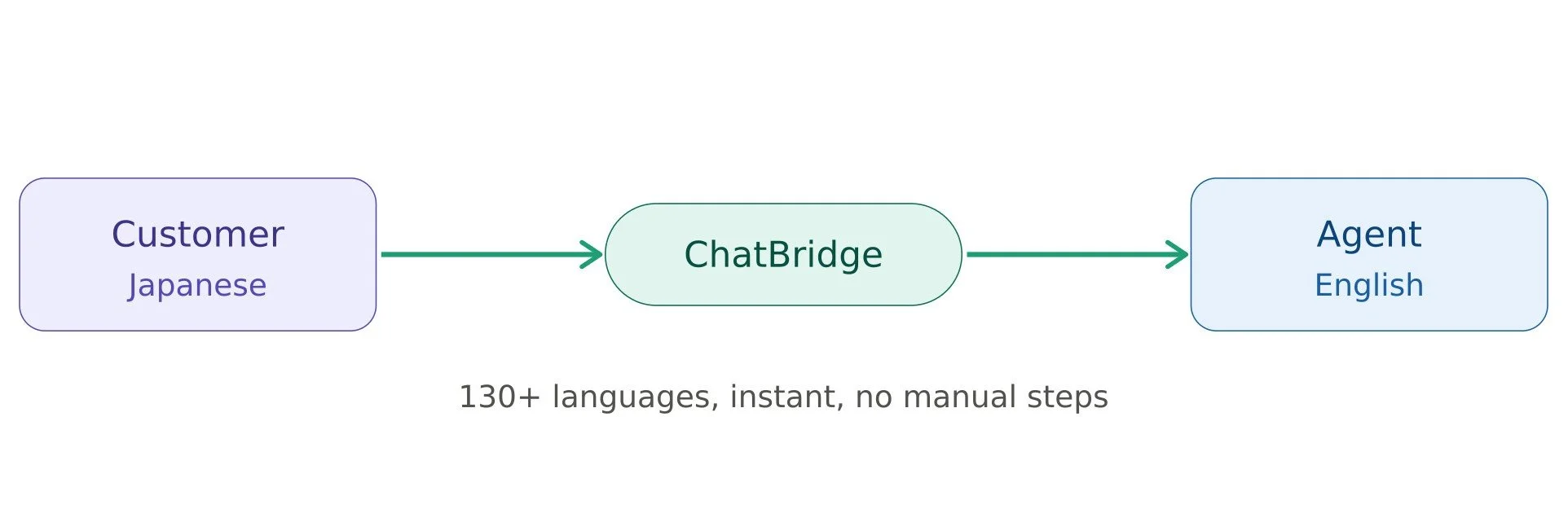
ChatBridge is a Salesforce chat translator built to sit natively inside Service Cloud, not as an extension or a separate platform your agents have to manage. As a Salesforce chat translation app, it brings real-time translation directly into live chat conversations, covering more than 130 languages with consistent quality across all of them.
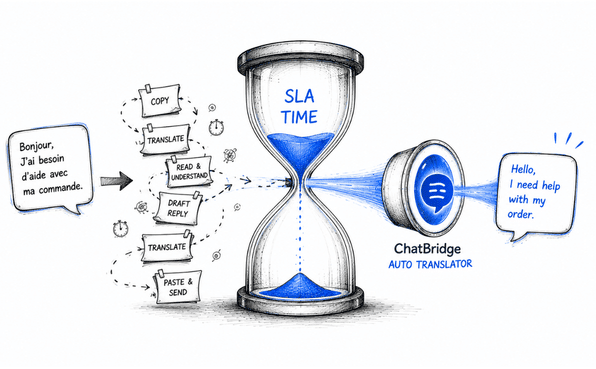
Here's what that looks like in practice. A customer writes in Japanese. The agent, who may only speak English, sees the message translated instantly inside their Salesforce console. They reply normally, and that reply gets translated back to the customer in real time. No copy-pasting, no external tools, no delay that breaks the natural flow of a live conversation.
Salesforce chat translation through ChatBridge means businesses don't need to hire bilingual agents for every language or region they operate in. Existing teams can handle conversations across dozens of languages, which directly supports scalability, reduces operational costs, and removes language as a barrier to global expansion. It's a focused solution to one of the most persistent challenges enterprise support teams face, built specifically for how Salesforce teams actually work.
Conclusion
Every business eventually reaches a point where its support setup, the one that worked fine early on, starts showing real strain. Rising expectations, a growing global customer base, increasing ticket volumes, and stretched agent capacity all add up, and patching around these problems only works for so long.
A genuine enterprise customer support solution addresses all of this directly: native integration, real-time communication, multilingual coverage, automation, scalability, security, and clear reporting. Get these right, and the benefits show up everywhere, from faster response times to smoother global expansion.
ChatBridge plays a specific but meaningful role in that bigger picture, solving the language barrier that so many growing businesses run into as they scale. If your business is expanding into new markets or already serving customers who speak different languages, it's worth asking whether your current Salesforce support setup can actually keep up, or whether it's quietly holding you back.
Frequently Asked Questions
-
It combines native Salesforce integration, real-time communication, multilingual support, automation, scalability, strong security, and detailed reporting, all working together without requiring separate disconnected tools.
-
Yes. ChatBridge integrates seamlessly with Salesforce Service Cloud and can work alongside Omni-Channel routing rules without disrupting automated ticket assignments or skill-based queues.
-
ChatBridge processes live translations via secure, encrypted API endpoints without storing sensitive chat logs outside your CRM. All customer conversation data remains governed entirely by your existing Salesforce security and data governance policies.
-
Yes. Without it, businesses offer inconsistent support quality across regions, which quietly affects customer satisfaction and retention as they expand into new, non-English-speaking markets.
-
ChatBridge lets your existing team handle 130+ languages instantly inside Salesforce, without the cost, delay, or ongoing hiring cycles required to build out region-specific bilingual teams.
Related Readings

Let’s Talk

Drop us a note, we’re happy to take the conversation forward 👇🏻